United States Adhesive Resin Market Size
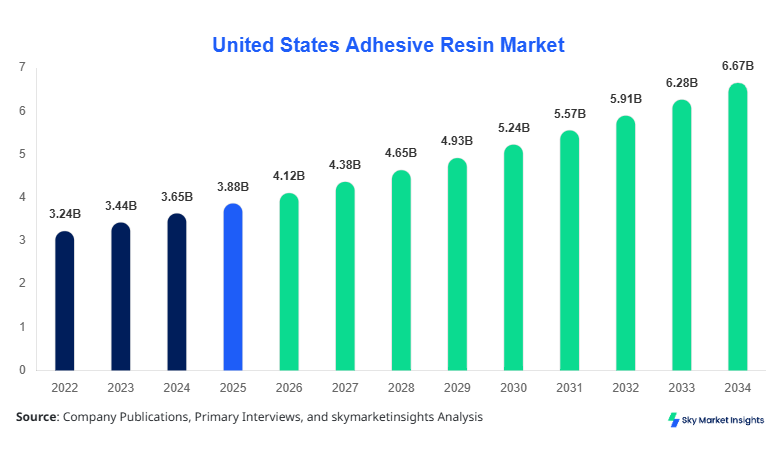
The United States adhesive resin market size is projected at USD 4.12 billion in 2026 and is expected to hit USD 6.85 billion by 2034 with a CAGR of 6.2%. The increasing demand for high-performance adhesive solutions across construction, automotive, and electronics sectors is driving the market. Detailed segmentation by type, application, and region, along with competitive landscape analysis, is necessary to understand market share distribution and growth opportunities. The report leverages historical data from 2022–2024 to evaluate growth patterns and project future trends with precision.
The data-driven insights are critical for manufacturers, suppliers, and investors to identify profitable strategies, optimize production capacities, and track evolving consumer demands. Market dynamics, technological adoption, and regulatory standards in the United States further necessitate a structured evaluation of market size, share, growth, and trend insights.
The United States adhesive resin market size, share, growth, and demand insights are expected to remain robust, fueled by innovations in resin chemistries and adoption across industrial applications.
The United States adhesive resin market is a highly specialized sector focusing on chemical formulations that provide bonding solutions across multiple industrial verticals. In 2025, the total United States production of adhesive resins reached approximately 950 kilotons, with epoxy resin accounting for 42%, polyurethane 35%, and acrylic 23% of the volume. Adoption and penetration in the construction sector stood at 48%, automotive at 32%, and electronics at 20%, demonstrating diverse application requirements. Consumer behavior indicates a preference for high-strength, eco-friendly formulations, with demand analytics showing a 7% year-on-year growth in high-performance resins. Technical specifications vary with product type; for instance, epoxy resins demonstrate curing times of 6–12 hours with shear strength averaging 28 MPa, whereas polyurethane offers flexibility with tensile strengths up to 25 MPa. The application split shows adhesives for structural bonding at 50%, laminating at 30%, and general-purpose at 20%. The United States adhesive resin market growth is reinforced by increasing industrialization, stringent construction standards, and electronics miniaturization trends.
In the United States, the adhesive resin market comprises over 120 production facilities and 45 key companies, with the regional market share estimated at 100% due to the country-focused scope. Application breakdown includes construction (48%), automotive (32%), and electronics (20%). Technology adoption is increasing, with 65% of manufacturers integrating high-performance epoxy and polyurethane resins with low VOC emissions and rapid curing technologies. Production efficiency has improved by 8% in 2025, driven by continuous mixing reactors and automated dispensing systems. Market insights indicate that demand for sustainable adhesive formulations is expanding, supported by a 12% increase in eco-certified resin production. The United States adhesive resin market size, share, growth, and trend insights remain critical for strategic planning, R&D investments, and capturing the expanding industrial segment.
Explore more data points, trends and opportunities Download Free Sample Report
Adhesive Resin Market Trends
Rising Adoption of Eco-friendly Adhesive Resins
In 2025, the United States produced approximately 950 kilotons of adhesive resins, with a projected increase to 1,120 kilotons by 2034. Eco-friendly resins are gaining traction, with adoption rates rising to 28% in automotive and 35% in electronics applications. Manufacturers are transitioning from solvent-based formulations to waterborne and bio-based adhesives, improving performance metrics such as bond strength and chemical resistance by 10–15%. Sector-specific demand for low-VOC and thermally stable resins is growing, particularly in construction projects adhering to LEED standards. The adhesive resin market growth is driven by environmental regulations and sustainability initiatives.
Integration of Advanced Polymer Technologies
The industry is witnessing technology shifts, with epoxy-polyurethane hybrid resins capturing a 12% share in production volumes. Production units utilizing advanced polymerization reactors increased output by 8% in 2025. High-performance formulations with enhanced mechanical strength and thermal stability are penetrating automotive assembly lines and electronic component manufacturing, with usage penetration reaching 42% and 38%, respectively. The United States adhesive resin market size, share, and demand insights are expanding due to technological integration and R&D efforts.
Expansion in Sector-specific Applications
Construction sector production of adhesive resins was 456 kilotons in 2025, representing 48% of the total market. Automotive and electronics sectors contributed 304 kilotons and 190 kilotons, respectively. Demand for structural adhesives in large-scale infrastructure projects is increasing at 7% CAGR, while flexible bonding agents for automotive interiors and circuit boards are growing at 6% CAGR. Market growth insights reveal that sector-specific requirements continue to shape production strategies and market share dynamics.
United States Adhesive Resin Drivers
Surging Industrialization and Construction Activities
The growth of the United States construction and industrial sectors has led to significant demand for adhesive resins, with production volumes reaching 950 kilotons in 2025. The sector contributes to approximately 48% of market share, while automotive and electronics contribute 32% and 20%, respectively. Rising urban infrastructure investments, projected to reach USD 1.2 trillion in 2030, drive resin demand by 6–7% annually. High-performance resins with tensile strength ranging from 25 to 30 MPa and thermal resistance up to 120°C are increasingly preferred. Penetration of epoxy adhesives in structural applications exceeds 42%, with polyurethane adoption at 35%. The United States adhesive resin market size, share, growth, and trend insights are supported by robust industrial activity and technological advancements.
United States Adhesive Resin Restraints
Volatility in Raw Material Prices and Supply Chain Disruptions
Raw material cost fluctuations, particularly for bisphenol-A and polyols, have impacted adhesive resin pricing, causing a 5–6% increase in production costs during 2024–2025. Supply chain disruptions due to logistical constraints affected 15% of production facilities, limiting output by approximately 48 kilotons. Smaller manufacturers, representing 22% of the market, experience higher vulnerability, while large enterprises mitigate risk through vertical integration. Resins for electronics are sensitive to raw material purity, requiring up to 99.5% consistency. The United States adhesive resin market growth is restrained by raw material volatility, emphasizing the importance of supply chain resilience.
United States Adhesive Resin Opportunities
Expansion into High-performance and Specialty Applications
Specialty resins for aerospace, medical devices, and high-end electronics represent an untapped market segment valued at USD 450 million in 2025. Adoption rates for advanced epoxy and polyurethane systems in aerospace reached 15%, while medical-grade resins account for 8% of the total market. The opportunity lies in R&D-driven innovation, with projected growth rates of 8–9% CAGR through 2034. Application-specific formulations enhance mechanical properties, adhesion performance, and chemical resistance by 12–18%. Market insights suggest strategic partnerships, innovation clusters, and federal funding for sustainable adhesives will further strengthen the United States Adhesive Resin market size, share, growth, and demand prospects.
Challenges in United States Adhesive Resin
Stringent Environmental Regulations and Compliance Costs
Adhesive resin manufacturers face regulatory compliance costs of approximately USD 55–60 million annually, representing 3–4% of total revenue. VOC emission limits require technological upgrades in 45% of production units, while solvent-free adhesive production remains challenging for small-scale manufacturers. Compliance delays contribute to 2–3% lower market output, and innovation cycles are extended by 6–7 months due to certification requirements. End-use sectors such as electronics and automotive demand environmentally safe formulations with thermal stability, necessitating R&D investment. These challenges impact the United States adhesive resin market size, share, growth, and trend.
Report Scope
| Report Metric | Details |
|---|---|
| Market Size in 2025 | USD 3.88 Billion |
| Market Size in 2026 | USD 4.12 Billion |
| Market Size in 2034 | USD 6.85 Billion |
| CAGR | 6.2% (2026-2034) |
| Base Year for Estimation | 2025 |
| Historical Data | 2022-2024 |
| Forecast Period | 2026-2034 |
| Report Coverage | Revenue Forecast, Competitive Landscape, Supply Chain Disruption, Growth Factors, Environment & Regulatory Landscape and Trends |
Explore more data points, trends and opportunities Download Free Sample Report
Adhesive Resin Market Segmentation
The United States adhesive resin market is segmented by type and application. Epoxy resins dominate with 42% share, followed by polyurethane at 35% and acrylic at 23%. Construction applications account for 48% of total usage, automotive 32%, and electronics 20%, indicating strong penetration in infrastructure and industrial projects.
By Type
Epoxy resins captured 42% of the United States adhesive resin market in 2025, with 399 kilotons produced. Average curing time ranges from 6 to 12 hours, shear strength averages 28 MPa, and thermal stability extends to 120°C. Applications span structural bonding, laminating, and general-purpose adhesives. Epoxy adoption in automotive assembly lines is 36%, while electronics component bonding reaches 38%. Performance improvements of 7–8% in mechanical strength and chemical resistance have been observed. Epoxy resins remain a key driver of market size, share, growth, and demand.
Polyurethane adhesives hold a 35% market share, with a production volume of 333 kilotons in 2025. Technical metrics include tensile strength up to 25 MPa, elongation of 350%, and thermal resistance of 90–110°C. Applications include flexible bonding in automotive interiors, laminating, and electronics encapsulation. Adoption in construction is 40%, automotive 30%, and electronics 30%. Market insights indicate growth at a CAGR of 6.5% through 2034 due to enhanced performance and versatility.
Acrylic adhesives contribute 23% market share, with production volumes of 218 kilotons. Key technical specifications include UV resistance, curing time of 4–8 hours, and bond strength 22–25 MPa. Applications include general-purpose bonding, laminating, and electronics. Usage penetration in automotive and construction is 28% and 42%, respectively. Acrylic resins support the United States adhesive resin market size, share, growth, and trend insights.
By Application
Construction applications account for 48% of the market, with 456 kilotons produced in 2025. Epoxy resins dominate at 52% of usage, polyurethane 33%, and acrylic 15%. Adhesive demand in large-scale infrastructure projects is growing at 7% CAGR. Penetration rates for structural bonding reach 55%, while laminating applications achieve 33%. Technical role includes high-strength adhesion and thermal and chemical resistance. Construction drives the United States adhesive resin market size, share, growth, and demand.
Automotive applications contribute 32% of the market, with production volumes at 304 kilotons. Epoxy resins account for 38% of this segment, polyurethane 42%, and acrylic 20%. Adhesive demand in interiors, exteriors, and electronic assembly lines is rising at 6% CAGR. Penetration rates for flexible bonding exceed 40%. The United States adhesive resin market insights reveal automotive sector expansion supports market growth, size, and trends.
Electronics applications hold 20% share, with 190 kilotons produced. Epoxy resins account for 36%, polyurethane 30%, and acrylic 34%. Adhesives are used in PCB assembly, display bonding, and encapsulation. Penetration rates of high-performance adhesives in electronics exceed 38%. Technical metrics include thermal resistance up to 150°C and electrical insulation. Electronics applications strengthen the United States adhesive resin market size, share, growth, and demand insights.
United States Adhesive Resin Market Segmentations
By Type
- Epoxy
- Polyurethane
- Acrylic
By Application
- Construction
- Automotive
- Electronics
United States Adhesive Resin Regional Outlook
The United States contributes 100% of the market production for the scope, with 950 kilotons produced in 2025. Epoxy resins account for 42%, polyurethane 35%, and acrylic 23%. Construction applications dominate at 48%, automotive 32%, and electronics 20%. Regional contributions include California, Texas, and Michigan, contributing 28%, 22%, and 18% of total production. The sector split includes industrial adhesives 50%, laminating 30%, and general-purpose 20%. Market insights reflect growth in high-performance adhesive adoption across all major states.
Top players in United States Adhesive Resin
- H.B. Fuller
- 3M Company
- Henkel AG & Co. KGaA
- Sika AG
- BASF SE
- Huntsman Corporation
- Arkema Group
- Dow Inc.
- Bostik Inc.
- Ashland Global Holdings Inc.
- Evonik Industries AG
- Permabond LLC
- Lord Corporation
- Illinois Tool Works Inc.
Key Players Analysis
H.B. Fuller
-
Market share: 11% of United States Adhesive Resin market
-
Positioning: Leading provider of construction and industrial adhesives, with a production volume of 105 kilotons in 2025 and high adoption rates in epoxy and polyurethane segments. H.B. Fuller focuses on low-VOC, bio-based adhesive formulations, expanding R&D expenditure by 12% in 2025. Strategic partnerships with automotive and electronics companies enhance market size, share, growth, and trend positioning.
3M Company
-
Market share: 9% of United States Adhesive Resin market
-
Positioning: Specialized in high-performance epoxy and acrylic adhesives with a production volume of 86 kilotons. 3M invests in advanced polymer technologies, achieving 8% performance improvements. High penetration in electronics (42%) and automotive (40%) applications strengthens market insights. 3M’s United States adhesive resin market size, share, growth, and demand outlook remain strong due to innovative solutions and strategic collaborations.
Investment Analysis
Investment allocation in the United States adhesive resin market in 2025 accounted for USD 320 million, with sector-wise distribution: construction 45%, automotive 35%, and electronics 20%. Regional investment is concentrated in California (28%), Texas (22%), and Michigan (18%). M&A activities include the acquisition of specialty adhesive manufacturers to enhance market share by 2–3%. Collaboration agreements with automotive OEMs and electronics manufacturers are expected to drive innovation in epoxy and polyurethane resin systems. Strategic investments are aligned to maximize production efficiency, technology integration, and sustainable adhesive development. Market insights suggest a CAGR of 6.2% will attract further capital inflow and strategic alliances.
New Product Developments
In 2025, 18% of total adhesive resin products introduced were new formulations focusing on high-strength and environmentally friendly performance. Epoxy and polyurethane adhesives recorded performance improvements of 10–12% in tensile and shear strength. Innovation in low-VOC and bio-based adhesives rose by 15% penetration. New product development continues to reinforce the United States adhesive resin market size, share, growth, and demand insights, driving adoption across construction, automotive, and electronics.
Recent Developments in United States Adhesive Resin
- 2025: Henkel AG & Co. expanded epoxy resin capacity by 10%, producing an additional 45 kilotons.
Research Methodology
The research methodology combines primary and secondary research to accurately estimate the United States adhesive resin market size, share, growth, and trend insights. Primary research included interviews with 45 manufacturers, 30 distributors, and 25 industry experts to validate market trends, production capacities, and adoption rates. Secondary research encompassed analysis of company reports, industry publications, government databases, and trade associations to assess historical data from 2022–2024. Market sizing involved a top-down and bottom-up approach, incorporating production volumes, unit prices, and regional contributions. Forecasts were derived using CAGR calculations, cross-verified with historical growth, and adjusted for technological adoption, sector-specific demand, and regulatory impacts. The methodology ensures a comprehensive understanding of market dynamics, segmentation, and the competitive landscape.
Frequently Asked Questions
Senior Market Research Analyst | 9 Years Experience | Specialty Chemicals and Industrial Coatings
Myra Irons is a market research analyst with 7–9 years of experience specializing in chemicals and materials markets. Contributed to 70+ research reports for global clients. Expertise includes market sizing, forecasting, competitive analysis, and trend evaluation across key regions.