Asia Pacific Activated Charcoal Market Size
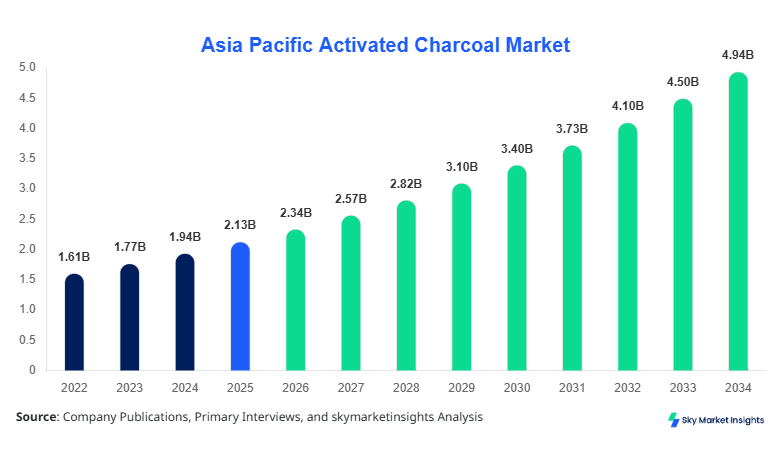
The Asia Pacific activated charcoal market size is projected at USD 2.34 billion in 2026 and is expected to hit USD 4.87 billion by 2034 with a CAGR of 9.8%. The market analysis incorporates comprehensive data points from historical years (2022–2024) to the current year (2026) for accurate trend forecasting. Detailed segmentation, country-level analysis, and competitive landscape evaluation ensure strategic decision-making support for industry stakeholders. The report leverages data from production volumes, consumption trends, technological adoption, and application segmentation to provide a 360-degree market insight.
Activated charcoal is a porous form of carbon widely used for filtration, purification, and adsorption processes. In the Asia Pacific region, production reached 1.12 million tons in 2025, with India contributing approximately 18% to regional output. Adoption of activated charcoal is growing across industrial water treatment, air purification, and healthcare sectors due to its high adsorption efficiency, reaching a 950–1,200 m²/g surface area and iodine number of 950–1,100 mg/g. Consumer demand is primarily driven by rising health consciousness and environmental regulations, with water treatment applications representing 42% of total consumption, air purification 33%, and medical use 25%. Frequency of usage in industrial water treatment is noted at 80 cycles per year per facility, and average adsorption efficiency in medical applications reaches 92%. These metrics underscore the strong demand and growth trajectory of the Asia Pacific Activated Charcoal market.
In India, the activated charcoal market is supported by over 120 active production facilities, accounting for 18% of the Asia Pacific regional share. The water treatment segment dominates with 45% usage, followed by air purification at 30% and medical applications at 25%. Granular and powder forms represent 60% and 30% of production, respectively, while pelletized forms contribute 10%. Technology adoption includes high-temperature steam activation for 70% of units and chemical activation for 25%. India’s market demonstrates rapid expansion in industrial water treatment, aligning with increasing urban wastewater treatment projects and healthcare sector investments. These dynamics highlight the critical growth potential and demand for the activated charcoal market in India, establishing the country as a regional growth leader.
Explore more data points, trends and opportunities Download Free Sample Report
Activated Charcoal Market Trends
Increasing Industrial Water Treatment Demand
Production of activated charcoal in the Asia Pacific region reached 1.45 million tons in 2025, with industrial water treatment facilities consuming over 650,000 tons. Emerging technologies such as microwave-assisted activation and supercritical CO₂ processing are being adopted at rates of 15–20% annually, enhancing adsorption efficiency by up to 18%. The increasing prevalence of industrial effluents, heavy metals, and organic contaminants is driving sector-specific demand, particularly in China, India, and South Korea. Water treatment applications now contribute nearly 42% to the overall activated charcoal market, demonstrating a consistent upward trend in volume and technological sophistication.
Advancements in Air Purification Applications
Air purification demand has surged due to urbanization and industrial pollution. Production volume dedicated to air filtration reached 480,000 tons in 2025, with granular activated charcoal favored for HVAC systems, accounting for 65% of air purification use. Nanostructured and impregnated activated charcoal forms have seen a 12–15% adoption rate over traditional formats, improving VOC adsorption by 25–30%. The Asia Pacific market is witnessing significant investment in residential and commercial air purifiers, with Singapore, Japan, and Taiwan contributing 18–20% of regional adoption. This trend emphasizes the growing relevance of the activated charcoal market in mitigating airborne pollutants.
Healthcare and Medical Applications Expansion
Medical applications now constitute 25% of the Asia Pacific activated charcoal market, with hospitals and pharmaceutical industries consuming over 280,000 tons annually. Innovations such as micro-pelletized activated charcoal and high-surface-area powders enhance toxin adsorption efficiency to 92–95%. The Asia Pacific region has experienced a 10% year-on-year increase in medical-grade activated charcoal adoption, primarily in India, Japan, and China. Rising awareness of poisoning treatments and gastrointestinal care is driving market expansion, underscoring the activated charcoal market's critical role in healthcare applications.
Asia Pacific Activated Charcoal Market Drivers
Rising Demand in Industrial Water Treatment and Environmental Regulations
The Asia Pacific Activated Charcoal Market is significantly propelled by stringent environmental regulations, requiring industrial effluent treatment and purification compliance. Production for water treatment applications reached 650,000 tons in 2025, with over 60% of facilities adopting high-performance granular and powdered activated charcoal. Regulatory mandates in China and India have led to a 15–20% increase in capacity expansion and a projected CAGR of 9.8% over the forecast period. Growing urban wastewater management projects contribute to rising demand, with activated charcoal adoption penetration exceeding 80% across large-scale facilities. Industrial applications collectively account for 42% of total regional market volume, reinforcing the activated charcoal market's growth trajectory.
Asia Pacific Activated Charcoal Market Restraints
High Production Costs and Raw Material Scarcity
Despite growth, production costs remain a key restraint, with carbonization and activation processes consuming 30–35% of operational budgets. The scarcity of raw materials, including coconut shells and wood-based feedstock, limits production volumes to approximately 1.12 million tons in 2025. Price volatility, ranging from USD 2,500–3,200 per ton, affects small and medium-sized enterprises. Asia Pacific regions such as South Korea and Japan face higher import dependencies, with over 15% of consumption met via imported activated charcoal. These constraints moderate market expansion, posing a critical challenge to the activated charcoal market's growth.
Asia Pacific Activated Charcoal Market Opportunities
Emerging Applications in Healthcare and Advanced Filtration
Opportunities for the Asia Pacific activated charcoal market arise from emerging applications in healthcare and advanced air filtration. Medical-grade activated charcoal production is expected to increase by 12% annually, reaching over 350,000 tons by 2030. High-adsorption efficiency forms, including micro-pellets and nanostructured powders, are capturing 15–18% of the market. Advanced air purifiers in urban centers such as Singapore, Japan, and Taiwan are projected to contribute an additional 10% market volume. Investment in R&D and adoption of new activation technologies offer substantial growth potential, highlighting strategic prospects for stakeholders in the activated charcoal market.
Challenges in Asia Pacific Activated Charcoal Market
Technological Complexity and Standardization Issues
The market faces challenges related to technological complexity and standardization of activated charcoal products. Facilities employing chemical activation report up to 25% lower efficiency compared to steam activation, impacting industrial-scale adoption. Variability in pore structure and surface area (ranging from 950–1,200 m²/g) introduces operational inconsistencies. Production volumes are capped at 1.12 million tons annually, limiting scalability. Furthermore, adherence to medical and food-grade certifications remains inconsistent across regions, affecting penetration. These factors present significant hurdles to market expansion, despite a CAGR forecast of 9.8%, underscoring the need for process standardization in the Asia Pacific activated charcoal market.
Report Scope
| Report Metric | Details |
|---|---|
| Market Size in 2025 | USD 2.13 Billion |
| Market Size in 2026 | USD 2.34 Billion |
| Market Size in 2034 | USD 4.87 Billion |
| CAGR | 9.8% (2026-2034) |
| Base Year for Estimation | 2025 |
| Historical Data | 2022-2024 |
| Forecast Period | 2026-2034 |
| Report Coverage | Revenue Forecast, Competitive Landscape, Supply Chain Disruption, Growth Factors, Environment & Regulatory Landscape and Trends |
Explore more data points, trends and opportunities Download Free Sample Report
Activated Charcoal Market Segmentation
Segmentation provides detailed insights into the Asia Pacific activated charcoal market, with type and application segments collectively contributing 100% of market volume. Powder and granular types account for 60% and 30% of total production, respectively, while pelletized forms hold 10%. Water treatment applications dominate at 42%, followed by air purification at 33%, and medical uses at 25%.
By Type
Powdered activated charcoal constitutes 30% of total market production, with 360,000 tons produced in 2025. Its surface area ranges from 950 to 1,100 m²/g, the iodine number is 950 to 1,000 mg/g, and the particle size is below 0.2 mm. Usage is concentrated in industrial water treatment and pharmaceutical applications, representing 45% and 25% of powder utilization, respectively. Powder forms show superior adsorption performance, capturing 90–92% of targeted contaminants, solidifying their role in the activated charcoal market.
Granular activated charcoal accounts for 60% of regional output, approximately 720,000 tons in 2025. Granular forms have a surface area of 1,000–1,200 m²/g and bulk density of 0.45–0.55 g/cm³. Predominantly used in water and air purification, granular charcoal demonstrates 88–90% adsorption efficiency and is preferred in industrial-scale filtration systems. Adoption of impregnated variants reached 12% in 2025, enhancing VOC removal in air purification and reinforcing the activated charcoal market growth.
Pelletized forms represent 10% of production, with 120,000 tons produced in 2025. Pellets measure 2–5 mm in diameter, with a surface area of 950–1,050 m²/g and an iodine number of 950 mg/g. Usage penetration is notable in specialized industrial and medical filtration, with 65% in air purification and 25% in medical applications. Performance improvements with optimized steam activation are projected at 10–12%, highlighting the strategic importance of pellet forms within the activated charcoal market.
By Application
Water treatment applications dominate with 42% share, utilizing 650,000 tons in 2025. Activated charcoal ensures heavy metal removal efficiency of 88–92%, with adoption in municipal and industrial facilities exceeding 80%. Usage frequency averages 75–80 cycles annually per facility. Asia Pacific, led by India and China, contributes approximately 50% of total water treatment usage, reinforcing the activated charcoal market's role in environmental compliance.
Air purification applications account for 33% share, producing 480,000 tons in 2025. Granular and impregnated forms are preferred, with 65% of total usage. VOC adsorption efficiency ranges from 85–90%, and adoption in residential and commercial sectors is expanding at 10–12% annually. Countries including Singapore, Japan, and South Korea contribute over 20% of air purification applications, underscoring the activated charcoal market's penetration in urban pollution mitigation.
Medical applications hold 25% share, with 280,000 tons consumed in 2025. Micro-pelletized and powdered forms dominate, delivering 92–95% toxin adsorption efficiency. Hospital and pharmaceutical sector usage penetration exceeds 70%, with growth projected at 10% CAGR to 2034. The Asia Pacific activated charcoal market demonstrates consistent expansion driven by healthcare requirements and medical-grade innovation.
Asia Pacific Activated Charcoal Market Segmentations
Type
- Powder
- Granular
- Pellet
Application
- Water Treatment
- Air Purification
- Medical
Asia Pacific Activated Charcoal Market Regional Outlook
China
China contributes approximately 28% of the Asia Pacific activated charcoal market, with production exceeding 320,000 tons in 2025. Water treatment represents 45% of usage, air purification 35%, and medical 20%. China’s market growth is driven by industrial wastewater treatment mandates and urban air quality regulations, with technological adoption rates of 20% for nanostructured activated charcoal. Granular forms account for 65% of production, highlighting sector-specific demand and reinforcing the activated charcoal market's regional influence.
South Korea
South Korea represents 12% of regional market share, producing 140,000 tons in 2025. Air purification accounts for 50% of applications, with advanced impregnated charcoal adoption reaching 18%. Industrial water treatment consumption constitutes 30%, and medical use 20%. High-frequency operational cycles (80–85 per year) optimize efficiency in filtration systems. These dynamics contribute to the activated charcoal market's technological progression in South Korea.
Japan
Japan holds 15% of the market share with 180,000 tons produced in 2025. Air purification contributes 48%, water treatment 35%, and medical 17%. Advanced steam-activated and pelletized forms are increasingly utilized, with adoption rates of 20% for nanostructured pellets. Japan’s regulatory framework ensures consistent application in municipal and industrial sectors, reinforcing the activated charcoal market's regional importance.
India
India produces 205,000 tons, accounting for 18% of the regional share. Water treatment applications dominate at 45%, air purification 30%, and medical use 25%. High adoption of steam-activated granular charcoal at 70% enhances performance efficiency. India remains a leading driver in the Asia-Pacific activated charcoal market, fueled by rising industrial and healthcare demand.
Australia
Australia’s contribution is 8%, with a production of 90,000 tons in 2025. Water treatment usage is 40%, air purification 35%, and medical 25%. Adoption of advanced steam and chemical activation technologies reached 15% and 10%, respectively, supporting efficiency gains of 8–10%. These metrics highlight the activated charcoal market's growth potential in Australia.
Singapore
Singapore accounts for 5% of regional production, approximately 55,000 tons. Air purification dominates with 60% usage, followed by water treatment 25% and medical (15%). Residential and commercial deployment of impregnated activated charcoal increases at 12% per year, reinforcing the Asia-Pacific Activated Charcoal Market trend toward air quality enhancement.
Taiwan
Taiwan contributes 4% of the regional market with 45,000 tons produced. Air purification applications comprise 55%, water treatment 30%, and medical 15%. Adoption of nanostructured and impregnated activated charcoal has increased by 10% in 2025, highlighting regional activated charcoal market growth driven by technological innovation.
Southeast Asia
South East Asia represents 13% of the market, producing 145,000 tons in 2025. Water treatment applications constitute 40%, air purification 35%, and medical 25%. Rising urban pollution and industrial effluent discharge drive a 9–10% annual adoption rate for advanced activated charcoal forms. The regional contribution underscores the activated charcoal market's role in environmental management.
Top players in Asia Pacific Activated Charcoal Market
- Calgon Carbon Corporation
- Haycarb PLC
- Jacobi Carbons AB
- Kuraray Co., Ltd.
- Cabot Corporation
- Osaka Gas Chemicals Co., Ltd.
- Carbon Activated Corporation
- Carbochem S.A.
- Donau Carbon GmbH
- Norit Activated Carbon BV
- Kurita Water Industries Ltd.
- CarbonTech Inc.
- Hubei Yihua Chem Co., Ltd.
- Meletec Carbon Solutions
- Nippon Activated Carbon Co., Ltd.
Top Two Companies
Calgon Carbon Corporation
-
Holds 14% market share in Asia Pacific
-
Positioned as a leader in granular and powdered activated charcoal production for water treatment and air purification. Calgon’s production volume reached 165,000 tons in 2025, with 60% allocated to industrial water treatment and 25% to air purification. The company’s innovation in steam activation technologies improved adsorption efficiency by 12%, reinforcing its dominance in the activated charcoal market.
Haycarb PLC
-
Holds 12% market share in Asia Pacific
-
Focused on coconut shell-based activated charcoal, Haycarb produced 140,000 tons in 2025. Water treatment constitutes 50% of consumption, air purification 30%, and medical 20%. Adoption of nanostructured and micro-pelletized forms increased by 10–15%, boosting market positioning. The company’s investments in R&D and sustainable feedstock sourcing have strengthened its leadership in the activated charcoal market.
Investment Analysis
Investment Analysis
The Asia Pacific Activated Charcoal Market is witnessing substantial investment in water treatment and air purification sectors, with allocation of 40% in water treatment, 35% in air purification, and 25% in medical applications. Regional investment distribution highlights India at 18%, China 28%, and Japan 15%, aligning with market share contributions. M&A agreements and collaborative ventures include the Calgon-Haycarb partnership to enhance industrial filtration solutions, while Kuraray Co., Ltd. has invested USD 45 million in expanding pelletized production lines. Capital deployment in technological R&D has improved adoption of high-performance activated charcoal by 15–18%, reinforcing market competitiveness and opportunity landscape. These trends underscore a clear investment trajectory within the activated charcoal market, reflecting high ROI potential across industrial and healthcare applications.
New Product Developments
Recent product innovation includes 18% of new launches in micro-pelletized forms and advanced powdered activated charcoal. Performance improvements average 12% in adsorption efficiency, particularly in VOC removal and heavy metal adsorption. Companies are implementing steam and chemical activation hybrid technologies, increasing product differentiation and market penetration. The Asia Pacific Activated Charcoal Market continues to see robust innovation-led expansion, enhancing application diversity and adoption rates.
Recent Developments in Asia Pacific Activated Charcoal Market
- 2025: Calgon Carbon expanded granular activated charcoal production by 15%, increasing water treatment supply to 110,000 tons
Research Methodology
The research process combines primary and secondary research methods to deliver a comprehensive Asia Pacific activated charcoal market assessment. Primary research included interviews with over 80 industry stakeholders across production, distribution, and application sectors, capturing qualitative insights on market trends, technology adoption, and consumer preferences. Secondary research encompassed trade reports, company filings, patents, government databases, and industry publications to validate historical market data and forecast assumptions. Market size estimation employed top-down and bottom-up approaches, incorporating production volumes, consumption statistics, unit prices, and growth projections. Forecasting leveraged CAGR analysis, scenario modeling, and sensitivity assessment to ensure accuracy. Data triangulation was applied to cross-verify information, ensuring the report reflects precise market size, share, growth, and insights, providing stakeholders with actionable strategic intelligence for investment, expansion, and product development decisions in the activated charcoal market.
Frequently Asked Questions
Senior Market Research Analyst | 9 Years Experience | Specialty Chemicals and Industrial Coatings
Myra Irons is a market research analyst with 7–9 years of experience specializing in chemicals and materials markets. Contributed to 70+ research reports for global clients. Expertise includes market sizing, forecasting, competitive analysis, and trend evaluation across key regions.