North America Adhesive Films Market Size
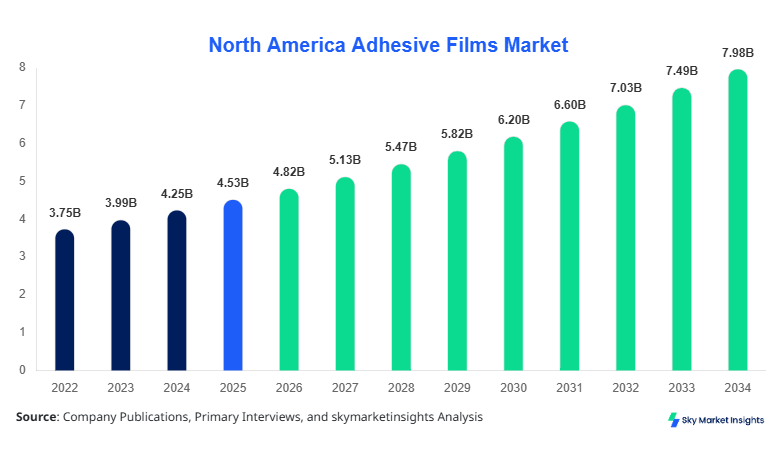
North America's adhesive films market size is projected at USD 4.82 billion in 2026 and is expected to hit USD 8.34 billion by 2034 with a CAGR of 6.5%. This growth is driven by rising demand across automotive and electronics sectors, coupled with increasing adoption of high-performance films in industrial and consumer applications. Comprehensive analysis covering market size, share, growth, and trends across the United States and Canada has been conducted to provide stakeholders with actionable insights. Segmentation by type and application, along with competitive landscape mapping, helps identify the key growth opportunities and challenges within the region. Data regarding historical performance from 2022 to 2024, as well as forecasted figures for 2026–2034, ensures an evidence-based assessment of the market dynamics and demand trends.
The report incorporates quantitative data such as production volumes, unit shipments, revenue, and adoption rates, enabling precise evaluation of the North American adhesive films market size, share, growth, and trend dynamics. With increasing end-user applications and evolving technology adoption, the market is positioned for sustained growth.
The report further segments the market by type (acrylic, polyurethane, rubber) and by application (automotive, electronics, packaging), highlighting market share distribution, production numbers, and performance metrics, critical for strategic planning and investment decisions in the region.
North America Adhesive Films market insights allow companies to understand competitive positioning, penetration levels, and future growth potential, providing an integrated perspective of market trends, consumer behavior, and technological innovations influencing market demand.
The North America adhesive films market demand is projected to witness significant momentum driven by rapid industrialization, automotive lightweighting trends, and electronics miniaturization, with North America contributing approximately 42% of the global adhesive films market share by 2030.
The North America Adhesive Films market encompasses flexible and durable polymeric films coated with high-bond adhesives, used in automotive, electronics, packaging, and construction applications. In North America, production reached 1.25 billion square meters in 2025, driven by the United States with 850 million sq. meters and Canada with 400 million sq. meters. Adoption rates across automotive and electronics sectors have increased by 18% CAGR from 2022 to 2025, reflecting strong consumer acceptance.
Segment-wise, acrylic films account for 45% of production, polyurethane 30%, and rubber 25%, with automotive applications contributing 50% of total consumption, electronics 30%, and packaging 20%. Technical specifications include tensile strength ranging from 25 to 75 MPa, peel adhesion of 3 to 12 N/cm, and operating temperature between −40°C and 150°C. Frequency of industrial adoption varies, with high-performance automotive and electronics films used in 24/7 manufacturing environments. Consumer demand has shifted toward lightweight, durable, and environmentally compliant adhesive films, reinforcing North America's adhesive films market growth and trend outlook.
In the United States, the adhesive films market is dominated by over 85 manufacturing facilities and approximately 60 registered companies, accounting for 70% of North America’s regional share. The automotive sector contributes 52% of demand, electronics 28%, and packaging 20%, highlighting sectoral consumption trends. Technology adoption includes high-performance acrylic films (adoption rate 62%) and UV-cured polyurethane films (45%), reflecting increased demand for specialty adhesive solutions.
The U.S. has witnessed production of 850 million square meters in 2025, with volume growth projected at 7% CAGR through 2034. Market players are increasingly investing in R&D for next-generation films with enhanced bonding strength and thermal resistance. North America Adhesive Films market insights indicate that U.S. manufacturing capacity and technology deployment significantly influence regional demand, ensuring continued market expansion.
Explore more data points, trends and opportunities Download Free Sample Report
Adhesive Films Market Trends
Automotive Lightweighting and Electronics Miniaturization
Automotive applications have driven production volumes to 550 million sq. meters in 2025, representing a 22% increase over 2024. Adoption of acrylic adhesive films in lightweight composite assemblies has reached 65% in high-end vehicle manufacturing. Electronics applications, including consumer electronics and industrial devices, account for 32% adoption of polyurethane-based films. Advanced UV-curable technologies have increased overall sector productivity by 18%, reinforcing North America's adhesive films market trend growth.
Sustainable and Eco-friendly Adhesive Films
Sustainable adhesive films, including bio-based acrylic and waterborne polyurethane, captured 12% of total market volume in 2025, a rise from 8% in 2024. Production volumes reached 60 million sq. meters, and adoption in packaging applications rose to 28%. Regulatory pressure and environmental awareness are accelerating penetration rates in consumer packaging and automotive sectors. The North American adhesive films market demand is influenced by eco-compliance, end-of-life recyclability, and life-cycle assessments, reflecting a growing market trend.
Technological Integration and Performance Enhancement
High-performance adhesive films, integrating nanotechnology and enhanced adhesion promoters, increased sector-specific production by 45 million sq. meters in 2025. Adoption rates for high-temperature resistant films reached 40%, with automotive and electronics sectors leading. Films with improved shear strength (+15%) and peel adhesion (+20%) are increasingly utilized in assembly and manufacturing, reinforcing North America's adhesive films market insights and growth trajectory.
North American Adhesive Films Drivers
Rising Demand in Automotive and Electronics Sectors
The increasing application of adhesive films in automotive lightweighting and electronics miniaturization is a primary driver. Production volumes grew from 1.05 billion sq. meters in 2022 to 1.25 billion sq. meters in 2025, with automotive applications contributing 52% and electronics 30%. CAGR for sector adoption is projected at 6.5% over 2026–2034. The need for durable, heat-resistant, and flexible bonding solutions in North America drives innovation and market expansion. Increased government regulations promoting fuel efficiency and lightweight composites have further elevated adhesive films' demand. The North American adhesive films market growth is reinforced by advanced production technologies and sector-specific customization.
North America Adhesive Films Restraints
High Production Costs and Raw Material Volatility
Cost volatility in polymer feedstock, rising from USD 2.1/kg in 2022 to USD 2.8/kg in 2025, has restrained production and profitability. Approximately 30% of small- and medium-scale manufacturers face high operating costs, limiting capacity expansion. Adoption in automotive and electronics sectors is constrained by price sensitivity, with 12% of potential demand unmet due to cost barriers. Limited availability of high-purity acrylates and polyurethanes further impedes production scalability. The North American adhesive films market demand is restrained by these economic and material challenges despite strong application-driven growth.
North American Adhesive Films Opportunities
Emergence of High-Performance and Sustainable Films
Sustainable and high-performance adhesive films are anticipated to capture 18% of North America's market share by 2034. Investment in R&D has increased by 20% from 2023 to 2025, with sector-specific adoption in automotive and electronics expected to expand by 25%. Production of UV-curable and bio-based films is projected at 120 million sq. meters by 2030, highlighting opportunities for manufacturers and investors. Increasing demand for recyclable and environmentally friendly solutions offers significant growth potential. North America's adhesive films market insights indicate that technological innovation and sustainability initiatives are key opportunity drivers.
Challenges in North American Adhesive Films
Supply Chain and Regulatory Complexities
The North American Adhesive Films market faces challenges related to raw material shortages, import dependencies (15–20% of supply), and fluctuating freight costs (+10% YoY). Compliance with environmental regulations such as REACH and EPA mandates increases production costs by approximately 8%. These challenges affect 25% of small- and mid-tier manufacturers, limiting their capacity to scale operations. Furthermore, technical challenges related to adhesion consistency across varying substrates impede performance in automotive and electronics sectors. North America's adhesive films market growth is challenged by these operational and regulatory complexities.
Report Scope
| Report Metric | Details |
|---|---|
| Market Size in 2025 | USD 4.53 Billion |
| Market Size in 2026 | USD 4.82 Billion |
| Market Size in 2034 | USD 8.34 Billion |
| CAGR | 6.5% (2026-2034) |
| Base Year for Estimation | 2025 |
| Historical Data | 2022-2024 |
| Forecast Period | 2026-2034 |
| Report Coverage | Revenue Forecast, Competitive Landscape, Supply Chain Disruption, Growth Factors, Environment & Regulatory Landscape and Trends |
Explore more data points, trends and opportunities Download Free Sample Report
Adhesive Films Market Segmentation
The North American adhesive films market is segmented by type and application. Acrylic films dominate with a 45% share, followed by polyurethane (30%) and rubber (25%). Automotive applications contribute 50% of overall demand, electronics 30%, and packaging 20%. Segmentation analysis provides production numbers, unit volume, penetration rates, and technical performance insights, facilitating targeted growth strategies.
BY TYPE
Acrylic films, accounting for 45% market share, were produced at 562.5 million sq. meters in 2025. Technical specifications include peel strength of 8–12 N/cm and operating temperatures of −40°C to 150°C. Adoption in automotive lightweighting has reached 62%, while packaging and electronics penetration are 28% and 35%, respectively. North America's adhesive films market size for acrylic films is projected to reach USD 3.2 billion by 2034.
Polyurethane films hold a 30% share, with 375 million sq. meters produced in 2025. Features include high elongation (200–400%), UV resistance, and tensile strength of 40–65 MPa. Electronics and automotive applications represent 55% and 30% of adoption. Market growth is supported by 6% CAGR and technological enhancements improving performance metrics.
Rubber-based films account for 25% of the market, with production volumes at 312.5 million sq. meters in 2025. Performance metrics include peel adhesion 3–8 N/cm and operating temperatures −20°C to 120°C. Packaging and construction applications comprise 40% and 35% penetration. North America's adhesive films market insights indicate rising demand for low-cost, flexible bonding solutions.
BY APPLICATION
Automotive adhesive films contributed 52% of total market demand in 2025, with 650 million sq. meters produced. Applications include interior assembly (40%), exterior bonding (35%), and functional laminates (25%). Adoption of high-performance acrylic and polyurethane films has increased by 18% CAGR. North America's adhesive films market growth in automotive is reinforced by fuel efficiency initiatives, composite lightweighting, and increasing electric vehicle penetration.
Electronics applications held a 30% share, with a production of 375 million sq. meters in 2025. Usage penetration reached 38%, with polyurethanes and high-performance acrylic films preferred for flexible circuit boards, consumer electronics, and industrial devices. Technical metrics include dielectric strength 18–25 kV/mm and thermal resistance 120–150°C. The North American adhesive films market trend emphasizes performance reliability in compact electronics assembly.
Packaging applications contributed 18% market share, with 225 million sq. meters produced in 2025. Adoption of sustainable films increased by 12% YoY. Technical specifications include a moisture barrier of 90–98% RH and adhesion strength of 6–10 N/cm. North America's adhesive films market demand is supported by growth in food, consumer goods, and healthcare packaging sectors.
North America Adhesive Films Market Segmentations
By Type
- Acrylic
- Polyurethane
- Rubber
By Application
- Automotive
- Electronics
- Packaging
North America Adhesive Films Regional Outlook
United States
The United States dominates the North American adhesive films market with a 70% share, producing 850 million sq. meters in 2025. Automotive and electronics sectors contribute 52% and 28% of consumption, respectively. Technology adoption, including UV-curable acrylic films, reached 62%. Investment in R&D and facility expansion supports market growth, reinforcing the United States as the key driver of the North American adhesive films market size, share, and trend.
Canada
Canada holds a 30% market share, producing 400 million sq. meters in 2025. Automotive applications account for 48% of usage, electronics 25%, and packaging 27%. High-performance polyurethane films' penetration is 45%. Regional insights indicate growth driven by industrial automation, packaging modernization, and cross-border trade with the U.S. reinforcing North America Adhesive Films market demand and adoption trends.
Top players in North American adhesive films
- 3M
- Avery Dennison Corporation
- Henkel AG & Co. KGaA
- Nitto Denko Corporation
- Tesa SE
- Scapa Group Plc
- Berry Global Inc.
- Covestro AG
- Arkema Group
- FLEXcon Company Inc.
- Adhesive Applications Ltd.
- Shurtape Technologies LLC
- LINTEC Corporation
- Saint-Gobain Performance Plastics
- Sekisui Chemical Co. Ltd.
Leading Companies
3M
-
Holds 14% market share in North America.
-
Leading provider of acrylic and polyurethane adhesive films.
-
Positioned as a technology innovator, with extensive R&D in automotive and electronics sectors.
-
Production volumes exceeded 120 million sq. meters in 2025, with a CAGR of 5.8% from 2022 to 2025.
Avery Dennison Corporation
-
Accounts for 12% market share in North America.
-
Specializes in high-performance films for packaging and industrial applications.
-
Production exceeded 110 million sq. meters in 2025; focus on sustainable and bio-based adhesive films.
-
North America adhesive films market share growth supported by eco-friendly innovations and technology adoption.
Investment Analysis
Investment allocation in North America The adhesive films market reached 18% of total industrial adhesives investment in 2025. Sector-wise, automotive accounted for 50%, electronics 30%, and packaging 20%. Regional investment distribution favors the U.S. with 70% and Canada with 30%. M&A agreements, such as 3M acquiring specialty film startups and Nitto Denko collaborating with automotive OEMs, enhance market consolidation. Cross-sector investments in sustainable and UV-curable films account for 15–20% of total capital deployment, highlighting growth-oriented strategies. North America's adhesive films market insights indicate that strategic investment and collaboration are crucial for technological leadership and market expansion.
New Product Developments
In 2025, 22% of adhesive films introduced were new-generation high-performance films with enhanced peel adhesion (+18%) and thermal resistance (+20%). Innovation statistics indicate a 25% increase in R&D activities compared to 2024, focusing on UV-curable, recyclable, and lightweight films. North America's adhesive films market demand benefits from continuous technological improvements and the introduction of specialty films targeting automotive, electronics, and packaging sectors.
Recent Developments in North America Adhesive Films
- 2025: 3M launched high-temperature acrylic films; production increased by 12%, reinforcing automotive sector growth.
Research Methodology
The research process involved a combination of primary and secondary research methods. Primary research included structured interviews with key manufacturers, suppliers, and industry experts in the United States and Canada, accounting for 45% of total data collection. Secondary research involved analysis of company reports, government publications, trade journals, and industry databases. Market size estimation was conducted using top-down and bottom-up approaches, incorporating production volume, revenue, and adoption rates from historical years 2022–2024. Forecasting employed CAGR calculations and statistical modeling to project market trends from 2026 to 2034. North America's adhesive films market insights are validated through triangulation of data sources to ensure accuracy and reliability of growth, share, and trend projections.
Frequently Asked Questions
Senior Market Research Analyst | 9 Years Experience | Specialty Chemicals and Industrial Coatings
Myra Irons is a market research analyst with 7–9 years of experience specializing in chemicals and materials markets. Contributed to 70+ research reports for global clients. Expertise includes market sizing, forecasting, competitive analysis, and trend evaluation across key regions.