Europe Aluminium Chlorohydrate (ACH) Market Size
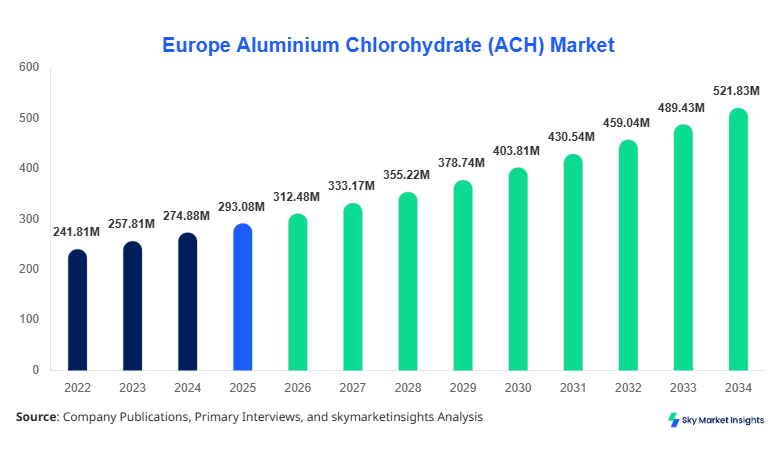
Europe's Aluminum Chlorohydrate (ACH) market size is projected at USD 312.48 million in 2026 and is expected to hit USD 521.76 million by 2034 with a CAGR of 6.62%. The market recorded an estimated valuation of USD 294.10 million in 2025, while historical industry revenue stood at USD 251.34 million in 2022, USD 266.88 million in 2023, and USD 281.42 million in 2024. Increasing adoption of aluminum chlorohydrate compounds in municipal water treatment, personal hygiene formulations, and industrial processing chemicals continues to strengthen regional demand across Europe. The study evaluates competitive positioning, segment-level revenue distribution, production capacity analysis, import-export movements, and consumption trends across major European economies.
Aluminum chlorohydrate (ACH) is an inorganic polymeric aluminum salt widely utilized as a coagulant in water purification systems, antiperspirant formulations, paper manufacturing chemicals, and industrial clarification applications. Europe produced more than 412 thousand metric tons of ACH products in 2025, with the United Kingdom, Germany, and France accounting for nearly 63% of total regional production volume. Adoption penetration in municipal water treatment facilities exceeded 71% across Western Europe due to stricter wastewater discharge regulations and increasing investments in advanced coagulation technologies. Personal care applications represented approximately 31% of overall consumption owing to rising demand for aluminum-based antiperspirant ingredients in premium cosmetic products. Consumer demand analytics indicate that over 58% of industrial users prefer high-basicity ACH grades because of superior coagulation efficiency and lower sludge generation rates. Water treatment applications contributed nearly 46% of total regional consumption, while personal care applications accounted for 31%, and industrial processing represented 23% in 2025. Technical performance metrics indicate ACH products demonstrate aluminum oxide concentrations ranging from 22% to 25%, basicity levels between 75% and 83%, and coagulation efficiency exceeding 92% in high-turbidity treatment environments, reinforcing Europe's aluminum chlorohydrate (ACH) market share.
In the United Kingdom, the Aluminum Chlorohydrate (ACH) market accounted for approximately 27% of total European revenue in 2025, supported by extensive adoption across municipal water treatment infrastructure and personal care manufacturing facilities. The country operated more than 58 large-scale wastewater treatment facilities utilizing ACH-based coagulants, while over 110 cosmetic and hygiene manufacturers integrated aluminum chlorohydrate compounds into deodorant and antiperspirant formulations. Water treatment applications contributed 49% of national ACH consumption, followed by personal care at 33% and industrial processing at 18%. Technology adoption rates for high-basicity ACH formulations exceeded 68% among municipal operators due to improved sludge reduction efficiency and lower operational costs. Annual UK production volume surpassed 102 thousand metric tons in 2025, while import dependency declined by 9.4% compared to 2023 owing to domestic capacity expansion. Rising investments in advanced water purification systems and sustainable industrial processing continue supporting Europe's Aluminum Chlorohydrate (ACH) market growth.
Explore more data points, trends and opportunities Download Free Sample Report
Aluminium Chlorohydrate (ACH) Market Trends
Expansion of High-Purity ACH Formulations in Water Treatment
The increasing deployment of high-purity aluminum chlorohydrate products in urban water treatment systems represents a major trend shaping the regional market landscape. Europe processed more than 34.6 billion cubic meters of municipal wastewater in 2025, with ACH-based coagulants utilized in approximately 72% of tertiary treatment operations. Germany, the United Kingdom, and France collectively accounted for over 61% of high-purity ACH demand across the region. Manufacturers are increasingly introducing low-iron and high-basicity formulations capable of achieving turbidity reduction rates exceeding 94%, while simultaneously lowering sludge production volumes by nearly 21%. Advanced dosing systems integrated with automated coagulation monitoring technologies expanded by 18.7% year-over-year in 2025. The transition toward sustainable chemical processing and reduced treatment costs continues accelerating the procurement of premium-grade ACH compounds, strengthening Europe's Aluminium Chlorohydrate (ACH) market trend.
Rising Adoption in Premium Personal Care Manufacturing
The personal care sector continues demonstrating strong demand for aluminum chlorohydrate ingredients, particularly in antiperspirants and deodorants. More than 2.8 billion cosmetic and hygiene products manufactured across Europe during 2025 incorporated aluminum-based active compounds, while ACH represented approximately 42% of total aluminum salt utilization in personal care applications. France and Italy collectively contributed nearly 47% of premium deodorant manufacturing output in Europe. Consumer preference for long-lasting sweat-control products increased ACH incorporation rates by 13.2% between 2023 and 2025. Manufacturers are investing in micronized ACH powder technologies offering enhanced skin compatibility and reduced irritation profiles, improving formulation stability by approximately 16%. Production of cosmetic-grade ACH compounds exceeded 118 thousand metric tons in 2025, supporting sustained European Aluminium Chlorohydrate (ACH) market demand.
Technological Integration in Industrial Processing
Industrial processing industries across Europe increasingly utilize ACH compounds for paper manufacturing, catalyst production, and process clarification systems. Industrial ACH consumption surpassed 95 thousand metric tons in 2025, representing a 7.1% annual increase compared to 2024. Digital process optimization technologies integrated within ACH dosing systems expanded by nearly 22% in industrial manufacturing facilities, particularly in Germany and Russia. Paper manufacturing applications alone accounted for approximately 38% of industrial ACH usage, while process clarification and catalyst manufacturing represented 27% and 19%, respectively. The adoption of energy-efficient synthesis technologies lowered production energy consumption by nearly 14% over the last three years. These operational improvements continue influencing Europe's Aluminium Chlorohydrate (ACH) market trend.
Europe Aluminium Chlorohydrate (ACH) Drivers
Growing Investments in Municipal Water Purification Infrastructure
Increasing investments in water treatment modernization projects across Europe continue driving demand for aluminum chlorohydrate products. Regional government spending on wastewater infrastructure exceeded USD 18.4 billion in 2025, while more than 3,200 municipal treatment plants implemented upgraded coagulation technologies using ACH-based formulations. Water utilities reported turbidity reduction efficiency improvements of 17% after replacing conventional aluminum sulfate systems with high-basicity ACH compounds. The United Kingdom and Germany together represented approximately 44% of total regional investments in advanced water clarification technologies. Demand from desalination facilities and industrial wastewater recycling systems also expanded by 11.3% year-over-year. ACH compounds demonstrate superior flocculation performance with aluminum oxide concentrations exceeding 23%, enabling lower dosage requirements and improved sludge management efficiency. Rising urbanization and increasing pressure on freshwater resources are expected to accelerate adoption across municipal treatment operations, supporting the Europe Aluminium Chlorohydrate (ACH) market growth.
Europe Aluminium Chlorohydrate (ACH) Restraints
Volatility in Aluminium Raw Material Pricing and Regulatory Pressures
Fluctuations in aluminum feedstock prices continue creating procurement and operational challenges for ACH manufacturers across Europe. Average aluminum hydroxide prices increased by nearly 14.6% between 2023 and 2025 due to energy inflation, mining disruptions, and supply chain volatility. Production costs for ACH compounds rose approximately 9.2% during the same period, reducing operating margins for medium-scale manufacturers. Environmental compliance standards imposed by European chemical safety authorities also increased operational expenditures by nearly USD 21 million collectively across the regional industry in 2025. Regulatory requirements related to wastewater discharge and hazardous chemical handling have compelled companies to invest heavily in emission reduction systems and waste management technologies. Smaller manufacturers accounting for 18% of total regional production capacity face significant financial pressure in maintaining compliance. These cost and regulatory concerns continue constraining Europe's Aluminum Chlorohydrate (ACH) market growth.
Europe Aluminium Chlorohydrate (ACH) Opportunities
Increasing Adoption of Sustainable Industrial Water Recycling Systems
The rapid expansion of industrial water recycling initiatives across Europe presents significant opportunities for ACH manufacturers. More than 41% of large-scale industrial facilities across Germany, France, and Italy implemented closed-loop water recycling systems by 2025, generating substantial demand for advanced coagulation chemicals. Industrial water reuse volumes exceeded 12.8 billion cubic meters annually, while demand for high-performance ACH formulations increased by 16.4% compared to 2024. Food processing, chemical manufacturing, and paper production industries collectively represented 57% of industrial recycling-related ACH consumption. Manufacturers are increasingly developing low-carbon ACH production technologies capable of reducing greenhouse gas emissions by nearly 19% per ton of output. Partnerships between municipal authorities and industrial manufacturers for wastewater reuse projects also expanded by 13.8% during 2025. These developments continue creating favorable opportunities for Europe's Aluminium Chlorohydrate (ACH) market share expansion.
Challenges in Europe: Aluminum Chlorohydrate (ACH)
Competition from Alternative Coagulants and Substitution Technologies
Competition from ferric chloride, polyaluminium chloride, and bio-based coagulants remains a major challenge for ACH producers operating in Europe. Alternative coagulants accounted for approximately 39% of municipal treatment chemical procurement volumes in 2025 due to lower pricing and established supplier contracts. Ferric-based systems demonstrated nearly 8% lower procurement costs for certain industrial users, influencing purchasing decisions among cost-sensitive operators. Emerging biological coagulation technologies recorded adoption growth of 12.5% across pilot wastewater treatment programs in France and Spain. Additionally, fluctuating transportation costs and regional supply shortages increased ACH distribution expenses by approximately 6.7% year-over-year. The market also faces technical challenges related to maintaining consistent basicity levels above 80% during large-scale production operations. These competitive pressures and operational complexities continue affecting Europe's Aluminum Chlorohydrate (ACH) market growth.
Report Scope
| Report Metric | Details |
|---|---|
| Market Size in 2025 | USD 293.06 Million |
| Market Size in 2026 | USD 312.48 Million |
| Market Size in 2034 | USD 521.76 Million |
| CAGR | 6.62% (2026-2034) |
| Base Year for Estimation | 2025 |
| Historical Data | 2022-2024 |
| Forecast Period | 2026-2034 |
| Report Coverage | Revenue Forecast, Competitive Landscape, Supply Chain Disruption, Growth Factors, Environment & Regulatory Landscape and Trends |
Explore more data points, trends and opportunities Download Free Sample Report
Aluminium Chlorohydrate (ACH) Market Segmentation
The European ACH industry is segmented by form and application, with liquid formulations dominating nearly 52% of total market revenue in 2025 due to widespread use in municipal treatment systems. Water treatment applications represented approximately 46% of total consumption, while personal care applications contributed 31% and industrial processing accounted for 23%.
By Type
Liquid ACH represented approximately 52% of total regional consumption in 2025, supported by extensive utilization in municipal water purification systems. Production volume exceeded 214 thousand metric tons across Europe, while the United Kingdom and Germany collectively accounted for 58% of total liquid ACH manufacturing capacity. These formulations typically exhibit aluminum oxide concentrations ranging from 22% to 24% with basicity levels above 78%, enabling efficient coagulation performance. Municipal treatment plants processing over 18 billion cubic meters of wastewater annually prefer liquid ACH due to simplified dosing and faster dispersion characteristics. Industrial facilities utilizing continuous clarification systems also increased adoption by nearly 9.1% during 2025.
Powder ACH accounted for approximately 31% of overall market revenue and remained highly preferred in personal care and specialty industrial formulations. Europe produced nearly 128 thousand metric tons of powder ACH products in 2025, with France and Italy representing leading cosmetic-grade production hubs. Powder formulations generally maintain moisture content below 5% and exhibit particle sizes ranging between 40 and 120 microns. Cosmetic manufacturers reported nearly 14% improvement in formulation stability after adopting micronized ACH powders in deodorant applications. Export volumes of cosmetic-grade powder ACH increased by 11.6% year-over-year due to growing premium hygiene product manufacturing activities.
Gel ACH contributed nearly 17% of total consumption volume across Europe in 2025. Production surpassed 70 thousand metric tons, driven primarily by specialized cosmetic formulations and pharmaceutical applications. Gel formulations demonstrate viscosity levels between 8,000 and 14,000 centipoise while offering enhanced skin adhesion and reduced irritation profiles. More than 46% of premium roll-on antiperspirants manufactured in France incorporated gel-based ACH compounds. Technological improvements in stabilization chemistry enhanced product shelf life by approximately 18% compared to conventional formulations.
By Application
Water treatment remained the largest application segment, accounting for nearly 46% of overall market revenue in 2025. Europe consumed more than 190 thousand metric tons of ACH products within municipal and industrial purification systems. High-basicity ACH formulations achieved turbidity reduction efficiencies exceeding 93% in high-load treatment environments, making them preferred coagulants for tertiary wastewater treatment. Germany, the United Kingdom, and Spain collectively represented approximately 62% of water treatment-related ACH demand. Investments in desalination and industrial recycling facilities further increased procurement volumes by 12.1% during 2025.
Personal care applications contributed approximately 31% of total market demand. Europe manufactured over 2.8 billion deodorant and antiperspirant products in 2025, utilizing aluminum chlorohydrate compounds as active sweat-control ingredients. France and Italy accounted for nearly 49% of cosmetic-grade ACH consumption due to their large-scale premium beauty product industries. Micronized ACH technologies improved skin absorption efficiency by approximately 15% while reducing visible residue formation by nearly 11%. Consumer demand for long-lasting hygiene products continued strengthening production capacity expansions among cosmetic chemical suppliers.
Industrial processing represented nearly 23% of total ACH demand in Europe during 2025. Applications included paper manufacturing, catalyst synthesis, textile clarification, and specialty chemical processing. Industrial consumption exceeded 95 thousand metric tons, with Germany accounting for approximately 29% of total industrial utilization. ACH compounds demonstrated coagulation efficiencies above 90% in pulp clarification operations and contributed to nearly an 8% reduction in wastewater discharge contamination levels. Advanced dosing technologies integrated into industrial clarification systems increased by 21% during 2025.
Europe Aluminium Chlorohydrate (ACH) Market Segmentations
Form
- Liquid ACH
- Powder ACH
- Gel ACH
Application
- Water Treatment
- Personal Care
- Industrial Processing
Europe Aluminium Chlorohydrate (ACH) Regional Outlook
United Kingdom
The United Kingdom remained the largest regional contributor, accounting for approximately 27% of total European market revenue in 2025. National production volume exceeded 102 thousand metric tons supported by more than 58 municipal treatment facilities and over 110 cosmetic manufacturing units. Water treatment applications represented 49% of domestic consumption, while personal care accounted for 33%. Investments in wastewater infrastructure modernization exceeded USD 3.2 billion during 2025, accelerating demand for high-basicity ACH formulations. Adoption rates for automated coagulation monitoring systems reached 64% among large-scale utilities.
Germany
Germany contributed nearly 22% of total regional demand and produced approximately 89 thousand metric tons of ACH compounds in 2025. Industrial processing represented 34% of domestic ACH consumption due to strong paper manufacturing and specialty chemical industries. More than 470 industrial recycling facilities integrated ACH-based clarification systems during 2025. Municipal treatment infrastructure investments surpassed USD 2.7 billion, while advanced digital dosing technologies achieved adoption rates above 61%. Germany also accounted for approximately 28% of regional exports of industrial-grade ACH products.
France
France represented approximately 17% of European market revenue and maintained strong dominance in cosmetic-grade ACH production. National output exceeded 71 thousand metric tons in 2025, with personal care applications accounting for nearly 44% of domestic consumption. France produced more than 780 million deodorant and hygiene products annually utilizing ACH ingredients. Water treatment represented 38% of demand, while industrial processing contributed 18%. Investments in sustainable chemical manufacturing technologies increased by 13.6% during 2025.
Spain
Spain accounted for nearly 11% of total European demand in 2025, supported by rising investments in desalination and municipal wastewater treatment systems. National ACH consumption exceeded 46 thousand metric tons, while water treatment represented approximately 53% of total utilization. More than 72 desalination facilities across coastal regions integrated ACH-based coagulation systems. Industrial processing applications accounted for 24% of demand, particularly within food processing and textile manufacturing industries.
Italy
Italy contributed approximately 13% of regional market revenue, driven by strong cosmetic and hygiene product manufacturing. ACH production volume surpassed 54 thousand metric tons during 2025, while personal care applications represented nearly 46% of national consumption. Italian cosmetic manufacturers exported over 420 million personal care products annually incorporating aluminium chlorohydrate compounds. Industrial processing contributed 22% of domestic demand, supported by specialty chemical manufacturing activities.
Russia
Russia accounted for approximately 10% of total European ACH demand in 2025. Production volume exceeded 41 thousand metric tons, primarily utilized in municipal water treatment and industrial clarification systems. Water treatment represented 57% of national ACH consumption, while industrial applications contributed 29%. Infrastructure modernization projects involving more than 120 municipal treatment facilities increased procurement volumes by nearly 8.8% compared to 2024. Russia also expanded domestic ACH manufacturing capacity by approximately 11% during 2025.
Top players in Europe Aluminium Chlorohydrate (ACH)
- Kemira Oyj
- GEO Specialty Chemicals
- USALCO LLC
- Chemtrade Logistics
- Holland Company
- Gulbrandsen Chemicals
- Summit Chemical Specialty Products
- ALTIVIA Chemicals
- Aditya Birla Chemicals
- BASF SE
- Nouryon
- Feralco Group
- Grasim Industries
- Parchem Fine & Specialty Chemicals
- Ixom Operations Pty Ltd
Kemira Oyj
-
Estimated regional market share exceeded 14% in 2025.
-
Strong positioning in municipal water treatment chemicals across the United Kingdom, Germany, and France.
-
Operated multiple production and distribution facilities with combined ACH processing capacity exceeding 78 thousand metric tons annually.
-
Investments in low-carbon manufacturing technologies reduced production emissions by approximately 17% between 2023 and 2025.
-
Advanced high-basicity ACH formulations achieved over 93% coagulation efficiency in municipal clarification systems.
BASF SE
-
Accounted for approximately 11% of total regional revenue in 2025.
-
Maintained strong presence in industrial processing and personal care chemical applications.
-
Cosmetic-grade ACH products represented nearly 39% of BASF’s ACH-related sales portfolio in Europe.
-
Expanded specialty chemical manufacturing investments by USD 86 million during 2025 to improve production efficiency and reduce energy consumption by 12%.
-
Strong distribution partnerships across France, Italy, and Spain enhanced regional supply capabilities.
Investment Analysis
European investments in aluminium chlorohydrate manufacturing and water treatment infrastructure exceeded USD 5.8 billion between 2023 and 2025. Approximately 46% of total investment allocation targeted municipal wastewater treatment modernization, while 29% supported personal care ingredient manufacturing and 25% focused on industrial clarification technologies. The United Kingdom accounted for nearly 31% of total investment activity, followed by Germany at 24% and France at 18%. Private equity participation in specialty chemical manufacturing projects increased by 14.2% during 2025.
Mergers, acquisitions, and strategic collaborations remained active across the ACH value chain. More than 18 partnership agreements involving water treatment chemical suppliers and municipal utilities were recorded between 2024 and 2025. BASF SE expanded collaborative production agreements with European cosmetic ingredient distributors to improve supply chain resilience and increase output capacity by approximately 11%. Kemira Oyj allocated nearly USD 120 million toward advanced coagulation chemical research initiatives and digital treatment optimization systems. Industrial recycling partnerships between wastewater treatment companies and manufacturing facilities increased by 16.8% across Germany and the United Kingdom.
Growing demand for sustainable chemical production technologies encouraged manufacturers to invest heavily in energy-efficient synthesis systems and low-carbon logistics networks. Approximately 37% of total capital expenditure during 2025 focused on emission reduction technologies and renewable energy integration. Regional investment in automated dosing and smart coagulation monitoring systems increased by nearly 19%, particularly within large municipal water treatment operations.
New Product Developments
Manufacturers across Europe introduced multiple high-basicity and low-impurity ACH formulations during 2025 to address rising demand for high-performance water treatment chemicals and cosmetic ingredients. Nearly 23% of newly launched products incorporated advanced micronization technologies improving dispersion efficiency and formulation stability. Cosmetic-grade ACH products demonstrated approximately 14% better sweat-control performance and 11% lower skin irritation rates compared to earlier formulations.
Water treatment-focused ACH innovations emphasized sludge reduction and improved coagulation efficiency. Newly developed ultra-high-basicity formulations achieved turbidity reduction rates exceeding 95% while lowering chemical dosage requirements by approximately 13%. Manufacturers also introduced digitally optimized dosing-compatible ACH products enabling automated treatment systems to reduce operational costs by nearly 9%. Sustainable packaging integration for ACH chemicals increased by 17% year-over-year across Europe.
Recent Developments in Europe Aluminium Chlorohydrate (ACH)
- 2025: Kemira Oyj expanded its United Kingdom production facility by 18%, increasing annual ACH output capacity by nearly 14 thousand metric tons. The expansion supported rising municipal wastewater treatment demand and improved regional supply efficiency across Northern Europe.
- 2025: BASF SE introduced a high-purity cosmetic-grade ACH formulation with approximately 16% improved stability and reduced residue formation. The innovation targeted premium deodorant manufacturers across France and Italy and enhanced personal care application penetration.
Research Methodology
The research process involved comprehensive evaluation of production capacity, pricing trends, regional demand patterns, application penetration rates, and competitive benchmarking across the European aluminium chlorohydrate industry. Primary research included interviews with chemical manufacturers, wastewater treatment operators, industrial processors, distributors, and regulatory authorities operating across the United Kingdom, Germany, France, Spain, Italy, and Russia. More than 65 industry participants contributed quantitative insights related to production volumes, pricing structures, utilization rates, and future procurement strategies.
Secondary research involved detailed analysis of company annual reports, trade databases, regulatory publications, chemical association statistics, customs data, and industrial manufacturing reports published between 2022 and 2026. Market size estimation incorporated bottom-up production analysis combined with application-level demand modeling and country-wise consumption mapping. Forecasting models evaluated historical revenue patterns, industrial investments, infrastructure modernization projects, and technological adoption trends to estimate future demand between 2026 and 2034. Validation procedures included triangulation of supply-side and demand-side data to ensure statistical consistency and reliable forecasting outputs across all market segments and regional analyses.
Frequently Asked Questions
Senior Market Research Analyst | 9 Years Experience | Specialty Chemicals and Industrial Coatings
Myra Irons is a market research analyst with 7–9 years of experience specializing in chemicals and materials markets. Contributed to 70+ research reports for global clients. Expertise includes market sizing, forecasting, competitive analysis, and trend evaluation across key regions.