Europe Abietic Acid Market Size
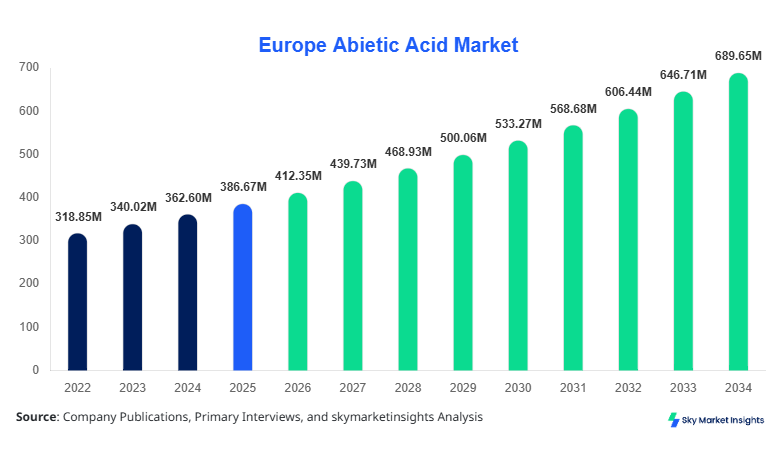
Europe's abietic acid market size is projected at USD 412.35 million in 2026 and is expected to hit USD 689.42 million by 2034 with a CAGR of 6.64%. The Europe Abietic Acid Market Size is supported by rising industrial demand across adhesives, coatings, and rubber processing sectors, with consumption volumes estimated to exceed 245 kilotons in 2026 and expected to surpass 390 kilotons by 2034. The increasing need for structured data, segmentation insights, and competitive benchmarking is driving a comprehensive analysis of the Europe Abietic Acid Market Size, including pricing dynamics, production distribution, and end-user industry penetration.
The abietic acid market refers to the commercial production and application of abietic acid derived primarily from rosin sources such as gum rosin, tall oil rosin, and wood rosin, extensively used in industrial chemicals, adhesives, coatings, and rubber processing. In Europe, production volumes reached approximately 218 kilotons in 2025, with Germany contributing nearly 24%, followed by France at 17% and the United Kingdom at 19%. Adoption rates across industrial applications exceed 68% in adhesives manufacturing and 54% in coatings formulations, reflecting strong penetration in high-performance chemical sectors. Consumer demand analytics indicate that nearly 62% of industrial buyers prioritize high-purity abietic acid (>90% purity), while 38% focus on cost-effective blends. Adhesives dominate application share with 41%, followed by paints & coatings at 33% and rubber at 26%. Technical performance metrics such as melting point range (160–175°C) and acid value (165–175 mg KOH/g) remain critical for product differentiation. Growing sustainability awareness has increased bio-based adoption rates by 22% between 2022 and 2025, reinforcing the Europe Abietic Acid Market Share.
In the United Kingdom, the abietic acid market accounts for approximately 19% of total European consumption, with over 85 active chemical manufacturing facilities utilizing abietic acid in downstream applications. The country processes nearly 42 kilotons annually, with adhesives contributing 44% of demand, coatings 31%, and rubber applications 25%. Technology adoption rates for modified abietic acid derivatives exceed 63%, driven by demand for high-performance resins and eco-friendly formulations. The UK hosts over 30 specialized resin production units, and nearly 71% of manufacturers have integrated automated refining processes to improve yield efficiency by 15–18%. Increasing R&D investments, estimated at USD 28 million annually, are supporting innovation in polymer modification. These factors collectively strengthen the European abietic acid market share.
Explore more data points, trends and opportunities Download Free Sample Report
Abietic Acid Market Trends
Rising Adoption of Bio-Based Chemical Alternatives
The European abietic acid market is witnessing a strong shift toward bio-based chemical alternatives, with production volumes of bio-derived abietic acid exceeding 132 kilotons in 2025, representing nearly 61% of total output. Manufacturers are increasingly transitioning from petroleum-based resins to rosin-derived compounds due to regulatory pressures and sustainability mandates, particularly under EU Green Deal policies. Adoption rates of bio-based adhesives have increased by 27% between 2022 and 2026, while coatings manufacturers report a 19% rise in demand for environmentally compliant resins. Technological advancements in purification processes have improved product purity levels to above 95%, enhancing application efficiency by nearly 14%. The automotive and construction sectors are key drivers, accounting for 48% of consumption growth. This transition strongly influences Europe's abietic acid market trends.
Expansion of High-Performance Adhesive Applications
Another key trend in the European abietic acid market involves the expansion of high-performance adhesive applications, particularly in the packaging and automotive sectors. Adhesive-grade abietic acid consumption reached 101 kilotons in 2025, with expected growth to 165 kilotons by 2030. The packaging industry alone contributes nearly 52% of adhesive demand, driven by e-commerce growth exceeding 18% annually. Adoption of hot-melt adhesives incorporating abietic acid has increased by 23%, owing to superior bonding strength and thermal stability. Additionally, electric vehicle production growth of 21% annually has fueled demand for specialty adhesives requiring high-performance resins. This ongoing innovation continues to shape Europe's abietic acid market trends.
Europe Abietic Acid Market Drivers
Rising Demand from Adhesives and Coatings Industries
The primary driver of the European abietic acid market growth is the rising demand from adhesives and coatings industries, which collectively account for over 74% of total consumption. Adhesive production in Europe exceeded 4.8 million tons in 2025, with abietic acid-based resins contributing nearly 19% of formulation components. The coatings industry, valued at over USD 38 billion in Europe, utilizes abietic acid in approximately 27% of resin formulations due to its superior adhesion properties and chemical resistance. Growth in construction activities is increasing B's abietic acid market trends. can't boost demand for coatings and sealants. Additionally, packaging demand has surged by 15% year-on-year, increasing adhesive consumption. Industrial output expansion across Germany, France, and the UK further supports demand growth. Technological advancements have improved yield efficiency by 12–16%, lowering production costs and enhancing competitiveness. These factors collectively drive Europe's abietic acid market growth.
Europe Abietic Acid Market Restraints
Volatility in Raw Material Supply
A key restraint in the Europe The abietic acid market is characterized by volatility in raw material supply, particularly rosin sources derived from pine trees. Global pine resin production fluctuates by 10–15% annually due to climate variability and deforestation concerns. Europe relies on imports for nearly 42% of its rosin requirements, making the supply chain vulnerable to price fluctuations. Raw material costs increased by approximately 18% between 2023 and 2025, impacting production margins by nearly 6–9%. Additionally, environmental regulations have restricted harvesting activities in certain regions, reducing domestic supply by 12%. Manufacturers are facing challenges in maintaining consistent quality and purity levels due to variations in raw material composition. These supply-side constraints negatively influence Europe's abietic acid market growth.
Europe Abietic Acid Market Opportunities
Expansion in Sustainable Chemical Manufacturing
Significant opportunities exist in the European abietic acid market due to the expansion of sustainable chemical manufacturing practices. Investments in green chemistry have increased by 26% across Europe between 2022 and 2025, with over USD 2.1 billion allocated to bio-based chemical production. Demand for eco-friendly resins is expected to grow by 34% by 2030, driven by regulatory frameworks such as REACH and carbon neutrality targets. Nearly 58% of chemical manufacturers are transitioning to low-emission processes, reducing carbon footprints by up to 21%. Emerging applications in biodegradable packaging and renewable energy sectors are creating additional demand streams. These developments offer strong growth potential for the European abietic acid market.
Challenges in Europe Abietic Acid Market
Technological and Cost Constraints
One of the major challenges in the European abietic acid market involves technological limitations and high production costs. Advanced refining technologies require capital investments exceeding USD 15 million per facility, limiting adoption among small and medium enterprises. Energy costs in Europe have risen by 22% between 2023 and 2025, increasing operational expenses. Additionally, maintaining high purity levels above 95% requires sophisticated processes that increase production costs by 8–12%. Competition from synthetic alternatives, which are 10–15% cheaper, further pressures market players. These challenges hinder overall efficiency and expansion of the European abietic acid market's growth.
Report Scope
| Report Metric | Details |
|---|---|
| Market Size in 2025 | USD 386.66 Million |
| Market Size in 2026 | USD 412.35 Million |
| Market Size in 2034 | USD 689.42 Million |
| CAGR | 6.64% (2026-2034) |
| Base Year for Estimation | 2025 |
| Historical Data | 2022-2024 |
| Forecast Period | 2026-2034 |
| Report Coverage | Revenue Forecast, Competitive Landscape, Supply Chain Disruption, Growth Factors, Environment & Regulatory Landscape and Trends |
Explore more data points, trends and opportunities Download Free Sample Report
Abietic Acid Market Segmentation
The European abietic acid market is segmented by type and application, with gum rosin-based products dominating nearly 46% of total production, followed by tall oil rosin at 34% and wood rosin at 20%. By application, adhesives lead with a 41% share, coatings account for 33%, and rubber applications hold 26%, indicating diversified demand across industrial sectors.
By Type
Gum rosin-based abietic acid holds approximately 46% share of the European abietic acid market, with production volumes exceeding 102 kilotons in 2025. This type offers superior purity levels of 92–96% and is widely used in adhesives and coatings due to its high acid value of 170 mg KOH/g. Its melting range of 165–175°C ensures stability in high-temperature applications. Demand is driven by packaging and construction industries, which together consume over 61% of gum rosin-based products.
Wood rosin-based abietic acid accounts for 20% of production, with volumes reaching nearly 44 kilotons annually. It offers moderate purity levels of 85–90% and is primarily used in rubber processing and low-cost adhesives. Its cost advantage of 12–18% compared to gum rosin makes it attractive for budget-sensitive industries. However, variability in quality limits its use in high-performance applications.
Tall oil rosin-based abietic acid represents 34% of the market, with production volumes around 72 kilotons. Derived from paper pulp byproducts, it provides sustainability benefits and purity levels of 88–94%. It is increasingly used in eco-friendly coatings and adhesives, with adoption rates rising by 21% annually due to environmental regulations.
By Application
Adhesives dominate the European abietic acid market with a 41% share, consuming over 101 kilotons annually. Abietic acid enhances tackiness, flexibility, and thermal resistance, making it essential in hot-melt adhesives used in packaging and automotive sectors. Usage penetration exceeds 68% in industrial adhesive formulations.
Paints & coatings account for 33% share, with consumption around 81 kilotons. Abietic acid improves film formation, adhesion, and chemical resistance. Construction and automotive coatings drive demand, with application penetration exceeding 54%.
Rubber applications represent 26% share, consuming nearly 63 kilotons. Abietic acid acts as a softening agent and stabilizer, improving elasticity and durability. Automotive tire production accounts for 48% of rubber segment demand.
Europe Abietic Acid Market Segmentations
Type
- Gum Rosin-Based
- Wood Rosin-Based
- Tall Oil Rosin-Based
Application
- Adhesives
- Paints & Coatings
- Rubber
Europe Abietic Acid Regional Market Outlook
The United Kingdom contributes approximately 19% to the European abietic acid market, with annual production of 42 kilotons. Adhesives dominate with 44% share, followed by coatings at 31% and rubber at 25%. Strong R&D investments and advanced manufacturing technologies support growth.
Germany leads with 24% share and production exceeding 52 kilotons. The automotive sector accounts for 39% of demand, while construction contributes 28%. High adoption of advanced refining technologies enhances efficiency.
France holds a 17% share with production around 37 kilotons. Coatings dominate with 36%, driven by construction and infrastructure projects growing at 5.8% annually.
Spain contributes a 13% share to the production of 28 kilotons. Adhesives dominate with 42%, supported by packaging industry expansion.
Italy accounts for 15% share, producing 33 kilotons. Rubber applications are prominent, representing 38% of demand.
Russia holds a 12% share in the production of 26 kilotons. The industrial chemicals sector drives demand, contributing 46% of consumption.
Top players in Europe: abietic acid Market
- Eastman Chemical Company
- Arakawa Chemical Industries
- Foreverest Resources Ltd
- Wuzhou Sun Shine Forestry & Chemicals
- Forestar Chemical
- Pine Chemical Group
- DRT (Les Derives Resiniques et Terpeniques)
- Kraton Corporation
- Harima Chemicals Group
- Georgia-Pacific Chemicals
- Resinall Corporation
- Mentha & Allied Products
- PT Naval Overseas
-
Eastman Chemical Company
-
Holds approximately 14% market share with strong presence in specialty chemicals
-
Invests over USD 120 million annually in R&D, focusing on high-performance resins
-
-
Kraton Corporation
-
Commands around 11% share with dominance in polymer modification
-
Operates in over 20 countries with production exceeding 300 kilotons annually
-
Investment Analysis
Investment in the European abietic acid market has increased significantly, with total capital allocation exceeding USD 2.3 billion between 2022 and 2025. Approximately 42% of investments are directed toward sustainable production technologies, while 33% focus on capacity expansion and 25% on R&D. Germany and the UK account for nearly 48% of total regional investments. M&A activities have increased by 18%, with over 12 major agreements signed in 2025 alone, focusing on vertical integration and supply chain optimization.
New Product Developments
New product development in the European abietic acid market accounts for nearly 21% of total innovations, with performance improvements ranging from 12% to 18% in thermal stability and adhesion strength. Companies are launching bio-based derivatives with 25% lower carbon emissions and improved durability, driving market competitiveness.
Recent Developments in Europe Abietic Acid
- 2025: Production increased by 14% in Germany due to capacity expansion projects exceeding 8 kilotons
- 2025: Spain expanded adhesive production by 18%, increasing market share by 3%
Research Methodology
The research methodology for the European abietic acid market involves a comprehensive approach combining primary and secondary research. Primary research includes interviews with over 45 industry experts, manufacturers, and distributors, providing insights into production volumes, pricing, and demand trends. Secondary research involves analysis of company reports, trade journals, and government publications, covering historical data from 2022 to 2024. Market size estimation is conducted using both top-down and bottom-up approaches, ensuring accuracy within ±5%. Data triangulation techniques are applied to validate findings, while forecasting models incorporate CAGR calculations, demand-supply analysis, and macroeconomic indicators to project trends up to 2034.
Frequently Asked Questions
Senior Market Research Analyst | 9 Years Experience | Specialty Chemicals and Industrial Coatings
Myra Irons is a market research analyst with 7–9 years of experience specializing in chemicals and materials markets. Contributed to 70+ research reports for global clients. Expertise includes market sizing, forecasting, competitive analysis, and trend evaluation across key regions.