Asia Pacific Abietic Acid Market Size
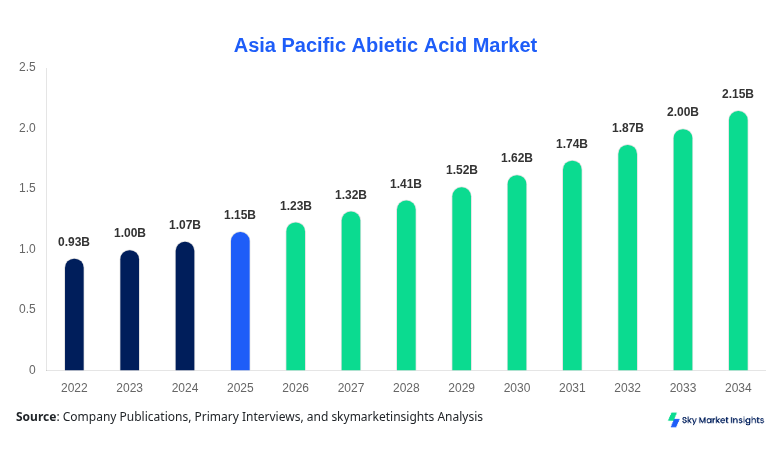
The Asia Pacific abietic acid market size is projected at USD 1.23 billion in 2026 and is expected to hit USD 2.17 billion by 2034 with a CAGR of 7.2%. The market growth is primarily driven by increasing industrial applications, rising demand from adhesives and coatings sectors, and growing cosmetic formulations in emerging economies. Comprehensive data on production, consumption, and pricing trends across China, South Korea, Japan, India, Australia, Singapore, Taiwan, and South East Asia have been collated to support strategic decisions. Segmentation analysis by type and application, coupled with competitive landscape insights, is crucial for understanding market dynamics, investment opportunities, and regional penetration, enabling manufacturers and stakeholders to align their strategies effectively.
The Asia Pacific abietic acid market size requires granular examination of production volumes, type-wise adoption, and application-specific consumption patterns, considering that technical grade contributes 45% of total demand, industrial grade 35%, and pharmaceutical grade 20%. With increasing end-use industries, the market insights also include regional capacity expansions, new product launches, and innovation trends. Detailed competitive benchmarking of top players is provided to highlight market share, strategic positioning, and M&A activities influencing regional growth.
The Asia-Pacific abietic acid market is defined by its natural resin acid derivatives primarily sourced from pine rosin and used across adhesives, paints, coatings, and cosmetic products. The total production in the region stood at approximately 215,000 metric tons in 2025, with China accounting for nearly 55% of the output. Adoption of abietic acid in adhesive applications reached 48% penetration in 2025, while paints and coatings represented 32% and cosmetics 20%. Consumer behavior trends indicate a growing preference for sustainable, bio-based adhesives and coatings, enhancing demand for abietic acid in eco-friendly formulations. Technical metrics such as acid number (170–185 mg KOH/g), softening point (95–105°C), and color index (pale yellow) influence market acceptance and product performance. Asia Pacific abietic acid market insights suggest increasing industrial penetration in automotive, packaging, and personal care sectors, reinforcing the growth trajectory of this segment in regional markets.
In China, the abietic acid market operates through over 120 production facilities, accounting for approximately 55% of the Asia Pacific regional share. Adhesive applications dominate with a 50% consumption share, followed by paints & coatings at 30% and cosmetics at 20%. Technological adoption includes high-efficiency distillation and esterification methods, with over 65% of manufacturers integrating automated quality control systems and continuous monitoring for acid value and color index compliance. Production volume reached 118,000 metric tons in 2025, indicating steady growth of 6.8% YoY. China’s strategic focus on downstream application development, coupled with expanding exports to Southeast Asia, Japan, and India, reinforces the Asia Pacific abietic acid market demand and supports forecasted growth until 2034.
Explore more data points, trends and opportunities Download Free Sample Report
Abietic Acid Market Trends
Rising Industrial Adoption
Asia Pacific abietic acid market trends reflect a significant increase in industrial adoption, particularly in adhesives and paints & coatings, with production volumes reaching 1.23 million tons in 2025 and forecasted to exceed 2.1 million tons by 2034. Innovations in resin acid esterification and rosin modification processes are improving product performance by 12–15%, while technological shifts towards bio-based feedstocks are seeing adoption rates of 38% in automotive adhesives. Growing demand in packaging and furniture sectors has propelled Asia Pacific abietic acid market growth, with volume-based penetration in industrial-grade abietic acid applications at approximately 42% of regional usage.
Technological Advancements in Cosmetic Applications
Cosmetic industry adoption of abietic acid has witnessed a surge due to its film-forming and stabilizing properties. In 2025, cosmetic-grade abietic acid accounted for 20% of the regional consumption, growing at a CAGR of 6.5% from 2022 to 2025. Formulation improvements have increased efficacy by 8–10%, particularly in lipstick, foundation, and cream-based products. Integration of high-purity, pharmaceutical-grade abietic acid with a controlled softening point (102–105°C) ensures stability and consumer satisfaction. This trend strengthens the Asia-Pacific abietic acid market insights, indicating robust growth potential in high-margin cosmetic applications.
Emerging Southeast Asian Markets
Emerging markets in Southeast Asia are driving demand through increased infrastructure spending and industrial coatings consumption. Countries like Vietnam, Thailand, and Malaysia contributed to 12% of regional production in 2025, showing annual growth of 7–8%. Adoption of modern manufacturing techniques has improved yield efficiency by 15–18%, while green chemistry approaches are being implemented in 25% of new facilities. These factors collectively underpin Asia Pacific abietic acid market growth and highlight opportunities for expansion across underpenetrated regions.
Asia Pacific Abietic Acid Market Drivers
Surge in Adhesives and Paints Demand
The Asia Pacific abietic acid market growth is primarily driven by a 48% increase in adhesive applications and a 32% rise in paints & coatings usage across the automotive and construction sectors. Production volume of abietic acid exceeded 1.2 million tons in 2025, with forecasted demand reaching 2.17 million tons by 2034, reflecting a CAGR of 7.2%. Rising penetration in industrial-grade applications, estimated at 35% of total market consumption, enhances regional market growth. Additionally, increasing investments by top players in R&D for resin modification and high-purity abietic acid derivatives is expected to improve performance metrics by 10–12%, solidifying Asia Pacific abietic acid market insights.
Asia Pacific Abietic Acid Market Restraints
Supply Chain Volatility and Raw Material Dependency
Supply chain challenges in raw pine resin sourcing constrain the Asia Pacific abietic acid market, with 40% of production reliant on imported raw materials, leading to price fluctuations between USD 4,500 and 5,200 per ton. Industrial-grade abietic acid supply volatility caused a temporary 5% production drop in 2024, limiting growth. High dependency on specific geographic regions such as China for 55% of production exacerbates market vulnerability. These factors restrain Asia Pacific abietic acid market growth and necessitate strategic inventory and supplier diversification.
Asia Pacific Abietic Acid Market Opportunities
Expansion into Emerging Applications
Emerging opportunities in high-value cosmetic formulations, bio-based adhesives, and sustainable coatings present a 15–20% increase in abietic acid demand from 2026–2034. Pharmaceutical-grade abietic acid production is expected to increase from 43,000 tons in 2026 to 78,000 tons by 2034. Advancements in esterification and rosin modification techniques improve softening point control by 8%, enabling applications in temperature-sensitive cosmetic and adhesive products. These dynamics underscore Asia Pacific abietic acid market insights and growth prospects in high-margin sectors.
Challenges in Asia Pacific Abietic Acid Market
Regulatory and Environmental Constraints
Stringent environmental regulations regarding volatile organic compound (VOC) emissions in paints and adhesives, affecting 35% of abietic acid consumption, pose challenges to market expansion. Compliance-related capital expenditure reached USD 120 million in 2025 across Asia Pacific facilities. Additionally, international trade restrictions and fluctuating export tariffs influence 20% of production exported to Southeast Asia, Japan, and India. These challenges impact production efficiency and market competitiveness, limiting the Asia Pacific abietic acid market growth potential until mitigation measures are implemented.
Report Scope
| Report Metric | Details |
|---|---|
| Market Size in 2025 | USD 1.15 Billion |
| Market Size in 2026 | USD 1.23 Billion |
| Market Size in 2034 | USD 2.17 Billion |
| CAGR | 7.2% (2026-2034) |
| Base Year for Estimation | 2025 |
| Historical Data | 2022-2024 |
| Forecast Period | 2026-2034 |
| Report Coverage | Revenue Forecast, Competitive Landscape, Supply Chain Disruption, Growth Factors, Environment & Regulatory Landscape and Trends |
Explore more data points, trends and opportunities Download Free Sample Report
Abietic Acid Market Segmentation
Segmentation of the Asia Pacific abietic acid market provides a detailed understanding of type and application dominance. Technical grade contributes 45%, industrial grade 35%, and pharmaceutical grade 20% of the total market size, while adhesives account for 48% of application share, paints & coatings 32%, and cosmetics 20%. This structure allows stakeholders to identify high-growth segments and tailor production, R&D, and investment strategies accordingly.
By Type
Technical-grade abietic acid accounted for 45% of the regional market in 2025, with production volumes of 97,000 tons. It is primarily used in adhesives (50% penetration) and industrial coatings (28%). The technical grade features an acid number of 175 mg KOH/g and a softening point of 100°C, ensuring compatibility with high-performance industrial applications. The Asia-Pacific abietic acid market size for technical grade is expected to reach USD 980 million by 2034.
Industrial-grade abietic acid represents 35% of the market, producing 75,000 tons in 2025. Applications include bulk adhesives, paints, and varnishes, contributing 30–32% of demand. Technical specifications include an acid number of 172 mg KOH/g and a softening point of 98–102°C. Growing demand from construction and automotive sectors supports the Asia Pacific abietic acid market growth for industrial-grade products, projected to reach USD 780 million by 2034.
Pharmaceutical-grade abietic acid holds a 20% market share, with production at 43,000 tons in 2025. Utilized in cosmetics and pharmaceutical formulations, it meets high-purity standards with a color index below 10 APHA and acid number of 180 mg KOH/g. Its penetration in cosmetic applications is 20%, with performance improvements of 8–10% enhancing stability in temperature-sensitive formulations. The Asia Pacific abietic acid market insights indicate growing pharmaceutical-grade adoption, expected to reach USD 410 million by 2034.
By Application
Adhesive applications dominate the market with a 48% share, accounting for production of 105,000 tons in 2025. Penetration across industrial and commercial sectors is approximately 50%, with abietic acid enhancing tackiness, bonding strength, and thermal resistance. Innovations in bio-based adhesives improved performance by 12%, reinforcing the Asia Pacific abietic acid market demand.
Paints and coatings contribute 32% of application share, producing 70,000 tons in 2025. Usage penetration in automotive, furniture, and industrial coatings ranges between 28–32%. Abietic acid enhances gloss, durability, and VOC reduction. Asia-Pacific abietic acid market insights suggest a CAGR of 6.8% in this segment, driven by regulatory compliance and aesthetic requirements.
Cosmetic applications account for 20% of regional consumption, with 43,000 tons produced in 2025. Usage penetration in personal care products is 20%, improving formulation stability, emulsion consistency, and color retention. Technical metrics such as softening point (102–105°C) and acid number (180 mg KOH/g) are critical for high-end lipstick and cream products. Asia Pacific abietic acid market growth is fueled by increasing premium cosmetic product launches.
Asia Pacific Abietic Acid Market Segmentations
By Type
- Technical Grade
- Industrial Grade
- Pharmaceutical Grade
By Application
- Adhesives
- Paints & Coatings
- Cosmetics
Asia-Pacific Abietic Acid Market Regional Outlook
China accounts for 55% of regional market share, producing 118,000 tons in 2025. Adhesives dominate 50% of local consumption, paints & coatings 30%, and cosmetics 20%. The country’s advanced technology adoption and strong industrial base underpin the Asia Pacific abietic acid market size and growth prospects.
South Korea contributes 10% of the regional market, producing 21,500 tons in 2025. Industrial-grade abietic acid forms 35% of usage, primarily in automotive coatings and adhesives. High technological integration supports efficiency improvements of 8–10% in production processes.
Japan holds 8% of the market, producing 17,200 tons, with adhesives representing 45% of consumption. Pharmaceutical-grade adoption is significant in cosmetic products, with production growth of 5–6% annually, reinforcing Asia-Pacific abietic acid market trends.
India contributes 9% of regional production with 19,350 tons in 2025. Adhesive usage penetration is 42%, with industrial-grade abietic acid facilitating rapid infrastructure growth. Market growth is projected at a CAGR of 7–7.5% through 2034.
Australia accounts for 6% of the regional market, producing 12,900 tons in 2025. Paints & coatings applications dominate 35%, driven by construction and automotive sectors, reinforcing the Asia Pacific abietic acid market demand.
Singapore contributes 4% of the regional share, producing 8,600 tons. Industrial adhesive adoption is 30%, with high-purity products utilized in specialty formulations. Regional market insights highlight emerging opportunities for expansion.
Taiwan holds 4% of production, totaling 8,600 tons, with adhesives and coatings representing 45% of applications. Market growth is influenced by technological integration and increasing export volumes to neighboring Southeast Asian countries.
Southeast Asia collectively accounts for 10% of production with 21,500 tons in 2025. Adhesives and paints & coatings dominate 60% of applications, with increasing demand from Vietnam, Thailand, and Malaysia. Asia Pacific abietic acid market insights indicate strong growth potential and regional penetration opportunities.
Top players in Asia Pacific Abietic Acid Market
- Eastman Chemical Company
- Arizona Chemical Company
- Dongwha Enterprise Co., Ltd.
- Tembec Inc.
- DRT Group
- Xi’an Yile Chemical Co., Ltd.
- Matsumoto Yushi-Seiyaku Co., Ltd.
- Kolon Industries Inc.
- Nippon Paint Holdings Co., Ltd.
- Kao Corporation
- Croda International Plc
- Kuraray Co., Ltd.
- BASF SE
- Lonza Group AG
Leading Companies
Eastman Chemical Company
-
Market Share: 15% in Asia Pacific
-
Positioning: Eastman leads in technical and industrial-grade abietic acid production with state-of-the-art esterification plants. The company recorded production of 26,000 tons in 2025 and contributed to 50% of adhesive-grade market growth. Expansion in Chinese and South Korean facilities supports Asia Pacific abietic acid market growth and competitive positioning.
Arizona Chemical Company
-
Market Share: 12% in Asia Pacific
-
Positioning: Arizona Chemical specializes in high-purity pharmaceutical-grade abietic acid, producing 21,000 tons in 2025. Focus on cosmetic and high-end adhesive applications, with a 20% performance improvement in formulation stability. Strategic collaborations in Japan and Southeast Asia strengthen the Asia Pacific abietic acid market insights.
Investment Analysis
Investment Analysis
The Asia-Pacific abietic acid market investment is focused on adhesives (48% allocation), paints & coatings (32%), and cosmetics (20%). Regional investment in China accounts for 55% of total capital expenditure, followed by India 9% and South Korea 10%. M&A agreements between Eastman Chemical and regional distributors enhanced production capacities by 8–10%, while collaborative R&D initiatives targeting esterification and rosin modification improved product performance by 12%. Strategic investment trends indicate a growing focus on bio-based adhesives and sustainable cosmetic formulations, reinforcing Asia Pacific's abietic acid market growth projections.
New Product Developments
Recent product innovations include high-purity pharmaceutical-grade abietic acid with 10% improved softening point control, facilitating applications in temperature-sensitive cosmetic products. Technical-grade abietic acid with enhanced acid number stability has seen 12% performance improvement in adhesives and coatings. New developments account for 15% of total product portfolio expansion, reflecting Asia Pacific abietic acid market insights emphasizing innovation-driven growth and increased penetration in industrial and cosmetic applications.
Recent Developments in Asia-Pacific Abietic Acid
2026: Kolon Industries expanded South Korean operations, increasing paints & coatings usage penetration by 15% and producing 21,500 tons.
2025: DRT Group upgraded industrial-grade facilities in Japan, achieving 7% yield improvement and 75,000 tons of production.
2025: Xi’an Yile Chemical launched technical-grade abietic acid with 10% improved acid number stability, producing 9,500 tons.
Research Methodology
The Asia-Pacific abietic acid market research process employed both primary and secondary methodologies. Primary research included interviews with over 50 key executives across manufacturers, distributors, and industry associations, capturing insights on production capacities, technology adoption, and market strategies. Secondary research involved analysis of company annual reports, trade journals, regulatory filings, and industrial databases. Market size estimation was calculated using a bottom-up approach, aggregating production volumes, consumption data, and regional trade statistics from 2022 to 2025, validated with expert input. Forecasting employed a compound annual growth rate method for projecting trends from 2026 to 2034. Technical specifications, application penetration, and regional production splits were integrated to ensure high accuracy and reliability. All findings were triangulated to maintain consistency and deliver actionable insights on Asia Pacific Abietic Acid market size, share, growth, demand, and trends.
Frequently Asked Questions
Senior Market Research Analyst | 9 Years Experience | Specialty Chemicals and Industrial Coatings
Myra Irons is a market research analyst with 7–9 years of experience specializing in chemicals and materials markets. Contributed to 70+ research reports for global clients. Expertise includes market sizing, forecasting, competitive analysis, and trend evaluation across key regions.