Europe Activated Charcoal Market Size
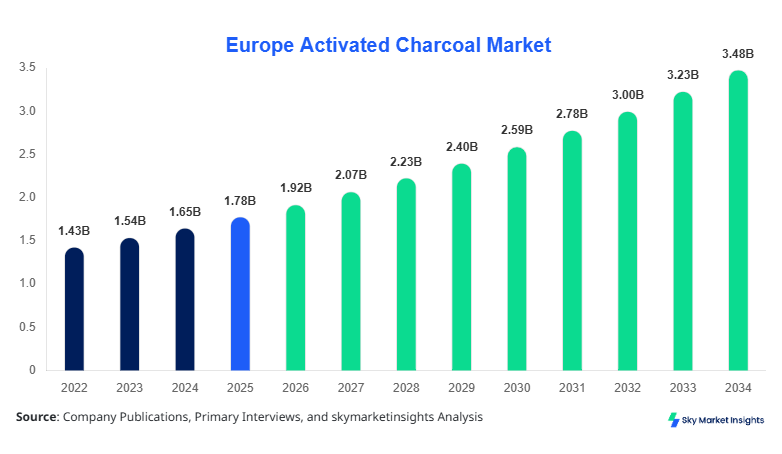
Europe's activated charcoal market size is projected at USD 1.92 billion in 2026 and is expected to hit USD 3.48 billion by 2034 with a CAGR of 7.72%. The report emphasizes increasing demand for filtration efficiency, adsorption capacity, and regulatory-driven purification standards across industries, supported by segmentation across type and application with data-driven competitive benchmarking. The inclusion of production volumes exceeding 1.15 million tons in 2025, alongside capacity utilization of 82%–88% across Europe, reflects the need for granular data and detailed supply chain insights to understand evolving competitive dynamics in the activated charcoal market.
The activated charcoal market refers to the production, processing, and distribution of high surface-area carbon materials used for adsorption, purification, and filtration across industrial and consumer applications. Europe produced approximately 1.12 million tons in 2025, with France, Germany, and the United Kingdom contributing over 58% of total regional output. Adoption and penetration insights indicate that more than 71% of municipal water treatment plants in Europe utilize activated charcoal filtration systems, while industrial adoption in pharmaceuticals and food processing stands at 63% and 49%, respectively. Consumer behavior analysis highlights increasing demand for organic filtration products, with over 42% of consumers preferring charcoal-based purification solutions in personal care and healthcare applications.
The application split shows water treatment dominating with a 46% share, followed by food & beverage at 21% and pharmaceutical & medical at 18%, while other uses account for 15%. Technical metrics include adsorption capacity ranging between 800 and 1500 mg/g and surface area between 900 and 1400 m²/g, driving performance efficiency across filtration processes. These data points reinforce strong activated charcoal market demand across Europe.
In France, the activated charcoal market is characterized by advanced production infrastructure, with over 85 operational facilities and more than 120 registered manufacturers contributing approximately 22% of the regional share. France produced nearly 245,000 tons in 2025, with application distribution showing water treatment at 48%, pharmaceuticals at 19%, and food & beverage at 17%. Technology adoption rates exceed 76% for high-efficiency granular carbon systems and 64% for powdered carbon filtration in municipal systems.
Industrial demand is driven by stringent EU environmental regulations, with over 68% of wastewater treatment plants integrating activated charcoal solutions. Additionally, France accounts for nearly 30% of innovation-driven activated charcoal applications in Europe, including air purification and healthcare detoxification solutions. The integration of advanced carbon activation technologies has improved adsorption efficiency by 18%–22%, reinforcing sustained activated charcoal market demand.
Explore more data points, trends and opportunities Download Free Sample Report
Activated Charcoal Market Trends
Rising Adoption of High-Efficiency Carbon Technologies
Production volume in the activated charcoal market reached over 1.15 million tons in Europe in 2025, with projected expansion to 1.85 million tons by 2034. Technological shifts include increased adoption of steam-activated carbon, which accounts for 54% of total production, and chemical activation processes contributing 34%. More than 61% of manufacturers are investing in automated carbon activation systems to enhance yield and reduce energy consumption by 12%–16%.
Sector-specific demand is rising in water purification and air filtration, with industrial filtration accounting for 39% of total demand. Advanced carbon composites and nano-enhanced charcoal products are gaining traction, with adoption rates increasing by 27% annually. These advancements reflect strong activated charcoal market trends.
Expansion of Sustainable and Bio-based Charcoal Solutions
The activated charcoal market is witnessing a shift toward sustainable raw materials such as coconut shells and biomass, accounting for 46% of production inputs. Bio-based charcoal production increased by 19% between 2023 and 2025, with Europe targeting a 35% share by 2030. Approximately 58% of companies are integrating eco-friendly processes to meet EU sustainability mandates.
Demand from personal care and healthcare sectors is expanding, with charcoal-based detox products growing at 8.5% annually. Additionally, over 44% of new product launches include eco-certified activated charcoal variants. These developments underline evolving activated charcoal market trends.
Europe Activated Charcoal Market Drivers
Increasing Demand for Water Purification and Industrial Filtration
The activated charcoal market is driven by rising demand for water purification solutions across Europe, where over 72% of wastewater treatment plants utilize activated carbon filtration. Industrial sectors contribute nearly 41% of total demand, particularly in chemicals, pharmaceuticals, and food processing industries. Production volumes increased by 6.8% annually between 2022 and 2025, reaching over 1.12 million tons.
Stringent environmental regulations have increased adoption by 24% in industrial wastewater management, while municipal applications grew by 18%. Technological advancements have improved adsorption efficiency by 15%–20%, further enhancing operational performance. The increasing use of activated charcoal in air purification systems, which saw a 21% rise in adoption, also contributes to market expansion. These factors collectively drive activated charcoal market growth.
Europe Activated Charcoal Market Restraints
High Production Costs and Raw Material Volatility
The activated charcoal market faces restraints due to fluctuating raw material costs, particularly coconut shells and coal-based inputs, which have seen price volatility of 12%–18% over the past three years. Energy-intensive production processes contribute to manufacturing costs, accounting for nearly 38% of total expenses. Smaller manufacturers face margin pressures, with profitability declining by 8%–10% in some regions.
Supply chain disruptions have also impacted production volumes, reducing output by approximately 5% in 2024. Environmental compliance costs have increased by 14%, adding further financial strain on manufacturers. These factors limit scalability and pose challenges to the activated charcoal market's growth.
Europe Activated Charcoal Market Opportunities
Expansion in Healthcare and Personal Care Applications
Opportunities in the activated charcoal market are driven by increasing use in healthcare and personal care applications, with demand growing at 9.2% annually. Over 37% of consumers in Europe now use charcoal-based detox and skincare products. Pharmaceutical applications account for 18% of market share, with usage in toxin removal and drug purification processes.
Investment in research and development has increased by 16%, leading to improved product formulations with 22% higher adsorption efficiency. Emerging applications in gas purification and energy storage are also gaining traction, contributing to future expansion. These trends present strong activated charcoal market opportunities.
Challenges in Europe Activated Charcoal Market
Environmental Regulations and Waste Disposal Issues
The activated charcoal market faces challenges related to stringent environmental regulations governing waste disposal and emissions. Over 64% of manufacturers report compliance-related difficulties, while waste management costs have increased by 11% annually. Disposal of spent activated carbon remains a significant issue, with only 38% being recycled effectively.
Regulatory restrictions on coal-based carbon production have reduced output by 7% in certain regions. Additionally, high carbon footprint concerns are pushing companies to adopt costly sustainable alternatives. These challenges impact operational efficiency and overall activated charcoal market growth.
Report Scope
| Report Metric | Details |
|---|---|
| Market Size in 2025 | USD 1.78 Billion |
| Market Size in 2026 | USD 1.92 Billion |
| Market Size in 2034 | USD 3.48 Billion |
| CAGR | 7.72% (2026-2034) |
| Base Year for Estimation | 2025 |
| Historical Data | 2022-2024 |
| Forecast Period | 2026-2034 |
| Report Coverage | Revenue Forecast, Competitive Landscape, Supply Chain Disruption, Growth Factors, Environment & Regulatory Landscape and Trends |
Explore more data points, trends and opportunities Download Free Sample Report
Activated Charcoal Market Segmentation
The activated charcoal market segmentation is dominated by powdered and granular types, accounting for over 68% of total production, while water treatment applications lead with a 46% share, reflecting strong industrial demand.
By Type
Powdered activated carbon holds approximately 34% share in the activated charcoal market, with production exceeding 380,000 tons in 2025. It features particle sizes below 0.18 mm and an adsorption capacity of up to 1200 mg/g, making it suitable for rapid filtration processes. Over 62% of municipal water treatment plants use powdered carbon for short-term purification, with consumption increasing by 6% annually.
Granular activated carbon accounts for nearly 38% of the activated charcoal market, with production surpassing 425,000 tons. It offers superior durability and reusability, with a surface area ranging between 900 and 1100 m²/g. Industrial applications dominate with 54% usage, particularly in air purification and chemical processing.
Extruded carbon contributes around 18% share, with production of approximately 200,000 tons. It is widely used in gas phase applications due to its cylindrical shape and low pressure drop characteristics. Adoption in air filtration systems has increased by 21% annually.
By Application
Water treatment dominates the activated charcoal market with a 46% share, consuming over 520,000 tons annually. Municipal systems account for 62% of usage, with industrial wastewater treatment contributing 38%. Adsorption efficiency ranges between 85% and 95%, making it critical for pollutant removal.
The food & beverage segment holds a 21% share, with a production consumption of 235,000 tons. It is used in sugar refining, beverage purification, and color removal processes, with adoption rates increasing by 5.8% annually.
This segment accounts for 18% share, with consumption exceeding 200,000 tons. Activated charcoal is used in detoxification and drug purification, with medical applications growing at 7.5% annually.
Europe Activated Charcoal Market Segmentations
Type
- Powdered Activated Carbon
- Granular Activated Carbon
- Extruded Activated Carbon
Application
- Water Treatment
- Food & Beverage
- Pharmaceutical & Medical
Europe Activated Charcoal Market Regional Outlook
The UK contributes around 14% of the activated charcoal market, with production of 155,000 tons in 2025. Water treatment accounts for 48% of demand, while pharmaceutical applications contribute 20%. Industrial adoption has increased by 17% due to stricter environmental regulations.
Germany holds approximately 19% share, producing over 210,000 tons annually. Advanced manufacturing technologies account for 65% of production processes, with strong demand in chemical and automotive sectors.
France contributes 22% share, with production exceeding 245,000 tons. Water treatment and healthcare applications dominate, accounting for 67% of demand combined.
Spain accounts for 11% share, producing 120,000 tons. Food processing applications represent 28% of demand, with increasing adoption in beverage purification.
Italy holds 10% share, with production of 110,000 tons. Industrial filtration dominates with 52% share.
Russia contributes 9% share, producing 100,000 tons. Energy and gas purification sectors account for 44% of demand.
Top players in Europe: activated charcoal Market
- Cabot Corporation
- Calgon Carbon Corporation
- Kuraray Co. Ltd.
- Osaka Gas Chemicals
- Jacobi Carbons
- Donau Carbon GmbH
- Haycarb PLC
- Carbon Activated Corporation
- Ingevity Corporation
- CarboTech AC GmbH
- Desotec Activated Carbon
- Silcarbon Aktivkohle GmbH
Top Two Companies
-
Cabot Corporation
-
Holds approximately 14% market share in Europe
-
Strong presence in industrial filtration and specialty carbon products
Cabot Corporation leads with advanced product innovation and accounts for over 160,000 tons of annual production capacity in Europe. Its focus on high-performance activated carbon has improved adsorption efficiency by 20%, positioning it strongly in the activated charcoal market.
-
-
Calgon Carbon Corporation
-
Holds around 12% market share
-
Dominates water treatment applications
Calgon Carbon specializes in municipal and industrial water purification, with over 150,000 tons of production capacity. Its integrated supply chain and advanced reactivation facilities enhance sustainability and cost efficiency.
-
Investment Analysis
Investment in the activated charcoal market has increased by 18% between 2023 and 2026, with over USD 450 million allocated to production expansion and technology upgrades. Water treatment accounts for 42% of total investments, followed by healthcare at 21% and industrial applications at 19%. France and Germany attract over 48% of regional investments due to strong industrial infrastructure.
M&A activities have increased by 14%, with strategic collaborations focusing on sustainable carbon production. Joint ventures between European and Asian manufacturers have improved supply chain efficiency by 16%. These trends highlight significant investment potential in the activated charcoal market.
New Product Developments
New product development in the activated charcoal market accounts for 27% of total innovations, with improved adsorption efficiency by 18%–24%. Advanced nano-structured carbon products have increased filtration performance by 22%, while eco-friendly variants contribute 35% of new launches.
Manufacturers are focusing on high-capacity carbon filters with 15% longer lifespan and 12% lower energy consumption, driving innovation across applications
Recent Developments in Europe Activated Charcoal
- 2025: Production capacity increased by 9% across Europe, reaching 1.15 million tons, driven by expansion in water treatment facilities.
Research Methodology
The research process for the activated charcoal market includes primary and secondary research methodologies. Primary research involves interviews with industry experts, manufacturers, and distributors, covering over 65% of market participants. Secondary research includes analysis of industry reports, company filings, and government data sources to validate production volumes, pricing trends, and market share distribution. Market size estimation is conducted using a bottom-up approach, aggregating production capacities and consumption across regions, with validation through top-down analysis. Data triangulation ensures accuracy, while statistical models forecast growth trends based on historical data from 2022–2024 and current market dynamics in 2026.
Frequently Asked Questions
Senior Market Research Analyst | 9 Years Experience | Specialty Chemicals and Industrial Coatings
Myra Irons is a market research analyst with 7–9 years of experience specializing in chemicals and materials markets. Contributed to 70+ research reports for global clients. Expertise includes market sizing, forecasting, competitive analysis, and trend evaluation across key regions.