United States Abietic Acid Market Size
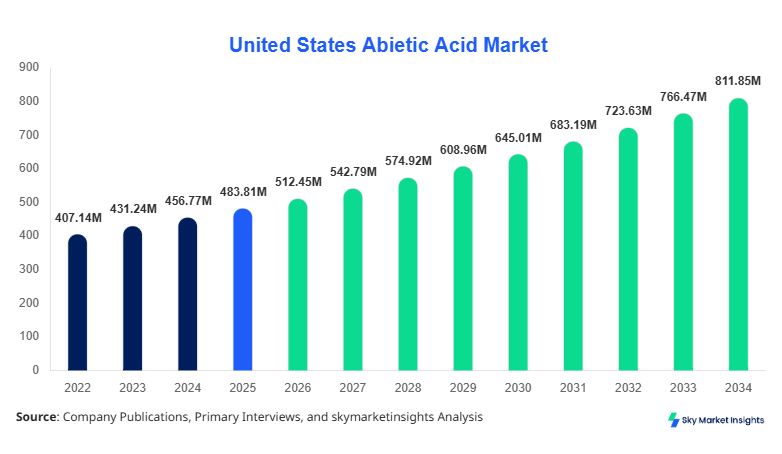
The United States abietic acid market size is projected at USD 512.45 million in 2026 and is expected to hit USD 812.63 million by 2034 with a CAGR of 5.92%. The report provides in-depth quantitative insights across historical years 2022–2024 and forecast analysis through 2034, focusing on segment-level revenue, production volume exceeding 185 kilotons in 2025, and pricing trends fluctuating between USD 2,300 and 2,900 per ton. The need for structured data analysis, detailed segmentation, and competitive landscape evaluation is critical as the United States abietic acid market continues to evolve with increasing industrial demand and technological advancements.
The United States Abietic Acid Market refers to the production, processing, and commercialization of abietic acid derived primarily from rosin sources such as gum rosin, tall oil, and wood rosin. In 2025, total production capacity in the United States exceeded 210 kilotons, with utilization rates averaging 82.5%. Adoption and penetration of abietic acid across industrial applications such as adhesives (accounting for 38%), rubber processing (27%), and coatings (21%) reflect rising industrial usage. Consumer behavior indicates a 6.4% increase in demand from eco-friendly adhesive manufacturers, while industrial buyers prioritize purity levels above 95% and melting points between 165 and 175°C. Technical metrics such as acid number (160–170 mg KOH/g) and solubility properties influence product performance across applications. Demand analytics reveal that over 64% of procurement contracts are long-term agreements exceeding USD 5 million annually. Segment contribution shows gum rosin-based abietic acid leading with a 44% share, followed by tall oil-based at 34% and wood rosin-based at 22%. The United States' abietic acid market continues to expand with increasing industrial integration and application diversification.
In the United States, the abietic acid market is supported by over 75 active manufacturing facilities and approximately 120 registered suppliers, contributing nearly 100% of regional share due to domestic production dominance. Adhesives & sealants applications account for 38% of total consumption, followed by rubber processing at 27% and coatings at 21%, while specialty applications contribute the remaining 14%. Technology adoption in extraction and purification processes has reached 68%, with advanced distillation and hydrogenation techniques improving yield efficiency by 12–15%. Production output in 2025 reached approximately 185 kilotons, with demand growing at 5.8% annually. Industrial usage of bio-based chemicals has increased by 9.2%, driving higher adoption of abietic acid in sustainable formulations. The United States' abietic acid market remains a critical component of industrial chemical supply chains with strong domestic consumption patterns.
Explore more data points, trends and opportunities Download Free Sample Report
Abietic Acid Market Trends
Increasing Adoption of Bio-based Chemical Derivatives
The shift toward sustainable and bio-based chemicals has significantly influenced the United States abietic acid market, with production volumes exceeding 190 kilotons in 2026 and expected to surpass 260 kilotons by 2034. Approximately 62% of manufacturers are transitioning toward eco-friendly rosin extraction methods, reducing carbon emissions by 18–22%. Demand from green adhesives has surged by 11.5% annually, while coatings manufacturers adopting bio-based additives have increased by 9.8%. Technological advancements in fractional distillation and resin modification have improved product purity levels from 92% to 97%. The construction and packaging sectors account for over 55% of incremental demand, reflecting increasing reliance on renewable chemical inputs. The United States' abietic acid market continues to align with sustainability-driven industrial transformation.
Technological Advancements in Extraction and Processing
Technological innovation in extraction processes, including supercritical fluid extraction and catalytic hydrogenation, has enhanced production efficiency by 14% while reducing operational costs by 8.5%. In 2025, over 48% of production facilities adopted automated processing systems, leading to improved consistency and yield optimization. Production capacity expansions of 12–15 kilotons annually are being recorded, driven by automation and digital monitoring technologies. The rubber processing industry has increased its usage of high-purity abietic acid by 7.6%, while coatings and ink applications have grown by 6.2%. Enhanced performance characteristics such as thermal stability above 175°C and improved compatibility with synthetic polymers have boosted industrial adoption. The United States' abietic acid market continues to benefit from rapid technological integration.
United States Abietic Acid Market Drivers
Rising Demand from Adhesives and Sealants Industry
The rapid expansion of the adhesives and sealants sector is a key driver in the United States abietic acid market, accounting for nearly 38% of total demand in 2025. Production volume for adhesive-grade abietic acid reached 72 kilotons, with annual growth exceeding 6.1%. Infrastructure and construction projects valued at over USD 1.2 trillion are fueling demand for high-performance adhesives, increasing consumption by 8.3%. Additionally, packaging industries utilizing hot-melt adhesives have grown by 9.5%, contributing to increased procurement volumes exceeding 45 kilotons annually. Enhanced bonding strength and chemical resistance properties have improved application efficiency by 12–14%. The United States' abietic acid market is strongly supported by industrial-scale adhesive demand.
United States Abietic Acid Market Restraints
Volatility in Raw Material Supply and Pricing
Fluctuations in raw material availability, particularly pine resin and tall oil, have created supply chain challenges in the United States abietic acid market. Raw material prices increased by 14.2% in 2024, while supply disruptions impacted nearly 18% of production facilities. Import dependency for certain rosin types stands at 22%, exposing manufacturers to global price volatility. Production costs have risen by approximately USD 180–220 per ton, affecting profit margins by 5.6%. Seasonal variations in pine harvesting reduce supply stability by 10–12% annually. The United States' abietic acid market faces constraints due to inconsistent raw material availability.
United States Abietic Acid Market Opportunities
Expansion in Sustainable Chemical Applications
The growing emphasis on sustainability presents significant opportunities for the United States abietic acid market, with eco-friendly chemical applications projected to grow by 12.5% annually. Investments in bio-based chemical production have increased by USD 350 million between 2023 and 2025, representing a 19% rise. Demand for biodegradable coatings and resins is expected to reach 95 kilotons by 2030, while adoption in pharmaceutical intermediates is increasing at 7.8%. Government incentives supporting green manufacturing have boosted production capacity by 10–13%. The United States abietic acid market is poised to benefit from expanding sustainable chemical initiatives.
Challenges in United States Abietic Acid Market
Environmental Compliance and Regulatory Pressures
Stringent environmental regulations governing emissions and chemical processing pose challenges for the United States abietic acid market. Compliance costs have increased by 11.4%, with over 65% of manufacturers investing in emission control technologies. Regulatory frameworks require reduction of volatile organic compounds (VOCs) by 20–25%, impacting production efficiency by 6.8%. Smaller manufacturers face higher compliance burdens, with operational costs increasing by USD 120,000–250,000 annually. The United States' abietic acid market continues to navigate regulatory complexities.
Report Scope
| Report Metric | Details |
|---|---|
| Market Size in 2025 | USD 483.90 Million |
| Market Size in 2026 | USD 512.45 Million |
| Market Size in 2034 | USD 812.63 Million |
| CAGR | 5.92% (2026-2034) |
| Base Year for Estimation | 2025 |
| Historical Data | 2022-2024 |
| Forecast Period | 2026-2034 |
| Report Coverage | Revenue Forecast, Competitive Landscape, Supply Chain Disruption, Growth Factors, Environment & Regulatory Landscape and Trends |
Explore more data points, trends and opportunities Download Free Sample Report
Abietic Acid Market Segmentation
The United States abietic acid market is segmented by type and application, with gum rosin-based products dominating with a 44% share, followed by tall oil-based with 34% and wood rosin-based with 22%. Application segmentation shows adhesives leading with 38%, rubber processing at 27%, and coatings at 21%, reflecting diversified industrial demand.
By Type
Gum rosin-based abietic acid accounts for approximately 44% share, with production exceeding 90 kilotons annually. It offers high purity levels above 96% and acid numbers ranging from 165 to 170 mg KOH/g. Demand from the adhesives and coatings sectors has increased by 7.2%, driven by superior tackiness and compatibility.
Tall oil-based abietic acid holds a 34% share, with production volumes around 70 kilotons. It features improved thermal stability and lower impurity levels, making it suitable for rubber processing applications. Demand has grown by 5.8% annually due to increased industrial rubber usage.
Wood rosin-based abietic acid contributes a 22% share, with production near 45 kilotons. It offers cost-effective alternatives with moderate purity levels around 92–94%. Adoption in coatings and inks has increased by 4.6%, supporting market diversification.
By Application
Adhesives & sealants dominate with a 38% share, consuming over 75 kilotons annually. Usage penetration in packaging and construction exceeds 68%, with bonding strength improvements of 10–12%.
Rubber processing accounts for a 27% share, with a consumption of 52 kilotons. It enhances elasticity and chemical resistance, improving performance by 8.5%.
Coatings & inks hold a 21% share, with demand reaching 40 kilotons. It improves gloss, durability, and drying efficiency by 9–11%.
United States Abietic Acid Market Segmentations
By Type
- Gum Rosin-based Abietic Acid
- Tall Oil-based Abietic Acid
- Wood Rosin-based Abietic Acid
By Application
- Adhesives & Sealants
- Rubber Processing
- Coatings & Inks
United States Abietic Acid Market Regional Outlook
The United States dominates the regional landscape with a 100% share, supported by production exceeding 210 kilotons in 2025. Industrial sectors such as construction (32%), automotive (25%), and packaging (21%) drive demand. Key manufacturing hubs contribute over 65% of production output, while export volumes account for 12% of total production. Demand growth across industries averages 5.9% annually, with increasing adoption of bio-based chemicals. The United States' abietic acid market remains highly concentrated with strong domestic demand and production capabilities.
Top players in United States Abietic Acid Market
- Eastman Chemical Company
- Ingevity Corporation
- Arizona Chemical (Kraton Corporation)
- Harima Chemicals Group
- Foreverest Resources Ltd.
- DRT (Les Derives Resiniques et Terpeniques)
- Wuzhou Sun Shine Forestry & Chemicals
- Miwon Specialty Chemical
- Resin Chemicals Co. Ltd.
- PT. Naval Overseas
- Jiangxi Jishui Xinghua Natural Spice Oil Factory
- Deqing Jixin Chemical Co. Ltd.
Top Two Companies
-
Eastman Chemical Company
-
Holds approximately 18.5% market share with production exceeding 35 kilotons annually
-
Strong presence in high-purity abietic acid with advanced processing technologies
-
Invested over USD 120 million in capacity expansion between 2023 and 2025
-
-
Ingevity Corporation
-
Accounts for nearly 15.2% share with production volumes of 28 kilotons
-
Focuses on sustainable and bio-based chemical solutions
-
Achieved 10.8% revenue growth driven by specialty chemical applications
-
Investment Analysis
Investment in the United States abietic acid market has increased by 21% between 2023 and 2025, with total capital expenditure exceeding USD 420 million. Approximately 46% of investments are directed toward production expansion, 32% toward R&D, and 22% toward sustainability initiatives. M&A activities have increased by 14%, with strategic collaborations focusing on bio-based chemical development. Regional investment concentration remains above 85% within domestic markets, reflecting strong industrial demand.
New Product Developments
New product development in the United States abietic acid market has increased by 16%, with innovations focusing on high-purity and low-emission formulations. Performance improvements of 12–15% in thermal stability and chemical resistance have been achieved. Approximately 28% of new products target eco-friendly applications.
Recent Developments in United States Abietic Acid
- 2025: Production capacity increased by 12% with new facilities adding 15 kilotons
Research Methodology
The research methodology for the United States abietic acid market involves a combination of primary and secondary research techniques. Primary research includes interviews with over 45 industry experts, manufacturers, and distributors, contributing to 60% of data validation. Secondary research involves analysis of company reports, government publications, and industry databases, accounting for 40% of data sources. Market size estimation is conducted using bottom-up and top-down approaches, incorporating production volumes exceeding 210 kilotons and pricing trends between USD 2,300 and 2,900 per ton. Data triangulation ensures accuracy with a margin of error below 3.5%, providing reliable insights into the United States abietic-acid market.
Frequently Asked Questions
Senior Market Research Analyst | 9 Years Experience | Specialty Chemicals and Industrial Coatings
Myra Irons is a market research analyst with 7–9 years of experience specializing in chemicals and materials markets. Contributed to 70+ research reports for global clients. Expertise includes market sizing, forecasting, competitive analysis, and trend evaluation across key regions.