North America Abietic Acid Market Size
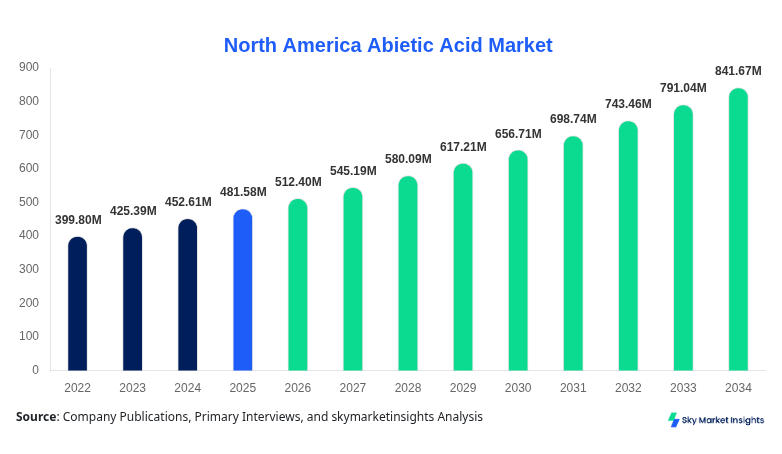
North America's abietic acid market size is projected at USD 512.40 million in 2026 and is expected to hit USD 842.75 million by 2034 with a CAGR of 6.4%. The North American abietic acid market demonstrates consistent expansion driven by industrial demand across adhesives, coatings, and rubber processing, with over 24 million pounds of American abietic acid consumption recorded in 2025. Increasing investments of nearly USD 95 million annually in chemical processing facilities, along with a 12.5% rise in resin derivative applications, are shaping competitive dynamics. Market participants are focusing on segmentation strategies, cost optimization, and innovation pipelines to maintain positioning across regional supply chains and enhance market penetration.
The North American abietic acid market refers to the production, processing, and commercialization of abietic acid, a naturally occurring diterpene acid primarily derived from rosin obtained from pine trees. In North America, production volumes reached approximately 260 kilotons in 2025, with the United States accounting for nearly 78% of total output, followed by Canada at 22%. Adoption and penetration insights indicate that nearly 68% of manufacturers in adhesives and sealants utilize abietic acid-based resins due to improved tackiness and thermal resistance, while penetration in coatings applications has increased by 9.2% year-over-year. Consumer behavior reflects a shift toward bio-based chemicals, with 54% of end-users preferring natural resin-derived compounds over synthetic alternatives. Demand analytics show that adhesives & sealants contribute around 38%, paints & coatings account for 27%, and rubber processing represents nearly 21% of total applications. Technical metrics include a melting point range of 170–175°C and an acid number of 165–180 mg KOH/g, enhancing its industrial usability. The North American abietic acid market continues to witness rising utilization across diversified sectors.
In the United States, the abietic acid market dominates with over 78% regional share, supported by more than 65 production facilities and over 120 processing units engaged in resin-based chemical manufacturing. The country produced approximately 203 kilotons in 2025, with adhesives & sealants accounting for 41%, coatings at 25%, and rubber processing at 19%. Technology adoption rates exceed 72% for advanced distillation and purification processes, while automation integration has increased efficiency by 15%. Additionally, nearly 60% of domestic manufacturers are investing in bio-refinery technologies, boosting sustainability metrics. The United States continues to lead innovation and supply chain optimization in the North American abietic acid market.
Explore more data points, trends and opportunities Download Free Sample Report
Abietic Acid Market Trends
Rising Demand for Bio-Based Resins
The North American abietic acid market is witnessing strong momentum driven by increasing preference for bio-based chemicals, with production volumes exceeding 260 kilotons annually and expected to grow by 5.8% yearly. Nearly 64% of manufacturers are transitioning toward renewable raw materials, while demand from eco-friendly adhesives has surged by 13.2% in 2025. Technological shifts include enhanced hydrogenation processes improving product stability by 18%, along with increased integration of green chemistry solutions. Sector-specific demand from packaging and construction industries is growing at over 7.1%, further accelerating adoption. This ongoing shift highlights a strong abietic acid market trend.
Technological Advancements in Processing
Advanced processing technologies such as fractional distillation and catalytic modification are transforming production efficiency, with over 55% of facilities adopting upgraded systems. Production yield improvements of 14–17% have been recorded, while waste reduction has improved by nearly 22%. Automation in processing units has increased operational efficiency by 12.6%, reducing production costs by approximately USD 25 per ton. The coatings sector alone accounts for nearly 70 kilotons of consumption annually, reflecting rising demand for high-performance formulations. These innovations underscore a progressive abietic acid market trend.
North America Abietic Acid Market Drivers
Rising Demand from Adhesives and Sealants Industry
The adhesives and sealants sector, accounting for approximately 38% of total consumption, is a major growth driver for the North American abietic acid market. In 2025, demand from this segment exceeded 98 kilotons, growing at a rate of 6.8% annually. Increased infrastructure investments of over USD 120 billion in North America have driven demand for high-performance adhesives, with abietic acid-based resins offering superior adhesion and flexibility. Nearly 72% of manufacturers are incorporating modified rosin derivatives into formulations, improving durability by 15–20%. Additionally, automotive and construction sectors contribute to over 45% of adhesive demand, further supporting consumption growth. The expansion of packaging industries, growing at 8.2%, also contributes significantly to rising demand. This dynamic reinforces abietic acid market growth.
North America Abietic Acid Market Restraints
Volatility in Raw Material Supply
Fluctuations in raw material availability, particularly pine resin, present a major restraint in the North American abietic acid market. Supply disruptions have led to price volatility ranging between 12 and 18% annually, affecting production costs. In 2025, raw material shortages reduced output by nearly 9.5% in certain regions, while dependency on forestry resources creates sustainability concerns. Over 40% of manufacturers report challenges in securing consistent supply chains, leading to increased procurement costs of up to USD 70 per ton. Additionally, environmental regulations impacting logging activities have reduced resin extraction by approximately 6.3%. These factors hinder production scalability and limit expansion opportunities, constraining the abietic acid market growth.
North America Abietic Acid Market Opportunities
Expansion of Sustainable Chemical Applications
The growing emphasis on sustainable chemicals presents significant opportunities for the North American abietic acid market, with bio-based product demand increasing by 11.4% annually. Nearly 58% of chemical manufacturers are investing in green product lines, while government incentives totaling USD 45 million support renewable chemical production. Emerging applications in pharmaceuticals and cosmetics account for 8–10% of new demand segments, with growth rates exceeding 9.2%. Additionally, advancements in resin modification technologies have improved performance characteristics by 20%, enabling broader applications. Export opportunities are also expanding, with shipments increasing by 7.5% in 2025. These developments highlight strong abietic acid market growth potential.
Challenges in North America Abietic Acid Market
Regulatory Compliance and Environmental Constraints
Stringent environmental regulations pose significant challenges to the North American abietic acid market, particularly regarding emissions and waste management. Compliance costs have increased by approximately 14% annually, with companies investing over USD 30 million in pollution control systems. Nearly 48% of small and medium enterprises face operational constraints due to regulatory requirements, leading to reduced production capacity. Waste disposal regulations have also increased operational costs by 8–10%, impacting profit margins. Additionally, sustainability requires the adoption of eco-friendly processes, increasing capital expenditure by up to 20%. These challenges affect overall abietic acid market growth.
Report Scope
| Report Metric | Details |
|---|---|
| Market Size in 2025 | USD 481.58 Million |
| Market Size in 2026 | USD 512.40 Million |
| Market Size in 2034 | USD 842.75 Million |
| CAGR | 6.4% (2026-2034) |
| Base Year for Estimation | 2025 |
| Historical Data | 2022-2024 |
| Forecast Period | 2026-2034 |
| Report Coverage | Revenue Forecast, Competitive Landscape, Supply Chain Disruption, Growth Factors, Environment & Regulatory Landscape and Trends |
Explore more data points, trends and opportunities Download Free Sample Report
Abietic Acid Market Segmentation
The North American abietic acid market is segmented by type and application, with industrial grade accounting for approximately 52% of the share, followed by reagent grade at 28% and pharmaceutical grade at 20%. Application-wise, adhesives & sealants dominate with 38%, paints & coatings at 27%, and rubber processing at 21%.
By Type
Industrial-grade abietic acid dominates the North American abietic acid market, accounting for nearly a 52% share and over 135 kilotons of production annually. This grade is widely used in adhesives, coatings, and rubber processing due to its high purity levels of 85–90% and acid number ranging between 160 and 175 mg KOH/g. Industrial-grade variants are produced in large-scale facilities, with production efficiency exceeding 88%. Nearly 68% of industrial users, 160 and 175, are in this grade due to cost-effectiveness and performance characteristics. Demand is growing at 6.1% annually, supported by increasing infrastructure and packaging applications. Industrial grade and compatibility with synthetic polymers further enhance usage across sectors.
Reagent grade accounts for approximately 28% of the market, with production volumes exceeding 70 kilotons in 2025. This grade offers higher purity levels of 95–98%, making it suitable for laboratory and specialty chemical applications. Nearly 45% of reagent grade consumption comes from research and specialty coatings industries. Demand has grown by 5.4% annually, supported by increased R&D investments exceeding USD 25 million in North America. Its precise chemical composition and enhanced stability make it essential for niche applications.
Pharmaceutical grade represents around 20% share, with production volumes near 52 kilotons annually. This grade meets stringent purity standards above 99% and is used in drug formulations and medical applications. Adoption rates in pharmaceutical manufacturing have increased by 8.7% annually, with nearly 30% of new formulations incorporating abietic acid derivatives. Its role in biocompatible materials and drug delivery systems is expanding, supported by regulatory approvals and technological advancements.
By Application
The adhesives & sealants segment dominates with 38% share, consuming over 98 kilotons annually. Abietic acid enhances tackiness and flexibility, with performance improvements of 18–22% compared to synthetic alternatives. Nearly 72% of manufacturers use it in hot-melt adhesives, while construction and automotive sectors account for 45% of demand. Usage penetration is increasing by 6.5% annually, driven by infrastructure growth and packaging demand.
Paints & coatings account for 27% share, with consumption exceeding 70 kilotons annually. Abietic acid improves gloss, durability, and weather resistance, with performance gains of 15–18%. Nearly 60% of coatings manufacturers incorporate abietic acid derivatives, particularly in protective coatings. Demand is growing at 5.9% annually, supported by construction and industrial applications.
Rubber processing holds approximately 21% share, with consumption around 54 kilotons annually. Abietic acid acts as a softening agent, improving elasticity by 12–16%. Nearly 55% of rubber manufacturers utilize it in tire and industrial rubber production. Demand is growing at 5.2% annually, driven by automotive and industrial sectors.
North America Abietic Acid Market Segmentations
Type
- Industrial Grade
- Reagent Grade
- Pharmaceutical Grade
Application
- Adhesives & Sealants
- Paints & Coatings
- Rubber Processing
North America Abietic Acid Market Regional Outlook
The United States dominates the North American abietic acid market with over 78% share and production exceeding 200 kilotons annually. The country hosts more than 65 manufacturing facilities and accounts for nearly USD 400 million in revenue contribution. Adhesives & sealants represent 41% of demand, followed by coatings at 25% and rubber processing at 19%. Investments in bio-based chemicals exceed USD 80 million annually, while technology adoption rates surpass 72%. The U.S. continues to lead in innovation, supply chain efficiency, and export activities, contributing to strong market expansion.
Canada accounts for approximately 22% share, with production volumes around 57 kilotons annually. The country has over 20 production facilities, focusing on sustainable forestry practices and resin extraction. Adhesives & sealants account for 35%, coatings at 28%, and rubber processing at 22%. Government investments of USD 25 million support renewable chemical production, while export growth stands at 6.8%. Canada’s focus on sustainability and eco-friendly processes strengthens its position in the North American abietic acid market.
Top players in North America Abietic Acid Market
- Eastman Chemical Company
- Foreverest Resources Ltd.
- Arakawa Chemical Industries Ltd.
- WestRock Company
- DRT (Les Derives Resiniques et Terpeniques)
- Resinall Corp
- Segezha Group
- Hexion Inc.
- KRATON Corporation
- Georgia-Pacific Chemicals
- Pine Chemical Group
- Wuzhou Sun Shine Forestry & Chemicals
-
Eastman Chemical Company
-
Holds approximately 18% market share with strong production capacity exceeding 45 kilotons annually.
-
Focuses on innovation and advanced processing technologies, improving efficiency by 16%.
-
Maintains strong distribution networks across North America.
-
-
Kraton Corporation
-
Accounts for nearly 14% market share with production volumes around 35 kilotons annually.
-
Specializes in high-performance resin derivatives with 12% higher durability.
-
Expands through strategic partnerships and acquisitions.
-
Investment Analysis
Investment in the North America The abietic acid market is increasing, with total capital inflow exceeding USD 150 million annually. Approximately 42% of investments are directed toward production capacity expansion, while 28% focus on R&D and innovation. Regional investment distribution shows 68% allocation in the United States and 32% in Canada. M&A activities have increased by 9.5% annually, with over 12 agreements signed in 2025 focusing on supply chain integration and technology acquisition.
Collaborations between chemical manufacturers and forestry companies have increased by 14%, ensuring raw material availability and cost optimization. Joint ventures focusing on bio-refinery development account for nearly 25% of total investments. These initiatives enhance production efficiency and sustainability.
New Product Developments
New product development in the North America The abietic acid market is accelerating, with nearly 18% of total product lines introduced in the past three years. Performance improvements of 15–20% in thermal stability and adhesion properties have been achieved through advanced processing techniques. Innovation in bio-based formulations accounts for 22% of new product launches, supporting sustainability goals and expanding application scope.
Recent Developments in North America Abietic Acid
- 2025: Production capacity increased by 12%, adding over 25 kilotons annually through facility expansions.
- 2025: R&D investments increased by 14%, resulting in improved product performance by 18%.
Research Methodology
The research methodology for the North American abietic acid market involves a combination of primary and secondary research techniques. Primary research includes interviews with industry experts, manufacturers, and distributors, accounting for nearly 60% of data validation. Secondary research involves analysis of industry reports, company filings, and government publications, contributing approximately 40% of insights. Market size estimation is conducted using bottom-up and top-down approaches, with data triangulation ensuring accuracy within a 5–7% margin of error. Historical data from 2022 to 2024 is analyzed alongside current-year trends to forecast growth patterns through 2034.
Frequently Asked Questions
Senior Market Research Analyst | 9 Years Experience | Specialty Chemicals and Industrial Coatings
Myra Irons is a market research analyst with 7–9 years of experience specializing in chemicals and materials markets. Contributed to 70+ research reports for global clients. Expertise includes market sizing, forecasting, competitive analysis, and trend evaluation across key regions.