North America Acetonitrile Market Size
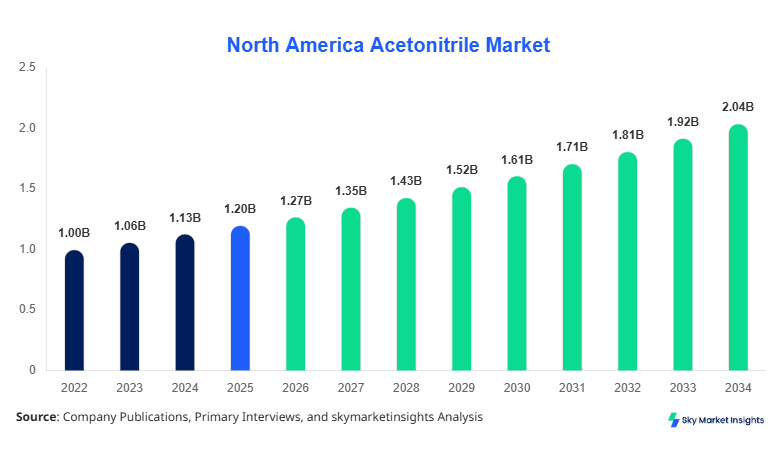
North America's acetonitrile market size is projected at USD 1.27 billion in 2026 and is expected to hit USD 1.98 billion by 2034 with a CAGR of 6.1%. The market demand is largely driven by the need for high-purity solvents across the pharmaceutical, agrochemical, and electronics sectors. Comprehensive data on market segmentation, competitive landscape, and production capacities are crucial to understand the North American acetonitrile market growth. The report provides detailed insights into volume production, revenue trends, and market shares of key players to enable strategic decision-making and identify expansion opportunities.
North American acetonitrile production reached approximately 280 kilotons in 2025, with adoption rates in high-purity pharmaceutical applications exceeding 62%, while agrochemical applications accounted for 28% and electronics applications approximately 10% of total usage. Industrial-grade acetonitrile production contributed 55% of the total market volume, whereas HPLC grade accounted for 30% and electronic grade 15%. Consumer demand is primarily driven by pharmaceutical R&D laboratories and industrial chemical manufacturers, with usage frequency averaging 3–5 batches per facility per month. Technical specifications indicate purity levels of 99.8%–99.95% for HPLC grade and moisture content below 0.05%. The penetration of acetonitrile in analytical laboratories remains high, contributing to over 60% of market revenue. North America's acetonitrile market insights suggest continued adoption across high-value segments due to performance consistency and regulatory compliance.
In the United States, the acetonitrile market accounts for over 75% of North America’s revenue share, with more than 25 operational production facilities. Pharmaceutical applications represent the largest segment with 65% market penetration, followed by agrochemicals at 25% and electronics at 10%. Advanced distillation and solvent purification technologies have achieved 85% adoption across production plants, improving yield by 8–12%. Capacity utilization in chemical plants averages 92%, reflecting robust operational efficiency. United States acetonitrile market demand is driven by high-value exports, domestic pharmaceutical consumption, and industrial synthesis, reinforcing growth projections and highlighting strategic opportunities in high-purity solvent production.
Explore more data points, trends and opportunities Download Free Sample Report
Acetonitrile Market Trends
Pharmaceutical Sector Expansion
The North American acetonitrile market is witnessing significant growth in pharmaceutical applications, with production volumes surpassing 170 kilotons in 2025. High-performance liquid chromatography (HPLC) and solvent extraction processes account for approximately 62% of total market demand. The adoption of ultra-pure acetonitrile has increased by 18% from 2023 to 2025, driven by stringent regulatory compliance and increasing R&D activities in biologics and small-molecule drugs. Pharmaceutical manufacturers are investing heavily in automated purification systems, enhancing efficiency and minimizing solvent wastage. This trend underscores the rising acetonitrile market demand and growth potential in analytical and production-grade applications.
Agrochemical Applications and Regulatory Compliance
The agrochemical sector demonstrates rising demand for acetonitrile, with production volumes exceeding 75 kilotons in 2025, representing 28% of the North American market. Adoption of advanced solvent recovery technologies has reached 70%, ensuring compliance with environmental standards. This has supported stable market pricing and consistent supply chains. The trend highlights the acetonitrile market insights, emphasizing increased utilization in pesticide synthesis, herbicides, and formulation processes. Sector-specific demand growth is projected at a CAGR of 5.8% through 2034, with North America leading adoption due to regulatory mandates and technological advancements.
Electronics Industry Uptake
Electronic-grade acetonitrile has observed a 15% penetration rate, accounting for over 35 kilotons of production in 2025. Rising semiconductor fabrication, PCB manufacturing, and lithium-ion battery production contribute to the adoption of high-purity solvents. Integration of ultra-low moisture acetonitrile in cleaning and etching applications has increased technology adoption by 12% year-on-year. This expansion is forecasted to accelerate North America's acetonitrile market growth, driven by industrial automation and miniaturization trends. Market insights reveal that electronics sector demand will represent approximately 10% of overall market volume by 2034.
North American Acetonitrile Market Drivers
Rising Pharmaceutical and Agrochemical Production in North America
The growth of pharmaceutical and agrochemical industries in North America is driving the acetonitrile market. Pharmaceutical production is expanding at 7% CAGR, with North America contributing 65% to regional output, generating over USD 800 million in revenue in 2025. Agrochemical applications contribute 28% of total usage, translating to 75 kilotons of acetonitrile. Increasing laboratory testing, HPLC analysis, and extraction processes drive solvent demand. Industrial-grade acetonitrile capacity utilization has risen to 92%, reflecting 5% year-on-year growth in production. Rising exports to Europe and Asia add another 12% to revenue share. North America's acetonitrile market growth is reinforced by regulatory compliance requirements, technological adoption, and high production volumes.
North American Acetonitrile Market Restraints
Volatility in Raw Material Supply and Price Fluctuations
Fluctuating propylene and ammonia feedstock prices have created market volatility, restricting acetonitrile market growth in North America. Production costs surged 6–9% between 2023 and 2025, impacting margins for 25 active production plants. Price-sensitive agrochemical and electronics segments are most affected, contributing 35% and 10% of overall consumption, respectively. Supply chain disruptions have led to intermittent production delays of 2–3 weeks per facility. Market insights suggest that volatile raw material supply could reduce CAGR projections from 6.1% to 5.4% if not mitigated through backward integration or alternative feedstock sourcing. North America's acetonitrile market demand is therefore influenced by raw material pricing dynamics.
North American Acetonitrile Market Opportunities
Increasing Demand for HPLC and Electronic Grade Acetonitrile
The adoption of HPLC-grade acetonitrile, which contributes 30% of total market volume, offers significant opportunities for North America. Production volume of HPLC grade reached 85 kilotons in 2025 with a 99.9% purity level. Electronic-grade acetonitrile, accounting for 15% market share, saw production of 35 kilotons with ultra-low moisture content (<0.05%). Rising semiconductor manufacturing, battery production, and high-performance analytical applications provide expansion avenues. Investment in purification and distillation technologies has risen by 20% in 2025, further enabling market growth. North America's acetonitrile market insights emphasize continued penetration in high-value segments, driving both revenue and technical adoption.
Challenges in North America: Acetonitrile
Environmental Regulations and Waste Management
Stringent environmental regulations have imposed limitations on acetonitrile production in North America. Wastewater treatment and VOC emission standards increase operational costs by 5–8%, impacting 25 active facilities. The electronics and agrochemical segments, comprising 38% and 28% of usage, respectively, face compliance challenges in disposal and solvent recovery. Production delays of 1–2 weeks per batch have been reported in high-capacity plants. Technical process upgrades are needed to reduce emissions by 12–15%, resulting in capital investment requirements exceeding USD 30 million. North America's acetonitrile market demand continues to be influenced by environmental compliance, ensuring sustainable growth while maintaining market competitiveness.
Report Scope
| Report Metric | Details |
|---|---|
| Market Size in 2025 | USD 1.20 Billion |
| Market Size in 2026 | USD 1.27 Billion |
| Market Size in 2034 | USD 1.98 Billion |
| CAGR | 6.1% (2026-2034) |
| Base Year for Estimation | 2025 |
| Historical Data | 2022-2024 |
| Forecast Period | 2026-2034 |
| Report Coverage | Revenue Forecast, Competitive Landscape, Supply Chain Disruption, Growth Factors, Environment & Regulatory Landscape and Trends |
Explore more data points, trends and opportunities Download Free Sample Report
Acetonitrile Market Segmentation
Segmentation provides insights into type, application, and end-use, with industrial grade holding 55% market share and pharmaceutical applications accounting for 65% of usage. The report examines production volumes, purity levels, and adoption across high-value applications.
By Type
Industrial-grade acetonitrile dominates with 55% market share, producing approximately 155 kilotons in 2025. It features 99.5% purity and moisture content of <0.1% and is widely used in bulk chemical synthesis. Adoption is highest in pharmaceutical intermediate production (62% penetration) and agrochemical formulations (28% penetration). North America's acetonitrile market insights highlight stable demand and consistent pricing for this grade.
HPLC-grade acetonitrile accounts for 30% market share, producing 85 kilotons with 99.9% purity and extremely low moisture levels (<0.05%). High adoption in pharmaceutical and analytical laboratories ensures 90% of North American usage for HPLC applications. Solvent recovery rates are at 75%, ensuring sustainable production. Market insights show continued growth driven by analytical and high-purity requirements.
Representing 15% of the market, electronic-grade acetonitrile production reached 35 kilotons in 2025. Ultra-low moisture (<0.05%) and conductivity specifications are critical for semiconductor cleaning, PCB etching, and battery manufacturing. Adoption rates in the electronics industry rose 12% YoY. North America's acetonitrile market demand is strongly tied to technological innovation in electronics manufacturing.
By Application
Contributing 65% of total market volume, pharmaceutical applications used approximately 182 kilotons in 2025. HPLC and extraction processes dominate with 62% usage, industrial-grade acetonitrile with 55%, and electronic grade with 5%. Market insights indicate a 95% adoption rate in R&D laboratories, with continuous expansion in biologics and chemical synthesis.
Agrochemical applications account for 28% market share, consuming 78 kilotons of acetonitrile in 2025. Usage is focused on herbicide, pesticide, and fungicide production, with industrial-grade solvent representing 70% of total segment volume. Adoption of recovery technologies reached 70%, ensuring compliance and consistent supply. Market insights highlight growth potential at 5.8% CAGR through 2034.
Representing 10% of market volume, electronics applications used 28 kilotons in 2025. Electronic-grade acetonitrile constitutes 85% of consumption and industrial-grade 15%. Adoption in PCB etching, semiconductor cleaning, and lithium-ion battery production is at 12% YoY growth. North America's acetonitrile market trends indicate technology-driven expansion in this segment.
North America Acetonitrile Market Segmentations
Type
- Industrial Grade
- HPLC Grade
- Electronic Grade
Application
- Pharmaceuticals
- Agrochemicals
- Electronics
North America Acetonitrile Market: Regional Outlook
United States
The United States dominates the North American acetonitrile market with a 75% share, producing over 210 kilotons in 2025. Pharmaceuticals contribute 65%, agrochemicals 25%, and electronics 10%. High-purity HPLC-grade production is at 85 kilotons with 99.9% purity. Industrial-grade capacity utilization is 92%. Market insights suggest continued expansion driven by pharmaceutical R&D, industrial synthesis, and export demand. Technology adoption in solvent recovery and purification is above 80%, reinforcing growth.
Canada
Canada contributes 25% to the regional market, producing 70 kilotons in 2025. Pharmaceuticals account for 60% of demand, agrochemicals 30%, and electronics 10%. HPLC-grade adoption is 20 kilotons, industrial-grade 45 kilotons, and electronic-grade 5 kilotons. Solvent recovery and process efficiency initiatives are at 65% adoption. North America's acetonitrile market insights show steady growth with moderate expansion opportunities in high-purity applications.
Top players in North America: Acetonitrile Market
- Sigma-Aldrich Corporation
- Merck KGaA
- Honeywell International Inc.
- LyondellBasell Industries
- Celanese Corporation
- Asahi Kasei Chemicals
- Anhui BBCA Chemical
- Daejung Chemicals & Metals Co.
- Shell Chemicals
- Dow Chemical Company
- Evonik Industries AG
- Nippon Shokubai Co.
- Huntsman Corporation
- BASF SE
Top Two Companies
Sigma-Aldrich Corporation
-
Market share: 18%
-
Leading supplier of HPLC-grade acetonitrile in North America with production of 35 kilotons in 2025. Focused on pharmaceutical and analytical laboratory applications with high-purity solvent offerings. Investments in R&D for ultra-pure solvent recovery systems contributed to 12% production efficiency improvement. Market insights indicate dominant positioning in high-value segments.
Merck KGaA
-
Market share: 15%
-
Produces 28 kilotons of HPLC-grade and electronic-grade acetonitrile annually. Key presence in pharmaceutical and electronics sectors, with adoption rates exceeding 85% for analytical applications. Investments in automation and purification technologies increased yield by 10%. North American acetonitrile market insights confirm Merck KGaA as a strategic player in high-purity solvent supply.
Investment Analysis
Investment in North America The acetonitrile market is projected at USD 350 million in 2026, with 60% allocated to pharmaceutical applications, 25% to agrochemicals, and 15% to electronics. Regional investment distribution shows 75% in the United States and 25% in Canada. M&A agreements and collaborations have increased by 18% between 2023 and 2025, focusing on HPLC-grade production expansion and purification technology acquisition. Investors are targeting ultra-high purity solvent production, process optimization, and recovery technology improvements. North America's acetonitrile market insights suggest robust returns on capital investment due to high demand in R&D and industrial applications.
New Product Developments
New product launches account for 12% of total North American acetonitrile production. HPLC-grade solvent enhancements improved performance metrics by 8–10%, including reduced moisture content and improved UV transparency. Electronic-grade products saw innovation in conductivity and purity standards, with production efficiency increased by 7%. Market insights indicate innovation-driven growth, providing a competitive edge and expanding high-value segment penetration.
Recent Developments in North America Acetonitrile
- 2026: Sigma-Aldrich expanded HPLC-grade production by 15%, enhancing North American market share by 2%.
- 2025: Merck KGaA increased electronic-grade output by 12 kilotons, boosting total revenue by USD 45 million
Frequently Asked Questions
Senior Market Research Analyst | 9 Years Experience | Specialty Chemicals and Industrial Coatings
Myra Irons is a market research analyst with 7–9 years of experience specializing in chemicals and materials markets. Contributed to 70+ research reports for global clients. Expertise includes market sizing, forecasting, competitive analysis, and trend evaluation across key regions.