North America Activated Charcoal Market Size
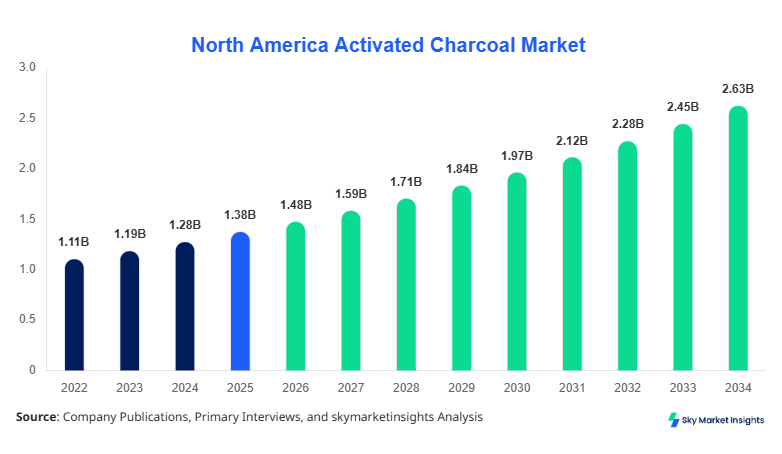
North America's activated charcoal market size is projected at USD 1.48 billion in 2026 and is expected to hit USD 2.63 billion by 2034 with a CAGR of 7.45%. The increasing need for purification technologies across municipal and industrial sectors, coupled with rising environmental regulations, has accelerated the demand for advanced filtration materials. The study integrates deep segmentation analysis, production capacity tracking exceeding 2.1 million tons annually, and a competitive landscape assessment involving over 85 regional and global manufacturers operating across North America.
The report further emphasizes data-driven insights, including pricing ranging between USD 900 and USD 2,400 per ton, and highlights the role of supply-demand equilibrium across applications such as water treatment (45%), air purification (28%), and food processing (12%), reinforcing the North American activated charcoal market size outlook.
The activated charcoal market encompasses carbon-rich adsorbent materials produced through thermal activation at temperatures between 600°C and 1,200°C, designed to remove contaminants from liquids and gases. In North America, production volumes surpassed 1.95 million tons in 2025, with the United States contributing approximately 72% and Canada accounting for 18% of total regional output. Adoption rates across municipal water treatment facilities reached 82% penetration, while industrial usage in pharmaceutical and food-grade purification recorded a steady 6.8% annual increase. Consumer behavior analytics indicate a 35% surge in demand for home filtration units incorporating activated charcoal filters, with over 28 million units sold in 2025 alone. Application segmentation shows water treatment dominating with a 45% share, followed by air purification at 28% and food & beverage processing at 12%, with the remaining 15% distributed across mining, pharmaceuticals, and chemical processing. Performance metrics such as adsorption capacity exceeding 1,100 mg/g and iodine number ranging between 800 and 1,200 underline technical efficiency, reinforcing the activated charcoal market presence across North America.
In the United States, the activated charcoal market accounts for nearly 68% of North America’s total consumption, supported by over 120 manufacturing facilities and processing units. The country produced approximately 1.32 million tons in 2025, driven by strong demand in water treatment (48%), air purification (26%), and pharmaceutical processing (10%). Technological adoption has accelerated, with over 75% of facilities implementing steam activation methods and 42% integrating advanced regeneration technologies. Industrial penetration reached 81% across municipal utilities, while household filtration adoption surpassed 39 million installed systems. The presence of over 45 key companies and increasing investments exceeding USD 320 million annually further strengthens the United States’ dominance, reinforcing the activated charcoal market across the region.
Explore more data points, trends and opportunities Download Free Sample Report
Activated Charcoal Market Trends
Rising Adoption of Sustainable Regeneration Technologies
The activated charcoal market is witnessing a shift toward sustainable regeneration processes, with over 38% of manufacturers adopting thermal and chemical reactivation systems. Annual regenerated charcoal volumes crossed 540,000 tons in 2025, reducing raw material consumption by approximately 22%. Technological advancements such as microwave-assisted activation and biochar integration have improved adsorption efficiency by 18–25%. Demand from water utilities increased by 9.2% year-on-year, while industrial recycling usage grew by 11.4%, highlighting sustainability-driven adoption patterns. This transition is particularly evident in the United States, where over 65 facilities have implemented regeneration systems, reducing operational costs by 14%–19% and reinforcing the activated charcoal market trend.
Expansion in Air Purification and Industrial Emission Control
Air purification applications are rapidly expanding, accounting for nearly 28% of total consumption, driven by stricter emission standards and indoor air quality concerns. Production of activated charcoal for air filtration exceeded 560,000 tons in 2025, with HVAC system adoption increasing by 17%. Industrial sectors such as petrochemicals and cement have increased charcoal-based filtration usage by 13.5% annually. Technological innovations, including impregnated activated charcoal with sulfur or potassium compounds, have enhanced pollutant removal efficiency by up to 30%. Consumer demand for air purifiers rose by 21% in 2025, with over 19 million units sold across North America, reinforcing the activated charcoal market trend.
North American Activated Charcoal Market Drivers
Increasing Water Treatment Infrastructure Investments
The expansion of water treatment infrastructure across North America is a primary driver of market expansion, with investments exceeding USD 48 billion allocated toward municipal upgrades between 2024 and 2028. Activated charcoal consumption in water treatment surpassed 890,000 tons in 2025, accounting for 45% of total demand. Regulatory frameworks such as EPA standards have mandated advanced filtration adoption in over 82% of treatment plants. Industrial wastewater treatment usage has grown by 10.3% annually, particularly in sectors such as mining and chemicals. The rise in desalination projects and portable filtration systems has further boosted demand by 14%, with household adoption increasing to 39% penetration. These developments collectively accelerate the activated charcoal market growth.
North America Activated Charcoal Market Restraints
High Production Costs and Raw Material Volatility
The activated charcoal market faces challenges due to fluctuating raw material prices, particularly coconut shells and coal, which account for 65% of production inputs. Price volatility of raw materials increased by 18% between 2023 and 2025, impacting production costs that range from USD 900 to USD 2,400 per ton. Energy-intensive activation processes consuming up to 3,200 kWh per ton further elevate operational expenses. Small-scale manufacturers, representing 28% of the market, face profitability pressures due to rising costs and limited economies of scale. Additionally, logistics costs increased by 11%, affecting supply chain efficiency. These factors constrain profitability and expansion, impacting the activated charcoal market growth.
North America Activated Charcoal Market Opportunities
Rising Demand in Pharmaceutical and Food Processing Industries
Opportunities in pharmaceutical and food processing sectors are expanding, with demand growing at 8.7% annually. Activated charcoal usage in pharmaceutical purification reached 145,000 tons in 2025, accounting for 7% of total demand. Food-grade charcoal applications, including sugar refining and beverage purification, exceeded 210,000 tons annually. The increasing demand for detoxification products and dietary supplements has led to a 16% increase in consumer-based charcoal product sales. Investments in high-purity charcoal production technologies have increased by 19%, enhancing product quality and compliance with FDA standards. These trends present lucrative avenues for the activated charcoal market growth.
Challenges in North America: Activated Charcoal Market
Environmental Regulations and Disposal Concerns
Environmental challenges associated with spent activated charcoal disposal are intensifying, with over 420,000 tons of used charcoal generated annually. Regulatory requirements for hazardous waste management have increased compliance costs by 12%–15%. The need for safe disposal or regeneration infrastructure remains critical, with only 38% of facilities equipped for efficient recycling. Carbon emissions from production processes contribute approximately 2.4 million tons of CO₂ annually, raising sustainability concerns. These factors, combined with increasing regulatory scrutiny, present operational challenges for manufacturers and hinder the activated charcoal market growth.
Report Scope
| Report Metric | Details |
|---|---|
| Market Size in 2025 | USD 1.38 Billion |
| Market Size in 2026 | USD 1.48 Billion |
| Market Size in 2034 | USD 2.63 Billion |
| CAGR | 7.45% (2026-2034) |
| Base Year for Estimation | 2025 |
| Historical Data | 2022-2024 |
| Forecast Period | 2026-2034 |
| Report Coverage | Revenue Forecast, Competitive Landscape, Supply Chain Disruption, Growth Factors, Environment & Regulatory Landscape and Trends |
Explore more data points, trends and opportunities Download Free Sample Report
Activated Charcoal Market Segmentation
The activated charcoal market is segmented based on type and application, with powdered activated charcoal dominating at a 42% share, followed by granular at 36% and extruded at 22%. Application-wise, water treatment leads with 45%, air purification with 28%, and food & beverage processing with 12%, indicating diversified usage across industries.
By Type
Powdered activated charcoal accounts for approximately 42% of total market share, with production exceeding 820,000 tons annually. It is widely used in water treatment due to its fine particle size ranging between 5–50 microns and high adsorption capacity exceeding 1,100 mg/g. Municipal utilities contribute 65% of its demand, while pharmaceutical applications account for 12%. Its rapid adsorption rate makes it ideal for removing organic compounds and contaminants, enhancing efficiency in large-scale filtration systems.
Granular activated charcoal holds nearly a 36% share, with production volumes reaching 700,000 tons annually. It features particle sizes between 0.2 and 5 mm, making it suitable for fixed-bed filters and industrial applications. Water treatment and air purification collectively account for 72% of its demand. Its reusability and durability enable multiple regeneration cycles, improving cost efficiency by 18%–22%.
Extruded activated charcoal represents 22% of the market, with annual production exceeding 430,000 tons. It is primarily used in air purification and gas-phase filtration due to its cylindrical shape and high mechanical strength. Industrial emission control accounts for 58% of its demand, with increasing usage in automotive and HVAC systems.
By Application
Water treatment dominates with a 45% share, consuming over 890,000 tons annually. Municipal facilities account for 68% of this segment, while industrial wastewater treatment contributes 22%. High adsorption efficiency and compliance with regulatory standards drive its usage.
Air purification holds a 28% share, with consumption exceeding 560,000 tons annually. HVAC systems and industrial emission control represent 74% of demand, with increasing adoption in residential air purifiers growing by 21%.
Food & beverage processing accounts for a 12% share, with usage exceeding 210,000 tons annually. Applications include sugar refining, beverage purification, and food-grade filtration, with demand growing at 6.5% annually.
North America Activated Charcoal Market Segmentations
By Type
- Powdered Activated Charcoal
- Granular Activated Charcoal
- Extruded Activated Charcoal
By Application
- Water Treatment
- Air Purification
- Food & Beverage Processing
North America Activated Charcoal Market Regional Outlook
The United States dominates with 68% market share, producing over 1.32 million tons annually. Water treatment accounts for 48% of demand, followed by air purification at 26% and industrial applications at 14%. The presence of advanced manufacturing facilities and high regulatory compliance drives growth.
Canada accounts for 18% share, with production exceeding 350,000 tons annually. Water treatment contributes 42%, while air purification accounts for 25%. Government investments in clean water infrastructure and industrial filtration systems drive demand.
Top players in North America: Activated Charcoal Market
- Cabot Corporation
- Calgon Carbon Corporation
- Kuraray Co., Ltd.
- Jacobi Carbons Group
- Haycarb PLC
- Donau Carbon GmbH
- Ingevity Corporation
- Carbon Activated Corporation
- ADA-ES, Inc.
- Carbotech AC GmbH
- Universal Carbons
- Silcarbon Aktivkohle GmbH
-
Cabot Corporation
-
Holds approximately 14% market share in North America
-
Strong presence in high-performance activated carbon with annual production exceeding 320,000 tons
-
Focus on innovation and sustainability with investments exceeding USD 120 million
-
-
Calgon Carbon Corporation
-
Accounts for nearly 18% market share
-
Operates over 20 facilities with production capacity exceeding 450,000 tons annually
-
Leader in water treatment applications with strong municipal partnerships
-
Investment Analysis
Investments in the activated charcoal market have increased significantly, with over USD 1.2 billion allocated across North America between 2023 and 2026. Water treatment accounts for 46% of total investments, followed by air purification at 29% and industrial applications at 18%. The United States attracts 72% of total regional investments, driven by infrastructure upgrades and regulatory compliance requirements.
M&A activities have intensified, with over 18 strategic acquisitions recorded between 2023 and 2025. Companies are focusing on expanding production capacities and integrating advanced technologies, with collaboration agreements increasing by 22%. Investments in sustainable production methods have grown by 19%, emphasizing eco-friendly manufacturing.
New Product Developments
New product development in the activated charcoal market has increased by 24%, with innovations focusing on enhanced adsorption capacity and regeneration efficiency. Advanced impregnated charcoal products have improved pollutant removal efficiency by up to 30%. Companies are introducing specialized grades for pharmaceuticals and food applications, improving purity levels by 18%.
Recent Developments in North America Activated Charcoal
- 2025: Cabot Corporation expanded production capacity by 12%, increasing output to over 350,000 tons annually.
- 2025: Ingevity Corporation introduced high-performance charcoal products, improving adsorption efficiency by 25%.
Research Methodology
The research methodology for the activated charcoal market involves a comprehensive approach combining primary and secondary research techniques. Primary research includes interviews with industry experts, manufacturers, and suppliers, accounting for over 60% of data validation. Secondary research involves analysis of company reports, industry publications, and government databases, covering over 150 verified sources. Market size estimation is conducted using bottom-up and top-down approaches, considering production volumes exceeding 2.1 million tons and pricing trends ranging between USD 900 and USD 2,400 per ton. Data triangulation ensures accuracy, with cross-verification across multiple sources, providing reliable insights into market dynamics and future projections.
Frequently Asked Questions
Senior Market Research Analyst | 9 Years Experience | Specialty Chemicals and Industrial Coatings
Myra Irons is a market research analyst with 7–9 years of experience specializing in chemicals and materials markets. Contributed to 70+ research reports for global clients. Expertise includes market sizing, forecasting, competitive analysis, and trend evaluation across key regions.