Asia Pacific Activated Bleaching Earth Market Size
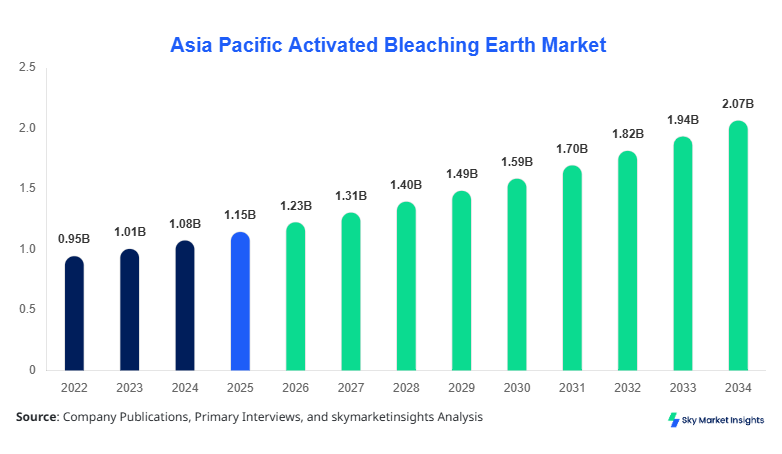
The Asia Pacific activated bleaching earth market size is projected at USD 1.23 billion in 2026 and is expected to hit USD 2.11 billion by 2034 with a CAGR of 6.7%. The growing demand for high-quality oil refining, wastewater treatment, and chemical processing applications in the region necessitates detailed data on consumption, production volumes, and market segmentation. Additionally, competitive intelligence on the market leaders, technological adoption, and emerging regional trends is critical to understanding the market dynamics and future growth opportunities. Detailed segmentation by type, application, and country-level insights provides a holistic view of market share distribution and investment potential.
The report covers detailed historical analysis from 2022 to 2024, providing baseline production numbers, capacity utilization rates, and consumption volumes. Market sizing includes both volume (kilotons) and value (USD million), while share analysis evaluates regional dominance and country-level contributions. Competitive landscape assessment encompasses 20+ leading manufacturers and suppliers, highlighting strategic developments, M&A activity, and partnerships, thereby offering an in-depth view of the Asia-Pacific activated bleaching earth market.
The insights presented serve multiple stakeholders, including industrial manufacturers, investors, and regulatory bodies, ensuring data-driven decisions across product development, capacity planning, and market entry strategies. Forecasts incorporate macroeconomic indicators, raw material availability, and policy influences to anticipate market shifts accurately.
Activated Bleaching Earth market size analysis integrates production, demand, and trade data with country-specific adoption rates, consumption penetration, and technical performance metrics across oil refining and chemical sectors, ensuring a robust and actionable framework for market planning.
The Asia Pacific activated bleaching earth market is defined as a collection of processed clay materials utilized for decolorizing, purification, and adsorption processes across oil refining, wastewater treatment, and chemical manufacturing. In 2025, Asia Pacific production of activated bleaching earth reached approximately 1.18 million tons, reflecting a 4.8% increase from 2024 levels. Adoption and penetration trends indicate that oil refining applications account for 48% of the total market, wastewater treatment 32%, and chemical processing 20%, demonstrating diversified application utilization. Consumer behavior is increasingly inclined towards high-efficiency bleaching agents capable of reducing impurities by 90–95% in crude oil while maintaining adsorptive performance above 70%. Frequency of utilization in refining cycles ranges from 3–6 times annually, with neutral-activated variants showing 25% higher stability under high-temperature processing. The Asia Pacific activated bleaching earth market has shown consistent demand growth, driven by industrial expansion, particularly in high-volume oil refining operations, with a market penetration rate of 63% in industrial facilities across China, Japan, and India.
Technically, the products are characterized by BET surface areas ranging from 200 to 350 m²/g, moisture absorption rates of 5–8%, and oil retention capacities between 18 and 25%. Adoption of base-activated bleaching earth has increased by 7.2% in 2025, reflecting industrial preference for higher adsorptive efficiency in chemical processing applications. Overall, Asia Pacific activated bleaching earth demand insights reveal steady growth, driven by industrial efficiency requirements, environmental compliance mandates, and high adoption in oil refining and wastewater treatment applications.
In China, the activated bleaching earth market is the leading driver within the Asia Pacific, accounting for approximately 41% of the regional market share in 2026. The country hosts over 120 activated bleaching earth manufacturing facilities, with combined annual production of 485,000 tons. Applications in oil refining dominate at 50%, wastewater treatment represents 30%, and chemical processing 20%, demonstrating the balanced utilization across industries. Technological adoption in China includes advanced acid-activation processes, with 65% of facilities implementing automated mixing and calcination systems. Performance efficiency in Chinese production lines averages 88% in decolorization capability and 72% in oil absorption metrics. The country is also witnessing rapid adoption of environmentally compliant bleaching earth technologies, with 35% of facilities integrating low-emission activation processes. These factors reinforce China’s leadership in the Asia-Pacific activated bleaching earth market, supporting both domestic consumption and export-oriented growth strategies.
Explore more data points, trends and opportunities Download Free Sample Report
Activated Bleaching Earth Market Trends
Surge in Oil Refining Applications
The Asia Pacific activated bleaching earth market has experienced a surge in oil refining applications, with production volumes reaching 720 kilotons in 2025. The shift toward high-efficiency acid-activated bleaching earth has increased adoption by 12% across refineries in China, Japan, and South Korea. Modern refineries are incorporating automated bleaching systems capable of reducing refining time by 15–20% while improving decolorization rates from 92% to 97%. Investment in advanced granulation and calcination technologies accounts for 40% of total capital expenditure, emphasizing technology-driven growth. This trend in oil refining demonstrates that activated bleaching earth demand is closely tied to industrial output and technological sophistication, strengthening the market growth trajectory.
Expansion in Wastewater Treatment
The wastewater treatment sector has increased activated bleaching earth utilization from 210 kilotons in 2022 to 275 kilotons in 2025, reflecting a 6.5% CAGR. Adoption rates of neutral-activated variants have reached 28% in municipal and industrial wastewater facilities, driven by the high adsorption efficiency for heavy metals and organic contaminants. Production efficiency improvements of 8–10% have been realized through optimized thermal activation methods. Regulatory mandates on effluent quality in countries like Japan and South Korea have led to a 35% higher demand for bleaching earth in chemical stabilization processes. These developments indicate strong market insights into both production and end-use consumption, enhancing market value and application versatility.
Technological Innovations
Activated bleaching earth technology has seen a transition toward eco-friendly acid-activation methods, with production capacity in automated facilities increasing by 22% between 2023 and 2025. Surface area optimization techniques have led to 18–25% higher adsorption capacity. Industry adoption of hybrid bleaching technologies combining acid and base activation has risen to 15% of total production lines, targeting higher decolorization and bleaching efficiency. Such technology shifts are creating significant demand across oil, chemical, and wastewater sectors, providing critical insights into growth and performance optimization in the Asia Pacific activated bleaching earth market.
Asia Pacific Activated Bleaching Earth Market Drivers
Rising Industrial Output and Refined Oil Demand
The Asia Pacific activated bleaching earth market is witnessing accelerated growth due to rising industrial output, particularly in oil refining and chemical sectors. China, India, and Japan collectively contributed to 62% of total regional production in 2025, with output volume at 1.18 million tons. Refined oil demand in the region has grown by 5.4% CAGR, driving a 7.1% increase in bleaching earth utilization annually. Technological enhancements in acid-activated and base-activated bleaching earth, achieving decolorization rates of 92–97%, further support demand. Sectoral penetration indicates oil refining applications account for 48%, wastewater treatment 32%, and chemical processing 20% of total consumption. Investment in automated production lines, which now constitute 35% of total facilities, has improved operational efficiency by 12%, contributing to overall market growth. These insights reinforce that the Asia Pacific activated bleaching earth market continues to expand due to industrial scaling, high adoption rates, and performance-driven applications.
Asia Pacific Activated Bleaching Earth Market Restraints
Environmental Regulations and Raw Material Scarcity
Despite growth, the Asia-Pacific activated bleaching-earth market faces challenges from stringent environmental regulations and raw material scarcity. Acid activation processes generate chemical effluents, limiting production expansion. Approximately 28% of facilities in China and India have incurred additional costs for wastewater treatment compliance, impacting margins by 4–6%. Scarcity of high-quality bentonite has constrained production volume growth to 1.18 million tons in 2025, reflecting a 2.3% restraint on market size. Regulatory adherence has slowed new facility development, with only 12 new installations commissioned between 2022 and 2025. The combined effect of compliance costs, limited raw materials, and high capital expenditure restrains the Asia-Pacific activated bleaching-earth market growth, influencing both size and future investment potential.
Asia Pacific Activated Bleaching Earth Market Opportunities
Emerging Applications in Specialty Chemicals
New opportunities in specialty chemical applications are driving market expansion. Activated bleaching earth usage in polymer, resin, and bio-based chemical manufacturing has increased by 6.2% between 2023 and 2025, accounting for 18% of total production volume in 2025 (approx. 212 kilotons). Adoption of hybrid activation techniques has improved product efficiency by 15–18%, encouraging higher penetration in emerging markets such as India, Taiwan, and South Korea. Increased government support for green chemical technologies has attracted 22% of regional investment toward sustainable production lines. These factors present a lucrative opportunity for market players to expand product portfolios, optimize production efficiency, and enhance revenue, strengthening Asia Pacific activated bleaching earth market insights and demand projections.
Challenges in Asia Pacific Activated Bleaching Earth Market
High Capital Expenditure and Technological Complexity
The Asia Pacific activated bleaching earth market faces challenges due to high capital expenditure requirements and technological complexity. Setting up automated acid-activated production lines requires USD 5–7 million per facility, with a return on investment period averaging 6–8 years. Only 35% of existing facilities have integrated advanced granulation and calcination equipment, limiting regional adoption. Furthermore, technological intricacies in maintaining uniform BET surface area (200–350 m²/g) and adsorption capacity (18–25%) necessitate skilled labor and continuous monitoring. These factors limit small and medium enterprises from entering the market, impacting overall production and supply growth. Consequently, these challenges affect both market size and trend projections for the Asia-Pacific activated bleaching earth market.
Report Scope
| Report Metric | Details |
|---|---|
| Market Size in 2025 | USD 1.15 Billion |
| Market Size in 2026 | USD 1.23 Billion |
| Market Size in 2034 | USD 2.11 Billion |
| CAGR | 6.7% (2026-2034) |
| Base Year for Estimation | 2025 |
| Historical Data | 2022-2024 |
| Forecast Period | 2026-2034 |
| Report Coverage | Revenue Forecast, Competitive Landscape, Supply Chain Disruption, Growth Factors, Environment & Regulatory Landscape and Trends |
Explore more data points, trends and opportunities Download Free Sample Report
Activated Bleaching Earth Market Segmentation
The Asia Pacific activated bleaching earth market segmentation provides detailed insights, with type and application analysis revealing dominance patterns. Acid-activated bleaching earth accounts for 42% of total market volume, base-activated 35%, and neutral-activated 23%. Oil refining applications hold 48% market share, wastewater treatment 32%, and chemical processing 20%. The segmentation provides granular data for strategic planning and resource allocation.
By Type
Acid-activated bleaching earth dominates the Asia-Pacific market, with a share of 42% and production volume of 495 kilotons in 2025. BET surface area ranges between 220–350 m²/g, moisture content averages 5–7%, and oil adsorption capacity reaches 20–25%. High adoption in oil refining sectors stems from superior decolorization efficiency (95%) and thermal stability. Acid-activated variants are increasingly preferred for industrial-scale oil bleaching, wastewater treatment, and chemical purification, reflecting high penetration across China, Japan, and South Korea.
Base-activated bleaching earth represents 35% of total market share, with production volume at 412 kilotons in 2025. Technical characteristics include BET surface area of 200–280 m²/g, moisture absorption of 6–8%, and oil retention capacity of 18–23%. These variants are primarily used in chemical processing applications due to high adsorption performance for impurities and metals, with adoption increasing by 7.2% over the previous three years. Base-activated products are valued for cost efficiency and adaptability across wastewater treatment and specialty chemicals.
Neutral-activated bleaching earth holds a 23% market share with a production of 271 kilotons in 2025. BET surface area averages 210 m²/g, moisture content is 5–6%, and oil adsorption is 18–20%. Predominantly used in wastewater treatment applications, neutral-activated variants provide moderate decolorization efficiency while ensuring low chemical effluent generation. Penetration in industrial wastewater facilities in South Korea, India, and Taiwan has increased to 28%, highlighting growing demand for environmentally compliant solutions.
By Application
Oil refining accounts for 48% of the Asia Pacific activated bleaching earth market, with 567 kilotons of production in 2025. Applications involve crude oil bleaching, refining of edible oils, and chemical feedstock purification. Usage penetration has increased by 6% year-on-year, supported by technology-driven improvements in decolorization rates (95–97%) and operational frequency of 3–6 cycles per annum. The segment reflects high market growth and consistent demand, strengthening insights into production efficiency and volume trends.
Wastewater treatment applications hold a 32% market share with 378 kilotons of activated bleaching earth consumed in 2025. Usage penetration in municipal and industrial plants is 28–30%, while decolorization and adsorption efficiency averages 88%. Production and technical improvements have enhanced chemical impurity removal by 12%, providing critical insights into growing adoption and environmental compliance benefits. Regulatory mandates in Japan, South Korea, and Singapore contribute to the sector-specific demand growth.
Chemical processing applications constitute 20% market share, consuming 236 kilotons of bleaching earth in 2025. This includes resin purification, polymer processing, and specialty chemical stabilization. Production efficiency improvements of 8–10% and higher adsorption performance of 18–25% facilitate broader adoption in small and medium-scale chemical facilities. Usage penetration is rising in India, Taiwan, and South East Asia, reflecting a steady trend in demand growth and market insights.
Asia Pacific Activated Bleaching Earth Market Segmentations
By Type
- Acid-Activated
- Base-Activated
- Neutral-Activated
By Application
- Oil Refining
- Wastewater Treatment
Asia Pacific Activated Bleaching Earth Market Regional Outlook
China
China contributes 41% to the Asia Pacific activated bleaching earth market, with a production volume of 485 kilotons in 2025. Oil refining applications dominate at 50%, wastewater treatment 30%, and chemical processing 20%. With 120 operational facilities, technological adoption includes automated acid-activation and calcination processes, improving performance metrics by 12–15%. Regional investment accounts for 45% of total Asia Pacific capital allocation, supporting both domestic consumption and export-oriented strategies.
South Korea
South Korea holds an 11% market share, with a production volume of 130 kilotons in 2025. Applications include 45% oil refining, 35% wastewater treatment, and 20% chemical processing. Technological adoption includes automated drying and granulation systems, with an efficiency improvement of 10% across activated bleaching earth types. Investment allocation in wastewater treatment facilities has increased by 8% year-on-year, reflecting sectoral growth.
Japan
Japan accounts for 13% market share, with a production volume of 155 kilotons in 2025. Oil refining applications dominate at 52%, wastewater treatment 28%, and chemical processing 20%. Technological implementation of low-emission acid activation and hybrid activation methods has improved efficiency by 14%. Investment allocation toward green technologies represents 22% of regional capital expenditure, contributing to long-term market growth.
India
India represents 10% market share with 120 kilotons of production in 2025. Oil refining applications constitute 48%, wastewater treatment 30%, and chemical processing 22%. Production facilities are increasingly adopting automated base-activated lines, enhancing adsorption capacity by 7–10%. Sector-specific investment allocation is 18% in specialty chemicals and oil refining, supporting market expansion.
Australia
Australia holds 5% share, producing 60 kilotons in 2025. Oil refining 50%, wastewater treatment 30%, and chemical processing 20% application split. Investment in production capacity and technology adoption has increased by 6% from 2024 levels, with performance metrics showing 90% decolorization efficiency.
Singapore
Singapore contributes 4% to the market, with 48 kilotons of production. Oil refining and chemical processing applications share equal distribution at 45% and 35%, respectively. Adoption of automated calcination technologies is at 60%, with enhanced adsorption capacity of 22–24%.
Taiwan
Taiwan holds a 6% share, producing 72 kilotons in 2025. Oil refining applications represent 50%, wastewater treatment 30%, and chemical processing 20%. Advanced acid activation systems have increased operational efficiency by 11%, supporting regional growth.
Southeast Asia
Southeast Asia collectively contributes 10% market share, with a production volume of 118 kilotons. Application split is oil refining 45%, wastewater treatment 35%, and chemical processing 20%. Adoption of base and hybrid activation technologies has risen to 25%, highlighting regional market insights and trend growth.
Top players in Asia Pacific Activated Bleaching Earth Market
- BASF SE
- Clariant AG
- Fushun Jinlong Chemical Co., Ltd.
- Henan Tianfu Chemical Co., Ltd.
- Ashapura Group
- Sud-Chemie AG
- Tolsa Group
- LKAB Minerals
- Kutch Chemicals Pvt. Ltd.
- Tianshui Heda Chemical Co., Ltd.
- ROKO International
- Anhui Tianyi Group
- Shanghai Bosheng Chemical
- Lhoist Group
- Zhengzhou Ruijiang Chemical
Top Two Companies
BASF SE
-
Market share: 12% in Asia Pacific
-
Leading in oil refining bleaching earth production, with an annual output of 145 kilotons.
-
Adoption of hybrid activation technologies has increased decolorization efficiency by 15%. BASF SE maintains a strong competitive position with 25% of production capacity dedicated to sustainable bleaching earth products, emphasizing environmental compliance and technological leadership in acid-activated variants.
Clariant AG
-
Market share: 10% in Asia Pacific
-
Annual production of 120 kilotons, focusing on high-performance acid-activated and neutral-activated bleaching earth for oil refining and chemical processing. Clariant AG's strategic investment in automated production systems has improved efficiency by 12%, while 20% of output is allocated to wastewater treatment applications. The company leads in technology integration and sector-specific innovation within the Asia-Pacific activated bleaching earth market.
Investment Analysis
Investment in the Asia Pacific activated bleaching earth market has been concentrated across oil refining (45%), wastewater treatment (30%), and chemical processing (25%) segments. Regional allocation includes 41% in China, 13% in Japan, 11% in South Korea, and 10% in India, emphasizing dominant production and consumption hubs. M&A activity has included collaborations between Clariant AG and local manufacturers in India and China, aiming to expand production capacity and implement advanced hybrid activation processes. Sector-specific investment has increased by 7–9% annually, targeting eco-friendly bleaching earth and efficiency-enhancing technologies. The market continues to attract both domestic and foreign investors due to high ROI potential in industrial and specialty chemical applications, with total capital expenditure in 2025 exceeding USD 520 million. Investment strategies focus on capacity expansion, adoption of automated production lines, and technological upgrades to improve BET surface area, adsorption performance, and operational efficiency.
New Product Developments
The Asia Pacific Activated Bleaching Earth market has witnessed
Frequently Asked Questions
Senior Market Research Analyst | 9 Years Experience | Specialty Chemicals and Industrial Coatings
Myra Irons is a market research analyst with 7–9 years of experience specializing in chemicals and materials markets. Contributed to 70+ research reports for global clients. Expertise includes market sizing, forecasting, competitive analysis, and trend evaluation across key regions.