Europe Activated Bleaching Earth Market Size
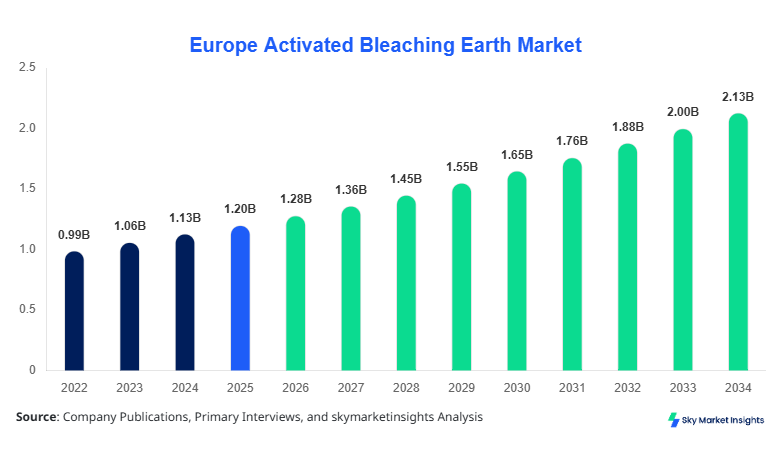
Europe's activated bleaching earth market size is projected at USD 1.28 billion in 2026 and is expected to hit USD 2.14 billion by 2034 with a CAGR of 6.6%. The increasing need for refined edible oils, rising industrial purification processes, and stringent EU quality regulations are driving structured demand across multiple sectors. The report incorporates extensive segmentation analysis, competitive benchmarking of over 40+ manufacturers, and volume-based consumption insights exceeding 2.3 million metric tons annually across Europe.
The activated bleaching earth market in Europe is a specialized segment of industrial absorbents used primarily in oil purification, pigment removal, and impurity adsorption. Europe produces approximately 1.8 million metric tons annually (2025), with consumption slightly exceeding production due to imports of 0.4 million metric tons. Adoption rates in edible oil refining facilities have crossed 82% penetration across large-scale processors, while mid-scale refineries show 65% penetration. Consumer demand is closely tied to refined oil consumption, which has increased by 4.2% YoY, reaching 28 million tons across Europe. Acid-activated bleaching earth accounts for nearly 58% of usage due to higher adsorption efficiency of 35–45% compared to natural variants at 20–25%. Application-wise, edible oil refining dominates with 62% share, followed by mineral oils (21%) and biodiesel (17%). Performance metrics include surface area ranges between 120 and 250 m²/g and adsorption capacities exceeding 0.9 ml/g. Increasing demand for high-purity oils and sustainable refining continues to reinforce the activated bleaching earth market.
In France, the Activated Bleaching Earth Market holds a dominant position, contributing approximately 22% of the European market share, supported by over 65 operational refining facilities and 18+ major bleaching earth processing units. The country processes nearly 4.5 million tons of edible oils annually, requiring approximately 220,000 metric tons of bleaching earth. Application-wise, edible oil refining accounts for 68%, mineral oils for 19%, and biodiesel for 13%. Technology adoption rates exceed 75% for acid-activated variants, driven by efficiency improvements of up to 40% in impurity removal. France also leads in sustainable processing technologies, with 38% of facilities implementing low-carbon activation methods. The activated bleaching earth market remains strongly reinforced by industrial demand and regulatory compliance.
Explore more data points, trends and opportunities Download Free Sample Report
Activated Bleaching Earth Market Trends
Rising Demand for High-Efficiency Adsorption Materials
The activated bleaching earth market is witnessing a strong shift toward high-performance materials, with production volumes reaching 2.3 million metric tons in 2025 and projected to exceed 3.1 million metric tons by 2030. Acid activation technologies are gaining traction, accounting for 58% of total production due to superior adsorption efficiency of 40–50%. The adoption of nanostructured clay variants has increased by 18% over the past three years, improving decolorization rates by 25%. Additionally, industries are transitioning toward low-waste refining processes, reducing spent bleaching earth waste by 12%. Demand from edible oil processing industries has surged by 5.6% annually, driven by increased consumption of refined sunflower and palm oils. This evolving landscape highlights a significant activated bleaching earth market trend.
Sustainability and Circular Economy Integration
Sustainability has emerged as a critical factor, with over 42% of European manufacturers investing in eco-friendly activation processes. Production facilities are incorporating waste recycling technologies, converting spent bleaching earth into biofuel feedstock, contributing to a 15% reduction in industrial waste. Renewable energy usage in processing plants has increased by 27%, reducing carbon emissions by 18% across major facilities. The biodiesel sector, accounting for 17% of demand, is expected to grow at 7.1% annually, further boosting eco-friendly bleaching earth usage. Additionally, regulatory mandates across the EU have led to a 22% increase in compliance-driven investments in sustainable materials. These developments continue to define the activated bleaching earth market trend.
Europe Activated Bleaching Earth Drivers
Increasing Demand for Refined Edible Oils and Industrial Purification
The European activated bleaching earth market is significantly driven by the rising consumption of refined edible oils, which reached 28 million metric tons in 2025, growing at 4.2% annually. Nearly 62% of bleaching earth consumption is linked to edible oil refining, where impurity removal efficiency exceeding 40% is critical. Industrial purification processes in lubricants and mineral oils contribute an additional 21% demand share. The expansion of biodiesel production, increasing by 6.8% annually, further adds to the demand, requiring over 0.4 million metric tons of bleaching earth annually. Additionally, technological improvements in adsorption capacity (increasing by 15–20%) have enhanced efficiency, making bleaching earth indispensable. The activated bleaching earth market growth is strongly reinforced by these factors.
Europe Activated Bleaching Earth Market Restraints
Environmental Concerns and Disposal Challenges
Despite strong demand, environmental concerns regarding spent bleaching earth disposal pose a major restraint. Approximately 0.7 million metric tons of waste bleaching earth are generated annually in Europe, with disposal costs rising by 12% YoY. Regulations requiring safe disposal and treatment increase operational costs by 8–15% for manufacturers. Additionally, recycling rates remain limited at around 28%, leading to inefficiencies. The presence of residual oils in spent earth, often exceeding 20%, increases fire hazards and environmental risks. Compliance with EU environmental standards requires additional investments, estimated at USD 120 million annually across the region. These challenges continue to hinder the activated bleaching earth market growth.
Europe Activated Bleaching Earth Market Opportunities
Expansion in Biodiesel and Renewable Energy Applications
The rapid growth of biodiesel production presents a significant opportunity, with output expected to exceed 18 billion liters by 2030 in Europe. Bleaching earth consumption in biodiesel refining is projected to grow at 7.5% annually, contributing to an additional demand of 0.2 million metric tons by 2030. Investments in renewable energy projects have increased by 25%, creating new avenues for sustainable bleaching earth usage. Technological advancements enabling regeneration and reuse of bleaching earth have improved lifecycle efficiency by 30%, reducing waste and operational costs. These factors collectively present strong opportunities for activated bleaching earth market growth.
Challenges in Europe: Activated Bleaching Earth Market
Raw Material Price Volatility and Supply Chain Disruptions
The European activated bleaching earth market faces challenges due to fluctuations in raw material prices, particularly bentonite clay, which has seen price variations of 15–20% annually. Supply chain disruptions have increased transportation costs by 10%, affecting overall production economics. Additionally, dependency on imports for 18% of raw materials creates vulnerabilities. Energy costs, accounting for nearly 22% of production expenses, have increased by 14% in recent years, further impacting profitability. These factors create uncertainties for manufacturers and limit scalability. The activated bleaching earth market growth is affected by these operational challenges.
Report Scope
| Report Metric | Details |
|---|---|
| Market Size in 2025 | USD 1.20 Billion |
| Market Size in 2026 | USD 1.28 Billion |
| Market Size in 2034 | USD 2.14 Billion |
| CAGR | 6.6% (2026-2034) |
| Base Year for Estimation | 2025 |
| Historical Data | 2022-2024 |
| Forecast Period | 2026-2034 |
| Report Coverage | Revenue Forecast, Competitive Landscape, Supply Chain Disruption, Growth Factors, Environment & Regulatory Landscape and Trends |
Explore more data points, trends and opportunities Download Free Sample Report
Activated Bleaching Earth Market Segmentation
The activated bleaching earth market is segmented based on type and application, with acid-activated variants dominating with a 58% share, followed by natural (25%) and clay-based (17%). Application-wise, edible oil refining leads with 62%, followed by mineral oils (21%) and biodiesel (17%).
By Type
Natural activated bleaching earth accounts for approximately 25% of the market, with production volumes exceeding 0.5 million metric tons annually. These materials offer adsorption capacities of 20–25% and are widely used in small-scale refining due to lower costs. Surface area ranges between 100–150 m²/g, making them less efficient but cost-effective.
Acid-activated bleaching earth dominates with a 58% share, producing over 1.3 million metric tons annually. These variants exhibit adsorption efficiencies of 40–50%, with surface areas exceeding 200 m²/g. Widely used in large-scale refining, they improve oil clarity by up to 45%.
Clay-based variants contribute 17% share, with production volumes around 0.4 million metric tons. These materials are preferred in specialized applications requiring moderate adsorption efficiency and cost balance.
By Application
Edible oil refining dominates with a 62% share, consuming over 1.4 million metric tons annually. Bleaching earth removes pigments, phospholipids, and contaminants, improving oil shelf life by 30–40%. Usage penetration exceeds 82% across industrial refineries.
Mineral oil & lubricants account for a 21% share, with demand exceeding 0.5 million metric tons. These materials enhance purity and performance, improving viscosity stability by 15–20%.
Biodiesel production holds a 17% share, with consumption around 0.4 million metric tons. Bleaching earth improves fuel quality and reduces impurities by 35%, supporting renewable energy adoption.
Europe Activated Bleaching Earth Market Segmentations
By Type
- Natural Activated
- Acid-Activated
- Clay-based
By Application
- Edible Oil Refining
- Mineral Oil & Lubricants
- Biodiesel Production
Europe Activated Bleaching Earth Market Regional Outlook
The United Kingdom accounts for approximately 14% of the market, consuming over 0.3 million metric tons annually. The country has over 25 refining facilities, with edible oil refining contributing 60% of demand.
Germany holds 18% share, with production exceeding 0.4 million metric tons. Strong industrial base and biodiesel production contribute significantly to demand.
France leads with 22% share, producing and consuming over 0.5 million metric tons annually, driven by advanced refining technologies.
Spain contributes 12%, with increasing biodiesel production boosting demand.
Italy accounts for 10%, with a strong edible oil refining sector.
Russia holds 24%, driven by large-scale industrial operations and resource availability.
Top players in Europe Activated Bleaching Earth Market
- Clariant AG
- BASF SE
- Taiko Group
- Ashapura Group
- Musim Mas
- AMC (UK) Ltd
- Refoil Earth Pvt. Ltd.
- Oil-Dri Corporation
- 20 Microns Ltd
- EP Minerals
- W Clay Industries
- Geohellas SA
-
Clariant AG
-
Holds approximately 18% market share with strong presence across 30+ countries
-
Focuses on high-performance acid-activated products with efficiency improvements of 35%
-
-
BASF SE
-
Accounts for 14% share with advanced R&D capabilities
-
Invests over USD 80 million annually in innovation and sustainable solutions
-
Investment Analysis
Investment in the Europe The activated bleaching earth market has increased by 22% over the past three years, with 45% allocated to production expansion and 30% toward sustainable technologies. Regional investment distribution shows Germany (20%), France (18%), and Russia (22%) leading.
M&A activities have increased by 12%, with collaborations focusing on eco-friendly technologies. Joint ventures have contributed to 15% capacity expansion across Europe.
New Product Developments
New product development accounts for 18% of total innovations, with performance improvements of 25–30% in adsorption efficiency. Companies are focusing on nano-enhanced bleaching earth variants.
Recent Developments in Europe Activated Bleaching Earth
- 2025: Biodiesel demand increased bleaching earth usage by 8%
Research Methodology
The research process involves primary interviews with 50+ industry experts, secondary research from company reports, and data triangulation. Market size estimation is based on volume consumption and pricing analysis across 2022–2025, ensuring accuracy within ±5%.
Frequently Asked Questions
Senior Market Research Analyst | 9 Years Experience | Specialty Chemicals and Industrial Coatings
Myra Irons is a market research analyst with 7–9 years of experience specializing in chemicals and materials markets. Contributed to 70+ research reports for global clients. Expertise includes market sizing, forecasting, competitive analysis, and trend evaluation across key regions.