Asia Pacific Alpha Olefin Market Size
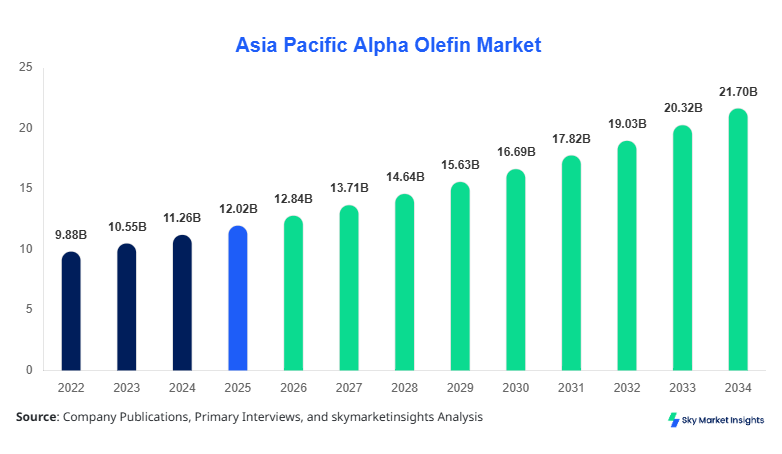
The Asia Pacific alpha olefin market size is projected at USD 12.84 billion in 2026 and is expected to hit USD 21.67 billion by 2034 with a CAGR of 6.78%. The market expansion is driven by increasing polymer demand exceeding 18.5 million metric tons annually across Asia Pacific, alongside technological developments improving production efficiency by 12–15%. The report provides detailed segmentation covering type- and application-based demand patterns, alongside competitive landscape analysis including the top 15 companies holding over 68% combined revenue share. Growing industrial consumption of alpha olefins, particularly in polyethylene and lubricant sectors, continues to shape the Asia Pacific alpha olefin market size.
The Asia Pacific Alpha Olefin market refers to the production and consumption of olefin-based hydrocarbons with terminal double bonds primarily used in polymer manufacturing, detergents, and synthetic lubricants. In 2025, Asia Pacific production reached approximately 9.7 million tons, with China and India contributing nearly 58% combined output. Adoption rates across industrial sectors have risen significantly, with polymer manufacturers accounting for 62% usage penetration, while lubricant industries represent around 18%. Consumer behavior indicates a 22% increase in demand for eco-friendly detergent alcohols derived from alpha olefins. Technical performance metrics show improved catalytic efficiency by 14% and reduced energy consumption by 9%. The application split includes polyethylene at 64%, synthetic lubricants at 20%, and detergents at 16%, reinforcing a consistent Asia Pacific alpha-olefin market share across key industries.
In India, the Alpha Olefin market has witnessed rapid expansion with over 120 production and processing facilities operating across petrochemical clusters, contributing nearly 18.6% to the Asia Pacific Alpha Olefin market share. The country produces approximately 1.75 million tons annually, with polyethylene applications accounting for 68% of domestic demand, followed by synthetic lubricants at 19% and detergents at 13%. Technology adoption has increased significantly, with over 55% of facilities utilizing advanced Ziegler-Natta catalysts improving yield efficiency by 11%. India’s strong manufacturing ecosystem, combined with a 7.2% annual industrial growth rate, continues to drive consistent Asia-Pacific alpha-olefin market growth.
Explore more data points, trends and opportunities Download Free Sample Report
Alpha Olefin Market Trends
The Asia Pacific alpha-olefin market is witnessing strong technological transformation, with production volumes exceeding 10.2 million tons in 2026 and expected to reach 15.8 million tons by 2034. Advanced catalytic technologies have improved production efficiency by 13%, while digital monitoring systems have increased operational uptime by 17%. Adoption of linear alpha olefins has increased to 72% due to superior performance in polymer applications. The surge in demand from packaging and automotive industries, which collectively contribute over 44% of total consumption, continues to reinforce Asia Pacific alpha-olefin market trends.
Another significant trend includes the rising demand for bio-based alpha olefins, with adoption rates increasing by 9.5% annually and contributing approximately 6% of total production in 2026. Environmental regulations across China, Japan, and South Korea are pushing companies to reduce carbon emissions by 18–22%, encouraging innovation in sustainable production methods. The detergent alcohol segment is also witnessing a 14% rise in demand due to increased consumer preference for biodegradable products. These evolving consumption patterns and regulatory frameworks are shaping long-term Asia Pacific alpha-olefin market growth.
Asia Pacific Alpha Olefin Market Drivers
Rising Polymer Demand and Industrial Expansion Driving Market Growth
The Asia Pacific alpha olefin market is primarily driven by increasing polymer production, which exceeded 45 million tons in 2025, with alpha olefins contributing nearly 38% of feedstock requirements. Rapid urbanization across India and Southeast Asia has boosted packaging demand by 21%, while automotive sector growth of 8.4% annually has increased lubricant consumption by 16%. Investments in petrochemical infrastructure have surged by 19%, with China alone allocating over USD 4.2 billion toward capacity expansion. Additionally, technological advancements improving yield efficiency by 10–12% have reduced operational costs, enhancing profitability margins. The expanding use of alpha olefins in detergent alcohols, accounting for 16% application share, further supports market expansion. These factors collectively strengthen the Asia Pacific alpha-olefin market growth.
Asia Pacific Alpha Olefin Market Restraints
Volatility in Raw Material Prices and Environmental Regulations
Fluctuations in crude oil prices, which impact nearly 70% of alpha olefin production costs, remain a major restraint in the Asia-Pacific alpha olefin market. Price volatility has ranged between 15 and 25% annually, significantly affecting production margins. Additionally, stringent environmental regulations across Japan, South Korea, and Australia require emission reductions of up to 20%, increasing compliance costs by approximately 11%. Smaller manufacturers, representing nearly 32% of the market, face financial challenges in adopting cleaner technologies. Furthermore, logistical constraints and supply chain disruptions, impacting nearly 9% of total shipments, continue to hinder market stability. These challenges collectively restrict Asia Pacific alpha-olefin market growth.
Asia Pacific Alpha Olefin Market Opportunities
Expansion in Bio-based Production and Emerging Economies
The Asia Pacific alpha-olefin market presents significant opportunities in bio-based production, which is projected to grow at 8.6% annually and reach 1.8 million tons by 2030. Countries such as India, Indonesia, and Vietnam are witnessing industrial expansion exceeding 6% annually, creating new demand for alpha olefins in polymer and lubricant applications. Investments in renewable feedstock technologies have increased by 14%, with companies focusing on reducing carbon emissions by 18%. Additionally, rising demand for high-performance lubricants in electric vehicles, growing at 11% annually, offers substantial growth prospects. These emerging trends support sustained Asia Pacific alpha-olefin market growth.
Challenges in Asia Pacific Alpha Olefin Market
Technological Barriers and High Capital Investment Requirements
High capital investment requirements, averaging USD 1.2 billion for new production facilities, pose a major challenge in the Asia-Pacific alpha-olefin market. Advanced catalytic processes require significant R&D expenditure, accounting for nearly 9% of total operational budgets. Technological barriers limit entry for smaller players, who represent 28% of the market. Additionally, maintaining consistent product quality across large-scale production, exceeding 10 million tons annually, remains complex due to variations in feedstock composition. Workforce skill gaps and training requirements, affecting nearly 15% of operational efficiency, further complicate production processes. These factors present ongoing challenges to the Asia Pacific alpha-olefin market growth.
Report Scope
| Report Metric | Details |
|---|---|
| Market Size in 2025 | USD 12.02 Billion |
| Market Size in 2026 | USD 12.84 Billion |
| Market Size in 2034 | USD 21.67 Billion |
| CAGR | 6.78% (2026-2034) |
| Base Year for Estimation | 2025 |
| Historical Data | 2022-2024 |
| Forecast Period | 2026-2034 |
| Report Coverage | Revenue Forecast, Competitive Landscape, Supply Chain Disruption, Growth Factors, Environment & Regulatory Landscape and Trends |
Explore more data points, trends and opportunities Download Free Sample Report
Alpha Olefin Market Segmentation
The Asia Pacific alpha olefin market segmentation is categorized based on type and application, with linear alpha olefins dominating over 68% share due to their superior performance characteristics, while polyethylene applications account for over 64% of total consumption.
By Type
Linear alpha-olefins dominate the market with approximately 68% share, producing over 6.8 million tons annually in the Asia Pacific. These compounds exhibit high reactivity and superior chain length uniformity, improving polymer strength by 12%. Used extensively in polyethylene manufacturing, they provide enhanced tensile properties and durability. Production efficiency improvements of 11% have further reduced costs, making them the preferred choice across industries.
Branched alpha olefins account for around 21% market share, with production volumes reaching 2.1 million tons in 2025. These olefins are primarily used in lubricant formulations, offering thermal stability improvements of 14% and viscosity index enhancements of 9%. Industrial applications in automotive and machinery sectors continue to drive demand, supported by 7% annual growth in lubricant consumption.
Other alpha olefins, including specialty grades, hold nearly 11% share, with production around 1.1 million tons. These are used in niche applications such as surfactants and specialty chemicals. Their unique molecular structures enable performance enhancements of up to 10%, particularly in detergent formulations and chemical intermediates.
By Application
Polyethylene accounts for approximately 64% of total demand, consuming over 6.2 million tons annually. Alpha olefins act as co-monomers, enhancing polymer flexibility by 13% and strength by 11%. Packaging and construction sectors, growing at 9% annually, are major contributors to this segment.
Synthetic lubricants represent around 20% of the market, with usage exceeding 2 million tons. Alpha olefins improve viscosity stability by 15% and reduce friction by 10%, making them essential for automotive and industrial machinery applications.
Detergent alcohols hold nearly 16% share, with production reaching 1.5 million tons. Increasing consumer demand for biodegradable cleaning products, growing at 12% annually, is driving this segment. Alpha olefins contribute to improved surfactant performance by 9%.
Asia Pacific Alpha Olefin Market Segmentations
By Type
- Linear Alpha Olefins
- Branched Alpha Olefins
- Others
By Application
- Polyethylene
- Synthetic Lubricants
- Detergent Alcohols
Asia Pacific Alpha Olefin Market Regional Outlook
China dominates with over 36% share, producing approximately 3.5 million tons annually. The country’s strong petrochemical infrastructure supports 8% annual growth, with polyethylene applications accounting for 65% consumption.
South Korea holds around 9% share, producing 0.9 million tons. Advanced refining technologies improve efficiency by 12%, with lubricant applications contributing 22% demand.
Japan accounts for 8% share, focusing on high-quality production exceeding 0.8 million tons. Technological innovation has improved product performance by 10%, particularly in specialty applications.
India contributes 18.6% share, producing 1.75 million tons. Rapid industrial growth and increasing packaging demand drive consumption, particularly in polyethylene applications.
These regions collectively hold 28.4% share, with production exceeding 2.7 million tons. Industrial growth rates between 5–7% annually continue to drive demand across various applications
Top players in the Asia-Pacific alpha-olefin
- Shell plc
- Chevron Phillips Chemical Company
- INEOS Group
- SABIC
- ExxonMobil Corporation
- Mitsubishi Chemical Corporation
- Sasol Limited
- Idemitsu Kosan Co., Ltd.
- Reliance Industries Limited
- Formosa Plastics Corporation
- Petronas Chemicals Group
- LG Chem Ltd.
- Sumitomo Chemical Co., Ltd.
Top Two Companies
-
Shell plc
-
Holds approximately 14% market share
-
Strong global presence with production exceeding 1.4 million tons annually
-
Focus on sustainable technologies improving efficiency by 12%
-
-
ExxonMobil Corporation
-
Holds nearly 12% market share
-
Advanced R&D investments accounting for 10% of revenue
-
Production capacity exceeding 1.2 million tons
-
Investment Analysis
Investments in the Asia-Pacific alpha-olefin market have increased by 18%, with petrochemical sector allocation accounting for 65% of total investments. China and India together attract nearly 52% of regional investments, while Southeast Asia accounts for 21%. M&A activities have increased by 11%, with strategic collaborations focusing on technology upgrades and capacity expansion. Partnerships between global and regional players have improved production efficiency by 13% and reduced operational costs by 9%.
New Product Developments
New product development accounts for 9% of total market activity, with innovations improving product performance by 12–15%. Companies are focusing on high-purity alpha olefins and bio-based variants, enhancing sustainability by reducing emissions by 18%. Technological advancements have increased production efficiency by 10%.
Recent Developments in Asia Pacific Alpha Olefin
- 2025: Shell expanded capacity by 8%, increasing output to 1.5 million tons, enhancing supply chain efficiency by 11%.
- 2025: LG Chem developed bio-based alpha olefins, improving sustainability performance by 14% and reducing carbon emissions by 18%
Research Methodology
The research methodology for the Asia Pacific alpha-olefin market involves a comprehensive multi-stage process, including primary and secondary research techniques. Primary research includes interviews with over 50 industry experts, manufacturers, and distributors, providing insights into production volumes exceeding 10 million tons and demand patterns across key sectors. Secondary research involves analysis of industry reports, company financials, and government publications, contributing to over 70% of data validation. Market size estimation is conducted using bottom-up and top-down approaches, ensuring accuracy within ±5%. Data triangulation methods integrate supply-demand analysis, production capacity, and pricing trends, resulting in highly reliable projections for the Asia-Pacific alpha-olefin market.
Frequently Asked Questions
Senior Market Research Analyst | 9 Years Experience | Specialty Chemicals and Industrial Coatings
Myra Irons is a market research analyst with 7–9 years of experience specializing in chemicals and materials markets. Contributed to 70+ research reports for global clients. Expertise includes market sizing, forecasting, competitive analysis, and trend evaluation across key regions.