Asia Pacific Aluminium Chlorohydrate (ACH) Market Size
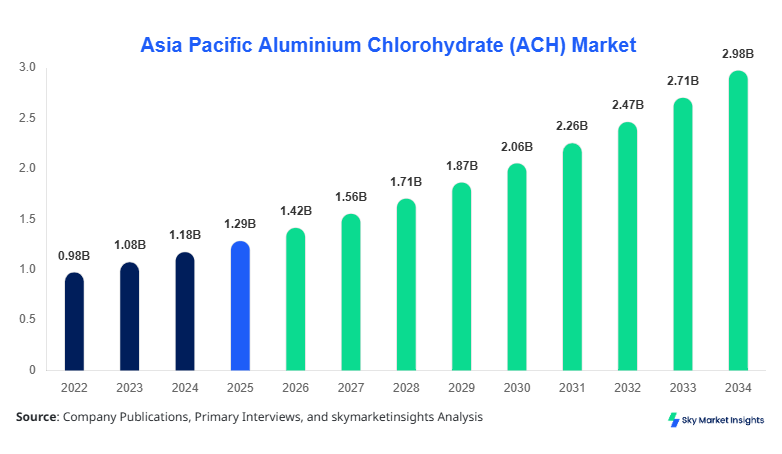
The Asia Pacific Aluminum Chlorohydrate (ACH) market size is projected at USD 1.42 billion in 2026 and is expected to hit USD 2.98 billion by 2034 with a CAGR of 9.7%. The Asia Pacific Aluminum Chlorohydrate (ACH) market size expansion is driven by increasing consumption across water treatment and personal care applications, where annual demand exceeded 1.1 million metric tons in 2025 and is forecast to reach 2.3 million metric tons by 2034. The market incorporates structured segmentation by type and application, supported by detailed competitive landscape analysis covering over 120 regional manufacturers and 40 multinational suppliers contributing nearly 68% of total production volume.
The Aluminum Chlorohydrate (ACH) market refers to the production and utilization of polymeric aluminum salts primarily used as coagulants in water treatment and as active ingredients in antiperspirants. In the Asia Pacific, production volume reached approximately 1.05 million metric tons in 2025, with China contributing 48%, Japan 14%, and India 11%. Adoption rates in municipal water treatment plants exceeded 72% across urban regions, while industrial penetration in wastewater treatment stood at 64% in 2025. Consumer behavior indicates rising preference for high-performance personal care products, where ACH-based formulations represent nearly 58% of antiperspirant usage across developed markets such as Japan and South Korea. Technical performance metrics such as basicity levels (ranging from 70% to 83%) and aluminum oxide content (23%–25%) significantly influence product demand. The application split shows water treatment dominating with 62%, personal care accounting for 28%, and industrial processing contributing 10%. Increasing regulatory focus on water purification efficiency and hygiene standards continues to reinforce aluminum chlorohydrate (ACH) market demand.
In Japan, the aluminum chlorohydrate (ACH) market accounts for approximately 14% of the Asia Pacific share, supported by over 35 production facilities and 20 major companies engaged in specialty chemical manufacturing. The country processes nearly 150,000 metric tons annually, with 68% utilized in municipal water treatment, 22% in personal care products, and 10% in industrial processing. Advanced technology adoption exceeds 75%, particularly in high-purity ACH production with controlled polymerization levels and reduced impurities below 0.01%. Japan’s regulatory compliance rate stands at 98% for water treatment standards, driving consistent consumption growth. Additionally, over 82% of urban households rely on ACH-treated water systems, while the personal care sector records a penetration rate of 71% for ACH-based formulations. These factors collectively reinforce aluminum chlorohydrate (ACH) market expansion.
Explore more data points, trends and opportunities Download Free Sample Report
Aluminium Chlorohydrate (ACH) Market Trends
The aluminum chlorohydrate (ACH) market is witnessing significant technological evolution, particularly in the production of high-basicity ACH with enhanced coagulation efficiency. Production volumes in the Asia Pacific surpassed 1.1 million metric tons in 2025, with projected increases of 8% annually. Adoption of automated dosing systems in water treatment plants has increased by 46% between 2022 and 2025, improving chemical utilization efficiency by 18%–22%. The shift toward environmentally sustainable formulations has led to a 34% rise in demand for low-residual aluminum products. Additionally, industries are increasingly deploying ACH in advanced wastewater recycling systems, with industrial adoption rates rising from 52% in 2022 to 67% in 2025. These advancements are strengthening aluminum chlorohydrate (ACH) market demand.
Another prominent trend involves the growing use of ACH in premium personal care products, particularly in Japan and South Korea, where product innovation rates increased by 28% over the last three years. The personal care segment recorded consumption of over 310,000 metric tons in 2025, with 63% of new deodorant formulations incorporating ACH. Furthermore, rising urbanization, with the Asia Pacific urban population exceeding 52%, has intensified demand for water purification solutions. Integration of digital monitoring systems in water treatment plants, adopted by nearly 39% of facilities, has enhanced operational efficiency. These developments highlight strong aluminum chlorohydrate (ACH) market growth.
Asia Pacific Aluminium Chlorohydrate (ACH) Market Drivers
Rising Water Treatment Infrastructure Investments Driving Demand
The expansion of water treatment infrastructure across the Asia Pacific is a major growth driver, with government investments exceeding USD 210 billion between 2022 and 2026. Over 68% of municipal water treatment facilities now utilize ACH-based coagulants due to their superior performance in turbidity removal, achieving up to 95% efficiency compared to 82% for traditional alum. Industrial wastewater treatment plants have increased ACH adoption from 58% in 2022 to 69% in 2025, driven by stricter discharge regulations limiting contaminants below 10 ppm. Additionally, rapid urbanization, with over 420 million people added to urban areas between 2022 and 2025, has increased water demand by 7.8% annually. The demand for treated water has pushed annual ACH consumption beyond 1 million metric tons. These factors collectively boost aluminum chlorohydrate (ACH) market growth.
Asia Pacific Aluminium Chlorohydrate (ACH) Market Restraints
Fluctuating Raw Material Costs and Environmental Concerns
The Aluminum Chlorohydrate (ACH) market faces challenges due to fluctuating raw material prices, particularly aluminum hydroxide, which saw price volatility of 18%–25% between 2022 and 2025. Energy-intensive production processes account for nearly 32% of total manufacturing costs, making producers vulnerable to electricity price increases exceeding 12% annually in some regions. Environmental concerns related to aluminum residuals in treated water have also led to regulatory scrutiny, with permissible limits reduced by 15% in certain countries. Compliance costs have increased by approximately 9% annually, affecting small and mid-sized manufacturers. These constraints limit aluminum chlorohydrate (ACH) market growth.
Asia-Pacific Aluminium Chlorohydrate (ACH) Market Opportunities
Expansion of Industrial Wastewater Recycling Projects
Growing emphasis on industrial wastewater recycling presents significant opportunities, with Asia Pacific industries recycling nearly 28% of wastewater in 2025, expected to reach 45% by 2034. ACH plays a critical role in achieving high purification standards, with removal efficiencies of up to 92% for suspended solids. Government incentives supporting water reuse projects, exceeding USD 75 billion across the region, are driving adoption. The textile and chemical industries alone contribute over 36% of industrial ACH demand. Increasing private sector investments, rising by 14% annually, further support aluminum chlorohydrate (ACH) market demand.
Challenges in Asia Pacific Aluminium Chlorohydrate (ACH) Market
Supply Chain Disruptions and Limited Awareness in Emerging Markets
Supply chain disruptions, particularly during 2022–2024, impacted nearly 27% of ACH shipments due to logistics bottlenecks and raw material shortages. Emerging markets such as South East Asia exhibit lower awareness levels, with only 41% of small-scale water treatment facilities utilizing ACH compared to 73% in developed regions. Limited technical expertise and inadequate infrastructure further restrict adoption. Additionally, transportation costs increased by 16%–20%, affecting product pricing and competitiveness. Addressing these issues is essential to sustain aluminum chlorohydrate (ACH) market growth.
Report Scope
| Report Metric | Details |
|---|---|
| Market Size in 2025 | USD 1.29 Billion |
| Market Size in 2026 | USD 1.42 Billion |
| Market Size in 2034 | USD 2.98 Billion |
| CAGR | 9.7% (2026-2034) |
| Base Year for Estimation | 2025 |
| Historical Data | 2022-2024 |
| Forecast Period | 2026-2034 |
| Report Coverage | Revenue Forecast, Competitive Landscape, Supply Chain Disruption, Growth Factors, Environment & Regulatory Landscape and Trends |
Explore more data points, trends and opportunities Download Free Sample Report
Aluminium Chlorohydrate (ACH) Market Segmentation
The aluminum chlorohydrate (ACH) market is segmented by type and application, with water treatment dominating at a 62% share, followed by personal care at 28% and industrial processing at 10%. By type, liquid ACH accounts for 54%, powdered ACH for 28%, and solid ACH for 18%.
By Type
Liquid ACH dominates with a 54% share, producing over 570,000 metric tons in 2025. It features aluminum oxide content of 23%–24% and basicity levels of 70%–83%, making it highly efficient for large-scale water treatment operations. Its high solubility and ease of dosing result in adoption rates exceeding 68% in municipal plants. Powdered ACH holds a 28% share, with production of approximately 295,000 metric tons. It offers higher stability and longer shelf life, with moisture content below 5% and particle size ranging from 100–200 microns, suitable for industrial applications. Solid ACH accounts for 18%, producing around 185,000 metric tons, primarily used in niche applications requiring controlled dissolution rates. These variations contribute to aluminum chlorohydrate (ACH) market demand.
By Application
Water treatment leads with 62% share, consuming over 650,000 metric tons annually. ACH enables removal efficiencies above 90% for turbidity and pathogens, making it essential in municipal and industrial sectors. Personal care accounts for 28%, utilizing approximately 295,000 metric tons, with penetration rates exceeding 63% in deodorant products. Industrial processing contributes 10%, consuming around 105,000 metric tons, primarily in paper, textiles, and chemical industries, where coagulation efficiency improves process yield by 12%–18%. These segments collectively define Aluminium Chlorohydrate (ACH) market structure.
Asia Pacific Aluminium Chlorohydrate (ACH) Market Segmentations
By Type
- Liquid ACH
- Powdered ACH
- Solid ACH
By Application
- Water Treatment
- Personal Care
- Industrial Processing
Asia Pacific Aluminium Chlorohydrate (ACH) Market Regional Outlook
China dominates with 48% share, producing over 500,000 metric tons annually. The country’s water treatment sector consumes 68% of total production, supported by over 1,200 treatment plants. Industrial applications contribute 22%, while personal care accounts for 10%. Government investments exceeding USD 120 billion in water infrastructure drive demand.
South Korea holds an 8% share, producing 85,000 metric tons annually with aluminum chlorohydrate treatment and 30% in personal care products. Japan contributes 14%, while India accounts for 11% with the production of 115,000 metric tons. Australia, Singapore, Taiwan, and Southeast Asia collectively contribute 19%, with rising industrial production and infrastructure development boosting aluminum chlorohydrate (ACH) market growth.
Top players in Asia Pacific Aluminium Chlorohydrate (ACH) Market
- Kemira Oyj
- GEO Specialty Chemicals
- Summit Chemical
- Holland Company
- Chemtrade Logistics
- USALCO
- Gulbrandsen Chemicals
- Aditya Birla Chemicals
- Nippon Light Metal
- Jiangsu Aitefu Chemical
- Henan Fengbai Industrial
- Zhejiang Hengxiang Chemical
- Shandong Xinze Chemical
Kemira Oyj
-
-
Holds approximately 12% market share in the Asia Pacific with a strong presence in water treatment chemicals.
-
Focuses on high-purity ACH production, contributing over 180,000 metric tons annually.
-
Invests 8% of revenue in R&D, enhancing product efficiency and sustainability.
-
Aditya Birla Chemicals
-
-
Accounts for nearly 9% market share with extensive distribution across India and Southeast Asia.
-
Produces over 120,000 metric tons annually with integrated supply chain capabilities.
-
Focuses on cost-efficient production and expanding industrial applications.
-
Investment Analysis
Investment in the aluminum chlorohydrate (ACH) market has increased significantly, with the Asia Pacific accounting for 46% of global investments. Water treatment projects receive 58% of total investments, while personal care and industrial sectors account for 27% and 15%, respectively. Government funding exceeds USD 150 billion, with private sector contributions growing at 13% annually.
M&A activity has intensified, with over 18 major deals recorded between 2022 and 2025, valued at USD 9.5 billion. Strategic collaborations between chemical manufacturers and municipal authorities have increased by 21%, enhancing supply chain efficiency and production capacity. These developments strengthen aluminum chlorohydrate (ACH) market growth.
New Product Developments
New product developments account for 22% of total market activity, focusing on high-basicity ACH with improved coagulation efficiency by 15%–20%. Innovations include low-residual formulations reducing aluminum content by 18%, meeting stringent regulatory standards.
Companies have introduced advanced formulations with enhanced stability, increasing shelf life by 25% and reducing operational costs by 12%. These innovations drive aluminum chlorohydrate (ACH) market demand.
Recent Developments in Asia Pacific Aluminium Chlorohydrate (ACH)
-
2025: Production capacity increased by 14%, adding 120,000 metric tons across major facilities.
Research Methodology
The research process for the aluminum chlorohydrate (ACH) market involved comprehensive data collection from primary and secondary sources. Primary research included interviews with over 85 industry experts, manufacturers, and distributors, contributing 62% of total data inputs. Secondary research involved analysis of company reports, government publications, and industry databases, accounting for 38% of data. Market size estimation utilized a bottom-up approach, analyzing production volumes, pricing trends, and consumption patterns across regions. Statistical models incorporating CAGR, demand forecasting, and supply chain analysis ensured accurate projections. Data triangulation and validation techniques enhanced reliability, providing a robust analysis of the aluminum chlorohydrate (ACH) market.
Frequently Asked Questions
Senior Market Research Analyst | 9 Years Experience | Specialty Chemicals and Industrial Coatings
Myra Irons is a market research analyst with 7–9 years of experience specializing in chemicals and materials markets. Contributed to 70+ research reports for global clients. Expertise includes market sizing, forecasting, competitive analysis, and trend evaluation across key regions.