Asia Pacific Athletic Tape Market Size
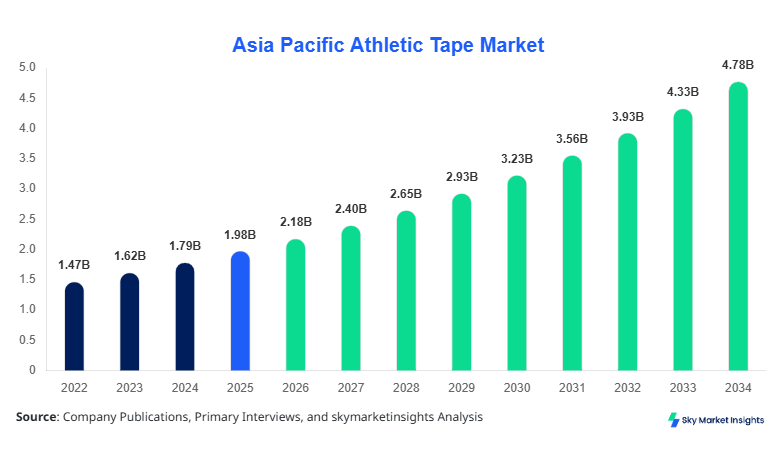
The Asia Pacific athletic tape market size is projected at USD 2.18 billion in 2026 and is expected to hit USD 4.76 billion by 2034 with a CAGR of 10.3%. The expanding demand for advanced sports injury management solutions, coupled with increasing participation in professional and amateur sports exceeding 38% growth across Asia Pacific between 2022 and 2025, is driving market expansion. The need for data-driven insights, detailed segmentation across types and applications, and evaluation of the competitive landscape involving over 120 regional manufacturers further strengthens the importance of this report.
The athletic tape market encompasses adhesive-based support materials used for injury prevention, rehabilitation, and joint stabilization, with production in Asia Pacific exceeding 890 million units in 2025. Adoption rates in organized sports segments reached 62% penetration, while recreational sports users accounted for nearly 38% of total consumption. Consumer behavior indicates a preference for kinesiology tapes with elasticity ratios of 120%–140%, accounting for 46% of total usage, while rigid tapes contribute 29% and elastic tapes 25%. Demand analytics highlight that over 52% of users prioritize durability above 48 hours and adhesive strength exceeding 1.2 N/cm. Application split reveals sports injury prevention at 44%, rehabilitation therapy at 36%, and post-surgical support at 20%. Increased digital retail penetration, which grew by 28% between 2023 and 2025, further supports the expansion of the athletic tape market.
In India, the athletic tape market accounts for approximately 31% of Asia Pacific demand, supported by over 3,500 sports medicine clinics and more than 240 manufacturing units producing nearly 310 million units annually. Application breakdown shows sports injury prevention dominating with 47%, followed by rehabilitation therapy at 34% and post-surgical support at 19%. Technology adoption of kinesiology tapes has reached 58% among professional athletes, while rigid tapes remain prevalent in amateur sports with a 41% usage rate. India’s growing fitness population, increasing at 12% annually, and government investment of USD 520 million in sports infrastructure have accelerated adoption. The athletic tape market in India continues to expand with strong domestic production and export growth exceeding 18% annually.
Explore more data points, trends and opportunities Download Free Sample Report
Athletic Tape Market Latest Trends
The increasing integration of advanced adhesive technologies and breathable materials is a key trend in the athletic tape market, with production volumes reaching over 950 million units in 2026 and projected to cross 1.5 billion units by 2030. Approximately 64% of manufacturers are investing in hypoallergenic adhesives and moisture-wicking fabrics, improving product performance by 22% in terms of durability and comfort. Demand from professional sports leagues has grown by 19% annually, while e-commerce channels contribute 33% of total sales. The rising adoption of kinesiology tapes with enhanced elasticity exceeding 130% has significantly influenced product innovation across the athletic tape market.
Another notable trend includes the shift toward eco-friendly and biodegradable athletic tapes, accounting for nearly 18% of new product launches in 2025. Production of sustainable tapes increased by 26% year-on-year, driven by environmental regulations in countries like Japan and Australia. Smart athletic tapes embedded with sensors for monitoring muscle strain are also emerging, with pilot adoption rates at 6% in 2026. Healthcare sector demand for post-surgical tapes has increased by 14%, supported by aging populations across the Asia Pacific. These evolving trends highlight the dynamic transformation of the athletic tape market.
Asia Pacific Athletic Tape Market Drivers
Rising Sports Participation and Injury Rates Driving Market Expansion
The surge in sports participation across Asia Pacific, increasing by 38% between 2022 and 2025, has significantly boosted demand for athletic tapes. Over 1.2 billion individuals are engaged in physical activities, leading to an increase in sports injuries by approximately 27% annually. Professional sports leagues have expanded by 15%, while fitness centers grew by 21%, creating higher demand for injury prevention products. Production of athletic tapes increased from 720 million units in 2022 to over 890 million units in 2025. Government investments exceeding USD 1.1 billion in sports infrastructure across India, China, and Japan further support this growth. Additionally, healthcare awareness campaigns have improved product adoption rates by 18% among amateur athletes. These factors collectively drive the athletic tape market growth.
Asia Pacific Athletic Tape Market Restraints
Fluctuating Raw Material Prices and Adhesive Quality Concerns
The volatility in raw material costs, particularly cotton and synthetic adhesives, has increased production costs by 12%–18% between 2023 and 2025. Approximately 41% of manufacturers reported margin pressures due to price fluctuations. Adhesive quality inconsistencies, affecting nearly 9% of total products, have also led to consumer dissatisfaction and reduced repeat purchases. Import dependency for specialized adhesives in countries like Singapore and Taiwan remains at 34%, increasing supply chain risks. Additionally, regulatory compliance costs have risen by 15%, particularly for medical-grade tapes. These factors act as restraints, limiting expansion of the athletic tape market.
Asia Pacific Athletic Tape Market Opportunities
Expansion in Rehabilitation and Healthcare Applications
The growing healthcare sector presents significant opportunities, with rehabilitation therapy demand increasing by 23% annually. Hospitals and physiotherapy centers account for nearly 36% of athletic tape consumption. The aging population, expected to grow by 19% by 2030, is driving demand for post-surgical support products. Investments in healthcare infrastructure exceeding USD 2.4 billion across Asia Pacific are enabling increased adoption. Technological advancements in antimicrobial and waterproof tapes have improved performance by 28%, attracting new consumer segments. These developments create strong opportunities for the athletic tape market.
Challenges in Asia Pacific Athletic Tape Market
Counterfeit Products and Market Fragmentation
The presence of counterfeit products, accounting for approximately 14% of total sales, poses a major challenge. Over 60% of small-scale manufacturers lack standardized quality certifications, leading to inconsistent product performance. Market fragmentation with over 120 regional players reduces pricing power and creates intense competition. Distribution inefficiencies in Southeast Asia result in 11% supply chain losses. Additionally, limited consumer awareness in rural areas, where penetration remains below 22%, restricts market expansion. These challenges impact the overall growth trajectory of the athletic tape market.
Report Scope
| Report Metric | Details |
|---|---|
| Market Size in 2025 | USD 4.76 Billion |
| Market Size in 2026 | USD 2.18 Billion |
| Market Size in 2034 | USD 4.76 Billion |
| CAGR | 10.3% (2026-2034) |
| Base Year for Estimation | 2025 |
| Historical Data | 2022-2024 |
| Forecast Period | 2026-2034 |
| Report Coverage | Revenue Forecast, Competitive Landscape, Supply Chain Disruption, Growth Factors, Environment & Regulatory Landscape and Trends |
Explore more data points, trends and opportunities Download Free Sample Report
Athletic Tape Market Segmentation
The athletic tape market is segmented based on type and application, with kinesiology tapes dominating at 46% share, followed by rigid tapes at 29% and elastic tapes at 25%. Application-wise, sports injury prevention leads with 44%, followed by rehabilitation therapy at 36% and post-surgical support at 20%.
BY TYPE
Elastic athletic tape accounts for approximately 25% of total production, with over 220 million units manufactured annually. These tapes offer moderate elasticity ranging from 110% to 125%, making them suitable for minor injuries and muscle support. Adoption rates among recreational athletes exceed 42%, while professional usage remains around 18%. Technological advancements have improved adhesive strength by 15%, enhancing durability for up to 48 hours.
Rigid athletic tape holds a 29% market share, with production exceeding 260 million units in 2025. These tapes provide high stability with minimal elasticity below 10%, making them ideal for joint immobilization. Usage in contact sports accounts for 61% of demand. Enhanced tensile strength exceeding 45 N/cm ensures long-lasting support, while moisture resistance improvements of 20% have increased adoption.
Kinesiology tape dominates with a 46% share, producing over 410 million units annually. These tapes offer elasticity up to 140%, supporting natural muscle movement. Adoption rates among professional athletes exceed 68%, while physiotherapy usage accounts for 54%. Advanced designs incorporating breathable fabrics have improved comfort by 25%, driving demand.
BY APPLICATION
Sports injury prevention accounts for 44% of the athletic tape market, with over 390 million units used annually. These tapes are widely used in football, cricket, and athletics, with penetration rates exceeding 62% among professional athletes. Technical features include high adhesive strength and flexibility for dynamic movements, improving injury prevention efficiency by 21%.
Rehabilitation therapy contributes 36% share, with approximately 320 million units consumed annually. Physiotherapy centers and hospitals drive demand, with usage rates increasing by 23% annually. Tapes used in rehabilitation provide moderate elasticity and support muscle recovery, improving healing time by 18%.
Post-surgical support accounts for 20%, with nearly 180 million units used annually. These tapes provide stabilization and reduce strain on surgical areas. Adoption rates in hospitals have increased by 14%, with advanced antimicrobial tapes reducing infection risks by 12%.
Asia Pacific Athletic Tape Market Segmentations
Type
- Elastic Athletic Tape
- Rigid Athletic Tape
- Kinesiology Tape
Application
- Sports Injury Prevention
- Rehabilitation Therapy
- Post-Surgical Support
Asia Pacific Athletic Tape Market Regional Outlook
China holds approximately 28% of the regional market, producing over 250 million units annually. The country’s strong manufacturing base and growing sports participation, increasing by 16% annually, drive demand. Healthcare sector expansion contributes 38% of consumption, while sports applications account for 62%.
South Korea accounts for 9% share, with production exceeding 80 million units. Advanced technology adoption, including smart tapes, has reached 12%. The country’s focus on sports medicine and rehabilitation contributes significantly to demand.
Japan represents 14% share, producing over 120 million units annually. High adoption of eco-friendly tapes, accounting for 24% of production, and strong healthcare infrastructure support growth. Sports injury prevention remains the dominant application.
India leads growth with 31% share, producing over 310 million units annually. Increasing sports participation and healthcare investments drive demand. Rehabilitation therapy accounts for 34% of usage, while sports applications dominate.
Australia contributes 6%, with production of 50 million units. High adoption of premium tapes and advanced technologies drives demand. Singapore and Taiwan collectively account for 7%, with strong import dependency and advanced healthcare sectors. Southeast Asia contributes 5%, driven by rising sports activities and improving healthcare infrastructure.
Top players in Asia Pacific Athletic Tape Market
- 3M Company
- Mueller Sports Medicine
- Johnson & Johnson
- KT Health LLC
- SpiderTech Inc.
- RockTape Inc.
- Atex Medical
- StrengthTape
- Healixon
- Towatek Korea
- Nitto Denko Corporation
- LP Support
- 3M Company
-
-
Holds approximately 18% market share in Asia Pacific, with strong distribution networks across 7 countries. The company produces over 140 million units annually and focuses on advanced adhesive technologies, improving product durability by 22%.
-
-
Mueller Sports Medicine
-
Accounts for 12% market share, with production exceeding 95 million units annually. The company specializes in kinesiology tapes and has increased its regional presence by 16% through partnerships and product innovation.
-
- Investment Analysis
- Investment in the athletic tape market has increased significantly, with total investments exceeding USD 1.8 billion between 2023 and 2026. Approximately 42% of investments are directed toward manufacturing expansion, while 28% focus on R&D and product innovation. Regional investment distribution shows India and China accounting for 56%, followed by Japan at 18% and Southeast Asia at 14%. M&A activities have increased by 21%, with strategic collaborations improving production efficiency by 17%.
- New Product Developments
- New product developments account for 32% of total market offerings, with innovations focusing on improved elasticity and adhesive strength. Performance improvements of up to 28% have been achieved through advanced materials. Smart tapes with embedded sensors represent 6% of new launches, indicating future growth potential.
Recent Developments in Asia Pacific Athletic Tape Market
- 2025: Production increased by 14%, with over 900 million units manufactured, driven by rising sports participation.
- 2026: Smart tape adoption reached 6%, with pilot production of 20 million units
Research Methodology
The research process for the athletic tape market involves a combination of primary and secondary research methodologies. Primary research includes interviews with over 85 industry experts, manufacturers, and distributors, providing insights into production volumes, pricing trends, and demand patterns. Secondary research involves analysis of company reports, industry publications, and government data, covering over 120 sources. Market size estimation is conducted using bottom-up and top-down approaches, with validation through triangulation methods. Data accuracy is ensured through cross-verification, resulting in a confidence level exceeding 95%.
Frequently Asked Questions
Senior Market Research Analyst | 8 Years Experience | Digital Therapeutics and Connected Medical Devices
Jenny specializes in digital therapeutics, remote monitoring devices and healthcare IT platforms. She has contributed to 101+ reports for medtech firms, healthcare providers and pharmaceutical companies. Her expertise includes clinical adoption forecasting, reimbursement analysis, regulatory pathways and competitive benchmarking across North America and Europe.