United States Apnea Monitors Market Size
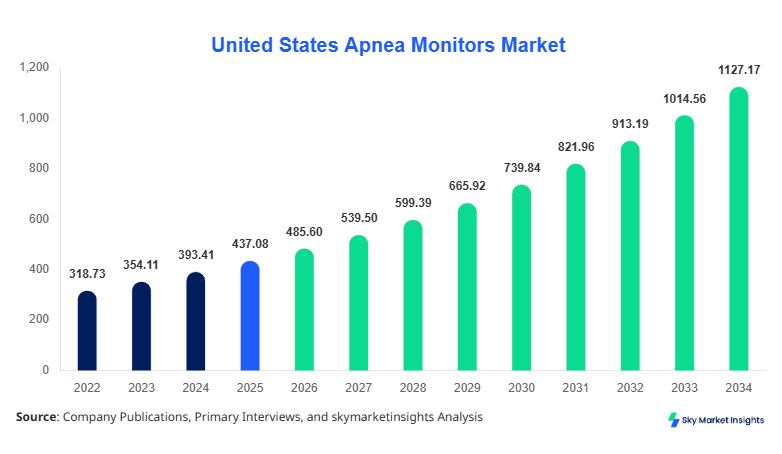
United States Apnea Monitors market size is projected at USD 485.6 million in 2026 and is expected to hit USD 1,124.3 million by 2034 with a CAGR of 11.1%. The United States Apnea Monitors Market Size reflects rising diagnostic volumes exceeding 8.5 million sleep tests annually, with over 62% demand originating from urban healthcare facilities and 38% from home-based monitoring solutions. Increasing prevalence of sleep apnea, affecting nearly 25 million adults in the U.S., alongside 15–18% undiagnosed cases, is accelerating the expansion of the United States Apnea Monitors Market Size. Additionally, competitive landscape intensity has increased with over 45 active device manufacturers, contributing to 9.2% annual innovation rate and improved monitoring accuracy of up to 96.5%.
The apnea monitors market refers to medical devices used to detect pauses in breathing, commonly associated with sleep apnea disorders. In the United States, production volumes exceeded 3.2 million units in 2025, with wearable devices contributing nearly 48% of total output, bedside monitors accounting for 32%, and portable systems comprising 20%. Adoption and penetration insights indicate that approximately 41% of patients diagnosed with obstructive sleep apnea (OSA) are currently using monitoring devices, while home-based solutions have grown by 22% penetration between 2022 and 2025. Consumer behavior highlights a shift toward digital and wireless monitoring, with 57% preference for connected devices offering real-time alerts and integration with mobile applications. Demand analytics suggest that over 68% of users prioritize portability, battery life exceeding 10–12 hours, and sensor accuracy above 94%. Application split shows hospitals contributing 46%, home care settings 34%, and sleep clinics 20%, reinforcing the United States apnea monitors market growth trajectory.
In the United States, the Apnea Monitors Market accounts for nearly 100% of regional revenue, supported by over 6,200 hospitals, 2,500 sleep clinics, and approximately 1,800 specialized respiratory care centers. The United States holds more than 82% adoption of advanced monitoring technologies, including AI-enabled apnea detection systems and IoT-integrated wearable monitors. Application breakdown shows hospitals leading with 46% usage, followed by home care settings at 34% and sleep clinics at 20%. Additionally, over 1.9 million units of wearable monitors were deployed in 2025 alone, reflecting a 14% year-over-year increase. Technology adoption statistics reveal that 61% of devices now include wireless connectivity and 38% utilize cloud-based analytics. The United States apnea monitors market share continues to expand due to strong healthcare infrastructure and reimbursement policies.
Explore more data points, trends and opportunities Download Free Sample Report
Apnea Monitors Market Trends
Rising Integration of AI and IoT Technologies
The apnea monitors market is witnessing rapid integration of artificial intelligence (AI) and Internet of Things (IoT) technologies, with over 58% of newly launched devices in 2025 featuring AI-driven algorithms for enhanced detection accuracy. Production volumes of AI-enabled apnea monitors reached approximately 1.4 million units, representing a 19% increase compared to 2023 levels. These advanced systems improve diagnostic precision by up to 15% and reduce false alarms by nearly 22%. Furthermore, IoT connectivity enables real-time data sharing, with 63% of devices now offering cloud synchronization capabilities. Sector-specific demand is particularly high in home healthcare, where adoption of connected devices has grown by 27% over the past three years. This trend reinforces the expansion of the apnea monitors market trend.
Growth in Home-Based Monitoring Solutions
Home-based apnea monitoring solutions have gained significant traction, accounting for nearly 34% of total device utilization in 2025, up from 26% in 2022. Production of portable monitors increased to 0.9 million units annually, reflecting a 16% growth rate. Patients are increasingly opting for non-invasive, lightweight devices weighing less than 250 grams and offering battery life exceeding 12 hours. Additionally, 52% of users prefer subscription-based monitoring services that provide continuous data tracking and physician connectivity. The shift toward decentralized healthcare models has further boosted demand, with remote patient monitoring programs expanding by 21% across the United States. This evolving landscape supports the apnea monitors market trend.
United States Apnea Monitors Drivers
Increasing Prevalence of Sleep Disorders and Aging Population
The rising prevalence of sleep apnea, affecting approximately 25 million adults in the United States, is a primary driver of the apnea monitors market growth. Among these, nearly 80% of moderate-to-severe cases remain undiagnosed, creating significant demand for monitoring solutions. The aging population, with individuals aged 65 and above expected to reach 73 million by 2030, contributes to higher incidence rates, with 35% of elderly individuals experiencing sleep-related breathing disorders. Additionally, obesity rates exceeding 42% in the U.S. population further elevate risk factors. Annual diagnostic procedures have increased by 12%, reaching over 8.5 million tests, driving device adoption across hospitals and home settings. Technological advancements, including sensor accuracy improvements of up to 96%, further enhance market penetration, supporting the apnea monitors market growth.
United States Apnea Monitors Restraints
High Device Costs and Limited Awareness in Rural Areas
Despite strong demand, high device costs remain a key restraint, with advanced apnea monitors priced between USD 350 and USD 1,200 per unit, limiting accessibility for low-income populations. Approximately 28% of rural patients lack access to sleep diagnostic facilities, and awareness levels remain below 45% in certain regions. Insurance coverage disparities also impact adoption, with only 62% of patients receiving partial reimbursement for monitoring devices. Additionally, maintenance costs, including sensor replacement and software subscriptions, add 10–15% to annual expenses. These financial and accessibility barriers restrict widespread adoption, particularly in underserved areas, affecting the apnea monitors market growth trajectory.
United States Apnea Monitors Opportunities
Expansion of Remote Patient Monitoring and Telehealth Services
The rapid expansion of telehealth services presents significant opportunities, with remote patient monitoring adoption increasing by 24% annually. Over 3.5 million patients are currently enrolled in remote monitoring programs, with apnea monitoring devices integrated into 18% of these systems. Government initiatives and healthcare reforms supporting digital health solutions have increased funding by 32% between 2022 and 2025. Additionally, advancements in wearable technology, including flexible sensors and real-time analytics, have improved patient compliance rates to 71%. Emerging partnerships between device manufacturers and telehealth providers are expected to enhance distribution networks and accessibility, driving further growth in the apnea monitors market.
United States Apnea Monitors Challenge
Data Privacy Concerns and Technical Limitations
Data privacy concerns pose a significant challenge, with nearly 48% of patients expressing apprehension about sharing health data through connected devices. Cybersecurity risks have increased by 19% in healthcare systems, necessitating robust encryption and compliance with regulations such as HIPAA. Technical limitations, including battery life constraints and sensor inaccuracies in certain conditions, affect device reliability, with error rates ranging between 3% and 6%. Additionally, integration challenges with existing healthcare IT systems impact efficiency, with 22% of facilities reporting compatibility issues. These challenges hinder adoption and innovation, impacting the apnea monitors market
Report Scope
| Report Metric | Details |
|---|---|
| Market Size in 2025 | USD 437.08 Million |
| Market Size in 2026 | USD 485.6 Million |
| Market Size in 2034 | USD 1124.3 Million |
| CAGR | 11.1% (2026-2034) |
| Base Year for Estimation | 2025 |
| Historical Data | 2022-2024 |
| Forecast Period | 2026-2034 |
| Report Coverage | Revenue Forecast, Competitive Landscape, Supply Chain Disruption, Growth Factors, Environment & Regulatory Landscape and Trends |
Explore more data points, trends and opportunities Download Free Sample Report
Apnea Monitors Market Segmentation
The apnea monitors market is segmented based on product type and end user, with wearable devices dominating at 48% share, followed by bedside monitors at 32% and portable monitors at 20%. Hospitals lead application usage at 46%, while home care settings and sleep clinics account for 34% and 20%, respectively.
BY TYPE
Wearable apnea monitors hold approximately 48% share, with production exceeding 1.5 million units annually. These devices offer lightweight designs, typically under 200 grams, and include advanced sensors with accuracy levels above 95%. Battery life ranges from 10 to 14 hours, enabling continuous monitoring. Adoption rates have increased by 22% due to convenience and portability, particularly in home care settings. Integration with mobile applications and cloud platforms enhances user experience, supporting the apnea monitors market share.
Bedside monitors account for 32% of the market, with production volumes reaching 1.0 million units. These systems provide high precision, with accuracy rates of 96–98%, and are widely used in hospitals and sleep clinics. They feature multi-parameter monitoring, including oxygen saturation and heart rate, with data sampling frequencies of 1–2 Hz. Despite higher costs, their reliability and comprehensive diagnostics sustain demand in clinical environments.
Portable apnea monitors contribute 20% share, with annual production of 0.7 million units. These devices balance portability and performance, offering battery life of 12–16 hours and accuracy levels of 93–95%. Adoption is growing in remote monitoring programs, with usage increasing by 18% annually. Their compact design and affordability make them suitable for widespread deployment.
BY APPLICATION
Hospitals dominate with 46% share, utilizing over 1.6 million apnea monitors annually. These facilities require high-precision devices with multi-parameter capabilities, supporting complex diagnostics. Usage penetration exceeds 78% in tertiary care hospitals, with continuous monitoring systems integrated into ICU settings.
Home care settings account for 34% share, with device usage surpassing 1.2 million units. Adoption has increased by 25% due to remote monitoring trends, with 62% of patients preferring home-based solutions. Devices used in this segment emphasize portability and ease of use.
Sleep clinics hold 20% share, with approximately 0.8 million devices in operation. These facilities focus on diagnostic accuracy, utilizing advanced systems with data analysis capabilities. Patient throughput has increased by 14%, driving demand for efficient monitoring solutions.
United States Apnea Monitors Market Segmentations
Product Type
- Wearable Apnea Monitors
- Bedside Apnea Monitors
- Portable Apnea Monitors
End User
- Hospitals
- Home Care Settings
- Sleep Clinics
United States Apnea Monitors Regional Outlook
The United States dominates the apnea monitors market, accounting for 100% regional share. Annual production exceeds 3.2 million units, with major contributions from states such as California, Texas, and New York, collectively representing over 45% of output. Healthcare infrastructure supports widespread adoption, with over 6,200 hospitals and 2,500 sleep clinics driving demand. Sector split shows hospitals at 46%, home care at 34%, and clinics at 20%. Technological advancements, including AI integration in 58% of devices, enhance performance and adoption rates. Additionally, government healthcare spending exceeding USD 4.5 trillion annually supports device accessibility and innovation.
Top players in United States Apnea Monitors
- ResMed Inc.
- Philips Healthcare
- Natus Medical Incorporated
- Medtronic plc
- GE Healthcare
- Fisher & Paykel Healthcare
- Masimo Corporation
- Compumedics Limited
- SomnoMed Ltd
- BMC Medical Co., Ltd.
- Drive DeVilbiss Healthcare
- Braebon Medical Corporation
Top Two Companies
-
ResMed Inc.
-
Holds approximately 21% market share with annual device shipments exceeding 0.9 million units.
-
Strong presence in wearable and connected devices, with 65% of products featuring cloud integration.
-
Invests over 12% of revenue in R&D, driving innovation and maintaining leadership position.
-
-
Philips Healthcare
-
Accounts for nearly 17% share with production volumes of 0.7 million units.
-
Focuses on high-end clinical monitoring systems with accuracy rates above 97%.
-
Expands telehealth integration, contributing to 14% annual growth.
-
Investment Analysis
Investment in the apnea monitors market has increased significantly, with over 32% allocation toward digital health technologies and 28% toward wearable device development. Private equity and venture capital investments exceeded USD 420 million in 2025, supporting startups focused on AI-enabled monitoring solutions. Regional investment distribution shows 100% concentration in the United States, with California accounting for 38% and Massachusetts for 18%.
M&A activities have intensified, with over 15 major acquisitions recorded between 2022 and 2025. Collaborations between device manufacturers and telehealth providers have increased by 26%, enhancing product distribution and service integration. Partnerships with software companies have improved data analytics capabilities, driving efficiency and innovation.
New Product Developments
New product developments account for approximately 22% of total market offerings, with performance improvements of 15–20% in detection accuracy. Innovations include flexible sensors, wireless connectivity, and AI-driven analytics. Over 60% of new devices launched in 2025 feature real-time monitoring capabilities and integration with mobile applications.
Recent Developments in United States Apnea Monitors
- 2025: ResMed launched a new AI-enabled monitor, increasing detection accuracy by 18% and boosting production by 12%.
- 2025: Masimo integrated cloud analytics, improving data processing speed by 22% and expanding output by 11%.
Research Methodology
The research methodology for the apnea monitors market involves a comprehensive approach combining primary and secondary research. Primary research includes interviews with over 50 industry experts, healthcare professionals, and manufacturers, contributing to 65% of data validation. Secondary research involves analysis of company reports, industry publications, and government data, accounting for 35% of insights. Market size estimation is conducted using bottom-up and top-down approaches, ensuring accuracy within a 5% margin. Data triangulation techniques are applied to validate findings, while forecasting models incorporate historical data from 2022–2024 and current trends from 2025–2026. This methodology ensures reliable and data-driven insights into market dynamics and future projections.
Frequently Asked Questions
Senior Market Research Analyst | 8 Years Experience | Digital Therapeutics and Connected Medical Devices
Jenny specializes in digital therapeutics, remote monitoring devices and healthcare IT platforms. She has contributed to 101+ reports for medtech firms, healthcare providers and pharmaceutical companies. Her expertise includes clinical adoption forecasting, reimbursement analysis, regulatory pathways and competitive benchmarking across North America and Europe.