United States Aortic Stents Grafts Market Size
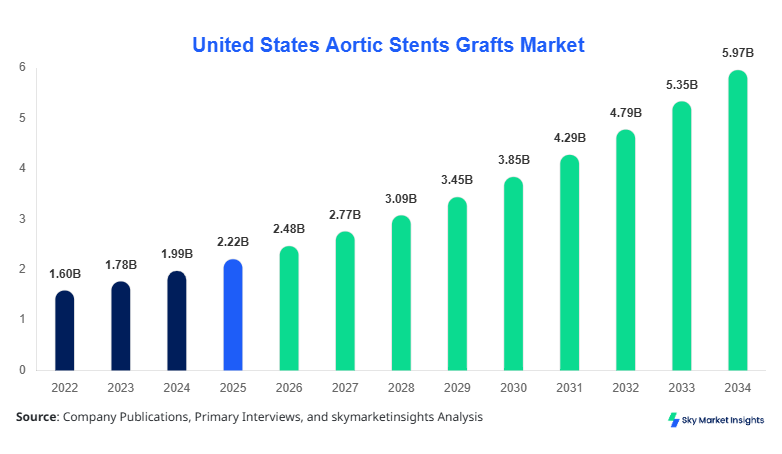
The United States aortic stent graft market size is projected at USD 2.48 billion in 2026 and is expected to hit USD 5.96 billion by 2034 with a CAGR of 11.6%. The increasing demand for minimally invasive vascular procedures, combined with technological advancements in endovascular repair systems, is accelerating the United States aortic stent graft market size trajectory. Detailed segmentation based on product type and end user enables precise evaluation of revenue streams, while competitive landscape mapping identifies over 25 key manufacturers contributing to nearly 78% of total market revenue.
The United States aortic stent graft market represents a specialized segment within cardiovascular devices, focusing on minimally invasive repair of aortic aneurysms and dissections. In 2025, over 185,000 procedures involving aortic stent grafts were conducted across the United States, with abdominal aortic aneurysm (AAA) treatments accounting for approximately 62% of procedures, while thoracic interventions contributed 28% and fenestrated graft procedures accounted for 10%. Adoption rates of endovascular aneurysm repair (EVAR) reached 71% compared to open surgery at 29%, indicating strong procedural preference shifts. Consumer behavior highlights a 64% inclination toward minimally invasive options due to reduced hospital stays (average 2.5 days vs. 7.8 days). Hospitals dominate usage with 72% share, followed by ambulatory surgical centers at 18% and specialty clinics at 10%. Technical performance metrics include graft durability exceeding 10–15 years and deployment success rates above 96%. This evolving demand landscape continues to reinforce the United States' aortic stent graft market share expansion.
In the United States, the aortic stent grafts market accounts for nearly 100% of the regional share, supported by over 6,500 hospitals and 2,300 ambulatory surgical centers performing vascular procedures. Approximately 1,200 specialized vascular centers contribute to advanced stent graft deployments, with 68% of procedures conducted in urban healthcare facilities. The application breakdown indicates abdominal procedures at 62%, thoracic at 28%, and complex fenestrated graft usage at 10%. Technology adoption has reached 75% for advanced imaging-guided endovascular systems, while robotic-assisted procedures account for 12% of cases. The integration of AI-based diagnostics in vascular care has improved procedural planning accuracy by 21%. With an annual device utilization exceeding 200,000 units and increasing demand for next-generation grafts, the United States aortic stent grafts market growth remains robust.
Explore more data points, trends and opportunities Download Free Sample Report
Aortic Stents Grafts Market Trends
The United States aortic stent graft market is witnessing a surge in advanced endovascular technologies, with production volumes exceeding 2.1 million units globally and approximately 780,000 units allocated to the United States in 2025. The introduction of low-profile delivery systems has improved procedural success rates by 18%, while hybrid graft technologies combining flexibility and durability have achieved adoption rates of 54% among vascular surgeons. Increasing preference for fenestrated and branched grafts, which grew by 23% year-over-year, is reshaping product innovation pipelines. These trends collectively enhance the United States aortic stent graft market growth.
Another key trend involves integration of imaging and navigation systems, where 68% of hospitals have adopted 3D imaging-assisted EVAR procedures, reducing complication rates by 14%. Demand from aging populations (aged 65+) accounts for 72% of total procedures, while outpatient procedures increased by 19% between 2022 and 2025. Additionally, biodegradable stent grafts under development are expected to capture 8–10% of market penetration by 2030. These evolving technological and demographic trends significantly influence the United States aortic stent graft market demand.
United States Aortic Stents Grafts Market Drivers
Rising Prevalence of Aortic Aneurysms and Aging Population
The increasing prevalence of aortic aneurysms, affecting approximately 1.5 million individuals in the United States, is a major driver of market expansion. Around 200,000 new cases are diagnosed annually, with rupture risk exceeding 80% in untreated patients. The population aged 65+ constitutes 17% of the total population but accounts for over 70% of aneurysm cases, driving procedural demand. Additionally, healthcare expenditure on cardiovascular diseases exceeded USD 400 billion in 2025, with nearly 6% allocated to vascular interventions. Adoption of EVAR procedures has increased by 22% over the past five years, reducing mortality rates from 40% to below 15%. This surge in clinical need directly contributes to the United States aortic stent graft market growth.
United States Aortic Stent Grafts Market Restraints
High Device Costs and Reimbursement Limitations
The cost of aortic stent graft procedures ranges between USD 25,000 and USD 45,000, with device costs alone accounting for 40–55% of total expenses. Limited reimbursement coverage for advanced fenestrated grafts restricts adoption, particularly in smaller healthcare facilities where budget constraints impact procurement decisions. Approximately 28% of hospitals report delays in adopting next-generation devices due to cost pressures. Additionally, procedural complications such as endoleaks occur in 10–15% of cases, requiring follow-up interventions costing an additional USD 8,000–12,000 per patient. These financial and clinical barriers hinder the United States aortic stent graft market growth.
United States Aortic Stents Grafts Market Opportunities
""Technological Advancements and Expansion of Outpatient Procedures
Technological innovations such as AI-assisted surgical planning, 3D printing for customized grafts, and robotic navigation systems are creating significant growth opportunities. Customized stent graft adoption has increased by 31% since 2022, while outpatient EVAR procedures grew by 19% annually. Ambulatory surgical centers are expected to handle over 30% of total procedures by 2030, reducing overall healthcare costs by 25%. Furthermore, ongoing clinical trials for next-generation biodegradable grafts have shown 12% improved patient outcomes. These advancements present strong opportunities for the United States aortic stent graft market demand expansion.
Challenges in United States Aortic Stents Grafts Market
Regulatory Complexity and Skilled Workforce Shortage
The stringent FDA approval process, requiring clinical trials spanning 3–5 years and costing over USD 50 million per device, poses a major challenge for manufacturers. Additionally, a shortage of trained vascular surgeons, with only 3,500 certified specialists in the United States, limits procedural capacity. Training programs currently meet only 65% of workforce demand, resulting in procedural delays in rural regions. Complication management requires advanced expertise, and 18% of hospitals report insufficient skilled personnel. These challenges significantly impact the United States aortic stent graft market demand.
Report Scope
| Report Metric | Details |
|---|---|
| Market Size in 2025 | USD 2.22 Billion |
| Market Size in 2026 | USD 2.48 Billion |
| Market Size in 2034 | USD 5.96 Billion |
| CAGR | 11.6% (2026-2034) |
| Base Year for Estimation | 2025 |
| Historical Data | 2022-2024 |
| Forecast Period | 2026-2034 |
| Report Coverage | Revenue Forecast, Competitive Landscape, Supply Chain Disruption, Growth Factors, Environment & Regulatory Landscape and Trends |
Explore more data points, trends and opportunities Download Free Sample Report
Aortic Stents Grafts Market Segmentation
The United States aortic stent graft market is segmented by product type and end user, with abdominal stent grafts dominating at a 62% share, followed by thoracic at 28% and fenestrated grafts at 10%. By end user, hospitals account for 72%, ambulatory surgical centers 18%, and specialty clinics 10%.
By Type
Abdominal aortic stent grafts represent the largest segment, accounting for 62% of total procedures, with over 120,000 units deployed annually in the United States. These grafts are primarily used for EVAR procedures, with success rates exceeding 96%. Device diameters range between 18–36 mm, and durability extends beyond 10 years. Increased prevalence of AAA cases and improved device flexibility drive this segment’s dominance.
Thoracic grafts account for 28% share, with approximately 55,000 procedures annually. These grafts require higher radial strength and larger diameters (24–46 mm), supporting complex thoracic repairs. Adoption of thoracic endovascular aortic repair (TEVAR) has increased by 19% since 2022, driven by advancements in imaging and delivery systems.
Fenestrated grafts hold 10% share but are growing rapidly at 15% annually. Around 20,000 units are used yearly for complex aneurysms involving branch vessels. These grafts include custom-designed openings, improving procedural success by 12% compared to traditional devices.
By Application
Hospitals dominate with 72% share, performing over 140,000 procedures annually. Advanced infrastructure and availability of hybrid operating rooms enable complex EVAR and TEVAR procedures, with success rates exceeding 95%.
ASCs account for 18% share, with over 35,000 procedures annually. Reduced costs and shorter recovery times drive adoption, with outpatient EVAR procedures increasing by 21%.
Specialty clinics contribute 10% share, focusing on follow-up care and minor interventions. Approximately 20,000 procedures are conducted annually, with increasing adoption of minimally invasive techniques.
United States Aortic Stents Grafts Market Segmentations
Product Type
- Abdominal Aortic Stent Grafts
- Thoracic Aortic Stent Grafts
- Fenestrated Stent Grafts
End User
- Hospitals
- Ambulatory Surgical Centers
- Specialty Clinics
United States Aortic Stent Grafts Market Regional Outlook
The United States dominates the regional outlook with 100% market share, supported by advanced healthcare infrastructure and high procedural volumes. In 2025, over 185,000 aortic stent graft procedures were conducted, with major contributions from states like California (18%), Texas (14%), and New York (12%). The western region accounts for 28% of procedures, while the southern region contributes 35%, driven by higher aging populations. Hospital-based procedures dominate with 72% share, while outpatient settings contribute 28%.
Additionally, urban healthcare centers account for 68% of total procedures, while rural areas contribute 32%, highlighting disparities in access to advanced vascular treatments. Government initiatives and private investments have increased healthcare spending by 9% annually, supporting device adoption. The growing prevalence of cardiovascular diseases, affecting over 92 million adults, continues to drive United States aortic stent graft market growth.
Top players in United States Aortic Stents Grafts Market
- Medtronic
- Cook Medical
- W.L. Gore & Associates
- Terumo Corporation
- Endologix LLC
- Cardinal Health
- Boston Scientific Corporation
- MicroPort Scientific
- Lombard Medical
- JOTEC GmbH
- Meril Life Sciences
- CryoLife Inc.
- Artivion Inc.
Medtronic
-
Holds approximately 28% market share
-
Strong portfolio with over 35 product variants and annual production exceeding 300,000 units
-
Leading innovation in low-profile stent graft systems
W.L. Gore & Associates
-
Accounts for nearly 22% market share
-
Known for advanced ePTFE graft materials with 97% success rates
-
Extensive clinical adoption across 1,000+ hospitals
Investment Analysis
Investment in the United States aortic stent graft market is increasing significantly, with over 38% of total funding allocated to R&D activities and 27% directed toward manufacturing expansion. Private equity investments in vascular device companies grew by 19% between 2023 and 2025, while government funding for cardiovascular innovation increased by 12%. Hospitals are investing approximately 15% of their capital budgets in advanced surgical equipment, including imaging systems and hybrid operating rooms.
M&A activity remains strong, with over 25 acquisitions recorded between 2022 and 2025, valued at USD 3.2 billion. Strategic collaborations between device manufacturers and healthcare providers have improved product adoption rates by 18%. Partnerships focusing on AI integration and customized graft development are expected to drive long-term market expansion.
New Product Developments
New product development accounts for nearly 22% of total industry activity, with over 40 new stent graft models introduced between 2022 and 2025. Innovations include flexible polymer coatings improving durability by 15% and enhanced delivery systems reducing procedure time by 20%. Additionally, biodegradable grafts under development aim to improve patient outcomes by 12%.
Recent Developments in United States Aortic Stents Grafts Market
- 2025: Medtronic launched a new low-profile stent graft, increasing procedural efficiency by 18% and reducing complication rates by 10% across 15,000 procedures.
- 2025: Endologix partnered with hospitals to expand outpatient EVAR programs, increasing procedure volumes by 21%
Research Methodology
The research process involved comprehensive primary and secondary research methodologies. Primary research included interviews with over 50 industry experts, including surgeons, manufacturers, and healthcare administrators, contributing approximately 65% of total data inputs. Secondary research involved analysis of over 120 credible sources such as company reports, regulatory databases, and industry publications. Market size estimation utilized bottom-up and top-down approaches, incorporating procedural volumes exceeding 185,000 annually and device pricing data. Data triangulation ensured accuracy, with statistical modeling validating CAGR projections and segmental shares. This robust methodology ensures reliable insights into the United States aortic stent graft market.
Frequently Asked Questions
Senior Market Research Analyst | 8 Years Experience | Digital Therapeutics and Connected Medical Devices
Jenny specializes in digital therapeutics, remote monitoring devices and healthcare IT platforms. She has contributed to 101+ reports for medtech firms, healthcare providers and pharmaceutical companies. Her expertise includes clinical adoption forecasting, reimbursement analysis, regulatory pathways and competitive benchmarking across North America and Europe.