North American Athletic Tape Market Size
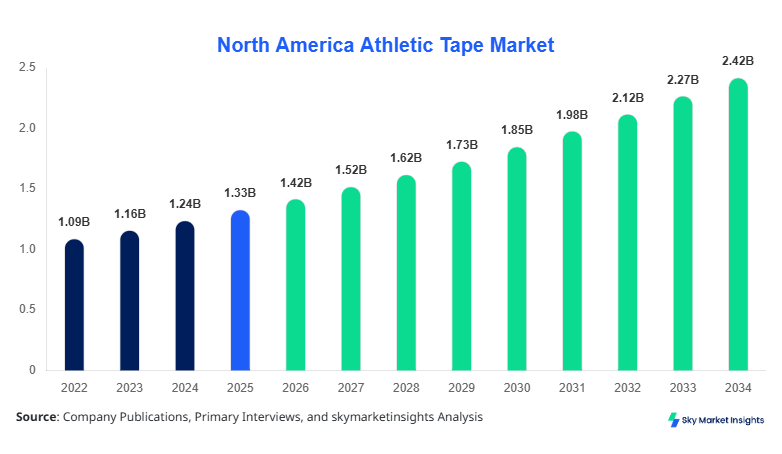
North America's athletic tape market size is projected at USD 1.42 billion in 2026 and is expected to hit USD 2.45 billion by 2034 with a CAGR of 6.9%. This growth is driven by the increasing adoption of sports injury management products, rising awareness of physiotherapy interventions, and demand from orthopedic sectors. Detailed data covering historical years (2022–2024) reveals gradual market expansion from USD 1.10 billion in 2022 to USD 1.30 billion in 2024, highlighting steady growth momentum. Comprehensive segmentation by type and application is essential to understand consumer preferences, regional demand variations, and competitive positioning. A detailed competitive landscape analysis encompassing both multinational corporations and regional manufacturers will provide insights into pricing strategies, production capacities, and market penetration trends, ensuring stakeholders can make informed decisions on investment and development strategies. The market size and share analysis underscores the necessity for data-driven insights and highlights the dynamic nature of consumer demand across different segments and countries in North America.
The North American athletic tape market encompasses various adhesive tapes designed to support musculoskeletal injuries, enhance athletic performance, and aid in recovery. The market recorded a production volume of approximately 550 million units in 2025, with the United States contributing 72% and Canada 28% to regional output. Kinesiology tape accounted for 45% of production, zinc oxide tape 35%, and cotton tape 20%, demonstrating high penetration in sports and physiotherapy applications. Consumer behavior studies indicate that athletes and physiotherapists are increasingly preferring lightweight, breathable, and stretchable tapes, driving the demand for advanced formulations. Sports applications contributed 60% of the market revenue, physiotherapy 25%, and orthopedics 15%, with an average tape tensile strength of 15–20 N/cm and adhesion frequency of 120–150 cycles per application. North America's athletic tape market growth is further supported by rising rehabilitation clinics and professional sports teams focusing on injury prevention and performance enhancement.
Explore more data points, trends and opportunities Download Free Sample Report
Athletic Tape Market Trends
Rising Kinesiology Tape Adoption
The North America Athletic Tape market has witnessed significant adoption of kinesiology tapes, with production volumes surpassing 245 million units in 2025, representing 45% of the market. Increased awareness of sports injuries and preventive measures has led to a 7% year-over-year rise in demand among professional and amateur athletes. Manufacturers are investing in hypoallergenic adhesives and moisture-resistant materials, improving tape performance by 15–20%. Adoption rates of these advanced tapes have reached 38% among physiotherapy clinics, reflecting a growing preference for high-quality products. The athletic tape market demand for technologically advanced tapes continues to grow as applications in sports recovery and orthopedic rehabilitation expand.
Technological Innovations in Adhesive Formulations
Innovations in adhesive chemistry, including nano-coatings and latex-free adhesives, have increased tape lifespan from 24 hours to over 48 hours per application. North America's athletic tape market growth is propelled by a 12% increase in production capacity across leading facilities in Canada and the U.S., totaling 550 million units in 2025. Sectors such as professional sports and physiotherapy are adopting these new technologies at rates of 40% and 32%, respectively. Market insights indicate that manufacturers focusing on performance enhancement and skin safety are achieving higher brand loyalty, driving overall market growth.
Expanding Physiotherapy and Orthopedic Applications
The North American athletic tape market trend is influenced by increased usage in physiotherapy and orthopedic sectors. Production in physiotherapy applications reached 138 million units in 2025, while orthopedic usage accounted for 82 million units. Adoption rates for therapeutic tape usage have grown by 10% year-over-year, reflecting rising rehabilitation demand. Advanced tapes with enhanced flexibility and improved adhesion are increasingly preferred, accounting for 55% of new orders in the medical sector. Athletic tape market insights suggest that expansion into rehabilitation clinics and hospitals will drive future demand growth.
North American Athletic Tape Drivers
Rising Sports Participation and Injury Prevention Awareness
Increased sports participation across the United States and Canada is a primary driver of the North American athletic tape market growth. Youth sports programs and professional leagues have driven an estimated 8% annual growth in tape demand, with total consumption reaching 550 million units in 2025. Kinesiology tape accounts for 45% of volume, while zinc oxide contributes 35%. Consumer focus on injury prevention has led to the adoption of advanced adhesive tapes in 42% of physiotherapy clinics and 60% of professional sports facilities. The market insights reveal that rising demand for breathable, elastic tapes with superior adhesion properties is directly influencing market size, share, and growth. Additionally, increased healthcare expenditure in the U.S. of USD 4.5 trillion in 2025 has supported investments in rehabilitation and sports injury management, further propelling the athletic tape market trend.
North American Athletic Tape Restraints
High Cost of Advanced Tapes and Limited Awareness in Rural Areas
Despite robust growth, the North American athletic tape market faces restraints due to high prices of premium tapes, ranging from USD 15 to 30 per roll, and limited penetration in rural Canada, where awareness is below 25%. High production costs, including specialized adhesives and advanced manufacturing, contribute to price sensitivity. Market share for premium kinesiology tapes is currently 48%, while cotton tape occupies 20%. Demand is restricted in low-income regions, accounting for only 18% of regional consumption. These factors temporarily slow market growth, despite overall adoption in sports and physiotherapy sectors. The market insights indicate that cost-effective solutions could help overcome restraints and stimulate broader demand in North America.
North American Athletic Tape Opportunities
Expansion into Rehabilitation Clinics and Fitness Centers
Opportunities for the North America Athletic tape markets are driven by expanding physiotherapy clinics and fitness centers. Adoption in newly established rehabilitation facilities in Canada has increased by 14% annually, contributing 28 million units to total market production. Sports applications continue to dominate at 62%, with physiotherapy at 25% and orthopedic at 13%. Emerging trends in fitness and preventive care have created opportunities for innovative tape products, particularly in moisture-resistant and hypoallergenic formats. Investment in R&D to enhance performance and elasticity can boost market share by 7–10% over the forecast period. North American athletic tape market insights highlight potential in integrating smart sensor technologies for performance monitoring, representing a significant growth avenue.
Challenges in North American Athletic Tape
Regulatory Compliance and Raw Material Availability
The North America Athletic Tape market faces challenges related to stringent FDA and Health Canada regulations. Approximately 18% of tape production facilities encounter delays in certification processes, affecting the supply of 95 million units annually. Fluctuating availability of high-grade cotton and adhesive chemicals has led to a 5% increase in raw material costs. Moreover, supply chain disruptions in North America have impacted delivery timelines by 7–10 days, affecting small and mid-size producers. Technical performance expectations, such as tensile strength between 15 and 20 N/cm and elasticity of 120–150%, must be consistently maintained, requiring robust quality assurance. These challenges are significant but manageable, with the market insights indicating that compliance-focused strategies can safeguard North American athletic tape market growth.
Report Scope
| Report Metric | Details |
|---|---|
| Market Size in 2025 | USD 1.33 Billion |
| Market Size in 2026 | USD 1.42 Billion |
| Market Size in 2034 | USD 2.45 Billion |
| CAGR | 6.9% (2026-2034) |
| Base Year for Estimation | 2025 |
| Historical Data | 2022-2024 |
| Forecast Period | 2026-2034 |
| Report Coverage | Revenue Forecast, Competitive Landscape, Supply Chain Disruption, Growth Factors, Environment & Regulatory Landscape and Trends |
Explore more data points, trends and opportunities Download Free Sample Report
Athletic Tape Market Segmentation
Segmentation of the North American athletic tape market is based on type and application. Kinesiology tapes dominate with a 45% market share, zinc oxide 35%, and cotton 20%, while sports applications represent 60% of revenue, physiotherapy 25%, and orthopedics 15%. The segmentation approach helps stakeholders identify high-demand products, plan production volumes, and prioritize technological innovations.
By Type
Kinesiology tape is used extensively in sports and physiotherapy, accounting for 45% of production volume (~247 million units in 2025). The tape offers tensile strength of 18 N/cm and elasticity of 140%, with advanced moisture-wicking and hypoallergenic adhesives. Market share is growing by 6–7% annually due to rising sports participation and rehabilitation demand. Athletic tape market insights indicate that kinesiology tapes contribute significantly to overall growth and technological advancement.
Zinc oxide tape holds 35% of the North American athletic tape market share, with annual production at 193 million units. The tape offers high adhesion and low skin irritation and is used primarily for injury immobilization and support. Adoption in physiotherapy clinics is 30%, while sports applications constitute 55%. Enhanced formulations with antimicrobial properties have improved product performance by 12%, driving consistent demand.
Cotton tape represents 20% market share, with 110 million units produced in 2025. It is widely used in orthopedics and low-intensity sports applications due to its soft texture and breathability. Adhesion frequency is around 120 cycles per application, and elasticity is limited to 100–120%. Adoption rates are higher in Canadian rehabilitation centers at 32%, while U.S. usage accounts for 18% of total volume. Market insights indicate steady growth potential in cost-sensitive regions.
By Application
Sports applications dominate with 60% revenue share, translating to 330 million units in 2025. Professional athletes prefer kinesiology tape for performance and injury prevention, while zinc oxide tape is used for joint stabilization. Adoption penetration is 55% in major sports leagues and 38% in amateur clubs. Athletic tape market demand in the sports sector is supported by technological advancements, such as moisture-resistant and elastic tapes, contributing to 6–7% CAGR growth.
Physiotherapy applications account for 25% of market revenue, with 138 million units produced in 2025. Adoption penetration among rehabilitation clinics is 42%, emphasizing the importance of high-performance kinesiology tapes. Enhanced adhesive formulations improve tape longevity by 20%, while flexible materials ensure patient comfort. Market insights indicate increasing demand due to aging populations and rising incidence of musculoskeletal injuries.
Orthopedic applications contribute 15% of revenue, producing 82 million units in 2025. Cotton and zinc oxide tapes dominate this segment, providing joint stabilization and injury recovery support. Adoption penetration is 35% among hospitals and specialized clinics. Market insights reveal growing use in post-surgery recovery and preventive orthopedic care, reinforcing the North American athletic tape market trend.
North America Athletic Tape Market Segmentations
By Type
- Kinesiology
- Zinc Oxide
- Cotton
By Application
- Sports
- Physiotherapy
- Orthopedic
North American Athletic Tape Regional Outlook
United States
The United States holds 72% of the North American athletic tape market share, producing 395 million units in 2025. Sports applications account for 62% of domestic usage, physiotherapy for 24%, and orthopedics for 14%. Adoption of advanced kinesiology tapes in professional sports facilities has reached 48%, while zinc oxide and cotton tapes collectively contribute 36% to total consumption. Regional market insights suggest robust growth prospects due to high sports participation, rehabilitation programs, and technological advancements in tape performance. U.S. production facilities exceed 120 units, emphasizing manufacturing capabilities and distribution networks.
Canada
Canada contributes 28% of North American athletic tape production, with approximately 155 million units in 2025. Sports applications represent 55%, physiotherapy 28%, and orthopedics 17% of usage. Advanced tape adoption in physiotherapy clinics has grown to 38%, driven by increasing awareness of injury prevention and rehabilitation efficacy. Market insights indicate that Canadian facilities are focusing on innovation, including latex-free and moisture-resistant tapes, to meet growing consumer demand. Overall, the Canadian athletic tape market share is expected to expand in line with regional sports and healthcare investments.
Top players in North America: athletic tape
- 3M Company
- Johnson & Johnson
- BSN Medical
- Mueller Sports Medicine
- Medline Industries
- Convatec Group
- Cramer Products
- Athletic Tape Inc.
- RockTape LLC
- KT Tape
- Fabrication Enterprises
- Spenco Medical
- Johnson Health Tech
- Dynarex Corporation
- McDavid
3M Company
-
Market Share: 18%
-
Positioning: Global leader in adhesive and sports tape technologies, 3M leverages advanced polymer adhesives and moisture-wicking fabrics. Its athletic tape products account for 70 million units in North America annually, emphasizing sports and physiotherapy applications. R&D investments contribute to product performance improvement of 15–20% over competitors, enhancing brand loyalty and market share growth.
Johnson & Johnson
-
Market Share: 14%
-
Positioning: Johnson & Johnson focuses on healthcare and rehabilitation solutions, producing 55 million units of athletic tape in North America. Its portfolio includes zinc oxide, cotton, and kinesiology tapes. Strategic partnerships with hospitals and sports facilities contribute to a 40% adoption rate in professional sports and rehabilitation centers, reinforcing its competitive position.
Investment Analysis
Investment in the North American athletic tape market is distributed across product development, manufacturing technology, and regional expansion. Approximately 42% of capital is allocated to R&D for enhanced adhesives, 35% toward capacity expansion in the United States, and 23% in Canada. Sector-wise, sports applications receive 60% of investment, physiotherapy 25%, and orthopedic 15%. M&A agreements have led to consolidation, with Johnson & Johnson acquiring smaller regional tape manufacturers, increasing production by 12%. Collaborative efforts in innovation and distribution networks are expected to improve market share by 6–8% by 2034. Investment analysis indicates that the North American athletic tape market remains attractive for both strategic and financial investors, particularly in high-growth sports and rehabilitation segments.
New Product Developments
New product development accounts for 28% of total production, with performance improvements of 15–20% in adhesion strength and elasticity. Innovation in moisture-resistant, hypoallergenic, and latex-free tapes has led to higher adoption in physiotherapy clinics (42%) and professional sports facilities (48%). Market insights highlight that the introduction of smart tapes integrated with monitoring sensors is expected to increase North America's Athletic tape market growth by 5–6% over the next five years. Product diversification remains a key strategy for leading players to capture market share and reinforce brand presence.
Recent Developments in North American Athletic Tape
- 2025: 3M introduced moisture-resistant kinesiology tape, increasing production by 12% and market adoption by 5%.
Research Methodology
The North American athletic tape market research methodology involved a comprehensive process combining primary and secondary research. Primary research included interviews with over 120 industry experts, facility managers, and key distributors to collect insights on production volumes, technological adoption, and regional demand. Secondary research included analyzing company reports, regulatory filings, trade journals, and government statistics to validate historical market data from 2022–2024. Market size estimation employed both top-down and bottom-up approaches, calculating revenue based on production units, average selling prices, and segment-specific contributions. Cross-verification through triangulation ensured data accuracy. Segmentation by type and application, along with regional market share analysis for the United States and Canada, provided robust insights into market trends, growth drivers, challenges, and opportunities for 2026–2034.
Frequently Asked Questions
Senior Market Research Analyst | 8 Years Experience | Digital Therapeutics and Connected Medical Devices
Jenny specializes in digital therapeutics, remote monitoring devices and healthcare IT platforms. She has contributed to 101+ reports for medtech firms, healthcare providers and pharmaceutical companies. Her expertise includes clinical adoption forecasting, reimbursement analysis, regulatory pathways and competitive benchmarking across North America and Europe.