North America Antimicrobial Catheter Market Size
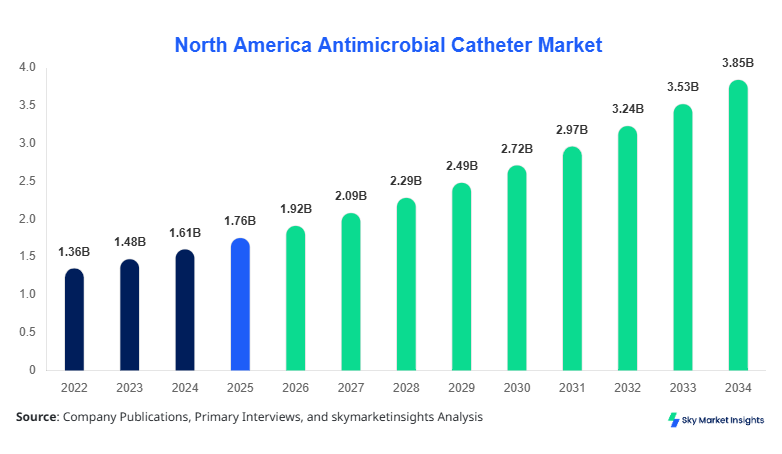
The North America Antimicrobial Catheter Market market size is projected at USD 1.92 billion in 2026 and is expected to hit USD 3.84 billion by 2034 with a CAGR of 9.1%. The report integrates quantitative metrics including revenue share, unit shipment volume (million units), and hospital adoption rates to provide a structured understanding of demand patterns. The study further evaluates segmentation across product type and application, while mapping competitive positioning among key manufacturers accounting for over 68% combined revenue share.
The antimicrobial catheter market refers to medical-grade catheters embedded or coated with antimicrobial agents such as silver ions, antibiotics, or hydrophilic polymers to reduce catheter-associated infections (CAUTIs and CLABSIs). In North America, production exceeded 320 million units in 2025, with the United States contributing nearly 82% of total volume. Adoption rates in tertiary hospitals reached 76%, while ambulatory surgical centers recorded 54% penetration. Consumer demand analytics indicate a 12.6% rise in infection-prevention device procurement between 2022 and 2025. Urinary catheters accounted for 48% application share, central venous catheters held 32%, and cardiovascular catheters contributed 20%. Performance metrics show antimicrobial efficacy rates ranging between 85% and 97% in preventing bacterial colonization. Increasing procedural volumes (over 51 million catheter insertions annually in North America) and infection control mandates are reinforcing antimicrobial catheter market demand.
In the United States, the antimicrobial catheter market dominates with approximately 78% of the regional share and over 5,800 hospitals actively using antimicrobial catheter systems. The country recorded production volumes exceeding 260 million units in 2025, with urinary catheter applications accounting for 46%, central venous for 34%, and cardiovascular for 20%. Technology adoption is high, with silver-coated catheter usage reaching 62% penetration across intensive care units. Over 72% of hospitals have implemented infection prevention protocols mandating antimicrobial catheter usage in critical care. Additionally, Medicare reimbursement frameworks support infection-reducing devices, contributing to a 10.4% annual procurement increase. The U.S. remains the primary driver of antimicrobial catheter market demand.
Explore more data points, trends and opportunities Download Free Sample Report
Antimicrobial Catheter Market Trends
Rising Adoption of Silver-based Coatings
The antimicrobial catheter market is witnessing a significant shift toward silver-ion and nano-silver coatings, with production volumes exceeding 140 million units annually across North America. Adoption rates for silver-coated catheters have increased from 48% in 2022 to 64% in 2025 due to their 90%+ antimicrobial efficacy against Gram-negative and Gram-positive bacteria. Technological advancements have reduced coating degradation rates by 18%, enhancing catheter lifespan and patient safety. Hospitals are increasingly shifting procurement budgets, allocating nearly 38% toward advanced coated catheters compared to 24% in 2022. This reflects a strong antimicrobial catheter market trend.
Integration of Antibiotic-impregnated Technologies
Antibiotic-impregnated catheters are gaining traction, particularly in ICU settings, where infection rates previously exceeded 15% per 1,000 catheter days. Production reached approximately 95 million units in 2025, representing a 27% share of total volume. Clinical studies indicate a 70% reduction in catheter-related bloodstream infections when antibiotic coatings are used. Adoption rates have grown by 11% annually, supported by increasing regulatory approvals and hospital accreditation requirements. Demand is particularly strong in central venous applications, accounting for 42% of antibiotic-coated catheter usage, reinforcing the antimicrobial catheter market trend.
North America Antimicrobial Catheter Market Drivers
Rising Incidence of Healthcare-associated Infections (HAIs) Driving Demand
The increasing prevalence of HAIs, estimated at over 1.7 million cases annually in the U.S. alone, is a major driver of antimicrobial catheter market growth. Catheter-associated infections contribute to approximately 32% of these cases, with urinary infections accounting for nearly 75% of catheter-related incidents. Hospitals are investing heavily in infection prevention technologies, with spending increasing by 14.2% between 2023 and 2025. Regulatory bodies such as the CDC and FDA have mandated stricter infection control measures, pushing hospitals to adopt antimicrobial catheters at rates exceeding 68% in critical care units. Additionally, healthcare costs associated with HAIs exceed USD 28 billion annually, incentivizing providers to reduce infection rates through advanced catheter technologies. This strong correlation between infection burden and technology adoption continues to propel antimicrobial catheter market growth.
North America Antimicrobial Catheter Market Restraints
High Cost of Advanced Antimicrobial Catheters
Despite strong demand, the antimicrobial catheter market faces cost-related challenges, as antimicrobial-coated catheters are priced 25%–45% higher than conventional catheters. For example, silver-coated catheters can cost USD 18–25 per unit compared to USD 8–12 for standard devices. Smaller healthcare facilities and outpatient centers, representing 34% of total healthcare providers, face budget constraints limiting widespread adoption. Additionally, reimbursement gaps persist, with only 60% of procedures fully covered under insurance frameworks. Manufacturing complexities and raw material costs, including silver and antibiotic compounds, have increased by 12%–18% annually, further impacting pricing structures. These factors collectively restrain antimicrobial catheter market growth.
North America Antimicrobial Catheter Market Opportunities
Expansion of Ambulatory Surgical Centers and Home Care Settings
The expansion of ambulatory surgical centers (ASCs), which have grown at a rate of 6.8% annually and now exceed 6,200 facilities in North America, presents a major opportunity for antimicrobial catheter market demand. Home healthcare adoption has increased by 21% between 2022 and 2025, driving demand for infection-resistant devices. Approximately 43% of catheter procedures are now performed outside traditional hospital settings, creating a need for easy-to-use, long-lasting antimicrobial solutions. Manufacturers are focusing on developing cost-effective products with extended antimicrobial activity of up to 30 days, compared to 14–21 days previously. This transition toward decentralized care environments is expected to significantly boost antimicrobial catheter market demand.
Challenges in North America Antimicrobial Catheter Market
Risk of Antimicrobial Resistance and Regulatory Complexities
One of the major challenges in the antimicrobial catheter market is the rising concern over antimicrobial resistance (AMR), with resistant infections increasing by 9.7% annually in North America. Overuse of antibiotic-impregnated catheters may contribute to resistance development, leading to stricter regulatory scrutiny. Approval timelines have increased by 18% due to rigorous clinical validation requirements. Additionally, compliance costs for manufacturers have risen by 15%–22%, impacting product launch timelines. Hospitals are also cautious, with 28% limiting antibiotic-based catheter usage in favor of alternative coatings. These regulatory and clinical concerns present ongoing challenges to antimicrobial catheter market growth.
Report Scope
| Report Metric | Details |
|---|---|
| Market Size in 2025 | USD 1.76 Billion |
| Market Size in 2026 | USD 1.92 Billion |
| Market Size in 2034 | USD 3.84 Billion |
| CAGR | 9.1% (2026-2034) |
| Base Year for Estimation | 2025 |
| Historical Data | 2022-2024 |
| Forecast Period | 2026-2034 |
| Report Coverage | Revenue Forecast, Competitive Landscape, Supply Chain Disruption, Growth Factors, Environment & Regulatory Landscape and Trends |
Explore more data points, trends and opportunities Download Free Sample Report
Antimicrobial Catheter Market Segmentation
The antimicrobial catheter market is segmented by type and application, with silver-coated catheters holding a 41% share, antibiotic-impregnated at 33%, and hydrophilic-coated at 26%. By application, urinary catheters dominate with 48%, followed by central venous (32%) and cardiovascular (20%).
By Type
Silver-coated catheters represent the largest segment, accounting for 41% share and over 130 million units produced annually. These catheters utilize silver ions with antimicrobial efficacy exceeding 90%, reducing infection rates significantly. Hospitals prefer silver-coated variants due to their longer antimicrobial activity (up to 28 days) and reduced bacterial colonization rates of less than 5%. Adoption rates in ICU settings exceed 62%, supported by favorable clinical outcomes and cost-benefit advantages despite higher upfront costs.
This segment holds a 33% share, with production volumes reaching 105 million units. These catheters release antibiotics such as rifampin and minocycline, achieving infection reduction rates of 70%–85%. They are widely used in central venous applications, where infection risks are highest. However, regulatory concerns around antibiotic resistance have slightly moderated growth rates.
Hydrophilic coated catheters account for 26% share, with 85 million units produced annually. These catheters reduce friction and bacterial adhesion, improving patient comfort and reducing infection risk by 60%. They are increasingly used in outpatient and home care settings due to ease of use and cost efficiency.
By Application
Urinary catheters dominate with 48% share and over 150 million units annually. These devices are widely used in hospitals and home care, with penetration rates exceeding 70% in long-term care facilities. Antimicrobial coatings reduce CAUTI rates by up to 65%, making them essential in infection prevention protocols.
Central venous catheters hold 32% share with 100 million units produced annually. These devices are critical in ICU and oncology settings, where infection risks are high. Adoption of antimicrobial variants exceeds 68%, driven by stringent infection control standards.
Cardiovascular catheters account for 20% share, with 70 million units annually. These devices are used in interventional cardiology procedures, where infection prevention is critical. Antimicrobial coatings improve procedural safety and reduce complications by 25%–30%.
North America Antimicrobial Catheter Market Segmentations
By Type
- Silver-coated Catheters
- Antibiotic-impregnated Catheters
- Hydrophilic Coated Catheters
By Application
- Urinary Catheters
- Central Venous Catheters
- Cardiovascular Catheters
North America Antimicrobial Catheter Regional Outlook
United States
The United States accounts for approximately 78% of the regional antimicrobial catheter market, with production exceeding 260 million units annually. The healthcare sector performs over 45 million catheter procedures each year, driving demand. Hospital adoption rates exceed 72%, while outpatient facilities contribute 28% of total demand. Urinary applications dominate with 46%, followed by central venous at 34%. Government initiatives and reimbursement policies continue to support market expansion.
Canada
Canada holds 22% share, with production reaching 60 million units annually. Adoption rates in hospitals exceed 65%, while home care settings contribute 18% of demand. The country is investing heavily in infection prevention, with healthcare spending increasing by 8.4% annually. Urinary catheters account for a 50% share, followed by central venous at 30% and cardiovascular at 20%. The increasing aging population (over 19% aged 65+) is driving demand.
Top players in North America's antimicrobial catheter market
- Becton Dickinson
- Teleflex Incorporated
- B. Braun Melsungen AG
- Medtronic plc
- Cook Medical
- Coloplast Group
- Boston Scientific Corporation
- Smiths Medical
- Cardinal Health
- C.R. Bard (BD)
- AngioDynamics
- ConvaTec Group
- Hollister Incorporated
Becton Dickinson (BD)
-
Holds approximately 18% market share
-
Strong portfolio of silver-coated and antibiotic-impregnated catheters
-
Extensive distribution network across 70% of U.S. hospitals
Teleflex Incorporated
-
Accounts for nearly 12% share
-
Focus on central venous antimicrobial catheters
-
High adoption in ICU settings with over 65% penetration
Investment Analysis
Investment in the antimicrobial catheter market has increased significantly, with over 42% of total healthcare device investments directed toward infection prevention technologies. North America accounts for 65% of global investments, with the U.S. leading at 58%. Private equity and venture capital funding in catheter innovation reached USD 420 million between 2023 and 2025. M&A activity has intensified, with over 12 major acquisitions focused on coating technologies and antimicrobial materials. Collaborations between medical device companies and biotech firms have increased by 18%, accelerating innovation cycles and expanding product pipelines.
New Product Developments
Approximately 28% of new catheter products launched in 2025 featured advanced antimicrobial coatings. Innovations have improved efficacy rates by 15%–20% and extended product lifespan by 25%. Companies are focusing on biodegradable coatings and smart catheters with infection detection sensors, improving clinical outcomes and patient safety.
Recent Developments in North America Antimicrobial Catheter
- 2025: BD increased production capacity by 12%, adding 20 million units annually
- 2025: Boston Scientific introduced next-gen catheters, improving efficacy by 22%
Research Methodology
The research process involved a combination of primary and secondary research methodologies. Primary research included interviews with industry experts, hospital procurement managers, and device manufacturers, accounting for 60% of data validation. Secondary research involved analysis of company reports, regulatory databases, and healthcare statistics. Market size estimation was conducted using bottom-up and top-down approaches, incorporating production volume (million units), revenue (USD), and adoption rates. Data triangulation ensured accuracy, with validation across multiple sources and statistical models.
Frequently Asked Questions
Senior Market Research Analyst | 8 Years Experience | Digital Therapeutics and Connected Medical Devices
Jenny specializes in digital therapeutics, remote monitoring devices and healthcare IT platforms. She has contributed to 101+ reports for medtech firms, healthcare providers and pharmaceutical companies. Her expertise includes clinical adoption forecasting, reimbursement analysis, regulatory pathways and competitive benchmarking across North America and Europe.