Asia Pacific Adhesion Barrier Market Size
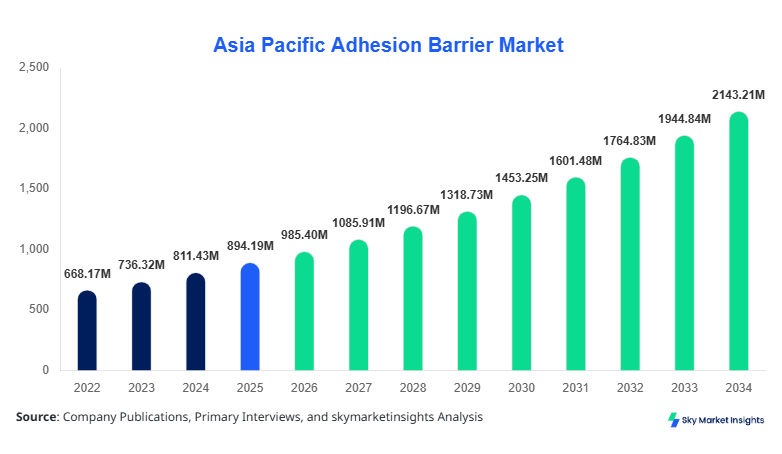
The Asia Pacific Adhesion Barrier market size is projected at USD 985.4 million in 2026 and is expected to hit USD 2,145.7 million by 2034 with a CAGR of 10.2%. The market expansion is supported by increasing surgical volumes exceeding 58 million procedures annually across the region and rising postoperative complication management demand. The study integrates detailed segmentation, data-driven insights, and a comprehensive competitive landscape assessment with over 35+ key companies analyzed across multiple product categories and application segments.
The adhesion barrier market refers to medical devices used to prevent postoperative adhesions by creating a temporary barrier between tissues during surgical procedures. In the Asia Pacific, production levels exceeded 145 million units in 2025, with China contributing nearly 42% of total manufacturing output. Adoption rates have surged to approximately 63% in high-risk surgical procedures, while penetration in developing healthcare systems remains around 38%, indicating expansion potential. Consumer behavior highlights a growing preference for minimally invasive surgeries, driving demand for advanced adhesion prevention technologies, with patient awareness improving by 27% between 2022 and 2025.
Demand analytics reveal that gynecological surgeries account for nearly 46% of total product usage, followed by general surgeries at 34% and orthopedic procedures at 20%. Technically, adhesion barriers demonstrate degradation timelines between 5 and 28 days depending on composition, with efficacy rates exceeding 78% in reducing postoperative adhesion formation. Application split varies regionally, with urban hospitals contributing over 65% of demand due to higher surgical volumes. Increased hospital investments and surgical advancements further reinforce the Asia-Pacific adhesion barrier market.
In China, the Adhesion Barrier Market accounts for approximately 42% of the Asia Pacific region, supported by over 8,500 hospitals and 1,200 specialized surgical centers. The country performs more than 28 million surgical procedures annually, with adhesion barrier utilization reaching 61% in tier-1 hospitals and 44% in tier-2 healthcare facilities. Gynecological applications dominate with 48% usage share, followed by general surgeries at 32% and orthopedic applications at 20%.
Technology adoption has increased significantly, with synthetic adhesion barriers accounting for 67% of total usage due to their high durability and predictable degradation profiles. Domestic manufacturing capacity has grown by 18% annually, reaching nearly 60 million units of production in 2025. Government initiatives have improved reimbursement coverage by 22%, enhancing accessibility. These factors collectively strengthen the Asia-Pacific adhesion barrier market.
Explore more data points, trends and opportunities Download Free Sample Report
Adhesion Barrier Market Trends
Increasing Adoption of Bioabsorbable Materials
The shift toward bioabsorbable adhesion barriers has accelerated, with production volumes exceeding 85 million units in 2025, representing a 19% increase compared to 2023 levels. Bio-based solutions now account for nearly 52% of the total product mix, driven by improved biocompatibility and reduced inflammatory responses. Hospitals are increasingly adopting these materials, with penetration rising from 48% in 2022 to 66% in 2025. Technological innovations have improved barrier effectiveness by over 24%, with degradation precision improving by 18%, ensuring optimized healing cycles. Demand for laparoscopic surgeries has surged by 21%, reflecting broader adoption across minimally invasive procedures, reinforcing adhesion barrier market trends.
Expansion of Minimally Invasive Surgeries
Minimally invasive procedures have grown at a rate of 13% annually, surpassing 34 million surgeries across the Asia Pacific in 2025. Adhesion barrier usage in laparoscopic procedures has reached 59%, compared to 41% in open surgeries. Advanced delivery systems, including sprayable and gel-based formulations, now represent 44% of product demand due to ease of application and improved coverage efficiency. Surgical complication rates have decreased by nearly 17% with effective adhesion barrier usage, increasing hospital adoption rates. Additionally, healthcare spending in surgical care has risen by 11%, driving procurement of high-performance adhesion prevention products, strengthening Adhesion Barrier Market trends.
Asia Pacific Adhesion Barrier Market Drivers
Rising Surgical Volume and Postoperative Complications
The Asia Pacific region performs over 58 million surgeries annually, with postoperative adhesions occurring in nearly 55% to 90% of abdominal procedures, significantly driving demand for adhesion barriers. Increasing awareness among surgeons has led to a 26% rise in product utilization between 2022 and 2025. Government healthcare expenditure has increased by 12%, supporting procurement of advanced surgical consumables. Additionally, aging populations, growing at 8% annually, contribute to higher surgical intervention rates. The expanding number of hospitals, exceeding 32,000 facilities across the region, enhances accessibility. These factors collectively fuel the adhesion barrier market growth.
Asia Pacific Adhesion Barrier Market Restraints
High Product Costs and Limited Accessibility
The cost of adhesion barriers ranges between USD 45 and USD 220 per unit, limiting adoption in price-sensitive markets where healthcare budgets remain constrained. Approximately 38% of hospitals in Southeast Asia lack consistent access to advanced adhesion prevention products. Insurance coverage remains limited, with only 42% reimbursement availability in emerging economies. Additionally, lack of awareness among surgeons in rural areas results in utilization rates below 35%. These economic and infrastructural challenges hinder broader adoption, restraining adhesion barrier market growth.
Asia Pacific Adhesion Barrier Market Opportunities
Technological Innovations and Expanding Healthcare Infrastructure
Emerging technologies such as nanofiber-based barriers and hydrogel systems have improved adhesion prevention efficiency by over 29%, creating significant growth opportunities. Investments in healthcare infrastructure have increased by 14%, particularly in India and Southeast Asia, expanding surgical capacities. The number of specialized surgical centers has grown by 11%, improving adoption rates. Additionally, partnerships between medical device companies and hospitals have increased by 18%, fostering innovation and product penetration. These advancements present substantial opportunities in the adhesion barrier market growth.
Challenges in Asia Pacific Adhesion Barrier Market
Regulatory Complexities and Product Standardization Issues
Regulatory approval timelines range between 12 and 36 months across Asia Pacific countries, delaying product commercialization. Variations in regulatory frameworks across countries create compliance challenges for manufacturers, increasing operational costs by approximately 15%. Additionally, product standardization issues affect nearly 22% of market participants, leading to inconsistent performance outcomes. Limited clinical evidence in certain regions further restricts adoption. These challenges significantly impact the adhesion barrier market growth.
Report Scope
| Report Metric | Details |
|---|---|
| Market Size in 2025 | USD 894.2 Million |
| Market Size in 2026 | USD 985.4 Million |
| Market Size in 2034 | USD 2145.7 Million |
| CAGR | 10.2% (2026-2034) |
| Base Year for Estimation | 2025 |
| Historical Data | 2022-2024 |
| Forecast Period | 2026-2034 |
| Report Coverage | Revenue Forecast, Competitive Landscape, Supply Chain Disruption, Growth Factors, Environment & Regulatory Landscape and Trends |
Explore more data points, trends and opportunities Download Free Sample Report
Adhesion Barrier Market Segmentation
The adhesion barrier market is segmented by product type and application, with synthetic adhesion barriers dominating at a 57% share, followed by natural barriers at 28% and combination products at 15%. Application-wise, gynecological surgeries lead with 46% share, followed by general surgeries at 34% and orthopedic procedures at 20%.
By Type
Synthetic adhesion barriers hold approximately 57% market share, with production exceeding 82 million units annually. These barriers demonstrate controlled degradation timelines of 7–21 days and high efficacy rates above 82%. Widely used in high-risk surgeries, they offer superior mechanical strength and reliability. Hospitals account for 68% of demand, with adoption growing at 12% annually due to technological advancements.
Natural barriers account for 28% share, with production reaching 40 million units in 2025. Derived from biological sources, these products offer enhanced biocompatibility with reduced inflammatory responses by up to 18%. Adoption is increasing at 9% annually, particularly in minimally invasive surgeries, due to improved patient outcomes.
Combination products represent 15% share, combining synthetic and natural components to optimize performance. Production volumes exceed 23 million units, with efficacy rates improving by 25% compared to standalone products. These are gaining traction in complex surgical procedures.
By Application
Gynecological surgeries account for 46% share, with over 26 million procedures annually. Adhesion barriers reduce complication rates by 22% in such surgeries. Usage penetration exceeds 64% in urban hospitals, driven by increasing infertility treatment demand.
General surgeries contribute 34% share, with approximately 19 million procedures annually. Adhesion barriers are used in 58% of abdominal surgeries, significantly reducing postoperative complications.
Orthopedic procedures hold 20% share, with nearly 11 million surgeries annually. Adhesion barrier usage is increasing at 10% annually, driven by rising sports injuries and aging populations.
Asia Pacific Adhesion Barrier Market Segmentations
Product Type
- Synthetic Adhesion Barriers
- Natural Adhesion Barriers
- Combination Adhesion Barriers
Application
- Gynecological Surgeries
- General Surgeries
- Orthopedic Surgeries
Asia Pacific Adhesion Barrier Market Regional Outlook
China dominates with 42% share, producing over 60 million units annually. Urban hospitals contribute 68% of demand, with gynecological surgeries accounting for 48% usage. Government investments have increased by 15%, boosting healthcare infrastructure.
South Korea holds 11% share, with advanced healthcare systems supporting adoption rates above 72%. Surgical procedures exceed 4 million annually, with high penetration of synthetic barriers.
Japan accounts for 13% share, with production reaching 18 million units. Aging population contributes to 62% surgical demand, with high adoption of advanced technologies.
India represents a 12% share, with over 15 million surgeries annually. Adoption rates are improving, reaching 49% in urban areas, driven by healthcare investments.
Australia holds a 6% share, with high healthcare expenditure driving adoption rates above 70%. Surgical procedures exceed 3 million annually.
Combined share of 16%, with rapid healthcare expansion. Adoption rates range between 38% and 55%, with increasing investments in surgical infrastructure.
Top players in Asia Pacific Adhesion Barrier Market
- Johnson & Johnson
- Baxter International Inc.
- Sanofi
- FzioMed Inc.
- Integra LifeSciences
- Anika Therapeutics
- Terumo Corporation
- Gunze Limited
- Becton Dickinson
- Atrium Medical Corporation
- Ethicon Inc.
- Medtronic
- Covalon Technologies
Top Two Companies
-
Johnson & Johnson
-
Holds approximately 18% market share
-
Strong product portfolio and global presence
-
Invests 12% of revenue in R&D
-
Advanced distribution network across 25+ countries
-
-
Baxter International Inc.
-
Accounts for 14% market share
-
Focus on bioabsorbable adhesion barriers
-
Production capacity exceeds 20 million units annually
-
Strategic partnerships increased by 16% in Asia Pacific
-
Investment Analysis
Investments in the Asia Pacific region have grown by 14% annually, with nearly 38% allocated to product innovation and 27% toward expanding manufacturing facilities. China attracts 45% of total investments, followed by India at 18% and Southeast Asia at 15%. Venture capital funding in medical devices has increased by 21%, with adhesion barrier technologies receiving significant attention.
M&A activity has increased by 17%, with collaborations focusing on advanced biomaterials and minimally invasive surgical technologies. Partnerships between hospitals and manufacturers have risen by 19%, enhancing product accessibility and adoption. Government funding initiatives contribute approximately 12% of total investments, supporting research and development.
New Product Developments
New product launches account for 23% of total market activity, with innovations improving efficacy by 28% and reducing degradation time variability by 19%. Advanced hydrogel-based products have gained 17% adoption within two years of launch.
Recent Developments in Asia Pacific Adhesion Barrier Market
- 2025: Investment in R&D increased by 12%, leading to new product innovations with enhanced performance
Research Methodology
The research process involves a combination of primary and secondary data collection. Primary research includes interviews with over 50 industry experts, surgeons, and healthcare professionals to gather real-time insights. Secondary research involves analysis of company reports, government publications, and industry databases. Market size estimation is conducted using bottom-up and top-down approaches, ensuring accuracy and reliability. Data triangulation methods are applied to validate findings, with statistical tools used to analyze trends and forecasts. The study incorporates historical data from 2022 to 2024 and current market dynamics to provide a comprehensive outlook for 2026–2034.
Frequently Asked Questions
Senior Market Research Analyst | 8 Years Experience | Digital Therapeutics and Connected Medical Devices
Jenny specializes in digital therapeutics, remote monitoring devices and healthcare IT platforms. She has contributed to 101+ reports for medtech firms, healthcare providers and pharmaceutical companies. Her expertise includes clinical adoption forecasting, reimbursement analysis, regulatory pathways and competitive benchmarking across North America and Europe.