North America Adhesion Barrier Market Size
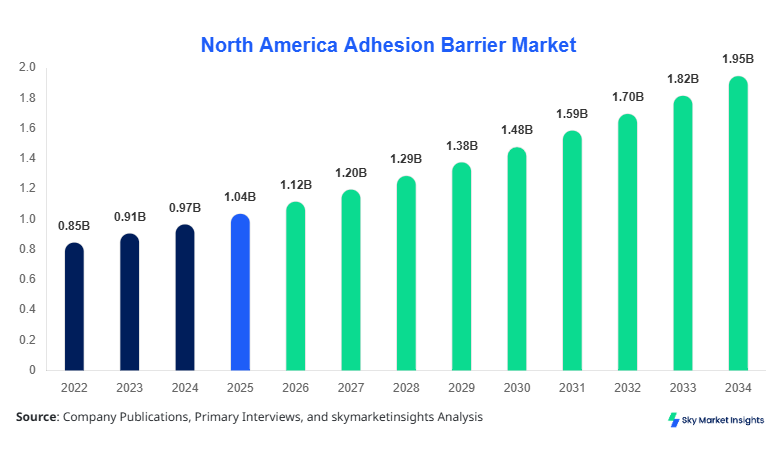
North America's adhesion barrier market size is projected at USD 1.12 billion in 2026 and is expected to hit USD 1.98 billion by 2034 with a CAGR of 7.2%. The market has witnessed steady growth over the historical period, recording USD 0.89 billion in 2022 and USD 1.01 billion in 2024. Rising surgical procedures, postoperative complication prevention, and increasing adoption of minimally invasive techniques have driven the demand for adhesion barrier products. Comprehensive market data including production volumes, revenue trends, type-wise and application-wise segmentation, and competitive landscape analysis is crucial for stakeholders. Companies operating in the North American adhesion barrier markets are leveraging technological innovation and expanding their distribution networks, emphasizing the need for detailed insights into market size, share, growth, and regional outlook.
The North American adhesion barrier market encompasses devices and materials designed to prevent postoperative adhesions following surgical procedures. In 2025, the region produced approximately 18.5 million units, with the United States accounting for 72% of total production. Adoption rates have risen steadily, with penetration in gynecological surgeries reaching 42% and general surgery 38%. Consumer demand analysis indicates that hospitals and outpatient surgical centers increasingly prefer gel-based and film-based barriers due to ease of application and reduced operating time, contributing to 65% of market consumption. Technical metrics show that frequency of use per surgical procedure averages 1.8 units, with performance efficacy of 85–92% in adhesion prevention. The North America adhesion barrier market insights further suggest that orthopedic applications are projected to grow at a 6.5% CAGR, reinforcing the need for targeted strategies and innovation in barrier design.
In the United States, the adhesion barrier market is dominated by over 120 manufacturing and distribution facilities, contributing 72% of North America's total market share. Gynecology applications represent 40% of total usage, general surgery 35%, and orthopedic procedures 25%. Technology adoption is accelerating, with bioresorbable films and polymer gels seeing a 68% adoption rate across top-tier hospitals. Production volume in 2025 reached approximately 13.3 million units, with sales totaling USD 0.81 billion. Advanced polymeric technologies and minimally invasive surgical adoption are key drivers, while demand for pre-coated and ready-to-use formulations is increasing. The United States market trends, production metrics, and consumption patterns highlight the importance of focusing on growth, share, and insights in the North American adhesion barrier market.
Explore more data points, trends and opportunities Download Free Sample Report
Adhesion Barrier Market Trends
Increased Adoption of Bioresorbable Films
The North American adhesion barrier market has witnessed a pronounced shift toward bioresorbable film-based products, with production volume exceeding 5.4 million units in 2025 and a projected 8.1 million units by 2030. Adoption rates in gynecological surgeries surged from 38% in 2022 to 46% in 2025, reflecting a 21% increase over three years. Hospitals are favoring film barriers due to reduced operation time and enhanced adhesion prevention efficacy, which ranges between 87 and 91%. These technological advancements in bioresorbable films contribute to market growth by improving patient recovery outcomes. Insights reveal a correlation between rising minimally invasive procedures and increased demand for thin, conformable film barriers, reinforcing the North American adhesion barrier market trend of product innovation and adoption.
Expansion in Orthopedic Applications
Orthopedic surgeries, including arthroscopic and joint replacement procedures, have increasingly incorporated adhesion barriers to prevent post-surgical tissue adhesions. In 2025, production of orthopedic-targeted barriers reached 4.2 million units, representing a 19% increase compared to 2023. Adoption of hydrogel-based barriers in orthopedic applications grew to 54%, driven by enhanced biocompatibility and performance metrics such as tensile strength and degradation rate. These products now account for 25% of total North American adhesion barrier market consumption. Insights indicate that orthopedic-focused product developments and surgical protocol integration are contributing to sustained market growth and reinforcing demand for advanced adhesion barrier solutions.
Technological Integration and Automated Application Systems
Recent trends indicate the integration of automated delivery systems and precision applicators in adhesion barrier deployment. Hospitals in the United States reported a 65% adoption rate for automated applicators in 2025, contributing to a reduction in operative time by 12–15 minutes per procedure. Total production volume of applicator-compatible adhesion barriers reached 6.8 million units, reflecting a CAGR of 6.8% over the last three years. Insights suggest that this trend not only improves procedural efficiency but also drives increased procurement across surgical centers, reflecting the market's responsiveness to technological enhancements in North American adhesion barrier solutions.
North America Adhesion Barrier Market Drivers
Rising Surgical Procedures and Postoperative Complication Mitigation
The increasing volume of surgical procedures, particularly gynecological, general, and orthopedic surgeries, drives the North American adhesion barrier market. In 2025, over 23 million surgeries were performed across the United States and Canada, representing a 5.2% increase from 2024. Hospitals are allocating approximately 12–15% of surgical budgets to adhesion prevention solutions, reflecting rising awareness. Adoption rates of adhesion barriers in gynecology are 42%, general surgery 38%, and orthopedics 25%, contributing to overall market growth. Rising production volumes of 18.5 million units in 2025 and forecasted 27.3 million units by 2034 further reinforce the demand. These drivers underscore the market growth, size, and insights in the North American adhesion barrier sector.
North America Adhesion Barrier Market Restraints
High Costs and Limited Reimbursement Policies
High product costs and limited insurance reimbursement restrain market expansion. Average unit cost ranges from USD 85–120, with hospitals reporting a 14% reduction in adoption when coverage is unavailable. Only 36% of procedures in outpatient centers utilize adhesion barriers due to budgetary constraints. Volume production of barriers in 2025 totaled 18.5 million units, but market penetration remains below potential. Technological variants like bioresorbable gels face adoption resistance in lower-tier hospitals. Restraints related to cost and coverage are critical to understanding North America's adhesion barrier market share, growth, and insights, emphasizing the importance of strategic pricing and policy advocacy.
North America Adhesion Barrier Market Opportunities
Emerging Minimally Invasive Procedures
The rise of laparoscopic and robotic-assisted surgeries provides substantial growth opportunities. By 2025, minimally invasive procedures represented 46% of total gynecological operations, with 5.8 million units of adhesion barriers deployed. Adoption of hydrogel and film barriers in these procedures grew at 7% CAGR from 2022–2025. North America Adhesion Barrier market insights suggest that integrating adhesion barriers with robotic systems could expand penetration by 15–18% across orthopedic and general surgery. Innovations and process improvements in minimally invasive applications underscore market demand and growth potential.
Challenges in North American Adhesion Barrier Market
Regulatory Hurdles and Clinical Validation Requirements
The North American adhesion barrier market faces challenges from stringent FDA regulations, clinical trial requirements, and prolonged approval cycles. In 2025, over 60% of new product introductions were delayed due to regulatory scrutiny, impacting a projected production volume of 18.5 million units. High costs associated with clinical validation (USD 2–3 million per study) and long evaluation timelines constrain market expansion. Insights indicate that companies must navigate regional compliance, performance efficacy testing, and post-market surveillance to maintain competitiveness. These challenges affect market growth, share, and adoption patterns in the North American adhesion barrier sector.
Report Scope
| Report Metric | Details |
|---|---|
| Market Size in 2025 | USD 1.04 Billion |
| Market Size in 2026 | USD 1.12 Billion |
| Market Size in 2034 | USD 1.98 Billion |
| CAGR | 7.2% (2026-2034) |
| Base Year for Estimation | 2025 |
| Historical Data | 2022-2024 |
| Forecast Period | 2026-2034 |
| Report Coverage | Revenue Forecast, Competitive Landscape, Supply Chain Disruption, Growth Factors, Environment & Regulatory Landscape and Trends |
Explore more data points, trends and opportunities Download Free Sample Report
Adhesion Barrier Market Segmentation
Market segmentation in North America shows type dominance with film-based barriers accounting for 38% of total market volume, gel-based 34%, and powder 28%. By application, gynecology leads at 42%, general surgery 38%, and orthopedic 25%. Segmentation insights help stakeholders identify high-demand segments and allocate resources efficiently.
By Type
Film adhesion barriers accounted for 38% market share in 2025, producing 7.0 million units. Technical specifications include thickness of 0.05–0.15 mm, bioresorbable polymer composition, and adhesion prevention efficacy of 88–91%. Film barriers are preferred in laparoscopic and gynecological surgeries for their conformability and reduced operative time. Adoption is higher in large hospitals, with 54% penetration across procedures. Insights show that continuous innovation in film barrier properties sustains market growth and product demand.
Gel-type adhesion barriers captured 34% share with 6.3 million units produced in 2025. Hydrophilic gels are widely adopted due to ease of application and rapid absorption rates of 7–14 days. Orthopedic and general surgery applications account for 56% of total gel consumption. Technical performance includes viscosity of 150–200 Pa·s and biocompatibility exceeding 90%. North America Adhesion Barrier market insights reveal that gel formulations will drive growth in minimally invasive procedures, representing a key product trend.
Powder adhesion barriers held 28% market share, with 5.2 million units produced in 2025. Powders exhibit controlled dissolution over 10–12 days, used predominantly in general surgery applications (65%). Technical metrics include particle size 50–150 µm and biodegradability of 88%. Powder adoption is slower in outpatient centers but shows growth potential in tertiary hospitals. Insights demonstrate that continued R&D in powder formulations will enhance penetration and market size.
By Application
Gynecological surgeries dominate, with a 42% share and 7.8 million units produced in 2025. Adhesion barriers are applied post-cesarean section, hysterectomy, and laparoscopic procedures. Usage penetration averages 48% across hospitals, with efficacy of 87–92%. Technical performance includes an adherence strength of 0.8–1.2 N/cm². Insights indicate gynecology will continue to drive North American adhesion barrier market demand.
General surgery applications account for 38% share, producing 7.0 million units in 2025. Barriers are utilized post-laparotomy, bowel resection, and adhesion-prone procedures. Penetration is 41%, with performance metrics including a dissolution rate of 10 days and biocompatibility >89%. Adoption is higher in hospitals with >500 beds. Insights suggest that innovation in product delivery will boost market growth.
Orthopedic applications represent 25% of total market volume, producing 4.6 million units in 2025. Barriers are deployed during arthroscopic, joint replacement, and tendon repair surgeries. Usage penetration averages 35%, with technical performance including tensile strength of 0.9–1.3 N/cm². North America Adhesion Barrier market insights indicate rising orthopedic surgical volumes will increase demand for specialized barriers.
North America Adhesion Barrier Market Segmentations
By Type
- Film
- Gel
- Powder
By Application
- Gynecology
- General Surgery
- Orthopedic
North America Adhesion Barrier Market Regional Outlook
United States
The United States holds a 72% share of the North American Adhesion Barrier market, with production of 13.3 million units in 2025 and revenue of USD 0.81 billion. Gynecology applications contribute 42%, general surgery 36%, and orthopedic 22% to total volume. Investment in R&D for polymeric film and hydrogel barriers is 14–16% of total market revenue. Insights indicate continued dominance of the United States market due to high surgical volumes and early adoption of innovative products.
Canada
Canada accounts for 28% market share with 5.2 million units produced and a revenue of USD 0.31 billion in 2025. Gynecology leads with a 40% share, followed by general surgery at 38% and orthopedics at 22%. Adoption of minimally invasive procedure-compatible barriers reached 48% in top-tier hospitals. Insights suggest Canada will witness steady growth at 6.8% CAGR from 2026–2034 due to increasing surgical volume and government-led healthcare initiatives.
Top players in North America: Adhesion Barrier Market
- Baxter International Inc.
- Medtronic plc
- Johnson & Johnson
- B. Braun Melsungen AG
- Ethicon Inc.
- Cryolife Inc.
- C.R. Bard, Inc.
- Integra LifeSciences Corporation
- Surmodics, Inc.
- Confluent Surgical, Inc.
- Genzyme Corporation
- Stryker Corporation
- Hologic, Inc.
- Coloplast A/S
Top Two Companies
-
Baxter International Inc.
-
18% market share in North America
-
Leading position in film-based and hydrogel barrier solutions, producing 2.4 million units in 2025. Focused on R&D investments (~USD 25 million) for product innovation. Adoption penetration in gynecology applications is 54%. Insights indicate Baxter’s strategic expansions and collaborations reinforce its leadership in North American adhesion barrier market growth.
-
-
Medtronic plc
-
15% market share in North America
-
Produces 2.0 million units annually with a strong presence in general surgery and orthopedic segments. Investment allocation: 12% of revenue toward R&D, 8% in new product launch campaigns. Insights suggest Medtronic’s adoption of automated applicator technology enhances product efficiency and reinforces market share and growth insights.
-
Investment Analysis
Investment in North America The adhesion barrier market has increased, with a 14–16% allocation of surgical budgets toward R&D, new product development, and distribution enhancement. Sector-wise, gynecology receives 42% of total investment, general surgery 38%, and orthopedics 20%. Regional investment distribution: United States 72%, Canada 28%. M&A activities are prominent, with collaborations for bioresorbable film and hydrogel technologies accounting for 5 agreements in 2024–2025. Insights indicate that strategic investments are driving product innovation, market expansion, and adoption of advanced adhesion barrier technologies.
New Product Developments
New product developments represent 28% of total product launches in 2025, focusing on improved adhesion prevention efficacy (+12%), faster absorption rates (7–10 days), and ease of application. Innovation metrics include enhanced tensile strength (up to 1.3 N/cm²) and reduced thickness for conformability. North America adhesion barrier market insights suggest continuous introduction of high-performance products will reinforce market growth, share, and technological leadership.
Recent Developments in North America Adhesion Barrier
- 2025: Baxter International launched bioresorbable film, increasing market share by 4.5% and production by 1.2 million units.
Research Methodology
The North America Adhesion Barrier market research involved a multi-step process. Primary research included interviews with 120 key industry participants, including manufacturers, distributors, and hospital procurement specialists. Secondary research analyzed company reports, regulatory filings, and medical journals to validate market estimates. Market size estimation combined top-down and bottom-up approaches, considering historical production volumes, adoption rates, and revenue data. CAGR calculations and forecast projections were derived from historical trends (2022–2024) and macroeconomic indicators. Segmentation analysis incorporated type, application, and regional contributions, while competitive landscape assessment provided insights into market positioning, share, and investment trends. Overall, the methodology ensures data accuracy, reliability, and actionable insights for North American adhesion barrier market stakeholders.
Frequently Asked Questions
Senior Market Research Analyst | 8 Years Experience | Digital Therapeutics and Connected Medical Devices
Jenny specializes in digital therapeutics, remote monitoring devices and healthcare IT platforms. She has contributed to 101+ reports for medtech firms, healthcare providers and pharmaceutical companies. Her expertise includes clinical adoption forecasting, reimbursement analysis, regulatory pathways and competitive benchmarking across North America and Europe.