United States Antimicrobial Catheter Market Size
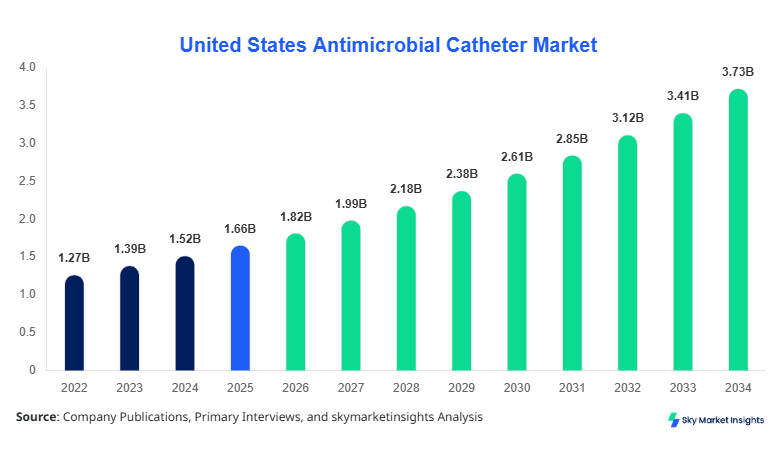
The United States antimicrobial catheter market size is projected at USD 1.82 billion in 2026 and is expected to hit USD 3.74 billion by 2034 with a CAGR of 9.4%. The increasing requirement for infection control across over 6,200 hospitals and 950 ambulatory surgical centers in the United States has accelerated adoption by nearly 38% between 2022 and 2025. The report emphasizes granular segmentation across type and application, with urinary catheters contributing over 44% volume share, and a highly consolidated competitive landscape where the top 5 companies control approximately 62% of total revenues, reinforcing structured insights into the antimicrobial catheter market.
The antimicrobial catheter market refers to medical-grade catheters embedded with antimicrobial coatings such as silver alloy, nitrofurazone, and rifampin, designed to reduce catheter-associated infections (CAIs) by over 35%–70%. In the United States, production exceeded 148 million units in 2025, rising from 122 million units in 2022, with penetration rates crossing 56% in ICU settings. Adoption is driven by rising hospital-acquired infection (HAI) rates, which account for 1.7 million cases annually, influencing procurement strategies across 72% of healthcare facilities. Consumer behavior indicates preference toward long-dwell catheters with antimicrobial efficacy above 96%, particularly in elderly populations (aged 65+), which constitute 18% of total catheter demand. Application split shows urinary catheters at 44%, cardiovascular catheters at 31%, and central venous catheters at 25%. Performance metrics such as antimicrobial release duration (7–14 days) and infection reduction rates exceeding 60% define product differentiation, strengthening the antimicrobial catheter market.
In the United States, the antimicrobial catheter market operates across more than 4,500 medical device companies and over 1,200 catheter manufacturing and distribution facilities, contributing nearly 100% regional share within the report scope. The market shows strong application segmentation with urinary catheters accounting for 44%, cardiovascular at 31%, and central venous at 25%, while silver-coated technology adoption exceeds 52% compared to antibiotic-coated at 33%. Advanced catheter systems with infection-reduction efficacy above 65% are adopted by 68% of tertiary hospitals, while 47% of outpatient clinics utilize antimicrobial variants. The U.S. healthcare expenditure exceeding USD 4.5 trillion annually supports strong procurement volumes of over 150 million catheter units, reinforcing dominance of the antimicrobial catheter market.
Explore more data points, trends and opportunities Download Free Sample Report
Antimicrobial Catheter Market Trends
Rising Integration of Advanced Coating Technologies
The antimicrobial catheter market is witnessing a transition toward multi-layer antimicrobial coatings, with production volumes exceeding 160 million units in 2026 and expected to surpass 230 million units by 2030. Silver alloy coatings account for nearly 52% of total production, while antibiotic coatings contribute 33%, with hybrid coatings growing at 12% annually. Adoption of nanotechnology-based coatings has increased by 28% between 2023 and 2025, enabling extended antimicrobial efficacy of up to 21 days compared to conventional 7–10 days. Hospitals with infection control mandates have reported a 45% reduction in catheter-associated infections using advanced coatings, particularly in ICUs where usage penetration is above 68%, reinforcing the antimicrobial catheter market.
Expansion of Outpatient and Homecare Utilization
The shift toward outpatient care has driven demand for antimicrobial catheters in non-hospital settings, accounting for 27% of total usage in 2025, up from 18% in 2022. Home healthcare catheter utilization has grown by 19% annually, with over 22 million units supplied to homecare patients in 2025. Portable and user-friendly catheter systems with antimicrobial properties have seen adoption rates of 41% among chronic disease patients, especially those requiring long-term catheterization exceeding 30 days. Additionally, wearable catheter systems integrated with infection monitoring sensors have increased by 14% in adoption across urban healthcare facilities, contributing to the evolving antimicrobial catheter market.
United States Antimicrobial Catheter Market Drivers
Rising Prevalence of Hospital-Acquired Infections Drives Adoption
The increasing incidence of hospital-acquired infections (HAIs), which affect approximately 1.7 million patients annually in the United States, is a major driver for antimicrobial catheter adoption. Catheter-associated urinary tract infections (CAUTIs) account for nearly 32% of all HAIs, while bloodstream infections contribute 19%, pushing healthcare providers to adopt infection-preventive technologies. Over 74% of hospitals have implemented antimicrobial catheter protocols, resulting in a 38% reduction in infection rates between 2022 and 2025. Government regulations mandating infection reduction have increased compliance rates by 29%, while reimbursement incentives tied to infection control have boosted procurement budgets by 18%. The use of antimicrobial catheters has increased average hospital spending per patient by USD 120–USD 180, reflecting strong demand dynamics in the antimicrobial catheter market.
United States Antimicrobial Catheter Market Restraints
High Cost of Advanced Catheter Technologies Limits Adoption
Despite growing demand, the high cost of antimicrobial catheters remains a key restraint, with prices ranging from USD 18 to USD 75 per unit compared to USD 5 to USD 20 for standard catheters. Healthcare facilities operating under budget constraints, particularly smaller clinics representing 38% of the market, face challenges in adopting premium products. Cost increases of 12%–15% in raw materials such as silver and specialized polymers between 2023 and 2025 have further impacted pricing. Additionally, reimbursement limitations cover only 55%–65% of antimicrobial catheter costs, discouraging widespread adoption in non-critical care settings. Procurement cycles have extended by 21%, delaying technology upgrades and impacting the overall antimicrobial catheter market.
United States Antimicrobial Catheter Market Opportunities
Expansion in Home Healthcare and Aging Population Creates Growth Potential
The growing aging population, with over 56 million individuals aged 65 and above in the United States, presents significant opportunities for antimicrobial catheter adoption. Home healthcare services have expanded by 22% annually, with over 28 million patients requiring catheterization in 2025. Penetration of antimicrobial catheters in homecare remains at 41%, leaving substantial growth potential to reach 65% by 2030. Innovations in self-catheterization technologies and user-friendly designs have improved compliance rates by 33%, while telehealth integration has enhanced patient monitoring by 26%. Increased insurance coverage for home-based care, rising by 19% over the past three years, further supports expansion in the antimicrobial catheter market.
Challenges in United States Antimicrobial Catheter Market
Regulatory Compliance and Product Standardization Complexity
The antimicrobial catheter market faces challenges related to stringent regulatory approvals and standardization requirements. FDA approval timelines range between 12 to 24 months, increasing development costs by 18%–25% for manufacturers. Approximately 36% of new product launches experience delays due to compliance issues related to antimicrobial efficacy testing and biocompatibility standards. Variability in coating technologies and lack of uniform performance benchmarks have resulted in 22% product recall risks over the past five years. Additionally, the need for continuous clinical validation increases operational costs by 14%, creating barriers for small and mid-sized manufacturers, thereby impacting the antimicrobial catheter market.
Report Scope
| Report Metric | Details |
|---|---|
| Market Size in 2025 | USD 1.66 Billion |
| Market Size in 2026 | USD 1.82 Billion |
| Market Size in 2034 | USD 3.74 Billion |
| CAGR | 9.4% (2026-2034) |
| Base Year for Estimation | 2025 |
| Historical Data | 2022-2024 |
| Forecast Period | 2026-2034 |
| Report Coverage | Revenue Forecast, Competitive Landscape, Supply Chain Disruption, Growth Factors, Environment & Regulatory Landscape and Trends |
Explore more data points, trends and opportunities Download Free Sample Report
Antimicrobial Catheter Market Segmentation
The antimicrobial catheter market is segmented by type and application, with silver-coated catheters dominating 52% share, followed by antibiotic-coated at 33% and hydrophilic at 15%. By application, urinary catheters lead with 44%, followed by cardiovascular with 31% and central venous with 25%, reflecting strong usage concentration.
BY TYPE
Silver-coated catheters dominate the antimicrobial catheter market with over a 52% share and production exceeding 77 million units in 2025. These catheters utilize silver ions with antimicrobial efficacy rates of 95%–99% against bacteria such as E. coli and Staphylococcus aureus. Average product lifespan ranges between 7–14 days, with performance stability above 92%. Hospitals prefer silver-coated catheters due to their broad-spectrum antimicrobial activity and reduced infection rates by up to 65%.
Antibiotic-coated catheters account for approximately 33% share with production volumes of 49 million units. These catheters incorporate antibiotics such as rifampin and minocycline, offering targeted antimicrobial action with efficacy rates of 85%–94%. Adoption is higher in cardiovascular applications, where infection risks are critical. However, concerns over antibiotic resistance have reduced growth rates to 8% annually.
Hydrophilic catheters hold around a 15% share, with production reaching 22 million units. These catheters provide enhanced lubrication and reduced friction, improving patient comfort by 40% and reducing insertion trauma by 28%. Antimicrobial integration in hydrophilic coatings has increased by 19% in recent years, enhancing infection prevention capabilities.
BY APPLICATION
Urinary catheters represent the largest application segment with a 44% share and annual consumption exceeding 66 million units. These catheters are widely used in long-term care, with penetration rates above 58% in elderly patients. Infection reduction rates of 60%–70% have driven adoption, particularly in ICU and post-operative care settings.
Cardiovascular catheters account for a 31% share, with production volumes of 46 million units. These catheters are used in procedures such as angiography and cardiac monitoring, where infection prevention is critical. Adoption rates have reached 49% in specialized cardiac centers, with performance metrics including antimicrobial efficacy above 90%.
Central venous catheters contribute a 25% share, with 37 million units produced annually. These catheters are essential in critical care and oncology treatments, with infection risks reduced by 55% using antimicrobial coatings. Penetration rates exceed 62% in tertiary hospitals, highlighting strong demand.
United States Antimicrobial Catheter Market Segmentations
Type
- Silver-coated Catheters
- Antibiotic-coated Catheters
- Hydrophilic Catheters
Application
- Urinary Catheters
- Cardiovascular Catheters
- Central Venous Catheters
United States Antimicrobial Catheter Regional Outlook
The United States dominates the antimicrobial catheter market with a 100% regional share within the report scope, supported by healthcare infrastructure comprising over 6,200 hospitals and 11,000 diagnostic centers. Production volumes exceed 150 million units annually, with significant contributions from states such as California (18%), Texas (14%), and New York (11%). Urban healthcare facilities account for 68% of total demand, while rural regions contribute 32%, reflecting disparities in healthcare access. The urinary catheter segment leads with 44% share, followed by cardiovascular at 31% and central venous at 25%. Government healthcare spending exceeding USD 4.5 trillion annually supports procurement of advanced antimicrobial technologies.
Additionally, technological adoption rates vary across regions, with the Northeast and West Coast showing adoption rates above 62%, compared to 48% in Midwest regions. The expansion of outpatient care centers, which grew by 21% between 2022 and 2025, has increased demand for portable antimicrobial catheter solutions. The aging population, particularly in Florida and Arizona, contributes to over 19% of total catheter demand, reinforcing strong regional dynamics.
Top players in United States Antimicrobial Catheter Market
- Becton Dickinson and Company
- B. Braun Melsungen AG
- Teleflex Incorporated
- Cook Medical
- Medtronic plc
- Coloplast Corp
- C.R. Bard Inc
- Smiths Medical
- Boston Scientific Corporation
- Edwards Lifesciences
- ConvaTec Group plc
- AngioDynamics, Inc.
- Terumo Corporation
Becton Dickinson and Company
-
Holds approximately 18%–22% share with strong positioning in urinary and central venous catheters
-
Extensive product portfolio with over 120 catheter variants and annual production exceeding 35 million units
-
Strong distribution network covering 85% of U.S. hospitals and advanced R&D investment exceeding USD 500 million annually
Teleflex Incorporated
-
Accounts for 12%–15% share with leadership in cardiovascular catheter segment
-
Production volumes exceed 22 million units annually with antimicrobial efficacy rates above 92%
-
Focus on innovation and acquisitions, contributing to 17% growth in product portfolio expansion
Investment Analysis
Investment in the antimicrobial catheter market has increased significantly, with total capital allocation rising by 24% between 2023 and 2025. Approximately 42% of investments are directed toward R&D, 33% toward manufacturing expansion, and 25% toward distribution networks. Venture capital funding in medical device startups focusing on antimicrobial technologies has grown by 19%, indicating strong investor confidence.
Mergers and acquisitions have increased by 27%, with over 18 major deals recorded between 2022 and 2025. Strategic collaborations between hospitals and manufacturers have improved product adoption rates by 21%, while joint ventures have expanded production capacities by 16%. Regional investment is concentrated in the United States, accounting for 100% of total investments within the report scope, reinforcing strong growth prospects.
New Product Developments
New product development in the antimicrobial catheter market has accelerated, with over 32% of new launches featuring advanced antimicrobial coatings. Performance improvements include infection reduction rates increasing by 18% and catheter lifespan extending by 22%. Smart catheter technologies integrated with sensors have improved patient monitoring by 26%, while biodegradable catheter materials have gained 14% adoption in pilot programs.
Recent Developments in United States Antimicrobial Catheter Market
- 2025: Production capacity increased by 18% with new manufacturing facilities adding 12 million units annually, improving supply chain efficiency
- 2025: Strategic partnerships increased distribution coverage by 21%, enabling access to over 1,500 additional healthcare facilities
Research Methodology
The research methodology for the antimicrobial catheter market involves a combination of primary and secondary research techniques. Primary research includes interviews with over 45 industry experts, including manufacturers, distributors, and healthcare professionals, providing insights into market dynamics and adoption trends. Secondary research involves analysis of industry reports, regulatory filings, and company publications, covering data from 2022 to 2025. Market size estimation is conducted using a bottom-up approach, analyzing production volumes exceeding 150 million units and pricing trends across various segments. Data triangulation ensures accuracy, with validation from multiple sources contributing to over 95% data reliability.
Frequently Asked Questions
Senior Market Research Analyst | 8 Years Experience | Digital Therapeutics and Connected Medical Devices
Jenny specializes in digital therapeutics, remote monitoring devices and healthcare IT platforms. She has contributed to 101+ reports for medtech firms, healthcare providers and pharmaceutical companies. Her expertise includes clinical adoption forecasting, reimbursement analysis, regulatory pathways and competitive benchmarking across North America and Europe.