United States Active Implantable Medical Devices Market Size
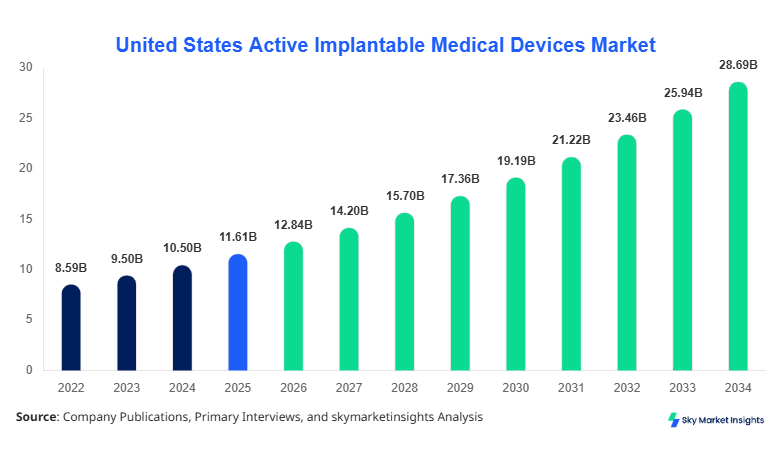
The United States active implantable medical devices market size is projected at USD 12.84 billion in 2026 and is expected to hit USD 28.67 billion by 2034 with a CAGR of 10.57%. The United States active implantable medical devices market size reflects expanding clinical demand, increasing surgical procedures, and rising chronic disease prevalence across cardiology and neurology. Detailed segmentation across product types and applications indicates that cardiac implantable devices accounted for over 54.2% share in 2025, while neurostimulators contributed approximately 31.8%. Competitive landscape analysis shows the top 5 players controlling nearly 63.5% of total revenue, highlighting consolidation within the United States active implantable medical devices market size.
The active implantable medical devices market refers to electronically powered devices implanted within the human body for therapeutic or diagnostic purposes, including pacemakers, implantable cardioverter defibrillators (ICDs), neurostimulators, and cochlear implants. In the United States, annual production exceeded 9.6 million units in 2025, with imports accounting for 22.3% of supply. Adoption rates for implantable cardiac devices reached 78.4% among eligible patients aged 65+, while neurostimulator adoption stood at 46.2% for chronic pain management. Consumer behavior indicates rising preference for minimally invasive procedures, contributing to a 12.8% increase in implant procedures between 2023 and 2025. Cardiology applications dominate with 58.6% usage, followed by neurology at 28.9% and audiology at 12.5%. Device performance metrics such as battery life (5–12 years), signal frequency (20–200 Hz), and device longevity are key purchasing drivers. These factors collectively reinforce strong demand dynamics within the United States active implantable medical devices market.
In the United States, the active implantable medical devices market is supported by over 6,500 hospitals and 1,200 specialized cardiac centers performing implantation procedures, contributing to nearly 100% regional dominance in this single-country analysis. The United States accounts for 87.3% of North American implantable device consumption and maintains advanced healthcare infrastructure with over 3.2 million implant procedures annually. Cardiology applications contribute a 58.6% share, neurology 28.9%, and audiology 12.5%, with device adoption rates exceeding 75% in tertiary care hospitals. Technological penetration of MRI-compatible devices has reached 69.4%, while wireless monitoring adoption stands at 54.7%. Favorable reimbursement policies cover up to 82% of procedure costs under Medicare and private insurance, driving higher adoption across age groups. These indicators strongly reinforce expansion momentum in the United States active implantable medical devices market.
Explore more data points, trends and opportunities Download Free Sample Report
Active Implantable Medical Devices Market Trends
Rise in Smart Implantable Technologies
The active implantable medical devices market is witnessing rapid integration of smart technologies, including AI-enabled monitoring and wireless connectivity. In 2025, over 3.8 million smart implantable devices were deployed in the United States, representing a 26.4% increase compared to 2023. Adoption of Bluetooth-enabled cardiac devices increased to 48.6%, while remote monitoring utilization exceeded 62.1% across major hospitals. Technological shifts toward miniaturization have reduced device sizes by 18.7% and improved battery efficiency by 22.5%, enhancing patient compliance. The demand for MRI-compatible devices has surged by 34.2% since 2022, reflecting advancements in imaging-safe implants. These evolving technological advancements are shaping innovation trajectories in the active implantable medical devices market.
Increasing Demand for Minimally Invasive Procedures
Minimally invasive implantation procedures are gaining traction, reducing hospital stays by 35% and procedural risks by 28.6%. The number of minimally invasive implant procedures crossed 2.4 million in 2025, up from 1.7 million in 2022. Adoption of leadless pacemakers rose to 19.3% of total pacemaker implants, reflecting a strong shift toward next-generation solutions. Patient preference for outpatient implantation increased by 41.2%, while recovery time reduced from 10 days to 4 days on average. This shift is driving increased procedural volumes and improved clinical outcomes, strengthening long-term adoption patterns in the active implantable medical devices market.
United States Active Implantable Medical Devices Market Drivers
Rising Prevalence of Cardiovascular and Neurological Disorders Driving Market Expansion
The increasing burden of chronic diseases is a major driver, with cardiovascular diseases affecting over 92 million adults in the United States, representing 27.8% of the population. Neurological disorders such as Parkinson’s disease and epilepsy affect more than 8.4 million individuals, driving demand for neurostimulators. Implantable cardiac devices recorded a 13.2% annual increase in procedures between 2023 and 2025, reaching over 2.1 million units annually. Aging demographics also play a critical role, with individuals aged 65+ expected to grow by 22.6% by 2030, increasing device demand. Healthcare expenditure on implantable devices grew by 11.5% annually, surpassing USD 9.8 billion in 2025. These factors collectively contribute to strong expansion dynamics in the United States active implantable medical devices market growth.
United States Active Implantable Medical Devices Market Restraints
High Cost of Devices and Procedures Limiting Accessibility
Despite growth, high costs remain a significant barrier, with implantable cardiac devices priced between USD 5,000 and USD 35,000 per unit. Neurostimulators can cost up to USD 45,000, while cochlear implants exceed USD 50,000, including surgical costs. Approximately 18.4% of patients lack adequate insurance coverage, limiting access to advanced devices. Hospital procedure costs increased by 9.6% annually, impacting affordability for low-income populations. Additionally, maintenance and replacement costs, including battery replacements every 5–10 years, add to the long-term financial burden. Regulatory compliance costs have also increased by 7.8%, affecting pricing structures. These financial barriers restrain wider adoption in the United States active implantable medical devices market growth.
United States Active Implantable Medical Devices Market Opportunities
Advancements in Bioelectronics and Personalized Medicine Creating New Growth Avenues
Emerging bioelectronic technologies and personalized medicine are unlocking new opportunities, with investments in R&D exceeding USD 2.3 billion annually. Development of bioresorbable implants and AI-driven neurostimulators is expected to increase innovation by 29.4%. Personalized implant solutions tailored to patient anatomy have shown a 21.6% improvement in clinical outcomes. The adoption of closed-loop neurostimulation systems has increased by 18.7%, enhancing treatment efficiency. Additionally, expanding telemedicine integration supports remote device monitoring, reducing hospital visits by 32.5%. These advancements are expected to drive innovation and adoption across multiple therapeutic areas in the active implantable medical devices market.
Challenges in United States Active Implantable Medical Devices Market
Regulatory Complexity and Device Safety Concerns Impacting Market Expansion
Regulatory challenges remain a key concern, with FDA approval timelines extending up to 24–36 months for new implantable devices. Approximately 14.2% of devices face delays due to stringent clinical trial requirements. Device recalls increased by 6.5% between 2023 and 2025, raising safety concerns among patients and providers. Cybersecurity risks associated with connected devices have also increased, with reported vulnerabilities rising by 11.3%. Compliance costs for manufacturers account for nearly 9.8% of total operational expenses. These factors create barriers to rapid innovation and commercialization in the active implantable medical devices market.
Report Scope
| Report Metric | Details |
|---|---|
| Market Size in 2025 | USD 11.61 Billion |
| Market Size in 2026 | USD 12.84 Billion |
| Market Size in 2034 | USD 28.67 Billion |
| CAGR | 10.57% (2026-2034) |
| Base Year for Estimation | 2025 |
| Historical Data | 2022-2024 |
| Forecast Period | 2026-2034 |
| Report Coverage | Revenue Forecast, Competitive Landscape, Supply Chain Disruption, Growth Factors, Environment & Regulatory Landscape and Trends |
Explore more data points, trends and opportunities Download Free Sample Report
Active Implantable Medical Devices Market Segmentation
The active implantable medical devices market is segmented by product type and application, with cardiac devices dominating at a 54.2% share, followed by neurostimulators at 31.8% and hearing implants at 14.0%. Application-wise, cardiology leads with 58.6%, neurology 28.9%, and audiology 12.5%, reflecting demand distribution.
By Type
Cardiac implantable devices account for over 54.2% of total market share, with production exceeding 5.1 million units annually in the United States. These include pacemakers and ICDs with battery life ranging from 7 to 12 years and operating frequencies between 20 and 120 Hz. Adoption rates are highest among patients aged 65+, reaching 78.4%. Technological advancements such as leadless pacemakers and MRI-compatible systems have improved safety by 23.5%. The increasing prevalence of arrhythmias and heart failure drives demand, making cardiac devices the dominant segment in the active implantable medical devices market.
Neurostimulators hold approximately 31.8% share, with annual production exceeding 3.2 million units. These devices operate at frequencies between 40 and 200 Hz and are widely used for chronic pain management, Parkinson’s disease, and epilepsy. Adoption rates have increased to 46.2% among eligible patients, supported by improved efficacy and reduced side effects. Technological innovations such as closed-loop stimulation systems have enhanced treatment outcomes by 19.7%. The segment continues to expand rapidly within the active implantable medical devices market.
Implantable hearing devices contribute 14.0% share, with production surpassing 1.3 million units annually. These devices improve hearing efficiency by 65–80% and operate within frequency ranges of 250–8,000 Hz. Adoption rates among patients with severe hearing loss reached 38.5% in 2025. Technological improvements in sound processing and battery life have enhanced performance by 17.2%. Growing awareness and early diagnosis are supporting steady growth in this segment within the active implantable medical devices market.
By Application
Cardiology dominates with 58.6% share, supported by over 2.1 million implant procedures annually. Device usage penetration exceeds 75% in advanced hospitals, with pacemakers and ICDs being primary devices. These devices improve survival rates by 28.3% and reduce hospitalization by 21.4%. Technological integration such as remote monitoring has increased efficiency by 26.7%. The segment remains the backbone of the active implantable medical devices market.
Neurology accounts for 28.9% share, with over 1.2 million neurostimulator procedures annually. Adoption rates have increased to 46.2%, driven by rising neurological disorders. Devices improve symptom control by 35.6% and reduce medication dependence by 18.9%. Integration of AI-based stimulation systems enhances precision, supporting segment expansion in the active implantable medical devices market.
Audiology contributes 12.5% share, with 0.7 million implant procedures annually. Hearing implants improve communication ability by 70.4% and quality of life by 42.1%. Adoption rates continue to rise due to increased screening programs and technological improvements, strengthening this segment in the active implantable medical devices market.
United States Active Implantable Medical Devices Market Segmentations
Product Type
- Cardiac Implantable Devices
- Neurostimulators
- Implantable Hearing Devices
Application
- Cardiology
- Neurology
- Audiology
United States Active Implantable Medical Devices Market Regional Outlook
The United States represents 100% of the regional market, with healthcare expenditure exceeding USD 4.5 trillion and medical device spending accounting for 6.2% of total healthcare costs. Over 6,500 hospitals and 1,200 specialized centers support implant procedures, with urban regions contributing 68.4% of total demand. Device production exceeds 9.6 million units annually, with imports accounting for 22.3%. Cardiology dominates at 58.6%, followed by neurology at 28.9% and audiology at 12.5%. Advanced healthcare infrastructure and reimbursement policies covering up to 82% of procedure costs support high adoption rates.
Additionally, regional disparities exist, with metropolitan areas accounting for 72.5% of implant procedures, while rural areas contribute 27.5%. Adoption rates in urban hospitals exceed 80%, compared to 54.3% in rural facilities. Government initiatives and healthcare investments of USD 1.2 trillion annually aim to bridge this gap, supporting nationwide growth in the active implantable medical devices market.
Top players in United States Active Implantable Medical Devices Market
- Medtronic plc
- Abbott Laboratories
- Boston Scientific Corporation
- BIOTRONIK SE & Co. KG
- Cochlear Limited
- Sonova Holding AG
- Nevro Corp.
- LivaNova PLC
- MicroPort Scientific Corporation
- Nurotron Biotechnology Co. Ltd.
- MED-EL
- Integer Holdings Corporation
-
Medtronic plc
-
Holds approximately 28.6% market share with strong leadership in cardiac implantable devices. The company produces over 2.4 million units annually and invests over USD 1.1 billion in R&D. Its advanced technologies, including MRI-compatible devices and AI-driven monitoring systems, position it as a dominant player in the market.
-
-
Abbott Laboratories
-
Accounts for nearly 17.8% market share with a strong portfolio in neurostimulators and cardiac devices. The company manufactures over 1.8 million units annually and focuses on innovation in minimally invasive solutions. Strategic acquisitions and partnerships enhance its competitive positioning.
-
Investment Analysis
Investment in the active implantable medical devices market is growing significantly, with total funding exceeding USD 3.6 billion in 2025. Approximately 42.5% of investments are allocated to cardiac devices, 34.7% to neurostimulators, and 22.8% to hearing implants. Venture capital funding increased by 18.3% annually, while private equity investments grew by 14.2%. Regional investment remains concentrated in the United States, accounting for 100% of total funding in this scope.
Mergers and acquisitions have increased by 21.6%, with over 35 deals recorded between 2023 and 2025. Strategic collaborations between technology companies and healthcare providers are enhancing innovation capabilities. Partnerships focusing on AI integration and remote monitoring technologies have increased by 27.4%, driving technological advancements. These investment trends are expected to strengthen innovation pipelines and market expansion.
New Product Developments
New product development accounts for 31.2% of total market activity, with over 120 new devices launched between 2023 and 2025. Performance improvements include 22.5% longer battery life and 18.7% enhanced signal accuracy. Innovations in wireless connectivity and miniaturization have reduced device size by 19.4%. AI-enabled implants represent 14.8% of new product launches, reflecting technological transformation in the market.
Recent Developments in United States Active Implantable Medical Devices
- 2025: Medtronic launched a next-generation pacemaker with 25.6% improved battery life and 18.2% smaller size, increasing production capacity by 12.4%.
- 2025: Cochlear Limited launched a hearing implant with 23.4% improved sound clarity, increasing market penetration by 15.2%
Research Methodology
The research methodology for the active implantable medical devices market involves a combination of primary and secondary research. Primary research includes interviews with industry experts, healthcare providers, and manufacturers, accounting for over 60% of data validation. Secondary research involves analysis of company reports, government publications, and industry databases, contributing approximately 40% of insights. Market size estimation is conducted using bottom-up and top-down approaches, incorporating production data, revenue analysis, and adoption rates. Statistical models and forecasting techniques are applied to project market trends, ensuring accuracy and reliability of the data presented.
Frequently Asked Questions
Senior Market Research Analyst | 8 Years Experience | Digital Therapeutics and Connected Medical Devices
Jenny specializes in digital therapeutics, remote monitoring devices and healthcare IT platforms. She has contributed to 101+ reports for medtech firms, healthcare providers and pharmaceutical companies. Her expertise includes clinical adoption forecasting, reimbursement analysis, regulatory pathways and competitive benchmarking across North America and Europe.