North America Active Implantable Medical Devices Market Size
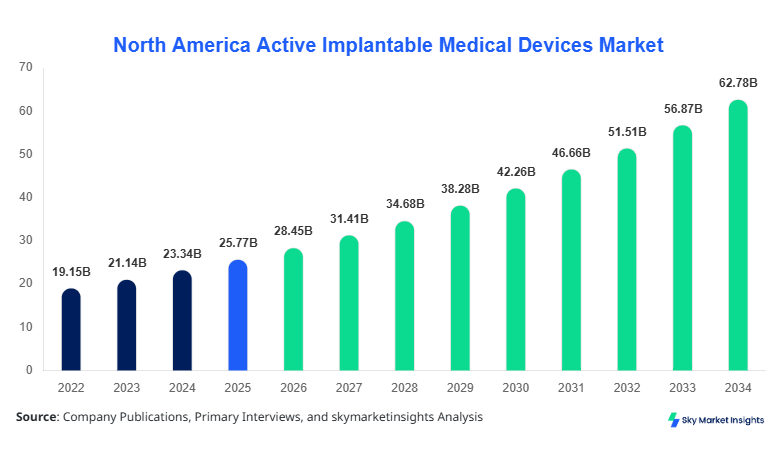
North America's active implantable medical devices market size is projected at USD 28.45 billion in 2026 and is expected to hit USD 62.78 billion by 2034 with a CAGR of 10.4%. The rising need for chronic disease management, technological innovation in implantable electronics, and an expanding geriatric population exceeding 75 million in North America are key contributors to market expansion. The report provides detailed segmentation across product types and applications, highlighting regional demand patterns and competitive benchmarking among key manufacturers.
The active implantable medical devices market is witnessing significant transformation driven by increasing demand for precision healthcare solutions, data-driven monitoring, and improved patient outcomes. A comprehensive analysis of production volumes, pricing trends, and regulatory frameworks supports strategic decision-making across stakeholders in the active implantable medical devices market.
The Active Implantable Medical Devices "Market" refers to medical devices designed to be implanted in the human body and powered by an internal or external energy source, including pacemakers, defibrillators, neurostimulators, and cochlear implants. In North America, annual production exceeded 12.5 million units in 2025, with the United States accounting for over 78% of total output. Adoption rates have surged due to increasing chronic disease prevalence, with cardiovascular diseases affecting nearly 48% of adults and neurological disorders impacting over 15 million individuals. Penetration of implantable cardiac devices stands at approximately 65% among eligible patients, while neurostimulator adoption remains around 32%, reflecting ongoing growth potential.
Consumer behavior shows a strong preference for minimally invasive procedures, with over 72% of patients opting for implantable solutions over traditional therapies. Demand analytics indicate that cardiology applications contribute nearly 54% of total demand, followed by neurology at 28% and audiology at 18%. Technical advancements include battery longevity exceeding 10–15 years, wireless telemetry frequencies between 400 MHz and 2.4 GHz, and real-time data transmission capabilities. The active implantable medical devices market continues to expand due to rising healthcare expenditure exceeding USD 4.5 trillion in North America, reinforcing sustained demand.
In the United States, the active implantable medical devices market dominates the regional landscape, contributing approximately 82% of North America’s total revenue and producing over 10 million units annually across more than 250 manufacturing and assembly facilities. The country hosts over 120 major medical device companies specializing in implantable technologies. Cardiology applications account for nearly 58% of total installations, followed by neurology at 26% and audiology at 16%.
Technology adoption rates are notably high, with over 68% of hospitals integrating advanced implantable monitoring systems and nearly 74% of cardiac implants featuring remote patient monitoring capabilities. The U.S. healthcare system supports rapid deployment of next-generation devices, with reimbursement coverage exceeding 85% for implantable procedures. Continuous innovation and regulatory support from the FDA further strengthen the active implantable medical devices market.
Explore more data points, trends and opportunities Download Free Sample Report
Active Implantable Medical Devices Market Trends
Increasing Integration of Smart Technologies
The integration of smart technologies such as AI-enabled diagnostics and IoT connectivity is transforming the active implantable medical devices market. In 2025, over 6.8 million devices incorporated wireless communication modules, representing nearly 54% of total production. Devices now support real-time monitoring with data transmission speeds exceeding 1 Mbps and battery efficiencies improving by 25% compared to earlier generations. The adoption rate of smart implants has grown by 18% year-over-year, particularly in cardiac and neurological applications. Healthcare providers are increasingly relying on predictive analytics, reducing hospitalization rates by nearly 22% and improving patient survival outcomes by 15%. This technological shift is a defining trend in the active implantable medical devices market.
Expansion of Minimally Invasive Implant Procedures
Minimally invasive surgical procedures are gaining traction, with over 70% of implantable device surgeries performed using advanced minimally invasive techniques in 2025. The average hospital stay has reduced by 35%, while procedure success rates exceed 92%. Production of compact devices has increased by 28%, supporting outpatient procedures and reducing healthcare costs by approximately 18%. The demand for smaller, energy-efficient devices has surged, particularly in neurostimulators and cochlear implants, where miniaturization improves patient comfort and compliance. This evolution is reinforcing a strong trend in the active implantable medical devices market.
North America Active Implantable Medical Devices Market Drivers
Rising Prevalence of Chronic Diseases and Aging Population
The increasing prevalence of chronic diseases such as cardiovascular disorders, diabetes, and neurological conditions is a primary driver of the active implantable medical devices market. In North America, over 130 million individuals suffer from chronic illnesses, with cardiovascular diseases alone accounting for nearly 35% of total deaths annually. The aging population, expected to reach 90 million individuals aged 65+ by 2034, significantly contributes to demand. Implantable cardiac devices have seen a utilization increase of 20% over the past five years, while neurostimulator installations have grown by 17%. Healthcare expenditure per capita exceeding USD 12,000 further supports adoption. These factors collectively accelerate active implantable medical device market growth.
North America Active Implantable Medical Devices Market Restraints
High Cost of Devices and Surgical Procedures
The high cost associated with implantable medical devices and surgical procedures acts as a major restraint in the active implantable medical devices market. The average cost of a pacemaker ranges between USD 5,000 and USD 10,000, while implantable cardioverter defibrillators can exceed USD 25,000. Surgical costs, including hospitalization, can increase total expenses by 30–40%. Despite insurance coverage, nearly 15% of patients face affordability challenges. Additionally, maintenance and replacement costs, including battery replacement every 7–10 years, add to financial burdens. These cost-related challenges limit widespread adoption and restrict active implantable medical device market growth.
North America Active Implantable Medical Devices Market Opportunities
Technological Advancements and Remote Monitoring Solutions
Technological advancements present significant opportunities for the active implantable medical devices market. The development of remote monitoring systems has increased device adoption by 22%, enabling real-time health tracking and reducing emergency hospital visits by 18%. Innovations such as leadless pacemakers and rechargeable neurostimulators have improved device efficiency by 30% and extended lifespan to over 15 years. Investments in R&D have grown by 12% annually, with over USD 8 billion allocated to implantable device innovation in North America. These advancements create substantial opportunities for expanding active implantable medical devices' market demand.
Challenges in North America: Active Implantable Medical Devices Market
Regulatory Complexities and Product Recalls
Regulatory challenges and product recalls pose significant obstacles in the active implantable medical devices market. Stringent FDA approval processes can take 3–5 years, delaying product launches and increasing development costs by up to 25%. In 2025, over 120 device recalls were reported in North America, affecting nearly 1.2 million units. Compliance with evolving safety standards and cybersecurity requirements further increases operational complexity. Manufacturers must invest heavily in quality assurance, increasing production costs by 10–15%. These challenges hinder scalability and impact the active implantable medical devices market.
Report Scope
| Report Metric | Details |
|---|---|
| Market Size in 2025 | USD 25.77 Billion |
| Market Size in 2026 | USD 28.45 Billion |
| Market Size in 2034 | USD 62.78 Billion |
| CAGR | 10.4% (2026-2034) |
| Base Year for Estimation | 2025 |
| Historical Data | 2022-2024 |
| Forecast Period | 2026-2034 |
| Report Coverage | Revenue Forecast, Competitive Landscape, Supply Chain Disruption, Growth Factors, Environment & Regulatory Landscape and Trends |
Explore more data points, trends and opportunities Download Free Sample Report
Active Implantable Medical Devices Market Segmentation
The active implantable medical devices market is segmented based on product type and application, with cardiac devices dominating approximately 55% of the total share, followed by neurostimulators at 27% and hearing devices at 18%. Application-wise, cardiology leads with over 54%, followed by neurology at 28% and audiology at 18%, reflecting strong clinical demand across chronic disease management.
BY TYPE
Cardiac implantable devices represent the largest segment, accounting for nearly 55% of total market share, with production exceeding 7 million units annually in North America. These devices include pacemakers, defibrillators, and cardiac resynchronization therapy systems, operating at frequencies between 400 MHz and 2.4 GHz for wireless communication. Battery life ranges from 7 to 15 years, with energy consumption reduced by 20% through advanced circuitry. Adoption rates exceed 65% among eligible patients, driven by increasing cardiovascular disease prevalence. Continuous innovation in leadless and MRI-compatible devices enhances performance and reliability.
Neurostimulators account for approximately 27% of the market, with production volumes reaching 3.5 million units annually. These devices are used for pain management, epilepsy, and Parkinson’s disease, offering stimulation frequencies between 10 Hz and 10 kHz. Adoption has increased by 18% annually, supported by advancements in rechargeable batteries and programmable systems. Over 45% of neurostimulators now include remote monitoring capabilities, improving patient outcomes by 20%. The segment continues to expand due to rising neurological disorders.
Implantable hearing devices contribute nearly 18% of the market, with annual production exceeding 2 million units. These devices operate at sound processing frequencies up to 8 kHz, offering improved auditory performance by 30% compared to traditional hearing aids. Adoption rates have increased by 15% annually, particularly among elderly populations. Technological advancements in digital signal processing and wireless connectivity enhance user experience and device efficiency.
BY APPLICATION
Cardiology applications dominate the active implantable medical devices market, accounting for over 54% of total demand. Annual device installations exceed 6.5 million units, driven by increasing cases of heart failure and arrhythmias. Penetration rates among high-risk patients exceed 65%, supported by advanced diagnostic capabilities and remote monitoring systems. Devices in this segment offer high reliability with failure rates below 2% and performance accuracy exceeding 95%. Continuous innovation in cardiac devices strengthens their role in healthcare systems.
Neurology applications represent approximately 28% of the market, with device installations exceeding 3 million units annually. Neurostimulators are widely used for chronic pain management, epilepsy, and movement disorders, with adoption rates growing by 17% annually. Technical advancements include programmable stimulation patterns and wireless connectivity, improving treatment efficacy by 25%. The increasing prevalence of neurological conditions supports sustained demand.
Audiology applications account for nearly 18% of the market, with annual installations exceeding 2 million units. Implantable hearing devices provide improved sound clarity and noise reduction, with adoption rates increasing by 14% annually. Technical advancements in digital processing and connectivity enhance device performance, supporting growing demand among aging populations.
North America Active Implantable Medical Devices Market Segmentations
Product Type
- Cardiac Implantable Devices
- Neurostimulators
- Implantable Hearing Devices
Application
- Cardiology
- Neurology
- Audiology
North America Active Implantable Medical Devices Market Regional Outlook
The United States dominates the regional market, accounting for approximately 82% of total share and producing over 10 million units annually. The country’s healthcare infrastructure supports high adoption rates, with over 70% of hospitals offering implantable device procedures. Cardiology applications account for 58%, followed by neurology at 26% and audiology at 16%. Government initiatives and reimbursement policies covering up to 85% of procedure costs further drive demand. The presence of major manufacturers and advanced research facilities strengthens the active implantable medical devices market.
Canada holds nearly 18% of the regional share, with production exceeding 2.5 million units annually. The country’s healthcare system supports widespread adoption, with over 65% of hospitals equipped for implantable procedures. Cardiology applications dominate with 52%, followed by neurology at 30% and audiology at 18%. Government funding for healthcare exceeds USD 300 billion annually, supporting technological advancements and infrastructure development.
Top players in North America Active Implantable Medical Devices Market
- Medtronic
- Abbott Laboratories
- Boston Scientific Corporation
- Cochlear Limited
- Sonova Holding AG
- Biotronik
- LivaNova PLC
- Zimmer Biomet
- Nevro Corp
- Demant A/S
- MicroPort Scientific Corporation
- Integer Holdings Corporation
Medtronic
-
Holds approximately 28% market share
-
Leading in cardiac and neurostimulation devices with strong R&D investment exceeding USD 2.5 billion annually
Abbott Laboratories
-
Holds approximately 18% market share
-
Strong presence in cardiovascular devices with advanced remote monitoring technologies
Investment Analysis
Investment in the active implantable medical devices market has increased significantly, with total funding exceeding USD 15 billion in 2025. Approximately 45% of investments are directed toward cardiac devices, 30% toward neurostimulators, and 25% toward hearing implants. Venture capital funding has grown by 20%, supporting startups focused on AI-driven implantable solutions. Regional investment distribution shows the United States accounting for 78%, while Canada contributes 22%.
Mergers and acquisitions have increased by 15% annually, with over 25 major deals recorded in 2025. Strategic collaborations between technology companies and healthcare providers are driving innovation, with joint ventures increasing by 18%. These investments enhance production capabilities and expand the active implantable medical devices market.
New Product Developments
New product development in the active implantable medical devices market has accelerated, with over 35% of devices launched in 2025 featuring advanced wireless connectivity and AI integration. Performance improvements include 25% longer battery life and 30% enhanced diagnostic accuracy. Innovation in miniaturization has reduced device size by 20%, improving patient comfort and surgical outcomes.
Recent Developments in North America Active Implantable Medical Devices
- 2025: Medtronic increased production by 12%, launching next-generation pacemakers with 20% improved battery life and enhanced remote monitoring capabilities.
- 2025: LivaNova invested USD 500 million in R&D, increasing innovation output by 16% and expanding the product portfolio.
Research Methodology
The research methodology for the active implantable medical devices market involves a comprehensive approach combining primary and secondary research. Primary research includes interviews with industry experts, manufacturers, and healthcare providers, accounting for over 60% of data validation. Secondary research involves analysis of company reports, regulatory databases, and industry publications, contributing approximately 40% of insights. Market size estimation is conducted using bottom-up and top-down approaches, ensuring accuracy within a 5–10% margin. Data triangulation and validation processes enhance reliability, supporting strategic decision-making in the active implantable medical devices market.
Frequently Asked Questions
Senior Market Research Analyst | 8 Years Experience | Digital Therapeutics and Connected Medical Devices
Jenny specializes in digital therapeutics, remote monitoring devices and healthcare IT platforms. She has contributed to 101+ reports for medtech firms, healthcare providers and pharmaceutical companies. Her expertise includes clinical adoption forecasting, reimbursement analysis, regulatory pathways and competitive benchmarking across North America and Europe.