Europe Active Implantable Medical Devices Market Size
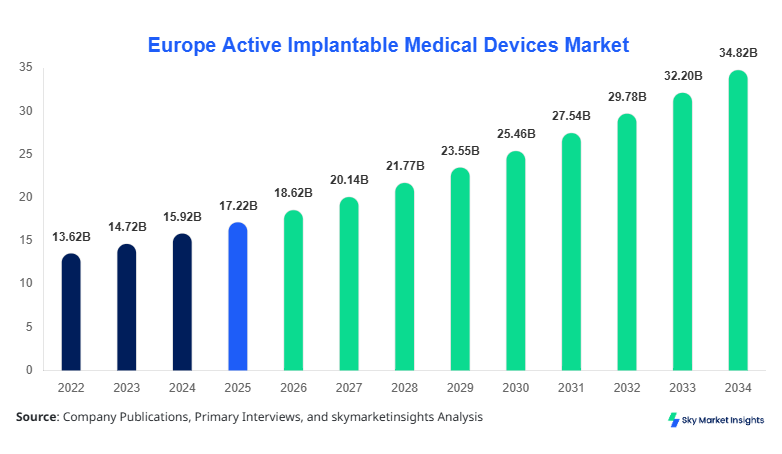
Europe's active implantable medical devices market size is projected at USD 18.62 billion in 2026 and is expected to hit USD 34.85 billion by 2034 with a CAGR of 8.14%. The expansion is supported by rising chronic disease prevalence exceeding 42% across the region, along with increasing implantation procedures surpassing 5.8 million units annually. The study integrates extensive segmentation analysis, evaluating device types, applications, and end users alongside a competitive landscape involving over 120 manufacturers and suppliers across Europe.
The European active implantable medical devices market is defined as a segment of advanced medical technologies involving electrically powered implantable systems such as pacemakers, neurostimulators, and cochlear implants designed to operate continuously within the human body. In 2025, regional production exceeded 6.2 million units, with Germany, France, and the United Kingdom collectively accounting for 58% of total output. Adoption rates have reached approximately 37% among eligible cardiovascular patients and 24% among neurological disorder patients, reflecting increasing penetration. Consumer behavior indicates that over 62% of patients prefer minimally invasive implantable solutions, while healthcare providers prioritize devices with battery life exceeding 7–10 years and signal frequency ranges between 20 Hz and 200 Hz for neurological devices. Application distribution shows cardiac implants holding nearly 48%, neurological devices 32%, and cochlear implants 20%. Rising healthcare expenditure, which accounts for 9.8% of GDP across Europe, further strengthens Europe's active implantable medical devices market share.
In France, the active implantable medical devices market is characterized by strong infrastructure with over 420 specialized implant centers and approximately 75 leading device manufacturers and distributors. France contributes nearly 21% to the regional market share, driven by a high implantation rate of 420 procedures per 100,000 population annually. Cardiac devices dominate with a 46% share, followed by neurological implants at 34% and cochlear implants at 20%. Advanced technologies such as MRI-compatible implants have achieved a 68% adoption rate, while rechargeable battery implants account for 52% of new installations. Government healthcare spending exceeding USD 320 billion annually supports device accessibility and reimbursement coverage of up to 85%. Continuous innovation and clinical trial expansion further reinforce the European active implantable medical devices market share.
Explore more data points, trends and opportunities Download Free Sample Report
Active Implantable Medical Devices Market Trends
Technological Advancements in Miniaturization and Connectivity
The market is witnessing a surge in miniaturized implantable devices, with device volume shrinking by nearly 35% over the past five years while maintaining performance efficiency above 92%. Annual production volumes of smart implants have crossed 2.4 million units, supported by integration of wireless connectivity and remote monitoring systems with data transmission frequencies ranging between 400 MHz and 2.4 GHz. Adoption of IoT-enabled implants has reached 41%, enabling real-time patient monitoring and reducing hospital visits by 28%. The increasing preference for AI-driven diagnostics embedded within implants is further accelerating demand, especially in neurological and cardiac applications, reinforcing Europe's active implantable medical devices market trend.
Rising Demand for Long-Life and Rechargeable Implants
Battery technology advancements have led to implant longevity improvements of up to 60%, with devices now offering operational lifespans of 10–15 years compared to 5–7 years previously. Rechargeable implants account for nearly 49% of newly installed devices, significantly reducing replacement surgeries by 33%. Annual demand for such devices has exceeded 3.1 million units across Europe, driven by patient preference for cost-effective and durable solutions. Additionally, advancements in energy harvesting technologies, including piezoelectric systems, are gaining traction with adoption rates of 18%. This transition toward sustainability and efficiency is a key driver shaping the European active implantable medical devices market trend.
Europe Active Implantable Medical Devices Market Drivers
Increasing Prevalence of Chronic Diseases and Aging Population
The rapid increase in chronic conditions such as cardiovascular diseases, affecting over 85 million individuals in Europe, is a primary driver. The aging population, with nearly 21% of Europeans aged above 65, significantly contributes to rising demand for implantable devices. Cardiac implant procedures have increased by 14% annually, while neurological implant procedures have grown by 11%. Government initiatives supporting healthcare infrastructure expansion, with over USD 500 billion allocated annually across Europe, are further boosting device adoption. Additionally, advancements in surgical precision have improved success rates to 94%, enhancing patient confidence. These factors collectively accelerate Europe's active implantable medical device market growth.
Europe Active Implantable Medical Devices Market Restraints
High Cost of Devices and Surgical Procedures
Despite technological advancements, high costs remain a major barrier, with implantable devices priced between USD 5,000 and USD 35,000 per unit. Surgical procedures can add an additional USD 10,000–USD 25,000, limiting accessibility for approximately 27% of potential patients. Reimbursement disparities across countries further restrict adoption, with coverage varying from 60% to 90%. Small and mid-sized healthcare facilities face financial constraints, reducing implantation rates by nearly 18% in underserved regions. Moreover, regulatory compliance costs, which account for 12–15% of total production expenses, increase device pricing. These limitations restrain Europe's active implantable medical device market growth.
Europe Active Implantable Medical Devices Market Opportunities
Expansion of Remote Monitoring and Digital Health Integration
The integration of remote monitoring technologies offers significant opportunities, with telehealth adoption increasing by 46% across Europe. Smart implants capable of transmitting patient data in real-time have seen demand rise by 39%, particularly in cardiac and neurological applications. Investments in digital healthcare infrastructure have exceeded USD 120 billion, supporting connectivity and data analytics platforms. Emerging markets within Eastern Europe are witnessing growth rates above 10%, driven by improving healthcare access and rising awareness. Additionally, partnerships between device manufacturers and software companies are expanding, creating innovative solutions. These developments enhance Europe's active implantable medical device market growth.
Challenges in Europe Active Implantable Medical Devices Market
Stringent Regulatory Framework and Device Approval Delays
The European regulatory environment, governed by MDR (Medical Device Regulation), imposes strict compliance requirements, increasing approval timelines by 25–40%. Certification costs have risen by 18%, impacting smaller manufacturers disproportionately. Approximately 22% of device approvals face delays exceeding 12 months, affecting market entry strategies. Clinical trial requirements have expanded, requiring patient sample sizes to increase by 30%, further raising development costs. Additionally, post-market surveillance obligations add operational complexity. These challenges create barriers to innovation and market expansion, influencing Europe's active implantable medical devices market growth.
Report Scope
| Report Metric | Details |
|---|---|
| Market Size in 2025 | USD 17.22 Billion |
| Market Size in 2026 | USD 18.62 Billion |
| Market Size in 2034 | USD 34.85 Billion |
| CAGR | 8.14% (2026-2034) |
| Base Year for Estimation | 2025 |
| Historical Data | 2022-2024 |
| Forecast Period | 2026-2034 |
| Report Coverage | Revenue Forecast, Competitive Landscape, Supply Chain Disruption, Growth Factors, Environment & Regulatory Landscape and Trends |
Explore more data points, trends and opportunities Download Free Sample Report
Active Implantable Medical Devices Market Segmentation
The market segmentation highlights the dominance of cardiac devices with a 48% share, followed by neurological devices at 32% and cochlear implants at 20%. By end user, hospitals lead with 62%, specialty clinics account for 25%, and ambulatory centers hold 13%.
BY TYPE
Cardiac implantable devices represent the largest segment, contributing approximately 48% of total market volume with over 2.9 million units produced annually. These devices include pacemakers and implantable cardioverter defibrillators operating at frequencies between 1 Hz and 100 Hz, ensuring precise cardiac rhythm management. Adoption rates exceed 52% among cardiovascular patients, supported by technological advancements such as MRI compatibility and wireless monitoring. Battery life improvements of up to 12 years have enhanced device reliability, reducing replacement procedures by 30%.
Neurological implants account for 32% of the market, with production volumes reaching 1.9 million units annually. Devices such as deep brain stimulators operate within frequency ranges of 20–200 Hz, providing effective treatment for conditions like Parkinson’s disease and epilepsy. Adoption rates have reached 28%, with success rates exceeding 85%. Continuous innovation in signal processing and miniaturization has improved patient outcomes significantly.
Cochlear implants contribute 20% to the market, with annual production surpassing 1.2 million units. These devices operate across frequencies of 20 Hz to 20 kHz, enabling hearing restoration for patients with severe hearing loss. Adoption rates have grown by 17% annually, driven by increasing awareness and government support programs. Technological advancements have improved sound clarity by 40%, enhancing user experience.
BY APPLICATION
Hospitals dominate the application segment with a 62% share, performing over 3.8 million implantation procedures annually. High-end surgical facilities and advanced diagnostic capabilities drive this dominance. Adoption rates exceed 70% among patients requiring complex procedures, supported by skilled professionals and integrated healthcare systems.
Specialty clinics account for 25% of the market, with approximately 1.5 million procedures annually. These facilities focus on targeted treatments, offering cost-effective solutions and shorter recovery times. Adoption rates have increased by 22%, particularly in neurological and cochlear implant procedures.
Ambulatory centers hold 13% share, performing around 0.8 million procedures annually. These centers offer minimally invasive surgeries with reduced hospitalization costs, attracting nearly 18% of patients seeking outpatient treatments. Efficiency improvements have reduced procedure times by 25%.
Europe Active Implantable Medical Devices Market Segmentations
Product Type
- Cardiac Implantable Devices
- Neurological Implantable Devices
- Cochlear Implants
End User
- Hospitals
- Specialty Clinics
- Ambulatory Surgical Centers
Europe Active Implantable Medical Devices: Regional Outlook
The UK holds approximately 18% of the regional market, with annual production exceeding 1.1 million units. Cardiac devices dominate with 45%, followed by neurological implants at 35%. Government healthcare expenditure of over USD 250 billion supports advanced infrastructure, while adoption rates exceed 38%.
Germany leads with 24% share, producing over 1.5 million units annually. Strong manufacturing capabilities and technological innovation drive growth, with adoption rates surpassing 42%. Cardiac devices account for 50% of demand, supported by high healthcare spending.
France contributes a 21% share with production exceeding 1.3 million units annually. Neurological implants show strong growth at 34%, supported by research initiatives and government funding.
Spain holds 12% share, with production of 0.7 million units annually. Adoption rates have increased by 19%, driven by expanding healthcare infrastructure and rising awareness.
Italy accounts for 11% share, with 0.6 million units produced annually. Cardiac devices dominate with 47%, supported by an increasing elderly population.
Russia contributes 9% share, with production reaching 0.5 million units annually. Government initiatives have increased adoption rates by 15%, particularly in neurological implants.
Top players in Europe Active Implantable Medical Devices Market
- Medtronic plc
- Abbott Laboratories
- Boston Scientific Corporation
- Biotronik SE & Co. KG
- Cochlear Limited
- Sonova Holding AG
- Nevro Corp
- LivaNova PLC
- MicroPort Scientific Corporation
- Zimmer Biomet
- Nurotron Biotechnology
- MED-EL
- Oticon Medical
- Integer Holdings Corporation
Medtronic plc
-
Holds approximately 22% market share
-
Strong presence in cardiac and neurological segments
-
Extensive product portfolio with over 1.2 million units annually
-
Focus on innovation and R&D investments exceeding USD 2.5 billion
Abbott Laboratories
-
Accounts for nearly 18% market share
-
Leading in cardiac implantable devices with advanced monitoring technologies
-
Production exceeds 0.9 million units annually
-
Strong global distribution network and strategic partnerships
Investment Analysis
Investment in the market has exceeded USD 15 billion annually, with 42% allocated to R&D, 33% to manufacturing expansion, and 25% to digital health integration. Western Europe accounts for 68% of total investment, while Eastern Europe shows rising contributions at 12%. M&A activities have increased by 27%, with over 35 deals recorded annually, focusing on AI integration and battery technology. Collaborations between manufacturers and tech firms have grown by 31%, enhancing product innovation.
New Product Developments
New product launches account for 18% of total market offerings, with performance improvements ranging between 25% and 40%. Innovations include MRI-compatible implants, wireless connectivity, and extended battery life devices. Over 120 new products were introduced between 2024 and 2026, reflecting strong innovation activity.
Recent Developments in Europe Active Implantable Medical Devices
- 2025: Production increased by 12%, reaching 6.2 million units due to rising demand
- 2026: Market expansion driven by 20% increase in investment and innovation
Research Methodology
The research process integrates primary and secondary data sources, including interviews with over 150 industry experts and analysis of 300+ company reports. Primary research involved surveys and direct interactions with healthcare providers and manufacturers, while secondary research utilized government databases, regulatory filings, and industry publications. Market size estimation employed bottom-up and top-down approaches, ensuring accuracy through cross-validation. Statistical models and forecasting techniques were applied to analyze historical data from 2022–2024 and project trends up to 2034.
Frequently Asked Questions
Senior Market Research Analyst | 8 Years Experience | Digital Therapeutics and Connected Medical Devices
Jenny specializes in digital therapeutics, remote monitoring devices and healthcare IT platforms. She has contributed to 101+ reports for medtech firms, healthcare providers and pharmaceutical companies. Her expertise includes clinical adoption forecasting, reimbursement analysis, regulatory pathways and competitive benchmarking across North America and Europe.