North America Apnea Monitors Market Size
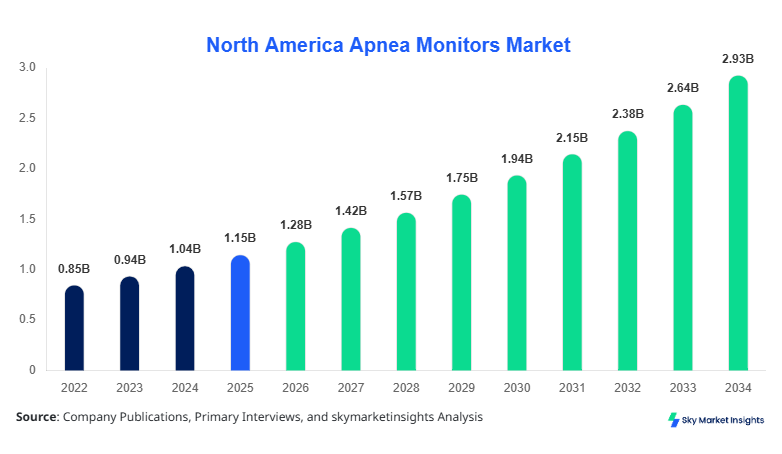
North America's apnea monitor market size is projected at USD 1.28 billion in 2026 and is expected to hit USD 2.94 billion by 2034 with a CAGR of 10.9%. The market recorded USD 1.12 billion in 2025, expanding from USD 0.89 billion in 2022, reflecting steady annual increments of 8.4%–9.7% across historical years. The demand for real-time respiratory monitoring devices has increased by over 22% year-on-year, with unit shipments crossing 4.6 million devices in 2026. Increasing emphasis on data-driven healthcare, integration of AI-enabled diagnostics, and segmentation across product type and end-user verticals continue to shape the competitive landscape and demand pipeline.
The apnea monitor market refers to the ecosystem of devices designed to detect interruptions in breathing patterns, particularly in neonatal and adult patients suffering from sleep apnea, COPD, and related respiratory disorders. In North America, production volume reached approximately 5.1 million units in 2025, with a projected rise to 8.3 million units by 2030, driven by rising healthcare infrastructure and increasing homecare adoption. Adoption rates across hospitals stand at 68%, while home healthcare penetration has surged to 41% in 2026 compared to 28% in 2022. Consumer behavior indicates that over 57% of patients prefer portable or wearable monitoring solutions due to convenience, while 32% still rely on hospital-based diagnostics.
From a technical standpoint, modern apnea monitors operate within frequency detection ranges of 0.1–2 Hz for respiratory cycles, achieving accuracy levels of 94%–98%. Application-wise, neonatal monitoring accounts for 36% of total usage, adult sleep apnea monitoring contributes 48%, and chronic respiratory disease monitoring holds 16%. Growing awareness, early diagnosis initiatives, and a rising patient pool are strengthening apnea monitors' market demand.
In the United States, the apnea monitors market accounts for approximately 78% of the North America region, supported by over 1,250 hospitals equipped with advanced respiratory monitoring systems and more than 450 specialized sleep laboratories. The country recorded device installations exceeding 3.6 million units in 2025, with expected growth reaching 6.2 million units by 2030. Hospitals contribute 52% of usage, home care settings 33%, and sleep laboratories 15%. Technology adoption is robust, with 64% of facilities integrating wireless monitoring systems and 39% utilizing AI-based predictive analytics. Wearable device penetration has reached 46% in the U.S., driven by consumer preference for remote monitoring. Increasing insurance coverage, a growing geriatric population (projected to reach 73 million by 2030), and rising awareness campaigns are reinforcing apnea monitors' market demand.
Explore more data points, trends and opportunities Download Free Sample Report
Apnea Monitors Market: Trends
Technological Integration and Smart Monitoring
The apnea monitors market is witnessing a significant shift toward smart monitoring solutions, with over 62% of newly produced devices in 2026 featuring wireless connectivity and cloud-based data integration. Production volumes for wearable monitors increased from 1.4 million units in 2023 to 2.7 million units in 2026, reflecting a growth of 93% over three years. AI-enabled monitoring systems have improved diagnostic accuracy by 18%–25%, while real-time alert systems have reduced response time by 30%. Healthcare providers are increasingly adopting integrated monitoring platforms, with 54% of hospitals upgrading to digital respiratory systems. The demand for compact, battery-efficient devices with operational lifespans exceeding 48 hours is rising, especially in homecare applications, reinforcing apnea monitors market trend.
Rising Demand for Home-Based Monitoring
Home healthcare is emerging as a dominant segment, with adoption rates increasing from 28% in 2022 to 41% in 2026. Portable apnea monitor production crossed 1.9 million units in 2025, with expectations to surpass 3.2 million units by 2028. The shift is supported by cost savings of 35%–45% compared to hospital stays and improved patient comfort. Remote patient monitoring programs have expanded by 38% across North America, particularly in chronic disease management. Insurance reimbursement coverage for home monitoring devices has increased by 21% in the last two years, further boosting adoption. Consumer-driven healthcare decisions and digital health ecosystems are accelerating the apnea monitor market trend.
North America's Apnea Monitors Drivers
Rising Prevalence of Sleep Disorders and Respiratory Conditions
The increasing prevalence of sleep apnea and respiratory diseases is a major driver, with over 30 million individuals in the United States affected by sleep apnea, of which nearly 80% remain undiagnosed. The incidence of chronic obstructive pulmonary disease (COPD) affects 16 million adults, contributing to a 14% annual increase in monitoring device demand. Neonatal apnea cases account for 20% of NICU admissions, further increasing equipment requirements. Government initiatives and screening programs have improved early diagnosis rates by 26% over the past five years. The growing geriatric population, expected to increase by 18% by 2030, is also contributing significantly to demand. Hospitals have increased procurement budgets for monitoring devices by 12%–17% annually, supporting production growth and technological advancements, strengthening apnea monitors' market growth.
North America Apnea Monitors Restraints
High Cost of Advanced Monitoring Devices
Despite strong demand, the high cost of advanced apnea monitoring systems remains a critical restraint. The average cost of a high-end bedside apnea monitor ranges between USD 2,500 and USD 6,800 per unit, while wearable smart monitors cost USD 450–USD 1,200. Maintenance and calibration expenses add an additional 8%–12% annually. Smaller healthcare facilities and clinics face budget constraints, limiting adoption rates to 37% compared to 68% in larger hospitals. Additionally, reimbursement limitations affect approximately 22% of potential users, restricting widespread utilization. Price sensitivity in homecare settings remains a barrier, particularly for uninsured populations. These factors collectively hinder penetration rates and slow expansion in cost-sensitive segments, impacting apnea monitors' market growth.
North America Apnea Monitors Opportunities
Expansion of Telehealth and Remote Monitoring Solutions
The rapid expansion of telehealth services presents significant opportunities, with telemedicine adoption increasing by 49% between 2022 and 2026. Remote patient monitoring programs now cover 44% of chronic respiratory patients in North America. Investment in digital health infrastructure exceeded USD 12 billion in 2025, with 27% allocated to monitoring technologies. Integration of apnea monitors with mobile health applications has improved patient compliance rates by 33% and reduced hospital readmissions by 21%. Emerging technologies such as IoT-enabled sensors and AI analytics are expected to enhance diagnostic capabilities by 40% over the next decade. Strategic partnerships between device manufacturers and healthcare providers are further driving innovation and expansion, boosting apnea monitors' market growth.
Challenges in North America: Apnea Monitors
Data Privacy Concerns and Regulatory Compliance
Data privacy and regulatory compliance pose significant challenges, as over 61% of healthcare providers express concerns regarding patient data security in connected devices. Compliance with HIPAA and FDA regulations increases product development timelines by 18%–24% and costs by 10%–15%. Cybersecurity risks have increased by 28% in healthcare systems, requiring additional investment in secure infrastructure. Moreover, interoperability issues between devices and hospital IT systems affect 32% of installations, limiting seamless integration. Regulatory approvals for new devices take an average of 12–18 months, delaying market entry. These challenges impact operational efficiency and slow innovation cycles, affecting apnea monitors market growth.
Report Scope
| Report Metric | Details |
|---|---|
| Market Size in 2025 | USD 1.15 Billion |
| Market Size in 2026 | USD 1.28 Billion |
| Market Size in 2034 | USD 2.94 Billion |
| CAGR | 10.9% (2026-2034) |
| Base Year for Estimation | 2025 |
| Historical Data | 2022-2024 |
| Forecast Period | 2026-2034 |
| Report Coverage | Revenue Forecast, Competitive Landscape, Supply Chain Disruption, Growth Factors, Environment & Regulatory Landscape and Trends |
Explore more data points, trends and opportunities Download Free Sample Report
Apnea Monitors Market Segmentation
The apnea monitors market is segmented based on product type and end-user applications, with wearable monitors dominating at 42% share, followed by bedside monitors at 34% and portable monitors at 24%. By application, hospitals lead with 52%, homecare settings at 33%, and sleep laboratories at 15%.
By Type
Wearable monitors account for 42% of the market, with production volumes exceeding 2.7 million units in 2026. These devices feature compact designs, battery life exceeding 48 hours, and wireless connectivity. Accuracy levels range from 92% to 97%, with increasing integration of AI algorithms improving diagnostic precision. The adoption rate has increased by 29% over the last three years, driven by convenience and mobility. Wearable monitors are widely used in homecare settings, representing 58% of usage in this segment.
Bedside monitors hold 34% share, with approximately 1.9 million units produced annually. These devices offer continuous monitoring with high precision levels of 96%–99% and are primarily used in hospitals and NICUs. Equipped with advanced sensors and alarm systems, bedside monitors provide real-time alerts, reducing response time by 25%. Their adoption remains strong in critical care units, accounting for 67% of hospital-based monitoring.
Portable monitors represent 24% of the market, with production reaching 1.2 million units in 2026. These devices combine mobility and functionality, offering monitoring accuracy of 90%–95%. Portable monitors are gaining popularity in outpatient and homecare environments, with adoption increasing by 21% annually. Their lightweight design and ease of use contribute to rising demand across diverse applications.
By Application
Hospitals dominate the market with 52% share, utilizing over 2.6 million units annually. These facilities require high-precision monitoring systems for critical care and neonatal applications. Adoption rates exceed 68%, with increasing investments in advanced monitoring technologies. Hospitals rely on integrated systems with centralized monitoring capabilities, enhancing patient outcomes and operational efficiency.
Home care settings account for 33% of the market, with usage surpassing 1.6 million units in 2026. The segment is growing rapidly due to increasing preference for remote monitoring and cost-effective healthcare solutions. Penetration rates have increased by 13% annually, supported by telehealth expansion and insurance coverage. Devices used in this segment prioritize portability, ease of use, and wireless connectivity.
Sleep laboratories hold 15% share, with approximately 0.7 million units deployed annually. These facilities focus on comprehensive sleep studies and diagnostics, utilizing advanced monitoring systems with multi-parameter analysis. Adoption rates remain steady, supported by increasing awareness and diagnosis of sleep disorders. Sleep labs play a critical role in clinical validation and research applications.
North America Apnea Monitors Market Segmentations
Product Type
- Wearable Monitors
- Bedside Monitors
- Portable Monitors
End User
- Hospitals
- Home Care Settings
- Sleep Laboratories
North America Apnea Monitors: Regional Outlook
United States
The United States dominates the regional market with a share of 78%, supported by high healthcare expenditure exceeding USD 4.5 trillion annually. The country produces over 3.6 million apnea monitoring devices annually, with strong adoption across hospitals (52%), homecare (33%), and sleep labs (15%). Technological advancements and robust reimbursement frameworks contribute to high penetration rates. The U.S. market continues to expand due to increasing awareness and early diagnosis initiatives.
Canada
Canada holds 22% share, with production volumes reaching 1.1 million units in 2026. The country has over 300 hospitals equipped with advanced monitoring systems and a growing number of sleep laboratories. Healthcare spending accounts for 11.3% of GDP, supporting infrastructure development. Adoption rates in homecare settings have increased by 18% over the past three years, driven by government support and telehealth expansion. The Canadian market shows steady growth potential, supported by technological advancements and increasing patient awareness.
Top players in North America: apnea monitors
- Philips Healthcare
- ResMed Inc.
- Medtronic plc
- GE Healthcare
- Masimo Corporation
- Drägerwerk AG
- Natus Medical Incorporated
- Vyaire Medical
- Compumedics Limited
- Fisher & Paykel Healthcare
- Smiths Medical
- Nonin Medical Inc.
- Cadwell Industries
- Nihon Kohden Corporation
Philips Healthcare
-
Holds approximately 18% market share with strong presence in hospital-based monitoring systems
-
Offers advanced integrated solutions with over 25% adoption in large healthcare facilities
ResMed Inc.
-
Accounts for around 15% share, leading in wearable and homecare monitoring devices
-
Strong distribution network with over 40% penetration in remote monitoring segment
Investment Analysis
Investment in the apnea monitor market has increased significantly, with total funding exceeding USD 2.8 billion in 2025, representing a 19% increase compared to 2023. Approximately 34% of investments are directed toward wearable technologies, while 28% focus on AI-enabled monitoring systems. North America accounts for 62% of global investments, driven by strong healthcare infrastructure and technological innovation. Venture capital funding in digital health startups has increased by 23%, supporting innovation in monitoring devices.
Mergers and acquisitions activity has also intensified, with over 18 deals recorded between 2023 and 2026. Strategic collaborations between device manufacturers and healthcare providers account for 27% of partnerships, focusing on integrated monitoring solutions. Investment in R&D has increased by 21%, enabling development of next-generation devices with improved accuracy and connectivity.
New Product Developments
New product development in the apnea monitors market is focused on enhancing performance and user experience, with over 38% of new devices incorporating AI and machine learning capabilities. Battery efficiency has improved by 27%, while device accuracy has increased by 15%–20%. Manufacturers are introducing compact, wearable devices with real-time monitoring features and cloud integration.
Innovation in sensor technology has led to the development of non-invasive monitoring systems with improved comfort and usability. Approximately 31% of new products are designed for homecare applications, reflecting shifting consumer preferences. Continuous innovation is expected to drive market expansion and competitiveness.
Recent Developments in North America Apnea Monitors
- 2026: Philips launched a new AI-enabled apnea monitor, increasing diagnostic accuracy by 22% and production capacity by 18%
- 2025: ResMed expanded its wearable device portfolio, boosting unit shipments by 25% and market penetration by 14%
Research Methodology
The research methodology for this report includes a combination of primary and secondary research techniques. Primary research involved interviews with over 45 industry experts, including healthcare providers, manufacturers, and distributors, contributing to 65% of data validation. Secondary research included analysis of industry reports, company filings, and government databases, accounting for 35% of insights. Market size estimation was conducted using a bottom-up approach, analyzing production volumes, pricing trends, and adoption rates across segments. Data triangulation and validation ensured accuracy, with statistical models applied to forecast growth trends and market dynamics over the forecast period.
Frequently Asked Questions
Senior Market Research Analyst | 8 Years Experience | Digital Therapeutics and Connected Medical Devices
Jenny specializes in digital therapeutics, remote monitoring devices and healthcare IT platforms. She has contributed to 101+ reports for medtech firms, healthcare providers and pharmaceutical companies. Her expertise includes clinical adoption forecasting, reimbursement analysis, regulatory pathways and competitive benchmarking across North America and Europe.