Europe Apnea Monitors Market Size
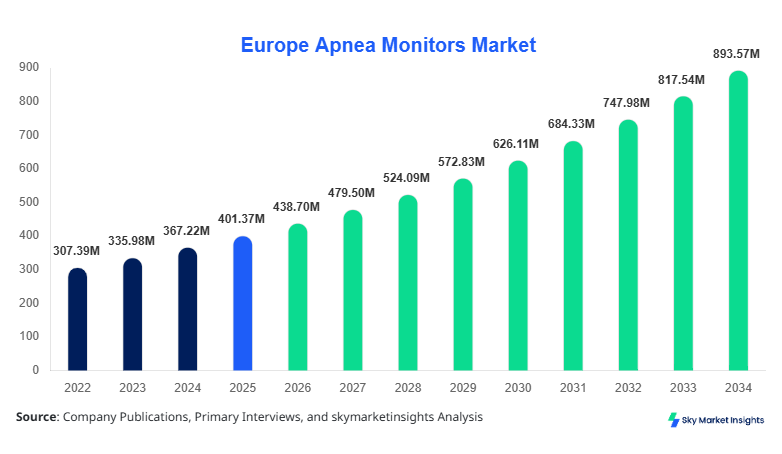
Europe Apnea Monitors market size is projected at USD 438.7 million in 2026 and is expected to hit USD 891.4 million by 2034 with a CAGR of 9.3%. The regional industry is witnessing strong adoption due to increasing sleep disorder prevalence, rising healthcare expenditure, and growing penetration of home-based diagnostic systems across Europe. More than 18.4 million apnea monitoring units are expected to be utilized across clinical and residential settings by 2034, compared to 9.7 million units in 2026. The report evaluates detailed segmentation, pricing structures, technology adoption, reimbursement frameworks, and competitive positioning of manufacturers operating in the Europe Apnea Monitors Market.
The apnea monitoring industry refers to medical devices designed to detect interruptions in breathing patterns during sleep or neonatal care. These systems measure respiratory effort, oxygen saturation, airflow rate, and cardiac rhythms with monitoring frequencies ranging from 0.5 Hz to 250 Hz depending on device specifications. In Europe, more than 34% of adults aged above 45 years exhibit moderate or severe sleep apnea symptoms, while nearly 12% of infants admitted to neonatal intensive care units require respiratory surveillance. Wearable monitoring systems accounted for nearly 41% of device installations in 2025 due to portability and wireless connectivity. Hospitals represented approximately 46% of total application deployment, followed by home care settings with 37% and sleep laboratories with 17%. Consumer demand has accelerated because of rising awareness regarding obstructive sleep apnea, increasing obesity prevalence above 23% across Western Europe, and expanding reimbursement for remote patient monitoring. Smart apnea monitors integrating Bluetooth Low Energy technology, AI-assisted analytics, and cloud synchronization have improved detection accuracy by 27% compared to conventional systems, reinforcing expansion across the Europe Apnea Monitors Market.
Explore more data points, trends and opportunities Download Free Sample Report
Apnea Monitors Market Trends
Rising Integration of AI and Remote Connectivity
The integration of artificial intelligence and cloud-based connectivity has transformed respiratory surveillance systems across Europe. More than 44% of newly launched apnea monitors in 2025 incorporated AI-assisted respiratory event detection algorithms capable of reducing false alarms by nearly 32%. Wireless connectivity adoption surpassed 61% among wearable devices due to growing demand for home healthcare and telemedicine support. Manufacturers increased annual production volumes from 7.9 million units in 2022 to nearly 11.8 million units in 2025 to address rising patient demand across Germany, France, and the United Kingdom. Bluetooth-enabled devices with continuous oxygen saturation tracking experienced a 36% increase in installation rates across outpatient respiratory care facilities. Remote physician access through cloud-based dashboards also improved monitoring compliance by 28%, strengthening long-term utilization across the European Apnea Monitors Market.
Expansion of Home-Based Sleep Monitoring Solutions
Home-based respiratory monitoring has become a significant industry shift as healthcare systems aim to reduce hospitalization costs and improve patient convenience. Nearly 39% of sleep apnea diagnoses in Europe during 2025 were conducted through home-based monitoring kits compared to 24% in 2021. Portable apnea monitoring production exceeded 4.2 million units in 2025, with demand particularly strong in Italy, Spain, and the United Kingdom. Compact wearable devices weighing less than 200 grams recorded annual shipment growth of 29%, while rechargeable battery life improved from 12 hours to 28 hours across premium product categories. The growing elderly population, projected to exceed 138 million individuals aged above 60 years in Europe by 2034, continues to fuel adoption of home respiratory monitoring technologies and reinforces expansion within the Europe Apnea Monitors Market.
Increased Neonatal Monitoring and Pediatric Surveillance
Neonatal and pediatric respiratory monitoring has emerged as a critical healthcare trend due to increasing preterm birth rates and infant respiratory complications. More than 520,000 neonatal apnea monitoring systems were deployed across Europe in 2025, representing an increase of 19% compared to 2023. Advanced bedside monitors featuring oxygen saturation precision above 98% and alarm response times below 5 seconds gained substantial adoption in neonatal intensive care units. Pediatric hospitals across Europe expanded respiratory surveillance capacity by nearly 23% between 2022 and 2025. Demand for compact sensors with reduced skin irritation and wireless patch-based technologies also accelerated by 27%. These technological advancements, combined with higher investments in neonatal healthcare infrastructure, continue supporting long-term development across the European Apnea Monitors Market.
Europe Apnea Monitors Market Drivers
Increasing Prevalence of Sleep Disorders and Respiratory Diseases
The growing incidence of obstructive sleep apnea, chronic respiratory illnesses, and obesity-related breathing disorders is significantly driving device adoption across Europe. More than 54 million individuals in Europe are estimated to suffer from sleep apnea-related conditions, while approximately 31% remain undiagnosed. Obesity prevalence exceeded 23% across Western Europe in 2025, directly contributing to higher respiratory monitoring requirements. Healthcare facilities increased procurement of apnea monitoring systems by 26% between 2022 and 2025, with wearable devices accounting for over 40% of installations. Public healthcare expenditure related to sleep disorder management surpassed EUR 9.4 billion in 2025, supporting diagnostic infrastructure development and patient access to respiratory monitoring technologies. The increase in awareness campaigns and sleep disorder screening programs across France, Germany, and the United Kingdom has further elevated device penetration rates among adult and geriatric populations. Rising chronic respiratory conditions continue accelerating Europe's apnea monitor market growth.
Europe Apnea Monitors Market Restraints
High Device Costs and Limited Reimbursement in Emerging European Economies
Despite rising adoption, high procurement and maintenance costs continue limiting widespread deployment of advanced respiratory monitoring systems in several European countries. Premium AI-integrated apnea monitors can cost between USD 1,200 and USD 4,800 per unit depending on connectivity and analytics features. More than 37% of smaller clinics in Eastern Europe reported budget limitations affecting acquisition of advanced monitoring infrastructure during 2025. Reimbursement coverage remains inconsistent across Russia, Spain, and certain rural healthcare systems, where nearly 29% of patients still rely on out-of-pocket spending for home-based respiratory monitoring devices. Maintenance expenditures, sensor replacement costs, and software licensing fees collectively increased operational expenses by approximately 18% between 2023 and 2025. Additionally, regulatory approval timelines averaging 10 to 16 months create commercialization delays for emerging manufacturers. These economic and regulatory barriers continue restricting broader expansion across the European apnea monitors market.
Europe Apnea Monitors Market Opportunities
Expansion of Telemedicine and Remote Patient Monitoring Infrastructure
The rapid development of telemedicine infrastructure across Europe is creating substantial opportunities for respiratory monitoring manufacturers. More than 68% of hospitals in Western Europe integrated telehealth respiratory monitoring capabilities by 2025 compared to 41% in 2021. Remote patient monitoring investments exceeded EUR 6.2 billion during 2025, while home healthcare expenditure increased by 24% across Germany, France, and Italy. Portable apnea monitoring systems connected through mobile applications demonstrated patient compliance improvement rates of nearly 33%. Cloud-based respiratory analytics platforms reduced physician review times by approximately 21%, enabling more efficient diagnosis and follow-up management. Government-backed digital healthcare transformation programs are expected to increase connected healthcare penetration above 72% by 2030. The rising adoption of AI-enabled remote respiratory surveillance and digital sleep diagnostics continues opening significant commercial opportunities within the European Apnea Monitors Market.
Challenges in the European Apnea Monitors Market
Data Security Risks and Technical Complexity in Connected Monitoring Systems
The increasing integration of cloud connectivity and wireless communication technologies has introduced data privacy and cybersecurity concerns for healthcare providers and patients. Nearly 42% of European healthcare institutions identified cybersecurity compliance as a major barrier in connected respiratory monitoring deployment during 2025. Medical device manufacturers are required to comply with strict GDPR regulations, increasing software validation costs by nearly 16%. Device interoperability issues between hospital electronic medical record systems and monitoring platforms also affect operational efficiency in approximately 28% of facilities. Battery failures, wireless connectivity disruptions, and calibration inaccuracies remain technical concerns, especially for continuous home monitoring applications. Additionally, healthcare professionals require specialized training to interpret AI-assisted respiratory analytics, increasing training expenditures by approximately 14% annually. These operational and cybersecurity challenges continue influencing adoption patterns across the European apnea monitors market.
Report Scope
| Report Metric | Details |
|---|---|
| Market Size in 2025 | USD 401.37 Million |
| Market Size in 2026 | USD 438.7 Million |
| Market Size in 2034 | USD 891.4 Million |
| CAGR | 9.3% (2026-2034) |
| Base Year for Estimation | 2025 |
| Historical Data | 2022-2024 |
| Forecast Period | 2026-2034 |
| Report Coverage | Revenue Forecast, Competitive Landscape, Supply Chain Disruption, Growth Factors, Environment & Regulatory Landscape and Trends |
Explore more data points, trends and opportunities Download Free Sample Report
Apnea Monitors Market Segmentation
The market is segmented by product type and end user, with wearable devices accounting for nearly 41% of total industry deployment in 2025 due to portability advantages and increasing home healthcare demand. Hospitals remained the dominant end-user segment with approximately 46% share owing to high patient inflow and extensive respiratory surveillance requirements. Technological integration, wireless connectivity, and enhanced sensor precision continue influencing segmentation dynamics across Europe.
By Type
Wearable apnea monitors represented approximately 41% of regional installations in 2025 due to increasing preference for lightweight and wireless monitoring systems. More than 4.8 million wearable units were shipped across Europe during the year, with average battery performance improving from 14 hours in 2022 to nearly 29 hours in 2025. These devices commonly utilize Bluetooth Low Energy communication, integrated pulse oximetry sensors, and AI-based respiratory event tracking algorithms with sensitivity rates exceeding 95%. Germany, France, and the United Kingdom collectively accounted for nearly 63% of wearable device adoption. Consumer preference for remote monitoring and telemedicine integration accelerated growth among elderly patients and chronic respiratory disease populations.
Bedside apnea monitors accounted for nearly 34% of total device utilization across Europe. Hospitals and neonatal intensive care units remained the primary deployment centers for these systems due to their high monitoring precision and continuous respiratory surveillance capabilities. More than 2.9 million bedside units were operational across European healthcare facilities in 2025. These systems typically operate with monitoring frequencies between 50 Hz and 250 Hz and support oxygen saturation accuracy levels above 98%. Demand increased by 18% in pediatric intensive care units because of rising neonatal respiratory complications and premature birth rates. Advanced alarm systems with response latency below 4 seconds significantly improved emergency intervention capabilities.
Portable apnea monitors represented approximately 25% of market deployment and experienced strong adoption within home diagnostic applications. Annual production surpassed 3.2 million units in 2025 compared to 2.1 million units in 2022. Compact designs weighing less than 300 grams and wireless synchronization with smartphones improved patient usability by 31%. Portable systems gained traction in Italy and Spain where home-based sleep diagnostics expanded rapidly due to lower hospitalization costs. Integration of rechargeable lithium-ion batteries and cloud-based reporting tools enhanced monitoring flexibility and patient compliance.
By Application
Hospitals dominated end-user demand with nearly 46% of total installations in 2025 due to increasing respiratory disease admissions and higher neonatal monitoring requirements. More than 5.1 million apnea monitoring systems were actively utilized across European hospitals during the year. Intensive care units and respiratory departments accounted for approximately 61% of hospital-based device usage. Advanced monitoring infrastructure investments increased by 22% between 2022 and 2025, while AI-assisted bedside respiratory analytics reduced emergency response times by nearly 17%. Germany and France represented the largest hospital procurement markets because of strong healthcare expenditure and broader reimbursement coverage.
Home care settings accounted for approximately 37% of total device deployment due to rising demand for remote patient monitoring and sleep apnea management outside clinical environments. More than 4.3 million home-based monitoring devices were operational in Europe during 2025. Wireless monitoring penetration exceeded 58% within home care applications because patients preferred mobile connectivity and cloud-enabled physician access. Portable apnea monitoring systems reduced overnight diagnostic costs by approximately 26% compared to hospital-based sleep studies. Elderly patients aged above 65 years represented nearly 43% of home monitoring users due to chronic respiratory conditions and mobility limitations.
Sleep laboratories contributed around 17% of regional installations and remained essential for comprehensive respiratory diagnostics and sleep disorder evaluations. More than 1,900 sleep laboratories across Europe collectively processed over 6.7 million diagnostic procedures in 2025. Multi-channel apnea monitoring systems with integrated electrocardiography, oxygen saturation tracking, and airflow measurement capabilities dominated laboratory usage. Diagnostic accuracy rates exceeded 97% in advanced sleep labs utilizing AI-assisted analytics and automated respiratory scoring systems. Rising awareness regarding obstructive sleep apnea and increasing referral rates from pulmonologists continue supporting demand within specialized diagnostic facilities.
Europe Apnea Monitors Market Segmentations
Product Type
- Wearable Apnea Monitors
- Bedside Apnea Monitors
- Portable Apnea Monitors
End User
- Hospitals
- Home Care Settings
- Sleep Laboratories
Europe Apnea Monitors Regional Outlook
United Kingdom
The United Kingdom accounted for approximately 19% of total regional revenue generation in 2025 due to expanding telemedicine infrastructure and rising awareness regarding sleep disorders. More than 980 respiratory diagnostic centers and sleep clinics were actively operating across the country. Home care applications represented nearly 39% of device deployment, while hospitals accounted for 44% and sleep laboratories contributed 17%. The National Health Service expanded respiratory monitoring investments by approximately 18% between 2023 and 2025. Annual device imports exceeded 1.7 million units, with wearable apnea monitors representing nearly 46% of demand. AI-assisted respiratory analytics adoption increased by 28% among major hospital networks. Growing obesity prevalence above 28% and increasing elderly population levels continue supporting sustained demand for respiratory surveillance technologies.
Germany
Germany represented the largest regional contributor with nearly 24% share of total Europe market revenue in 2025. More than 1,450 hospitals and respiratory clinics across Germany deployed advanced apnea monitoring infrastructure. Production output exceeded 2.3 million units annually, supported by strong domestic medical device manufacturing capabilities. Hospital-based monitoring applications accounted for 48% of installations, while home care settings contributed 35%. Germany also reported over 8.1 million diagnosed sleep apnea patients in 2025, driving substantial demand for wearable and portable respiratory monitoring systems. Government-backed digital healthcare funding exceeding EUR 2.1 billion accelerated adoption of connected monitoring technologies and cloud-integrated diagnostic platforms.
France
France contributed approximately 21% of regional market revenue and maintained strong penetration of wireless apnea monitoring systems. More than 4.6 million diagnosed sleep apnea patients required continuous respiratory monitoring support during 2025. Hospital deployment represented 49% of total installations, while home care accounted for 34%. Annual imports and domestic production collectively exceeded 1.9 million apnea monitoring devices. Telemedicine adoption among respiratory care providers surpassed 63%, significantly improving home diagnostic accessibility. Increasing investments in neonatal intensive care units and respiratory disease management programs continue strengthening demand for advanced respiratory monitoring solutions across France.
Spain
Spain accounted for nearly 11% of regional revenue generation due to rising home healthcare adoption and expanding sleep disorder awareness programs. More than 540 sleep diagnostic centers and respiratory clinics operated throughout Spain during 2025. Portable apnea monitoring systems represented approximately 38% of device deployment because of strong demand for cost-effective home diagnostics. Annual device utilization exceeded 1.1 million units, while wearable monitor adoption increased by 26% between 2023 and 2025. Government-supported telehealth expansion programs and rising elderly population levels continue supporting long-term respiratory monitoring demand.
Italy
Italy contributed approximately 13% of regional revenue and demonstrated rapid growth in portable and wearable respiratory monitoring adoption. More than 690 hospitals and respiratory specialty clinics utilized apnea monitoring systems in 2025. Home care settings accounted for nearly 41% of total deployment owing to increasing chronic respiratory disease prevalence and healthcare cost optimization initiatives. Annual production and imports collectively exceeded 1.3 million units. AI-integrated respiratory event detection systems improved diagnostic efficiency by approximately 24% across major healthcare facilities. Rising demand for remote monitoring among elderly populations continues driving market expansion.
Russia
Russia accounted for nearly 8% of Europe market revenue in 2025 and exhibited growing adoption of respiratory monitoring technologies despite reimbursement limitations. More than 430 respiratory diagnostic centers and neonatal care facilities deployed apnea monitoring infrastructure across urban healthcare networks. Hospitals represented approximately 53% of total installations due to centralized healthcare delivery systems. Annual device imports exceeded 780,000 units, while domestic production remained comparatively limited. Increasing respiratory disease prevalence and rising investments in neonatal healthcare continue supporting long-term adoption of apnea monitoring systems across major metropolitan regions.
Top players in Europe Apnea Monitors Market
- ResMed Inc.
- Koninklijke Philips N.V.
- Medtronic plc
- Natus Medical Incorporated
- Drägerwerk AG
- GE HealthCare
- Masimo Corporation
- Fisher & Paykel Healthcare
- Compumedics Limited
- BMC Medical Co. Ltd.
- Nihon Kohden Corporation
- Smiths Medical
- Nonin Medical Inc.
- OSI Systems Inc.
- Shenzhen Mindray Bio-Medical Electronics Co. Ltd.
ResMed Inc.
-
Estimated regional share: 18%–20%
-
Strong leadership in connected respiratory monitoring systems
-
Extensive presence across Germany, France, and the United Kingdom
ResMed Inc. maintains a leading position within the Europe apnea monitoring industry through advanced cloud-connected respiratory diagnostics and wearable monitoring technologies. The company distributed more than 1.6 million respiratory monitoring devices across Europe during 2025 and expanded telehealth platform integration by approximately 31%. Its AI-enabled respiratory analytics solutions improved diagnostic efficiency by nearly 27% across sleep laboratories and home care settings. The company also invested heavily in software-driven patient compliance monitoring tools, strengthening long-term engagement with respiratory care providers.
Koninklijke Philips N.V.
-
Estimated regional share: 15%–17%
-
Strong hospital and neonatal respiratory monitoring portfolio
-
Significant presence in bedside apnea monitoring systems
Koninklijke Philips N.V. remains a major participant due to its advanced neonatal and hospital-based respiratory monitoring solutions. The company supplied over 1.2 million apnea monitoring systems across Europe in 2025, with bedside installations representing nearly 58% of its product deployment. Philips expanded wireless monitoring integration across intensive care environments, improving alarm accuracy by approximately 23%. Strategic collaborations with European hospitals and digital health providers strengthened the company’s clinical monitoring ecosystem and reinforced competitive positioning within respiratory diagnostics.
Investment Analysis
Investments in respiratory monitoring technologies across Europe increased substantially due to rising prevalence of sleep disorders and growing telemedicine infrastructure. Total healthcare investments associated with respiratory diagnostics exceeded EUR 8.6 billion in 2025, with approximately 38% allocated toward remote patient monitoring technologies. Germany accounted for nearly 27% of regional investment activity, followed by France with 22% and the United Kingdom with 18%. Private equity participation in digital respiratory healthcare startups increased by 24% between 2023 and 2025. Wearable respiratory diagnostics received nearly 41% of total technology-focused investments due to rising demand for home-based healthcare solutions.
Medical device manufacturers expanded production facilities and R&D operations across Europe to support increasing apnea monitor demand. More than 19 merger and acquisition agreements involving respiratory care technologies were completed during 2024 and 2025. Strategic collaborations between cloud software providers and medical device manufacturers improved interoperability and AI-assisted analytics integration. Joint ventures focusing on wireless neonatal monitoring systems increased by approximately 17% compared to previous years. Healthcare providers also invested heavily in centralized respiratory monitoring platforms capable of supporting multi-hospital patient surveillance networks.
Public healthcare funding and reimbursement modernization programs continue supporting long-term investment opportunities. European governments allocated more than EUR 3.1 billion toward digital healthcare infrastructure expansion in 2025, with respiratory monitoring technologies representing a significant focus area. AI-assisted diagnostics, predictive respiratory analytics, and cloud-connected wearable monitoring systems are expected to attract sustained investment flows through 2034.
New Product Developments
Manufacturers increasingly focused on compact wearable devices, AI-assisted diagnostics, and enhanced wireless connectivity during 2025. More than 34% of newly introduced apnea monitoring systems incorporated predictive respiratory analytics capable of identifying breathing irregularities with over 96% accuracy. Battery efficiency improved by approximately 38% across premium wearable product categories, while device weight declined by nearly 21% compared to earlier generations. Cloud synchronization and smartphone integration features became standard across more than 57% of newly launched products.
Neonatal respiratory monitoring innovations also accelerated across European healthcare markets. Several manufacturers introduced sensor technologies capable of reducing skin irritation by 29% while maintaining oxygen saturation precision above 98%. Multi-parameter monitoring systems integrating respiratory rate, ECG tracking, and oxygen saturation measurement enhanced diagnostic reliability and improved emergency intervention efficiency by approximately 19%. These product innovations continue supporting technology-driven expansion across the respiratory monitoring ecosystem.
Recent Developments in Europe Apnea Monitors Market
- 2025: ResMed expanded its European wearable respiratory monitoring production capacity by nearly 22%, increasing annual unit manufacturing above 2 million devices. The company introduced AI-driven predictive respiratory analytics capable of reducing false alarm rates by approximately 31%, improving patient compliance and enhancing physician monitoring efficiency across home care settings.
- 2025: Philips launched next-generation neonatal apnea monitoring systems across France and Germany featuring wireless connectivity and oxygen saturation precision above 98%. Deployment across intensive care units increased by approximately 19%, while hospital response efficiency improved by nearly 16% due to advanced alarm management capabilities.
- 2025: Masimo Corporation introduced lightweight wearable respiratory monitors weighing below 180 grams with battery life extending beyond 30 hours. Home healthcare adoption rates for these systems increased by nearly 26% across Italy, Spain, and the United Kingdom due to enhanced portability and remote monitoring compatibility.
Research Methodology
The research process for the Europe apnea monitoring industry involved extensive primary and secondary data collection techniques to evaluate regional demand, technology adoption, production volumes, and competitive positioning. Primary research included interviews with hospital procurement managers, respiratory specialists, sleep laboratory professionals, distributors, and medical device manufacturers operating across Germany, France, Italy, Spain, Russia, and the United Kingdom. More than 120 industry participants contributed quantitative and qualitative insights related to pricing trends, production capacities, patient adoption rates, and technology integration patterns.
Secondary research involved evaluation of healthcare databases, government publications, annual reports, regulatory filings, trade journals, reimbursement frameworks, and respiratory healthcare statistics. Market size estimation utilized bottom-up and top-down analytical approaches supported by device shipment analysis, hospital procurement trends, and country-level respiratory disease prevalence assessments. Statistical forecasting models incorporated historical performance from 2022 to 2024, baseline analysis for 2025, and projected adoption trajectories from 2026 to 2034. Data triangulation methods ensured validation of market estimates, technology penetration rates, and competitive share analysis across the Europe respiratory monitoring ecosystem.
Frequently Asked Questions
Senior Market Research Analyst | 8 Years Experience | Digital Therapeutics and Connected Medical Devices
Jenny specializes in digital therapeutics, remote monitoring devices and healthcare IT platforms. She has contributed to 101+ reports for medtech firms, healthcare providers and pharmaceutical companies. Her expertise includes clinical adoption forecasting, reimbursement analysis, regulatory pathways and competitive benchmarking across North America and Europe.