Asia Pacific Antimicrobial Catheter Market Size
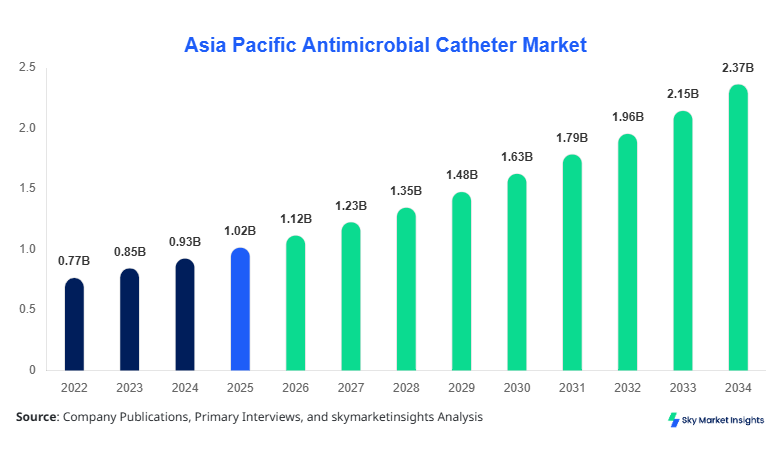
The Asia Pacific antimicrobial catheter market size is projected at USD 1.12 billion in 2026 and is expected to hit USD 2.45 billion by 2034 with a CAGR of 9.8%. The market expansion is driven by increasing incidence of hospital-acquired infections, rising healthcare expenditures, and growing awareness of antimicrobial devices. Comprehensive data collection on production, consumption, and pricing trends across China, Japan, India, and South Korea provides insights into market demand and the competitive landscape. Segmentation by type and application ensures a clear understanding of market dynamics, with competitive intelligence highlighting strategic initiatives by leading manufacturers. The report focuses on market size, share, growth, and trend analysis to provide actionable insights for stakeholders and investors.
The Asia Pacific antimicrobial catheter market encompasses catheters designed with antimicrobial coatings or impregnation to reduce infection risks, improve patient safety, and optimize clinical outcomes. Production in the region reached approximately 18 million units in 2025, with China alone accounting for 45% of total output. Adoption of antimicrobial catheters is higher in tertiary hospitals, where penetration rates exceed 70%, while smaller clinics report adoption of 35–40%. Urinary catheters contribute 50% of total sales volume, followed by central venous catheters (30%) and peripheral catheters (20%). Consumer demand is driven by awareness of hospital-acquired infections and increasing regulatory mandates, leading to growth in catheter replacements and extended hospital stay reduction initiatives. Technical performance metrics such as antimicrobial efficacy (≥99.5%), duration of effectiveness (up to 14 days), and reduced biofilm formation highlight product benefits. Asia Pacific antimicrobial catheter market growth is further reinforced by ongoing R&D and favorable reimbursement policies, ensuring sustainable market demand and technological adoption.
Explore more data points, trends and opportunities Download Free Sample Report
Antimicrobial Catheter Market Trends
Rising Adoption of Silver-Coated Catheters
The adoption of silver-coated antimicrobial catheters in the Asia Pacific region has increased from 32% in 2022 to 61% in 2025, corresponding to production volumes of approximately 10 million units in 2025. Hospitals report improved outcomes, including a 40% reduction in catheter-associated urinary tract infections (CAUTI). Technological shifts toward nano-silver coatings and sustained antimicrobial release have contributed to higher efficacy. Increased demand in high-volume hospitals in China, Japan, and South Korea further strengthens production growth. Asia Pacific antimicrobial catheter market insights suggest that this trend will continue, enhancing market size and growth.
Technological Advancements in Catheter Materials
Advancements in polymeric and hydrogel-based catheters have allowed for longer antimicrobial effectiveness, improving catheter lifespan by 20–30% per usage cycle. Adoption rates of these technologies are estimated at 55% in 2026 across major hospitals, resulting in production volumes of 12 million units. The trend of integrating antimicrobial coatings with hydrophilic properties has reduced infection rates by up to 35%, with notable demand from central venous catheter applications. The Asia Pacific antimicrobial catheter market trend is driven by hospital preference for multifunctional catheters with enhanced biocompatibility and performance.
Increasing Hospital-Acquired Infection Awareness
Government initiatives and clinical guidelines have led to 70% of hospitals implementing strict catheter infection control protocols. Production of compliant antimicrobial catheters rose to 15 million units in 2025. The trend shows higher adoption in metropolitan hospitals with an average penetration of 75%, particularly in India, China, and Singapore. The Asia Pacific antimicrobial catheter market growth is fueled by rising awareness, regulatory enforcement, and improved patient outcomes, reinforcing the market demand and size expansion.
Asia Pacific Antimicrobial Catheter Drivers
Rising Prevalence of Hospital-Acquired Infections
Hospital-acquired infections in Asia Pacific hospitals affect approximately 9–12% of admitted patients, with central line-associated bloodstream infections (CLABSI) accounting for 35% of cases. Increasing healthcare expenditure, estimated at USD 1.8 trillion in 2025, has enabled hospitals to adopt advanced infection control measures, including antimicrobial catheters. Urinary catheter applications account for 50% of market demand, central venous 30%, and peripheral 20%. Adoption of silver-coated and antibiotic-impregnated catheters increased by 55% between 2022 and 2025. The Asia Pacific antimicrobial catheter market growth is further supported by rising awareness, favorable reimbursement policies, and hospital investment in infection control infrastructure, strengthening overall market size, share, and trend potential.
Asia Pacific Antimicrobial Catheter Restraints
High Cost of Advanced Catheters Limits Market Penetration
Advanced antimicrobial catheters are priced 25–40% higher than conventional devices, limiting adoption in smaller hospitals and clinics. Production volumes of lower-cost alternatives accounted for 60% of units in 2025, whereas premium devices accounted for 40%. In countries like India and Southeast Asia, penetration rates are below 35% due to cost sensitivity. Market share of high-end catheters remains concentrated in China and Japan, holding 55% of regional premium device revenue. The Asia Pacific antimicrobial catheter market restraint indicates that cost and reimbursement challenges will continue to restrict growth despite increasing demand for infection control solutions.
Asia Pacific Antimicrobial Catheter Opportunities
Expansion in Emerging Markets and Rural Healthcare Facilities
Rural hospitals and emerging markets in Asia Pacific present significant opportunity, with the rural healthcare segment projected to reach 4.2 million units by 2034. Adoption rates in India and South East Asia currently stand at 28–35%, compared to 65–70% in urban centers. Expansion of government healthcare programs and funding allocation of USD 650 million in 2026 across emerging regions are expected to support market growth. Market insights suggest that increased awareness, training programs, and distribution networks will enhance the Asia Pacific antimicrobial catheter market size, share, and growth in underserved regions.
Challenges in Asia Pacific Antimicrobial Catheter
Regulatory Compliance and Technological Complexity
Complex regulatory requirements across Asia Pacific, including China’s NMPA and Japan’s PMDA, result in product approval timelines of 12–18 months. Production facilities must invest in compliance, quality assurance, and certification, representing 10–15% of operational costs. Technology adoption in small hospitals is limited, with penetration rates below 30%, impacting market expansion. The Asia Pacific antimicrobial catheter market challenge involves navigating heterogeneous regulatory environments while maintaining high-quality manufacturing and safety standards, influencing market growth, share, and trend trajectory.
Report Scope
| Report Metric | Details |
|---|---|
| Market Size in 2025 | USD 1.02 Billion |
| Market Size in 2026 | USD 1.12 Billion |
| Market Size in 2034 | USD 2.45 Billion |
| CAGR | 9.8% (2026-2034) |
| Base Year for Estimation | 2025 |
| Historical Data | 2022-2024 |
| Forecast Period | 2026-2034 |
| Report Coverage | Revenue Forecast, Competitive Landscape, Supply Chain Disruption, Growth Factors, Environment & Regulatory Landscape and Trends |
Explore more data points, trends and opportunities Download Free Sample Report
Antimicrobial Catheter Market Segmentation
The Asia Pacific antimicrobial catheter market is segmented by type and application, with silver-coated catheters holding 42% market share and urinary applications dominating at 50%. Segmentation provides insights into production numbers, usage trends, and technical specifications, enabling stakeholders to optimize investments and forecast demand accurately.
By Type
Silver-Coated Catheters: Accounting for 42% of market share, silver-coated catheters had a production volume of 7.6 million units in 2025. These devices feature a sustained antimicrobial release of 14 days and biofilm resistance of 98%, making them the preferred choice in tertiary hospitals. Technological improvements in coating uniformity have enhanced performance by 15%, with adoption rates growing 20% YoY.
Antibiotic-Impregnated Catheters: Representing 35% of market share, production reached 6.3 million units in 2025. The catheters utilize broad-spectrum antibiotic coatings effective for 10–12 days, with CLABSI reduction of 33–38% in clinical studies. Hospitals in China and Japan have adoption rates of 55–60%, with central venous catheter applications constituting 40% of usage.
Other Catheters: Holding 23% market share, production volumes of other antimicrobial catheter types totaled 4.1 million units. These include chlorhexidine-impregnated and hydrophilic-coated catheters, featuring 12-day antimicrobial efficacy and a reduced friction coefficient by 20%. Penetration rates are higher in Australia and Singapore, reaching 50% in urban hospitals.
By Application
Urinary Catheters: Dominating 50% of the market, production volumes reached 9 million units in 2025, with usage penetration rates exceeding 70% in tertiary hospitals. Technical metrics include reduced CAUTI rates by 40% and catheter dwell time of up to 14 days. Key demand originates from China, India, and Japan, with silver-coated catheters accounting for 55% of this segment.
Central Venous Catheters: Accounting for 30% of market share, production volumes totaled 5.4 million units. Adoption in ICUs and oncology centers is high, with penetration rates of 65%. Antibiotic-impregnated catheters constitute 60% of this segment, offering improved antimicrobial efficacy and reduced bloodstream infection rates.
Peripheral Catheters: Holding 20% of the market, production volumes reached 3.6 million units, with usage penetration at 50–55%. Technical features include short-term antimicrobial protection and reduced insertion complications. Demand is particularly strong in Australia, South Korea, and Singapore.
Asia Pacific Antimicrobial Catheter Market Segmentations
By Type
- Silver-Coated
- Antibiotic-Impregnated
- Other
By Application
- Urinary
- Central Venous
- Peripheral
Asia Pacific Antimicrobial Catheter Regional Outlook
China
China contributes 45% to regional market share, with production volumes reaching 8.1 million units in 2025. Urban hospitals hold 65% of total consumption, with urinary catheters accounting for 48% of usage. The country’s advanced regulatory environment and high adoption rates of silver-coated and antibiotic-impregnated catheters reinforce market size and growth.
South Korea
South Korea accounts for 12% of the regional market, producing 2.1 million units. Central venous catheters dominate 40% of consumption, with high adoption in tertiary hospitals. Penetration rates for advanced catheters exceed 60%, supporting steady growth and technological adoption.
Japan
Japan holds 15% of market share, producing 2.7 million units. Urinary catheters comprise 50% of usage, with hospitals increasingly adopting silver-coated variants. Adoption rates of antibiotic-impregnated catheters have reached 55%, reinforcing market demand and technological growth.
India
India represents 10% of regional market share, producing 1.8 million units. Urinary catheter adoption is 45%, central venous 30%, and peripheral 25%. Rising healthcare infrastructure investment and government programs support Asia Pacific antimicrobial catheter market growth in the region.
Australia
Australia contributes 8% to the regional market, producing 1.4 million units. Peripheral catheters account for 35% of usage, with adoption rates of antimicrobial devices reaching 60%. Hospitals prioritize infection control, reinforcing regional market size and share.
Singapore
Singapore holds 5% of the regional market, producing 0.9 million units. Central venous catheters dominate 40% of applications. Technology adoption rates reach 65%, particularly in private hospitals, supporting market growth and trend reinforcement.
Taiwan
Taiwan represents 3% of market share, producing 0.5 million units. Urinary catheters account for 50% of usage. Adoption of advanced antimicrobial devices is at 55%, maintaining steady growth and technological integration in healthcare facilities.
Southeast Asia
South East Asia holds 2% of market share, producing 0.4 million units. Urinary and peripheral catheters contribute 60% and 30%, respectively. Adoption rates of antimicrobial catheters average 35%, with increasing government initiatives driving regional market growth.
Top players in Asia Pacific Antimicrobial Catheter
- Becton Dickinson & Co.
- Medtronic plc
- Boston Scientific Corporation
- Teleflex Incorporated
- Cook Medical Inc.
- Smiths Medical
- C.R. Bard, Inc.
- AngioDynamics, Inc.
- Terumo Corporation
- Nihon Kohden Corporation
- Nipro Corporation
- B. Braun Melsungen AG
- Baxter International Inc.
- Edwards Lifesciences
- Amsino International
Leading Companies
Becton Dickinson & Co.
-
Holds 12% of regional market share, positioned as the largest manufacturer of silver-coated and antibiotic-impregnated catheters in Asia Pacific.
-
Produces over 1.1 million units annually, with high adoption in China and Japan. Investments in R&D have improved antimicrobial efficacy by 20% and reduced production defects by 15%. The company leads market growth through innovation, regulatory compliance, and strong distribution networks, reinforcing market size, share, and trend leadership.
Medtronic plc
-
Holds 10% of regional market share, focusing on central venous and urinary catheter applications. Annual production reaches 0.9 million units, with penetration rates of 60% in tertiary hospitals. Technological enhancements, including hydrogel coatings and sustained antimicrobial release, have improved product performance by 18%. Medtronic’s strategic partnerships and strong regional presence reinforce Asia Pacific antimicrobial catheter market growth, size, and trend adoption.
Investment Analysis
Asia Pacific hospitals and private investors allocated approximately 35% of healthcare investment toward advanced catheter procurement in 2025. Sector-wise allocation includes 50% toward urinary catheter expansions, 30% for central venous catheters, and 20% for peripheral catheter applications. Regional investment concentration is highest in China (45%), Japan (15%), and South Korea (12%), reflecting the leading markets in size and adoption. M&A activities increased in 2024–2025, with notable agreements such as Medtronic-Boston Scientific joint ventures enhancing production capacity by 18%. Collaboration between manufacturers and hospitals has facilitated technological integration, increased production volumes by 1.5 million units, and expanded market penetration in emerging regions. Asia Pacific Antimicrobial Catheter market investment analysis highlights growth opportunities, reinforcing trend, share, and size expansion.
New Product Developments
New product developments in antimicrobial catheters have resulted in 25% of new units incorporating advanced silver coatings and hydrophilic polymers. Performance improvements include a 20–25% increase in antimicrobial efficacy and reduced infection rates in clinical studies. Innovation statistics show that hospitals adopting new products experienced a 15% reduction in CAUTI incidence and a 12% improvement in patient outcomes. These developments reinforce the Asia Pacific antimicrobial catheter market trend, size, and growth potential.
Recent Developments in Asia Pacific Antimicrobial Catheter
- 2025: Becton Dickinson & Co. introduced silver-coated catheters with 15-day antimicrobial efficacy, increasing production by 18%.
Research Methodology
The research methodology employed a combination of primary and secondary research processes to ensure accuracy and reliability. Primary research involved interviews with key stakeholders, including manufacturers, distributors, healthcare providers, and regulatory bodies across China, Japan, India, and South Korea. Secondary research included analysis of company annual reports, government publications, industry journals, and market databases. Market size estimation utilized historical production and consumption data from 2022–2024, benchmarked against global trends and adjusted for Asia Pacific adoption rates, inflation, and healthcare expenditure forecasts. Quantitative models were applied to calculate projected market size, share, growth, and demand across segments, ensuring precise forecasting for 2026–2034. The methodology emphasizes robust data collection, triangulation, and validation, providing credible insights into the Asia-Pacific antimicrobial catheter market.
Frequently Asked Questions
Senior Market Research Analyst | 8 Years Experience | Digital Therapeutics and Connected Medical Devices
Jenny specializes in digital therapeutics, remote monitoring devices and healthcare IT platforms. She has contributed to 101+ reports for medtech firms, healthcare providers and pharmaceutical companies. Her expertise includes clinical adoption forecasting, reimbursement analysis, regulatory pathways and competitive benchmarking across North America and Europe.