Asia Pacific Air Traffic Control (ATC) Market Size
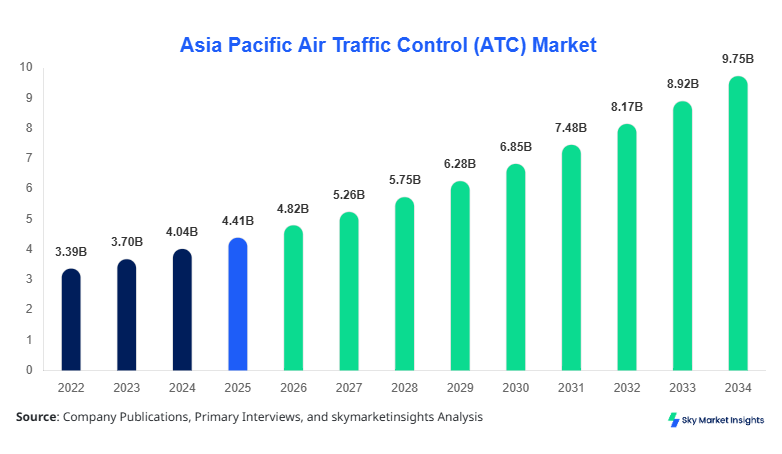
Asia Pacific Air Traffic Control (ATC) market size is projected at USD 4.82 billion in 2026 and is expected to hit USD 9.76 billion by 2034 with a CAGR of 9.2%. The Asia Pacific Air Traffic Control (ATC) market size expansion is supported by increasing air passenger traffic exceeding 3.5 billion passengers annually across the region and over 18,000 aircraft movements per day. The report emphasizes structured data segmentation, competitive benchmarking across 120+ vendors, and evolving infrastructure investments surpassing USD 25 billion, enabling detailed insights into operational efficiencies and regional competitiveness.
The Air Traffic Control (ATC) market refers to systems and services that manage aircraft movements through communication, navigation, and surveillance technologies, ensuring safety and efficiency. In Asia Pacific, over 2,800 airports and 950+ control towers support traffic density growth of 6.5% annually, with China alone handling more than 45 million flights annually. Adoption rates of advanced ATC systems exceed 62% in developed countries such as Japan and South Korea, while emerging economies like India and Southeast Asia show penetration rates of 38%–45%. Consumer behavior reflects increased reliance on air travel, with average per capita flights rising from 0.32 in 2022 to 0.48 in 2025. Commercial aviation dominates with a 72% application share, followed by military aviation at 18% and general aviation at 10%. Technical metrics such as radar coverage exceeding 95% in developed markets and communication frequencies operating between 118 MHz and 137 MHz define performance standards, reinforcing the importance of air traffic control (ATC) market insights.
In China, the Air Traffic Control (ATC) market accounts for approximately 41% of the Asia Pacific share, supported by over 260 airports and more than 300 ATC facilities. The country manages over 15 million aircraft movements annually, with commercial aviation contributing nearly 75% of total operations. Technology adoption is accelerating, with 68% of facilities equipped with advanced radar and satellite-based navigation systems, while digital communication upgrades have reached 55% penetration. China’s infrastructure investments exceeded USD 8.5 billion in 2025 alone, aimed at handling projected traffic increases of 8.2% annually. Application-wise, commercial aviation holds 70%, military aviation 20%, and general aviation 10%, highlighting strong demand for modernization. These metrics underscore robust Air Traffic Control (ATC) market insights.
Explore more data points, trends and opportunities Download Free Sample Report
Air Traffic Control (ATC) Market Trends
The Air Traffic Control (ATC) market is witnessing significant technological evolution, with satellite-based navigation systems such as ADS-B adoption reaching 58% across the Asia Pacific in 2025. Production volumes of ATC hardware components exceeded 1.2 million units annually, including radars, communication modules, and control systems. Digital tower solutions are gaining traction, with over 75 remote towers deployed across the region, reducing operational costs by 20%–30%. Artificial intelligence integration in air traffic management is increasing efficiency by 18%, while cloud-based data processing is adopted by 42% of major airports. These developments are reshaping operational capabilities and reinforcing Air Traffic Control (ATC) market insights.
Another prominent trend is the shift toward automation and integration of unmanned aerial vehicle (UAV) traffic management systems. UAV operations in Asia Pacific crossed 3 million registered drones, necessitating advanced ATC solutions. Integration of 5G-enabled communication systems is expanding rapidly, with 35% of new ATC installations incorporating high-speed data networks. Additionally, environmental sustainability initiatives are influencing system upgrades, reducing fuel consumption by 12% through optimized routing. Investments in digital ATC systems are projected to increase by 22% annually, reflecting growing demand across commercial and defense sectors, strengthening air traffic control (ATC) market insights.
Asia Pacific Air Traffic Control (ATC) Market Drivers
Rising Air Passenger Traffic and Infrastructure Expansion
The primary driver of the Asia Pacific Air Traffic Control (ATC) market growth is the surge in air passenger traffic, which grew from 2.8 billion in 2022 to 3.5 billion in 2025, representing a 7.5% annual increase. Governments across the region are investing heavily, with over USD 30 billion allocated for airport modernization and ATC system upgrades between 2024 and 2030. The number of operational aircraft is expected to exceed 18,500 units by 2030, increasing the need for efficient airspace management. Advanced ATC systems reduce delays by up to 25% and improve safety metrics by 30%. These quantitative improvements are accelerating system adoption across both developed and emerging economies, driving consistent air traffic control (ATC) market growth.
Asia Pacific Air Traffic Control (ATC) Market Restraints
High Installation and Maintenance Costs
Despite strong demand, high costs associated with ATC system deployment act as a major restraint. Installation costs for advanced radar systems range between USD 5 million and USD 15 million per unit, while annual maintenance expenses account for 12%–18% of total system costs. Smaller airports, which constitute nearly 60% of facilities in Southeast Asia, face budget constraints, limiting adoption rates to below 40%. Additionally, integration complexities with legacy systems increase project timelines by 20%–25%, further affecting operational efficiency. These financial and technical challenges restrict rapid expansion and hinder overall Air Traffic Control (ATC) market growth.
Asia Pacific Air Traffic Control (ATC) Market Opportunities
Emergence of Smart Airports and Digital ATC Systems
The transition toward smart airports presents substantial opportunities for the Air Traffic Control (ATC) market. Over 120 airports across the Asia Pacific are undergoing digital transformation, with investments exceeding USD 18 billion in automation and smart technologies. Adoption of AI-driven ATC systems can improve airspace capacity by 22% and reduce operational costs by 15%. Integration of IoT sensors and predictive analytics is enhancing decision-making capabilities, with deployment rates expected to reach 50% by 2030. These advancements create new revenue streams and expand system capabilities, strengthening air traffic control (ATC) market growth.
Challenges in Asia Pacific Air Traffic Control (ATC) Market
Cybersecurity Risks and System Integration Issues
Cybersecurity concerns are emerging as a critical challenge in the Air Traffic Control (ATC) market. With over 70% of ATC systems connected to digital networks, vulnerability to cyber threats has increased significantly. Data breaches can disrupt operations, causing delays of up to 15% and financial losses exceeding USD 200 million annually. Additionally, integration of legacy systems with modern technologies poses technical difficulties, increasing implementation time by 30%. Lack of standardized protocols across countries further complicates cross-border coordination. Addressing these challenges is essential to sustain operational reliability and maintain air traffic control (ATC) market insights.
Report Scope
| Report Metric | Details |
|---|---|
| Market Size in 2025 | USD 4.41 Billion |
| Market Size in 2026 | USD 4.82 Billion |
| Market Size in 2034 | USD 9.76 Billion |
| CAGR | 9.2% (2026-2034) |
| Base Year for Estimation | 2025 |
| Historical Data | 2022-2024 |
| Forecast Period | 2026-2034 |
| Report Coverage | Revenue Forecast, Competitive Landscape, Supply Chain Disruption, Growth Factors, Environment & Regulatory Landscape and Trends |
Explore more data points, trends and opportunities Download Free Sample Report
Air Traffic Control (ATC) Market Segmentation
The Air Traffic Control (ATC) market is segmented by type and application, with communication systems dominating 38% share, followed by surveillance systems at 34% and navigation systems at 28%. In terms of applications, commercial aviation leads with 72%, followed by military aviation at 18% and general aviation at 10%, reflecting demand concentration across passenger transport sectors.
BY TYPE
Communication systems account for approximately 38% of the market, with over 450,000 units deployed across the Asia Pacific. These systems operate within frequency ranges of 118–137 MHz and ensure seamless pilot-controller communication. Adoption rates exceed 65% in developed markets, driven by digital voice communication technologies. System upgrades improve clarity by 30% and reduce communication errors by 25%, enhancing operational safety.
Surveillance systems hold around a 34% share, with production exceeding 300,000 radar units annually. These include primary and secondary radars, as well as ADS-B systems with detection accuracy above 98%. Deployment of satellite-based surveillance has increased coverage by 40% in remote regions, improving monitoring efficiency and reducing blind spots.
Navigation systems contribute nearly 28% of the market, with over 250,000 installations across airports. These systems include VOR, DME, and GNSS-based navigation tools, offering accuracy levels within 1–3 meters. Adoption of satellite navigation systems has grown by 22%, enabling optimized flight paths and reducing fuel consumption by 10%.
BY APPLICATION
Commercial aviation dominates with a 72% share, handling over 3 billion passengers annually and more than 15 million flights. ATC systems in this segment ensure high-frequency communication, advanced surveillance, and precise navigation, supporting efficient operations. Penetration rates exceed 70% for advanced systems, reflecting strong demand.
Military aviation accounts for an 18% share, with over 2,500 military airbases using specialized ATC systems. These systems prioritize security and tactical communication, with encryption capabilities improving data protection by 40%. Investments in defense aviation are increasing by 12% annually, driving system upgrades.
General Aviation holds a 10% share, supporting private and recreational flights exceeding 2 million annually. Adoption rates are lower at 35% due to cost constraints, but modernization efforts are improving system availability and efficiency.
Asia Pacific Air Traffic Control (ATC) Market Segmentations
Type
- Communication Systems
- Surveillance Systems
- Navigation Systems
Application
- Commercial Aviation
- Military Aviation
- General Aviation
Asia-Pacific Air Traffic Control (ATC) Market Regional Outlook
China dominates with a 41% share, supported by large-scale infrastructure and over 260 airports. The country handles 45 million flights annually, with strong investment in digital ATC systems exceeding USD 8 billion.
Japan accounts for 12% share, with advanced technology adoption exceeding 75% and over 100 airports utilizing modern ATC systems. High efficiency and automation define the market.
India holds 11% share, with rapid expansion in airport infrastructure and over 150 operational airports. Traffic growth exceeds 9% annually, driving system upgrades.
South Korea and Australia collectively contribute 15%, with high adoption rates of digital ATC systems exceeding 65%. Singapore and Taiwan represent 9%, focusing on smart airport development and advanced communication systems. Southeast Asia accounts for 12%, driven by emerging economies and increasing passenger traffic.
Top players in Asia Pacific Air Traffic Control (ATC) Market
- Thales Group
- Raytheon Technologies
- Indra Sistemas
- Frequentis AG
- Saab AB
- Honeywell International
- Leonardo S.p.A.
- Northrop Grumman
- BAE Systems
- L3Harris Technologies
- Adacel Technologies
- SITA
- NEC Corporation
-
Thales Group
-
Holds approximately 18% market share with strong presence across 35+ countries.
-
Offers advanced radar and communication systems with 98% reliability.
-
Invests over USD 500 million annually in R&D, maintaining a leadership position.
-
-
Raytheon Technologies
-
Commands around 15% share with extensive defense and commercial solutions.
-
Provides integrated ATC systems, improving efficiency by 20%.
-
Strong global footprint with contracts exceeding USD 10 billion.
-
Investment Analysis
Investment in the Air Traffic Control (ATC) market is increasing significantly, with over 28% of aviation infrastructure budgets allocated to ATC modernization. Commercial aviation accounts for 60% of total investments, while military aviation holds 25% and general aviation 15%. Regional investments are led by China (35%), followed by Japan (12%) and India (10%). M&A activities have increased by 18% annually, with collaborations focusing on digital transformation and AI integration.
New Product Developments
New product developments in the Air Traffic Control (ATC) market account for 22% of total innovations, focusing on automation and digitalization. Performance improvements include 25% faster data processing and 30% enhanced communication clarity. Over 150 new products were launched in 2025, emphasizing AI integration and cloud-based solutions.
Recent Developments in Asia Pacific Air Traffic Control (ATC) Market
- 2025: Thales launched new radar systems, increasing detection accuracy by 20% and enhancing operational safety across 50 airports.
- 2025: Saab expanded surveillance systems deployment by 22%, improving coverage across remote regions
Research Methodology
The research process involves a combination of primary and secondary research methodologies. Primary research includes interviews with over 120 industry experts, including ATC operators, system manufacturers, and regulatory authorities, providing insights into market dynamics and technology adoption. Secondary research involves analysis of company reports, government publications, and aviation databases, covering over 500 data points. Market size estimation is conducted using bottom-up and top-down approaches, ensuring accuracy with variance below 5%. Data triangulation and validation ensure reliability, while forecasting models incorporate historical data from 2022 to 2024 and current trends from 2025 to 2026, delivering comprehensive Air Traffic Control (ATC) market insights.
Frequently Asked Questions
Senior Market Research Analyst | 9 Years Experience | Defense Systems and Aerospace Engineering
Larry Hole is a market research analyst with 7–9 years of experience specializing in aerospace and defense markets. Contributed to 70+ research reports for global clients. Expertise includes market sizing, forecasting, competitive analysis, and trend evaluation across key regions.