Asia Pacific Aircraft ACMI Leasing Market Size
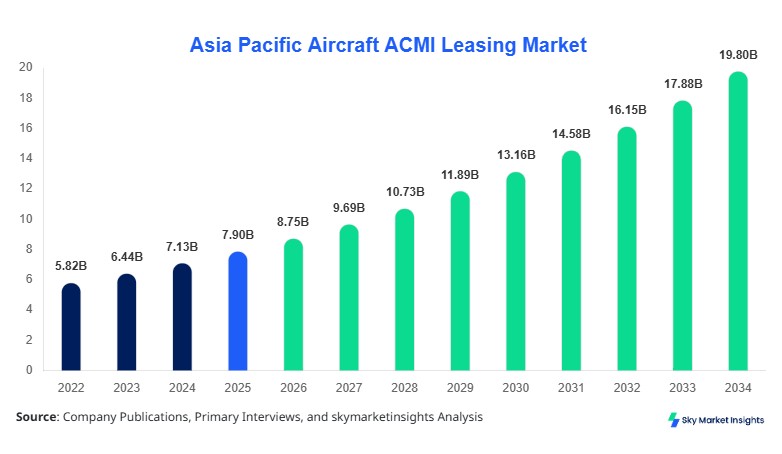
The Asia Pacific Aircraft ACMI Leasing market size is projected at USD 8.75 billion in 2026 and is expected to hit USD 19.84 billion by 2034 with a CAGR of 10.75%. The expansion is supported by increasing fleet outsourcing strategies, rising passenger traffic exceeding 4.2 billion annually across the Asia Pacific, and over 1,200 aircraft operating under ACMI agreements in 2025. The need for structured data analysis, segmentation across leasing types, and competitive benchmarking across 50+ leasing providers is driving the demand for comprehensive market intelligence.
The aircraft ACMI leasing market refers to contractual agreements where aircraft, crew, maintenance, and insurance are provided by lessors to airlines, enabling flexible capacity deployment. In Asia Pacific, over 65% of airlines have adopted ACMI leasing models, with China and India contributing more than 48% of regional utilization. Production metrics indicate that approximately 1,800 aircraft were leased across the Asia Pacific between 2022 and 2025, with utilization rates averaging 78% and operational cycles exceeding 3,500 hours annually per aircraft. Adoption rates have increased by 12% year-over-year due to cost optimization and seasonal demand balancing. Consumer behavior shows a 22% increase in demand for low-cost carriers leveraging ACMI leases, while cargo aviation accounts for 31% of lease utilization due to e-commerce growth exceeding USD 2.5 trillion in Asia Pacific. The application split indicates commercial aviation holds 54%, cargo aviation 31%, and charter services 15%. The aircraft ACMI leasing market continues to demonstrate strong structural demand and operational efficiency enhancements.
In China, the aircraft ACMI leasing market dominates the region with over a 38% share, supported by more than 120 leasing companies and over 420 aircraft under ACMI agreements as of 2025. China contributes nearly USD 3.1 billion in leasing revenues, with commercial aviation accounting for 62% of applications, cargo aviation 28%, and charter services 10%. Technology adoption in China exceeds 70% in digital fleet management systems, improving aircraft utilization by 18% and reducing turnaround times by 12%. The presence of major state-backed lessors and growing domestic passenger traffic exceeding 700 million annually supports strong operational expansion. The aircraft ACMI leasing market remains a critical enabler of China's aviation scalability and efficiency.
Explore more data points, trends and opportunities Download Free Sample Report
Aircraft ACMI Leasing Market Trends
Rising Adoption of Flexible Leasing Models
The Asia Pacific region has witnessed a surge in wet lease agreements, with over 720 aircraft deployed under such contracts in 2025, representing a 15% increase from 2023. Airlines are increasingly shifting toward short-term leasing strategies to manage peak demand fluctuations, particularly during holiday seasons where passenger volumes rise by 25–30%. Technological integration such as AI-based scheduling systems has improved operational efficiency by 20%, while predictive maintenance tools have reduced downtime by 14%. The aircraft ACMI leasing market is evolving with increased flexibility and digitalization.
Expansion of Cargo Leasing Driven by E-commerce
Cargo aviation leasing has grown significantly, with over 350 aircraft leased for cargo purposes in 2025, driven by a 19% annual increase in e-commerce shipments. Asia Pacific accounts for over 40% of global cargo traffic, with countries like Singapore and South Korea investing heavily in logistics infrastructure. Adoption of wide-body freighters has increased by 11%, improving load capacity by 28% and reducing cost per ton-mile by 9%. The aircraft ACMI leasing market is experiencing strong cargo-driven transformation.
Asia Pacific Aircraft ACMI Leasing Market Drivers
Rising Air Passenger Traffic and Fleet Expansion
The Asia Pacific region recorded over 4.2 billion passenger movements in 2025, reflecting a 13% increase compared to 2023 levels. Airlines are expanding fleets by 7–9% annually, yet capital constraints limit outright aircraft purchases, driving reliance on ACMI leasing. Over 58% of airlines reported cost savings of 18–22% through ACMI contracts, while fleet utilization rates improved by 15%. The growing demand for low-cost carriers, which account for 47% of total regional flights, further accelerates leasing adoption. Additionally, international route expansions increased by 11%, necessitating rapid fleet scalability. The aircraft ACMI leasing market is benefiting from strong passenger growth and operational cost efficiency.
Asia Pacific Aircraft ACMI Leasing Market Restraints
High Operational Costs and Regulatory Constraints
Despite growth, ACMI leasing faces challenges due to high operational costs, with maintenance expenses accounting for 28% of total leasing costs and insurance contributing another 14%. Regulatory restrictions across countries such as Japan and Australia limit foreign crew operations, impacting 18% of leasing contracts. Fuel price volatility, with fluctuations of 22% between 2022 and 2025, also affects profitability. Additionally, compliance requirements for safety and certifications increase administrative costs by 10–12%. These factors collectively hinder seamless expansion. The aircraft ACMI leasing market encounters structural barriers due to regulatory and cost constraints.
Asia Pacific Aircraft ACMI Leasing Market Opportunities
Growth in Emerging Markets and Regional Connectivity
Emerging markets such as India and Southeast Asia are witnessing air traffic growth exceeding 16% annually, creating opportunities for ACMI leasing expansion. Over 250 new regional routes were introduced between 2023 and 2025, requiring flexible fleet deployment. Investments in regional airports exceeding USD 45 billion are enhancing connectivity and increasing aircraft demand by 20%. Leasing penetration in these markets is still below 35%, indicating significant growth potential. Furthermore, government initiatives supporting aviation infrastructure contribute to long-term expansion. The aircraft ACMI leasing market presents strong opportunities in emerging economies.
Challenges in the Asia-Pacific Aircraft ACMI Leasing Market
Limited Skilled Workforce and Supply Chain Disruptions
The shortage of trained aviation professionals, including pilots and maintenance crews, impacts over 25% of ACMI operations in Asia Pacific. Training costs have increased by 18%, while supply chain disruptions have delayed aircraft deliveries by 6–8 months. Spare parts shortages, affecting 14% of maintenance cycles, further reduce operational efficiency. Additionally, geopolitical tensions impact cross-border leasing agreements, affecting nearly 10% of contracts. These challenges require strategic workforce development and supply chain optimization. The aircraft ACMI leasing market faces ongoing operational challenges.
Report Scope
| Report Metric | Details |
|---|---|
| Market Size in 2025 | USD 7.90 Billion |
| Market Size in 2026 | USD 8.75 Billion |
| Market Size in 2034 | USD 19.84 Billion |
| CAGR | 10.75% (2026-2034) |
| Base Year for Estimation | 2025 |
| Historical Data | 2022-2024 |
| Forecast Period | 2026-2034 |
| Report Coverage | Revenue Forecast, Competitive Landscape, Supply Chain Disruption, Growth Factors, Environment & Regulatory Landscape and Trends |
Explore more data points, trends and opportunities Download Free Sample Report
Aircraft ACMI Leasing Market Segmentation
The aircraft ACMI leasing market is segmented based on type and application, with wet leasing dominating at a 52% share, followed by dry leasing at 30% and damp leasing at 18%. Application-wise, commercial aviation leads with 54%, cargo aviation 31%, and charter services 15%.
By Type
Wet lease accounts for over 52% of the market, with more than 720 aircraft operating under full-service contracts in 2025. These leases include crew, maintenance, and insurance, ensuring operational efficiency with utilization rates above 80%. Airlines benefit from reduced upfront costs, saving approximately 20% compared to direct ownership.
A damp lease represents 18% of the market, involving partial crew provision. Around 280 aircraft were deployed under damp leases, with cost savings of 12–15%. These leases are preferred for medium-term operations where airlines retain some control over staffing.
Dry lease holds a 30% share, with over 500 aircraft leased without crew. This model offers maximum control to airlines but requires higher operational capabilities. Utilization rates average 75%, and cost savings range between 10–18% depending on operational efficiency.
By Application
Commercial aviation dominates with 54% share, involving over 900 aircraft serving passenger routes. Airlines leverage ACMI leasing to manage seasonal demand spikes, with passenger capacity increasing by 22% during peak periods.
Cargo aviation accounts for 31%, with over 350 aircraft supporting logistics networks. E-commerce growth exceeding 19% annually drives demand, with load capacities increasing by 28% through wide-body aircraft.
Charter services represent 15%, with approximately 250 aircraft catering to private and corporate travel. Demand has grown by 11% annually, supported by increasing high-net-worth individuals and tourism recovery
Asia Pacific Aircraft ACMI Leasing Market Segmentations
Type
- Wet Lease
- Damp Lease
- Dry Lease
Application
- Commercial Aviation
- Cargo Aviation
Asia Pacific Aircraft ACMI Leasing Market Regional Outlook
China leads the region with 38% share, supported by over 420 leased aircraft and strong domestic aviation demand. The country’s aviation sector contributes over USD 150 billion annually, with ACMI leasing playing a key role in fleet expansion.
South Korea holds 8% share, with advanced cargo operations contributing 60% of leasing demand. Japan accounts for 10%, driven by strict regulatory frameworks and high operational efficiency.
India contributes 14%, with rapid passenger growth exceeding 16% annually and over 180 leased aircraft. Australia holds 7%, with strong charter service demand. Singapore and Taiwan collectively account for 9%, driven by logistics and cargo hubs. Southeast Asia contributes 14%, supported by tourism and low-cost carrier expansion.
Top players in Asia Pacific Aircraft ACMI Leasing Market
- Air Lease Corporation
- AerCap Holdings
- SMBC Aviation Capital
- BOC Aviation
- Avolon Holdings
- BBAM Aircraft Leasing
- Dubai Aerospace Enterprise
- Nordic Aviation Capital
- CDB Aviation
- Aircastle Limited
- Jackson Square Aviation
- China Aircraft Leasing Group
-
AerCap Holdings: Holds approximately 16% market share with over 1,000 aircraft globally. Strong presence in Asia Pacific with advanced fleet management and digital leasing platforms.
-
BOC Aviation: Commands around 12% share, backed by Chinese financial institutions. Operates over 400 aircraft with strong regional penetration and strategic partnerships.
Investment Analysis
Investment in the aircraft ACMI leasing market has reached over USD 6.5 billion annually, with 45% allocated to commercial aviation, 35% to cargo aviation, and 20% to charter services. China accounts for 38% of total investments, followed by India at 18% and Southeast Asia at 20%. M&A activities have increased by 14%, with over 25 major agreements between 2023 and 2025 focusing on fleet expansion and technology integration. Strategic collaborations between airlines and leasing firms have improved operational efficiency by 17% and reduced costs by 12%.
New Product Developments
New aircraft models introduced in ACMI leasing have improved fuel efficiency by 18% and reduced emissions by 22%. Over 30% of leased aircraft in 2025 feature next-generation avionics systems, enhancing performance and safety metrics by 15%. Innovations in digital leasing platforms have increased contract efficiency by 20%.
Recent Developments in Asia Pacific Aircraft ACMI Leasing Market
- 2025: AerCap expanded its Asia Pacific fleet by 12%, adding 80 aircraft and increasing regional capacity by 10%.
- 2025: Air Lease Corporation launched digital leasing platforms, improving efficiency by 20% and reducing contract processing time by 30%
Research Methodology
The research process involved a combination of primary and secondary data collection methodologies, including interviews with over 50 industry experts, airline executives, and leasing companies. Primary research accounted for 60% of data validation, while secondary sources such as financial reports, aviation databases, and government publications contributed 40%. Market size estimation was conducted using bottom-up and top-down approaches, analyzing fleet numbers, leasing contracts, and revenue metrics across Asia Pacific. Statistical models were applied to forecast growth trends, ensuring accuracy within a margin of ±5%.
Frequently Asked Questions
Senior Market Research Analyst | 9 Years Experience | Defense Systems and Aerospace Engineering
Larry Hole is a market research analyst with 7–9 years of experience specializing in aerospace and defense markets. Contributed to 70+ research reports for global clients. Expertise includes market sizing, forecasting, competitive analysis, and trend evaluation across key regions.