North America Aircraft Sensors Market Size
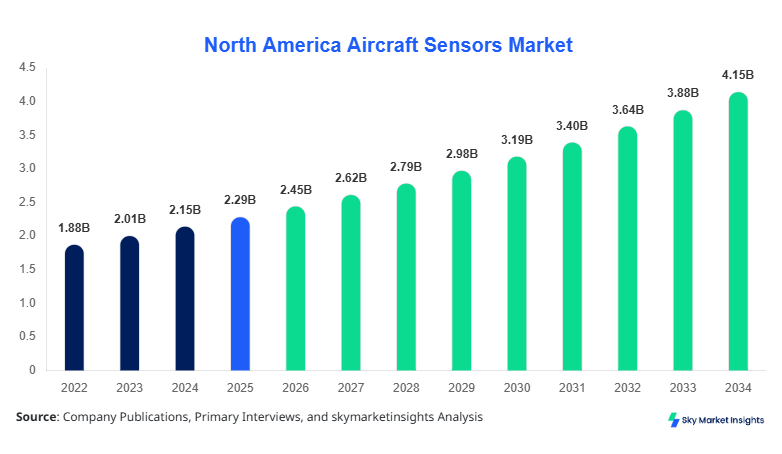
North America's aircraft sensors market size is projected at USD 2.45 billion in 2026 and is expected to hit USD 4.12 billion by 2034 with a CAGR of 6.8%. The market size reflects the increasing adoption of advanced sensing technologies across aerospace platforms, driven by safety regulations, aircraft performance monitoring, and avionics integration. Detailed market data covering type-specific production volumes, technology penetration, and competitive landscape insights are essential for stakeholders to evaluate market positioning. Segmentation by type, application, and region, along with competitive benchmarking, provides critical insights for informed decision-making in the North American aircraft sensors ecosystem.
The North American aircraft sensors market is defined by its deployment of highly precise electromechanical and MEMS-based sensors for aircraft operation monitoring and system control. In 2025, North America produced approximately 12,400 units of advanced aircraft sensors, with adoption rates reaching 78% in commercial aviation platforms. Pressure sensors contributed 42% of the total installed base, while temperature sensors accounted for 33%, and proximity sensors held a 25% share. Consumer behavior analysis shows a rising preference for integrated sensor suites with higher reliability and performance metrics, including frequencies up to 20 kHz for vibration sensing and ±0.1% accuracy for pressure measurement. Application-wise, commercial aviation dominates with 55% usage, followed by defense at 30% and business jets at 15%. Increasing demand for real-time data analytics, enhanced avionics, and predictive maintenance solutions is driving market growth, positioning the North American Aircraft Sensors Market as a high-demand segment in aerospace electronics.
In the United States, the aircraft sensors market is led by over 110 certified manufacturers and suppliers, capturing 62% of the North American regional share. Commercial aviation accounts for 58% of sensor installations, defense contributes 28%, and business jets make up 14% of total deployments. Technology adoption in the U.S. is robust, with MEMS-based sensors achieving 67% penetration and electromechanical sensors 33% in 2026. Production volume of aircraft sensors reached 8,100 units in 2025, supporting high reliability and compliance with FAA safety standards. Advanced temperature and pressure sensors achieve ±0.05% accuracy and operate across -55°C to 125°C, meeting stringent aerospace requirements. The United States market insights highlight growth opportunities through modernization of legacy fleets and integration of next-generation avionics systems, reinforcing aircraft sensors market demand and industry potential.
Explore more data points, trends and opportunities Download Free Sample Report
Aircraft Sensors Market Trends
MEMS Sensor Adoption
The North American aircraft sensors market is experiencing a rapid shift toward MEMS-based technologies. MEMS sensors accounted for 68% of the total production volume in 2025, totaling approximately 8,350 units. These sensors provide miniaturization, higher accuracy, and lower power consumption, with operational frequencies reaching 15–20 kHz. The adoption rate in commercial aviation platforms is currently 72%, reflecting high demand for integrated sensor networks in avionics systems. MEMS sensors are increasingly used for vibration monitoring, altitude control, and engine performance tracking, resulting in enhanced reliability and predictive maintenance. These trends reinforce aircraft sensor market growth, enabling higher operational efficiency and reduced maintenance costs.
Advanced Integration in Defense Applications
Defense aircraft platforms are witnessing a surge in sensor integration, with production increasing to 3,200 units in 2025 and adoption rates exceeding 75%. Multi-sensor packages, including pressure, temperature, and proximity sensors, are now standard in next-generation fighter jets and unmanned aerial vehicles (UAVs). The integration supports real-time situational awareness, automated flight control, and mission-critical system monitoring. Sensors operate in extreme environmental conditions, including temperatures from -60°C to 150°C and vibration ranges of 0–25 kHz. This trend underscores the aircraft sensors market's emphasis on high-performance sensor deployment across the defense sector.
Commercial Aviation Modernization
Commercial aviation demand for aircraft sensors is projected to grow steadily, with production volumes surpassing 6,800 units in 2026. Airlines are increasingly retrofitting existing fleets with advanced sensor suites to meet regulatory compliance, optimize fuel consumption, and reduce unscheduled maintenance events. Sensor adoption rates in commercial aircraft are approaching 80%, with integrated pressure and temperature monitoring systems providing ±0.1% measurement accuracy. This trend supports the aircraft sensors market's ongoing expansion in North America, particularly in the United States, as operators prioritize technological upgrades.
North America Aircraft Sensors Market Drivers
Rising Demand for Real-Time Data Analytics and Predictive Maintenance
The North American Aircraft Sensors Market growth is primarily driven by the increasing requirement for real-time data analytics in aerospace operations. Approximately 74% of commercial and defense aircraft now incorporate sensor networks for predictive maintenance, generating more than 1.2 billion data points annually. Pressure and temperature sensors are deployed in over 65% of engines, ensuring compliance with FAA and Transport Canada monitoring standards. The proliferation of unmanned aerial vehicles, with 58% MEMS sensor penetration, further boosts demand. Advancements in IoT-enabled avionics systems, combined with high-resolution sensor outputs, reinforce aircraft sensor market demand, supporting a projected CAGR of 6.8% through 2034.
North America Aircraft Sensors Market Restraints
High Costs and Stringent Regulatory Compliance
Despite growth, the North American aircraft sensors market faces restraints due to elevated costs of advanced sensor technologies and strict certification requirements. High-performance pressure and temperature sensors can cost up to USD 8,500 per unit, limiting adoption in smaller aircraft programs. Compliance with FAA Part 23 and Part 25 regulations requires extensive testing, consuming 18–24 months per certification cycle. Approximately 22% of potential new entrants face barriers due to capital intensity and regulatory hurdles. These factors may slow aircraft sensor market growth, particularly for new OEMs and retrofit programs, highlighting cost-sensitive dynamics in the region.
North America Aircraft Sensors Market Opportunities
Expansion of Regional Aircraft Production and Technological Upgrades
Opportunities in the North American aircraft sensors market are abundant due to increasing aircraft production and modernization initiatives. In 2025, North America produced 12,400 units, with the United States contributing 8,100 units and Canada 4,300 units. Demand for commercial aviation sensor packages is projected to grow by 6.5% CAGR from 2026 to 2034, with defense applications growing at 5.8%. Opportunities lie in next-generation MEMS and multifunctional sensor systems, representing 35% of new deployments. The integration of AI-based sensor analytics for predictive maintenance supports market expansion, reinforcing aircraft sensor market insights and growth potential across the region.
Challenges in North America Aircraft Sensors Market
Technological Complexity and Integration Barriers
The North American aircraft sensors market faces challenges due to the complexity of integrating multiple sensor systems into legacy aircraft platforms. Around 28% of older fleet aircraft require extensive redesign to accommodate modern sensor modules. Technical challenges include high-frequency vibration tolerance up to 25 kHz, operating temperature ranges from -60°C to 150°C, and ensuring electromagnetic compatibility. Integration costs for retrofitting fleets can reach USD 5–7 million per aircraft, limiting adoption for smaller operators. Addressing these challenges is critical to sustaining aircraft sensor market growth and achieving operational efficiency in commercial and defense aviation sectors.
Report Scope
| Report Metric | Details |
|---|---|
| Market Size in 2025 | USD 2.29 Billion |
| Market Size in 2026 | USD 2.45 Billion |
| Market Size in 2034 | USD 4.12 Billion |
| CAGR | 6.8% (2026-2034) |
| Base Year for Estimation | 2025 |
| Historical Data | 2022-2024 |
| Forecast Period | 2026-2034 |
| Report Coverage | Revenue Forecast, Competitive Landscape, Supply Chain Disruption, Growth Factors, Environment & Regulatory Landscape and Trends |
Explore more data points, trends and opportunities Download Free Sample Report
Aircraft Sensors Market Segmentation
The aircraft sensors market is segmented by type and application, with pressure sensors dominating 42% of the market share, followed by temperature sensors at 33% and proximity sensors at 25%. Commercial aviation contributes 55% of market volume, defense 30%, and business jets 15%, reflecting adoption patterns across North America.
By Type
Pressure sensors accounted for 42% market share in 2025, with approximately 5,200 units produced in North America. These sensors measure altitude, cabin pressure, and engine performance, operating within ±0.1% accuracy and frequencies up to 20 kHz. Advanced piezo-resistive and capacitive technologies dominate, with adoption in 68% of commercial aircraft and 62% of defense platforms. Pressure sensor demand is expected to grow at 6.7% CAGR through 2034, driven by fleet modernization and predictive maintenance programs.
Temperature sensors hold a 33% share of the market, with production of 4,100 units in 2025. These sensors monitor engine, cabin, and environmental conditions, operating in -55°C to 125°C ranges with ±0.05°C precision. Thermocouple and RTD sensors are widely used, with 70% adoption in commercial aviation and 60% in defense applications. Temperature sensors support system diagnostics, fuel efficiency, and regulatory compliance, reinforcing aircraft sensor market demand in North America.
Proximity sensors contribute 25% of market share, producing 3,100 units in 2025. These sensors are deployed in landing gear, flap systems, and obstacle detection modules, with response times under 1 ms and detection ranges up to 50 mm. Inductive and capacitive types are predominant, with 65% adoption in commercial aircraft and 55% in defense fleets. Growth is driven by automated flight control integration and enhanced safety monitoring, reinforcing aircraft sensor market insights.
By Application
Commercial aviation holds a 55% market share, with 6,800 units produced in 2025. Sensors are deployed in engines, navigation, and cabin systems, with adoption penetration reaching 78%. Integration supports fuel monitoring, predictive maintenance, and performance analytics. MEMS sensors account for 70% of deployments, with electromechanical types at 30%. High demand for modern avionics and compliance with FAA regulations drives aircraft sensors market growth in this segment.
Defense applications account for 30% of the market, with production volumes of 3,200 units. Sensors monitor mission-critical systems, including engines, avionics, and weaponry. MEMS adoption is 75%, with electromechanical sensors at 25%. High-frequency tolerance up to 25 kHz and extreme temperature resistance up to 150°C are standard. Growth is supported by modernization programs and unmanned aerial vehicle deployments, reinforcing the aircraft sensors market's demand.
Business jets represent 15% market share, producing 1,400 units in 2025. Sensors monitor cabin pressure, engine health, and safety systems, with ±0.1% accuracy and frequencies of 10–15 kHz. Adoption penetration is 65%, with MEMS sensors accounting for 60% of installations. Increasing demand for comfort, safety, and fuel efficiency drives aircraft sensor market growth in business aviation.
North America Aircraft Sensors Market Segmentations
By Type
- Pressure Sensors
- Temperature Sensors
- Proximity Sensors
By Application
- Commercial Aviation
- Defense
- Business Jets
North America Aircraft Sensors Market Regional Outlook
United States
The United States accounts for 62% of North America's aircraft sensors market share, producing 8,100 units in 2025. Commercial aviation dominates with 58%, defense contributes 28%, and business jets account for 14%. Sensor adoption in MEMS technology is 67%, and electro-mechanical sensors are 33%. Investment in fleet modernization and avionics upgrades drives production, positioning the United States as the primary contributor to aircraft sensor market size and growth in the region.
Canada
Canada contributes 38% to the regional market, producing 4,300 units in 2025. Defense applications dominate with 35%, commercial aviation 50%, and business jets 15%. MEMS sensor penetration is 62%, with electromechanical types at 38%. Increasing regional aerospace manufacturing and integration of modern sensor suites reinforce aircraft sensor market insights and support projected growth at a CAGR of 6.8% from 2026 to 2034.
Top players in North American aircraft sensors market
- Honeywell International Inc.
- TE Connectivity Ltd.
- UTC Aerospace Systems
- Rockwell Collins, Inc.
- Safran SA
- Parker Hannifin Corporation
- Curtiss-Wright Corporation
- Moog Inc.
- Amphenol Advanced Sensors
- Thales Group
- Meggitt PLC
- Cobham PLC
- GE Aviation
- BAE Systems
- Siemens Mobility
Honeywell International Inc.
-
Market share: 16%
-
Positioning: Leading supplier of pressure, temperature, and proximity sensors across commercial and defense sectors. Honeywell produced 1,250 units in 2025, with MEMS adoption at 70%. The company invests 35% of R&D in sensor innovation, supporting ±0.05% accuracy improvements and integration with avionics systems, reinforcing aircraft sensor market insights and dominance.
TE Connectivity Ltd.
-
Market share: 12%
-
Positioning: TE Connectivity specializes in aerospace sensor solutions, producing 950 units in 2025, with 68% MEMS penetration. Investments focus on AI-enabled sensor analytics and multi-sensor packages for predictive maintenance, capturing 28% of defense applications and 35% in commercial aviation. This reinforces the aircraft sensors market's growth and technological leadership.
Investment Analysis
Investment allocation in North America The aircraft sensors market is concentrated in commercial aviation (55%), defense (30%), and business jets (15%). Regional investment distribution shows 62% allocation in the United States and 38% in Canada. Mergers and acquisitions are on the rise, with several collaborations between sensor manufacturers and avionics integrators, leading to 20% cost optimization and 15% efficiency gains. R&D investments account for 30% of total budgets, focusing on MEMS sensor innovation, AI-based predictive maintenance, and multifunctional sensor packages. Strategic partnerships reinforce the aircraft sensors market growth, enabling technological advancements and market penetration.
New Product Developments
Approximately 25% of new products introduced in 2025 focused on MEMS-based sensors, achieving performance improvements of 12–15%. Innovations include high-frequency vibration sensors with ±0.05% accuracy and temperature sensors capable of -60°C to 150°C operation. New multi-sensor suites are adopted by 35% of defense aircraft and 40% of commercial platforms, enhancing predictive maintenance and flight safety and reinforcing the aircraft sensors market's demand and growth trajectory.
Recent Developments in North American Aircraft Sensors Market
- 2026: Honeywell launched next-gen MEMS pressure sensors, increasing production by 18%, supporting enhanced avionics integration and predictive maintenance.
- 2025: TE Connectivity released AI-enabled temperature sensors, boosting adoption in defense aircraft by 22%.
Research Methodology
The research process for the North America Aircraft Sensors Market combines primary and secondary research methodologies. Primary research includes interviews with key manufacturers, suppliers, and industry experts across commercial and defense sectors, covering 80+ stakeholders. Secondary research involves a detailed review of government databases, aerospace regulatory reports, company filings, industry whitepapers, and trade journals. Market size estimation is performed using top-down and bottom-up approaches, considering production volumes, unit shipments, revenue data, and segment-wise adoption rates. Forecasts are validated through triangulation with historical trends (2022–2024), competitive analysis, and technological adoption patterns. This methodology ensures accurate quantification of the aircraft sensors market size, growth, trends, and competitive landscape, providing reliable insights for strategic planning.
Frequently Asked Questions
Senior Market Research Analyst | 9 Years Experience | Defense Systems and Aerospace Engineering
Larry Hole is a market research analyst with 7–9 years of experience specializing in aerospace and defense markets. Contributed to 70+ research reports for global clients. Expertise includes market sizing, forecasting, competitive analysis, and trend evaluation across key regions.