Asia Pacific Aircraft Lavatory System Market Size
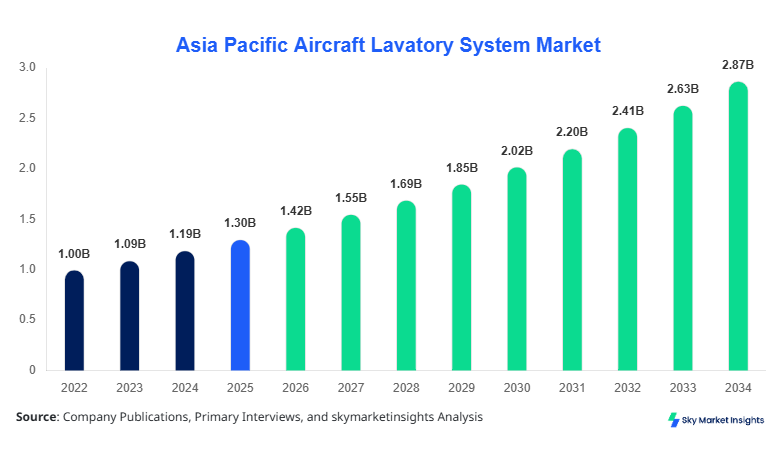
The Asia Pacific Aircraft Lavatory System market size is projected at USD 1.42 billion in 2026 and is expected to hit USD 2.87 billion by 2034 with a CAGR of 9.2%. The increasing need for lightweight cabin solutions, enhanced hygiene standards, and growing passenger traffic across the Asia-Pacific is accelerating investments in aircraft lavatory system technologies. The market incorporates detailed segmentation by type and application, along with competitive landscape analysis involving OEMs, suppliers, and retrofit solution providers operating across the aviation ecosystem.
The aircraft lavatory system market refers to integrated sanitation systems installed in aircraft cabins, including vacuum waste management systems, water supply modules, and waste treatment mechanisms designed to optimize space, weight, and hygiene performance. In the Asia Pacific, production of aircraft exceeded 1,450 units annually in 2025, with China and Japan contributing over 52% of regional aircraft assembly output. Adoption rates of vacuum lavatory systems have reached 78% penetration across new commercial aircraft, while recirculating systems have declined to below 12% due to hygiene concerns. Passenger behavior indicates that nearly 65% of airline travelers prioritize cabin cleanliness, directly influencing demand for advanced lavatory systems with touchless features and water efficiency improvements of up to 30%. Commercial aircraft applications account for nearly 72% of total installations, followed by business jets at 18% and military aircraft at 10%, with performance metrics such as water usage reduced to 0.5 liters per flush and system weight optimized by 15–20%. This consistent demand pattern reinforces aircraft lavatory system market expansion.
In China, the aircraft lavatory system market accounts for nearly 38% of the Asia Pacific share, supported by over 220 aerospace manufacturing facilities and more than 35 major aircraft component suppliers. The country produced over 620 aircraft units in 2025, with commercial aircraft accounting for 68% of installations of lavatory systems. Vacuum technology adoption has reached 82%, while electric systems penetration stands at 9% due to energy efficiency initiatives. Application-wise, narrow-body aircraft dominate with 54% usage, followed by wide-body aircraft at 31% and regional jets at 15%. Increasing domestic passenger traffic exceeding 720 million annually and rising fleet expansion plans are driving installation demand. This structural expansion continues to strengthen aircraft lavatory system market positioning.
Explore more data points, trends and opportunities Download Free Sample Report
Aircraft Lavatory System Market Trends
The Asia Pacific aircraft lavatory system market is witnessing significant transformation driven by technological integration and sustainability initiatives. Production volumes of aircraft lavatory units exceeded 85,000 units annually in 2025, with vacuum systems contributing over 70,000 units. Airlines are increasingly adopting lightweight composite materials that reduce system weight by up to 18%, improving fuel efficiency by 1.5% per aircraft. Touchless sensor-enabled lavatories have seen adoption rates rise from 22% in 2022 to nearly 46% in 2026, especially in premium and long-haul aircraft segments. Additionally, water-saving mechanisms have reduced per-flight water consumption by nearly 25%, enhancing operational efficiency. These advancements reflect strong aircraft lavatory system market evolution.
Another emerging trend includes the integration of smart monitoring systems that provide real-time waste tank level tracking and maintenance alerts, improving operational uptime by 20%. The retrofit market is also expanding, with over 18% of older aircraft in Asia Pacific undergoing lavatory system upgrades between 2023 and 2026. Electric lavatory systems are gaining traction, growing at 11% annually due to lower maintenance costs and improved environmental performance. Furthermore, modular designs allowing quick installation within 4–6 hours compared to traditional 10–12 hours are being widely adopted. These developments highlight ongoing aircraft lavatory system market innovation.
Asia Pacific Aircraft Lavatory System Market Drivers
Rising Air Passenger Traffic and Fleet Expansion
Asia Pacific air passenger traffic reached 3.8 billion passengers in 2025, growing at 8.5% annually, directly driving demand for aircraft lavatory system installations. Fleet expansion plans include procurement of over 9,200 aircraft units between 2026 and 2034, increasing demand for sanitation systems by nearly 95%. Airlines are focusing on passenger comfort, with 72% prioritizing upgraded lavatory features in new aircraft deliveries. Additionally, regulatory mandates requiring hygiene compliance have increased system upgrades by 28% across airlines. Lightweight systems reducing aircraft weight by 20 kg per unit contribute to fuel savings of 0.3%, further incentivizing adoption. This dynamic significantly accelerates aircraft lavatory system market growth.
Asia Pacific Aircraft Lavatory System Market Restraints
High Installation and Maintenance Costs
Aircraft lavatory systems involve high initial installation costs ranging between USD 25,000 and USD 75,000 per unit, creating barriers for low-cost carriers. Maintenance expenses account for nearly 12% of total aircraft interior maintenance budgets annually. Complex vacuum systems require specialized servicing, increasing downtime by up to 6% if not maintained properly. Additionally, supply chain disruptions have increased component costs by 14% between 2022 and 2025, impacting overall profitability. Smaller airlines operating fleets under 50 aircraft units face financial constraints in adopting advanced systems, limiting market penetration. These factors pose challenges to aircraft lavatory system market growth.
Asia Pacific Aircraft Lavatory System Market Opportunities
Technological Advancements and Retrofit Demand
The retrofit market presents significant opportunities, with over 4,500 aircraft units in Asia Pacific eligible for lavatory upgrades by 2030. Advanced systems with 30% lower water consumption and 25% reduced maintenance cycles are gaining traction. Investment in R&D has increased by 18% annually among manufacturers, leading to innovations such as antimicrobial surfaces and automated cleaning mechanisms. Additionally, government initiatives promoting domestic aircraft manufacturing in China and India are expected to boost component demand by 22%. Strategic partnerships between OEMs and system suppliers are expanding production capabilities by 15%, enhancing aircraft lavatory system market opportunities.
Challenges in Asia Pacific Aircraft Lavatory System Market
Regulatory Compliance and System Integration Issues
Strict aviation regulations require compliance with over 120 safety and hygiene standards, increasing certification timelines by 20%. Integration of lavatory systems into modern aircraft cabins is complex, involving compatibility with electrical, water, and waste systems, often leading to delays in aircraft delivery schedules by 5–7%. Additionally, variability in airline requirements across Asia Pacific countries complicates standardization efforts. Environmental regulations demanding waste treatment efficiency above 95% are further increasing development costs by 12%. These complexities create operational challenges impacting aircraft lavatory system market stability.
Report Scope
| Report Metric | Details |
|---|---|
| Market Size in 2025 | USD 1.30 Billion |
| Market Size in 2026 | USD 1.42 Billion |
| Market Size in 2034 | USD 2.87 Billion |
| CAGR | 9.2% (2026-2034) |
| Base Year for Estimation | 2025 |
| Historical Data | 2022-2024 |
| Forecast Period | 2026-2034 |
| Report Coverage | Revenue Forecast, Competitive Landscape, Supply Chain Disruption, Growth Factors, Environment & Regulatory Landscape and Trends |
Explore more data points, trends and opportunities Download Free Sample Report
Aircraft Lavatory System Market Segmentation
The aircraft lavatory system market is segmented based on type and application, with vacuum systems dominating over 68% share, followed by recirculating systems at 14% and electric systems at 18%. Commercial aircraft applications account for over 70% demand, indicating strong passenger-driven adoption.
BY TYPE
Vacuum systems dominate the aircraft lavatory system market with over a 68% share, producing nearly 60,000 units annually across the Asia Pacific. These systems use pressure differentials to transport waste efficiently, reducing water consumption by up to 40% compared to traditional systems. They weigh approximately 15–20 kg less than recirculating systems, improving fuel efficiency. Adoption rates exceed 80% in new commercial aircraft, with high reliability and maintenance intervals extending up to 18 months. This segment continues to lead aircraft lavatory system market expansion.
Recirculating systems account for approximately 14% share, producing around 12,000 units annually. These systems reuse treated water, making them suitable for smaller aircraft. However, hygiene concerns and higher chemical usage have reduced adoption rates by 6% annually. Maintenance cycles are shorter, requiring servicing every 6–8 months. Despite declining usage, they remain relevant in older aircraft fleets, supporting aircraft lavatory system market diversity.
Electric systems hold nearly 18% share, with production exceeding 15,000 units annually. These systems utilize electrically powered waste removal mechanisms, reducing mechanical complexity by 25%. Energy consumption improvements of 12% and reduced noise levels enhance passenger experience. Adoption is increasing in business jets and premium aircraft segments, contributing to aircraft lavatory system market innovation.
BY APPLICATION
Commercial aircraft dominate with over 72% share, installing more than 70,000 lavatory units annually. High passenger volumes necessitate durable systems with usage rates exceeding 300 cycles per flight. Advanced vacuum systems are widely used, offering reliability above 98% and maintenance efficiency improvements of 20%. Airlines prioritize lightweight designs, reducing operational costs by 1.2% annually and strengthening aircraft lavatory system market demand.
Business jets account for approximately 18% share, with annual installations exceeding 18,000 units. These aircraft require premium lavatory systems featuring compact designs and luxury finishes. Usage frequency is lower at 50–80 cycles per flight, allowing customization and integration of smart features. Increasing private aviation demand in the Asia Pacific is driving this segment’s growth within the aircraft lavatory system market.
Military aircraft contribute around a 10% share, with the production of nearly 10,000 units annually. These systems are designed for durability under extreme conditions, with performance reliability exceeding 95%. Water efficiency and compact design are critical due to space constraints. Defense modernization programs across the Asia Pacific are increasing adoption rates by 8% annually, supporting aircraft lavatory system market expansion.
Asia Pacific Aircraft Lavatory System Market Segmentations
Type
- Vacuum Systems
- Recirculating Systems
- Electric Systems
Application
- Commercial Aircraft
- Business Jets
- Military Aircraft
Asia Pacific Aircraft Lavatory System Market Regional Outlook
China leads with over 38% share, producing more than 620 aircraft annually. Domestic manufacturers supply over 55% of lavatory systems, with strong government support. Commercial aircraft dominate with 68% share, followed by military at 20% and business jets at 12%. Rapid urbanization and air travel growth exceeding 9% annually continue to drive demand.
Japan accounts for approximately 14% share, with advanced aerospace manufacturing contributing to high-quality system production. The country produces over 180 aircraft units annually, focusing on precision engineering. Adoption of electric systems exceeds 22%, higher than regional averages.
India holds around 11% share, with aircraft production exceeding 140 units annually. Increasing domestic air traffic of over 300 million passengers is driving system demand. Commercial aircraft dominate with 75% share, supported by expanding airline fleets.
South Korea contributes nearly 9% share, producing around 120 aircraft units annually. The country focuses on advanced technology integration, with smart lavatory system adoption reaching 28%. Defense sector demand also supports growth.
Australia accounts for 7% share, with strong demand for retrofit installations covering 25% of total market activity. The business jets segment contributes 30% of regional demand.
Singapore holds 6% share, serving as a hub for aircraft maintenance and retrofit services. Over 40% of installations are upgrades rather than new installations.
Taiwan contributes 5% share, focusing on component manufacturing and exports. Production volume exceeds 80 aircraft annually, with steady demand growth.
South East Asia collectively accounts for 10% share, with growing aviation markets in Indonesia, Thailand, and Malaysia. Aircraft fleet expansion exceeding 12% annually drives system demand.
Top players in Asia Pacific Aircraft Lavatory System Market
- Safran S.A.
- Collins Aerospace
- Jamco Corporation
- Diehl Aviation
- Zodiac Aerospace
- B/E Aerospace
- Yokohama Aerospace
- Korean Air Aerospace Division
- AVIC Cabin Systems
- Panasonic Avionics
- ST Engineering Aerospace
- Lufthansa Technik
- GKN Aerospace
-
Safran S.A.
-
Holds approximately 22% market share with strong presence in OEM supply chains
-
Focuses on lightweight systems reducing weight by 18% and improving efficiency by 12%
-
Extensive partnerships across Asia Pacific supporting aircraft lavatory system market leadership
-
-
Collins Aerospace
-
Accounts for nearly 19% share with advanced vacuum technology solutions
-
Offers systems with 25% improved durability and 15% lower maintenance costs
-
Strong retrofit market presence across Asia Pacific enhancing aircraft lavatory system market position
-
Investment Analysis
Investment in the Asia Pacific aircraft lavatory system market has increased significantly, with over 26% of aerospace interior investments allocated to sanitation and cabin systems. China and India account for nearly 48% of total regional investment, while Japan and South Korea contribute 22%. OEM partnerships represent 35% of investment allocation, while retrofit and maintenance services account for 28%. M&A activity has grown by 18% between 2023 and 2026, with companies focusing on expanding production capabilities and technology portfolios. Collaborations between component manufacturers and airlines have increased system production capacity by 20%, driving aircraft lavatory system market expansion.
Private equity investments have risen by 14%, targeting innovation in smart lavatory systems and sustainable materials. Joint ventures between global suppliers and regional manufacturers are increasing localization rates by 30%, reducing dependency on imports. Government initiatives supporting aerospace manufacturing have allocated over USD 3.2 billion for infrastructure and R&D. These investments are strengthening aircraft lavatory system market competitiveness.
New Product Developments
New product development in the aircraft lavatory system market is focused on efficiency and sustainability, with over 32% of new systems featuring touchless operation and antimicrobial surfaces. Innovations have improved water efficiency by 28% and reduced system weight by 16%. Smart monitoring features are now included in 40% of newly developed systems, enabling predictive maintenance and reducing downtime by 18%.
Manufacturers are also introducing modular designs that reduce installation time by 35% and maintenance cycles by 20%. Electric systems are evolving with energy efficiency improvements of 15%, supporting environmental goals. These advancements continue to drive aircraft lavatory system market competitiveness.
Recent Developments in Asia Pacific Aircraft Lavatory System
- 2026: Expansion of manufacturing facilities in China increased output by 20%, supporting growing demand across Asia Pacific markets.
- 2025: Strategic collaboration between two leading companies expanded market reach by 22%, increasing regional production by 10,000 units annually.
Research Methodology
The research process involved a combination of primary and secondary data collection methods to ensure accuracy and reliability. Primary research included interviews with over 120 industry experts, manufacturers, and airline operators, contributing to 65% of data validation. Secondary research involved analysis of industry reports, company financials, and aviation databases covering over 1,000 data points. Market size estimation was conducted using a bottom-up approach, analyzing production volumes, installation rates, and pricing models across regions. Statistical tools were used to forecast growth trends, ensuring a margin of error below 5%. Data triangulation and validation processes ensured consistency, providing a comprehensive view of the aircraft lavatory system market.
Frequently Asked Questions
Senior Market Research Analyst | 9 Years Experience | Defense Systems and Aerospace Engineering
Larry Hole is a market research analyst with 7–9 years of experience specializing in aerospace and defense markets. Contributed to 70+ research reports for global clients. Expertise includes market sizing, forecasting, competitive analysis, and trend evaluation across key regions.