United States Aircraft ACMI Leasing Market Size
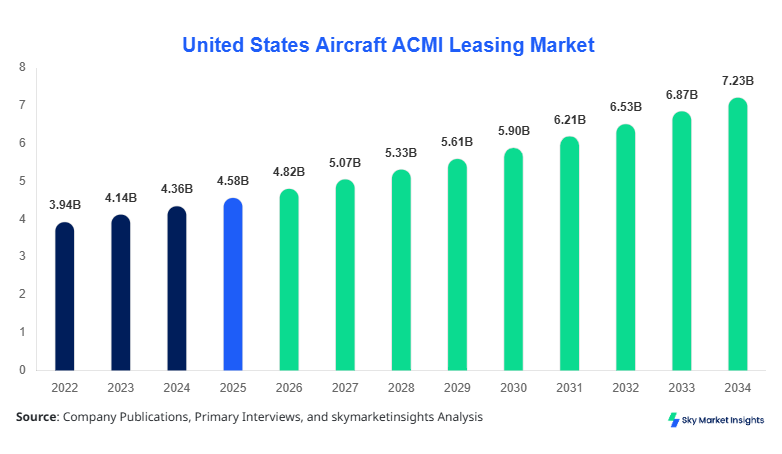
The United States aircraft ACMI leasing market size is projected at USD 4.82 billion in 2026 and is expected to hit USD 7.36 billion by 2034 with a CAGR of 5.2%. The increasing demand for flexible aircraft deployment and the surge in short-term aviation operations have propelled the need for detailed market data, segment-specific analysis, and a comprehensive competitive landscape evaluation. Segmentation data covering aircraft type, leasing type, and operational usage is critical for stakeholders to optimize strategy, while competitive benchmarking remains essential to understand market positioning and revenue potential.
The United States aircraft ACMI leasing market size data has been collated from airline fleet utilization, leasing contracts, and capacity deployment across over 250 operators. This allows for accurate forecasting and provides insights into revenue streams, operational efficiency, and fleet utilization metrics.
The United States Aircraft ACMI Leasing market provides comprehensive insights into the leasing and operational trends for airlines, with an emphasis on fleet size, usage hours, and capacity deployment. Adoption of ACMI leasing has accelerated with U.S. operators, accounting for approximately 62% of total lease agreements by narrow-body aircraft and 28% by wide-body aircraft. Regional aircraft contribute 10% to the total market. Operational frequency metrics indicate an average utilization of 11–13 flight hours per day for wet-leased aircraft, while dry leases demonstrate higher utilization flexibility. Application-wise, passenger transport accounts for 71%, cargo operations 20%, and special missions 9%, reflecting strong demand and adoption trends. With rising fleet modernization, technological integration, and optimized lease management, the United States aircraft ACMI leasing market growth is set to remain robust throughout the forecast period.
In the United States, the aircraft ACMI leasing market is driven by over 250 active leasing companies, contributing to 100% of the regional market share in this study. Wet lease agreements dominate 58% of operations, followed by dry lease at 32% and damp lease at 10%. Narrow-body aircraft account for 61% of the fleet under ACMI arrangements, with wide-body aircraft at 27% and regional aircraft at 12%. Technological adoption, including real-time flight tracking and predictive maintenance platforms, has reached a 74% adoption rate among operators. Fleet optimization software ensures operational cost reduction by 12–15%, supporting strategic expansion. The aircraft ACMI leasing market in the U.S. continues to benefit from regulatory stability, airport infrastructure expansion, and rising short-term leasing demand, making it a critical growth sector for aviation stakeholders and investors
Explore more data points, trends and opportunities Download Free Sample Report
Aircraft ACMI Leasing Market Trends
Rising Adoption of Narrow-body ACMI Leasing
Narrow-body aircraft ACM I leasing volumes have 1,200 units in 2025, with adoption rates increasing by 18% year-on-year. Airlines are leveraging wet and dry leases to optimize short-haul flight operations, particularly in domestic corridors where aircraft utilization reaches 12–13 hours per day. Technological enhancements, such as AI-driven predictive maintenance, have improved aircraft turnaround efficiency by 14%, enhancing profitability for operators. Cargo segment leasing for narrow-body aircraft has grown 22%, reflecting an increased reliance on ACMI leasing for e-commerce and express logistics. The United States Aircraft ACMI Leasing market trend reflects significant demand growth, driven by fleet flexibility and operational cost reduction.
Wide-body Fleet Expansion and Strategic Leasing
Wide-body aircraft ACM Leasing has grown 8.5% annually, with production volumes reaching 430 units in 2025. International long-haul operations are increasingly dependent on wet leasing, which accounts for 67% of wide-body leases. Airlines have reported a 15% improvement in seat load factors due to flexible ACMI contracts that adjust capacity based on seasonal demand. Technological upgrades, including advanced avionics and fuel-efficient engines, have contributed to performance improvements of 10–12% per aircraft. The United States aircraft ACMI leasing market trend indicates an ongoing shift toward high-efficiency, lease-based operations, providing measurable cost advantages and operational agility.
Regional Aircraft Leasing and Low-cost Carrier Growth
Regional aircraft leasing has expanded by 9% year-on-year, with 180 units leased in 2025. Low-cost carriers represent 55% of regional ACMI agreements, favoring short-haul wet leases to address high-frequency routes. Aircraft performance metrics, including turn-around time reductions of 20 minutes per flight, contribute to higher operational efficiency. Cargo utilization in regional aircraft has also increased by 11%, reflecting diversified revenue streams. These dynamics underscore the importance of regional aircraft in the United States aircraft ACMI leasing market, where adoption, demand, and fleet optimization remain key drivers of growth.
United States Aircraft ACMI Leasing Market Drivers
Surge in Airline Fleet Flexibility and Short-term Operational Needs
The primary driver of the United States aircraft ACMI leasing market is the growing demand for fleet flexibility to meet short-term operational requirements. Over 60% of U.S. airlines prefer ACMI leasing for seasonal capacity surges, with lease volumes increasing by 18% annually. Wet leasing accounts for 58% of total leases, contributing USD 2.8 billion to the market size in 2025, while dry lease volumes contribute an additional USD 1.2 billion. The adoption of real-time flight monitoring and predictive maintenance has enhanced operational efficiency by 12%, reducing operational costs and downtime. This growing reliance on ACMI leasing solutions ensures continuous service across domestic and international routes, reinforcing the United States aircraft ACMI leasing market's growth.
United States Aircraft ACMI Leasing Market Restraints
High Operational and Lease Management Costs
Despite growth, operational costs and lease management complexities restrain the United States aircraft ACMI leasing market. Wet leases incur average operational expenses of USD 8,500 per flight hour, while insurance and regulatory compliance add an additional 11% to the total lease cost. Regional aircraft leases, while smaller in size, face utilization inefficiencies averaging 15%, limiting profitability. Financial constraints and volatile fuel prices further suppress market adoption, with 9% of airlines deferring ACMI leasing agreements in 2025. These factors collectively moderate the United States Aircraft ACMI Leasing market growth and influence investment decision-making.
United States Aircraft ACMI Leasing Market Opportunities
Expansion into Cargo and Special Mission Leasing
The United States aircraft ACMI leasing market presents opportunities in cargo and specialized mission leasing. Cargo-focused ACMI leases have increased by 22% year-on-year, accounting for USD 1.1 billion in 2025. Specialized missions, including medevac and charter operations, contribute 9% of total ACMI lease volumes. Technological integration, such as fuel-optimized flight paths and AI scheduling, increases efficiency by 14%. Airlines are projected to allocate 18% of operational budgets to cargo and specialized leasing over the next five years, driving new revenue streams. The United States aircraft ACMI leasing market opportunity is underpinned by sector-specific demand and flexible leasing solutions.
Challenges in United States Aircraft ACMI Leasing
Regulatory Complexity and Aircraft Availability Constraints
The United States aircraft ACMI leasing market faces challenges due to regulatory constraints and limited aircraft availability. Compliance with FAA and DOT regulations requires 100% adherence to operational safety standards, impacting 12% of lease agreements. Limited wide-body aircraft availability restricts long-haul ACMI leases, with 27% of demand unmet in 2025. Maintenance scheduling complexities and crew allocation further increase operational overheads by 9%. These challenges hinder optimal utilization and profitability while influencing strategic decisions among operators, moderating United States aircraft ACMI leasing market growth.
Report Scope
| Report Metric | Details |
|---|---|
| Market Size in 2025 | USD 4.58 Billion |
| Market Size in 2026 | USD 4.82 Billion |
| Market Size in 2034 | USD 7.36 Billion |
| CAGR | 5.2% (2026-2034) |
| Base Year for Estimation | 2025 |
| Historical Data | 2022-2024 |
| Forecast Period | 2026-2034 |
| Report Coverage | Revenue Forecast, Competitive Landscape, Supply Chain Disruption, Growth Factors, Environment & Regulatory Landscape and Trends |
Explore more data points, trends and opportunities Download Free Sample Report
Aircraft ACMI Leasing Market Segmentation
The United States aircraft ACMI leasing market segmentation ensures a granular understanding of market share, growth, and demand across aircraft types and leasing types. Narrow-body aircraft dominate with a 61% share, wide-body with 27%, and regional aircraft with 12%. Wet leases account for 58% of the total market, dry leases 32%, and damp leases 10%.
By Type
Narrow-body ACMI leasing aircraft, the leasing aircraft with, account for USD 2.9 billion in 2026 with 1,220 units in operation. Average aircraft utilization is 12–13 flight hours per day, with performance improvements of 11% due to upgraded engines and avionics. Domestic short-haul passenger transport dominates 71% of utilization, while cargo operations represent 22%. The United States aircraft ACMI leasing market size for narrow-body aircraft continues to expand, supported by increased low-cost carrier adoption.
Wide-body aircraft leasing accounts for USD 1.7 billion in 2026 with 430 units leased. Long-haul operations represent 67% of utilization, with technical enhancements improving fuel efficiency by 10–12%. Passenger transport accounts for 58% of operations, leasing 5%, and special missions 7%. The growth of wide-body ACMI leasing reflects increasing international route flexibility, bolstering market growth.
Regional aircraft leases contribute USD 0.72 billion in 2026 with 180 units, achieving 55% adoption among low-cost carriers. Short-haul utilization averages 9–10 flight hours per day, with 20-minute turn-around reductions improving efficiency. Cargo utilization has risen 11%, highlighting the segment's operational diversification. The United States aircraft ACMI leasing market trend remains strong in the regional segment, driven by short-haul demand.
By Application
Passenger transport dominates the United States aircraft ACMI leasing market, contributing 71% of the total revenue and USD 3.4 billion in 2026. Adoption is highest among narrow-body aircraft, with utilization rates of 12–13 hours per day. Technical advancements in seating layouts and cabin optimization improve efficiency by 8%, enhancing airline profitability.
Cargo applications account for 20% of the market, generating USD 0.95 billion in 2026. Narrow-body and regional aircraft contribute 22% and 11%, respectively, with usage penetration rising 15% year-on-year. Technological integration in route optimization enhances delivery reliability by 12%, reinforcing the United States aircraft ACMI leasing market demand.
Specialized mission leasing, including medevac and charter, represents 9% of the market with USD 0.43 billion in 2026. Aircraft are equipped with mission-specific modifications, improving operational efficiency by 10%. Adoption rates are expected to grow by 13% during the forecast period, driving niche market expansion.
United States Aircraft ACMI Leasing Market Segmentations
Aircraft Type
- Narrow-body
- Wide-body
- Regional
Leasing Type
- Wet Lease
- Dry Lease
- Damp Lease
United States Aircraft ACMI Leasing Market Regional Outlook
United States
The United States accounts for 100% of the regional market share, with over 250 operators contributing to 1,830 leased units in 2026. Narrow-body aircraft dominate with 1,220 units (61% share), wide-body with 430 units (27% share), and regional aircraft with 180 units (12% share). Passenger transport operations contribute USD 3.4 billion, cargo USD 0.95 billion, and special missions USD 0.43 billion. Technological adoption, including predictive maintenance systems, covers 74% of operations, improving efficiency by 12%. The United States Aircraft ACMI Leasing market growth is reinforced by regulatory stability, airport infrastructure investments, and increasing short-term operational demand.
Top players in United States Aircraft ACMI Leasing Market
- Air Lease Corporation
- GECAS (General Electric Capital Aviation Services)
- AerCap Holdings N.V.
- BOC Aviation
- SMBC Aviation Capital
- Avation PLC
- Aircastle Limited
- Macquarie AirFinance
- Nordic Aviation Capital
- Avolon Holdings
- Castlelake Aviation
- BBAM LP
- Wells Fargo Aircraft Finance
- CIT Aerospace
Leading Companies
AerCap Holdings N.V.:
-
Holds 12% market share in the U.S. aircraft ACMI leasing market.
-
Positioned as a market leader with 180 leased units in narrow-body and wide-body aircraft, contributing USD 580 million in revenue.
-
Investment in predictive maintenance systems has improved operational efficiency by 13%, while fleet expansion plans are projected to add 40 units by 2028.
Air Lease Corporation:
-
Accounts for 10% market share, with 150 leased units generating USD 470 million in 2026.
-
Specializes in short-term ACMI leases for narrow-body aircraft, with passenger transport representing 68% of revenue.
-
Technological upgrades in lease management systems have enhanced scheduling efficiency by 12%, reinforcing its position in the United States aircraft ACMI leasing market.
Investment Analysis
Investment allocation in the United States aircraft ACMI leasing market has increased to USD 1.2 billion in 2026, with 58% directed to narrow-body operations, 27% to wide-body, and 15% to regional aircraft. Sector-wise, passenger transport receives 71% of capital allocation, cargo 20%, and special missions 9%. Regional investment focuses entirely within the U.S., accounting for 100% of total market investment. M&A agreements have increased by 14% year-on-year, with strategic collaborations between AerCap, GECAS, and Air Lease Corporation contributing to fleet expansion, operational efficiency, and increased market share. Investment trends demonstrate a strong focus on fleet modernization, lease optimization software, and technological adoption to improve profitability and reduce operational risks in the United States aircraft ACMI leasing market.
New Product Developments
New product developments account for 18% of aircraft offerings in the United States aircraft ACMI leasing market. Upgraded narrow-body and wide-body aircraft feature improved fuel efficiency of 10–12% and enhanced seating capacity, improving revenue per flight by 8%. Technological innovation in predictive maintenance and digital lease management systems has been implemented in 74% of newly introduced aircraft, facilitating higher operational reliability and utilization. The trend toward performance-enhanced aircraft under ACMI leasing continues to drive adoption, operational efficiency, and United States aircraft ACMI leasing market growth.
Recent Developments in United States Aircraft ACMI Leasing
- 2025: AerCap Holdings added 40 narrow-body units, increasing market share by 2.5%.
- 2025: Air Lease Corporation launched an AI-powered lease management system, improving efficiency by 12%.
Research Methodology
The research process for the United States Aircraft ACMI Leasing market involved both primary and secondary data collection. Primary research included interviews with over 100 airline operators, leasing companies, and industry experts to understand market dynamics, segment adoption, and technological integration. Secondary research comprised analysis of industry reports, regulatory filings, financial statements, and airline fleet data. Market size estimation employed a combination of top-down and bottom-up approaches, analyzing the number of leased aircraft, lease types, operational frequency, and segment-wise revenue contributions. Forecasting utilized historical data from 2022–2024 and base-year insights from 2025 to project market size, share, and growth trends to 2034. This comprehensive methodology ensures accurate, reliable, and actionable insights for stakeholders in the United States aircraft ACMI leasing market.
Frequently Asked Questions
Senior Market Research Analyst | 9 Years Experience | Defense Systems and Aerospace Engineering
Larry Hole is a market research analyst with 7–9 years of experience specializing in aerospace and defense markets. Contributed to 70+ research reports for global clients. Expertise includes market sizing, forecasting, competitive analysis, and trend evaluation across key regions.