India Aviation Market Size
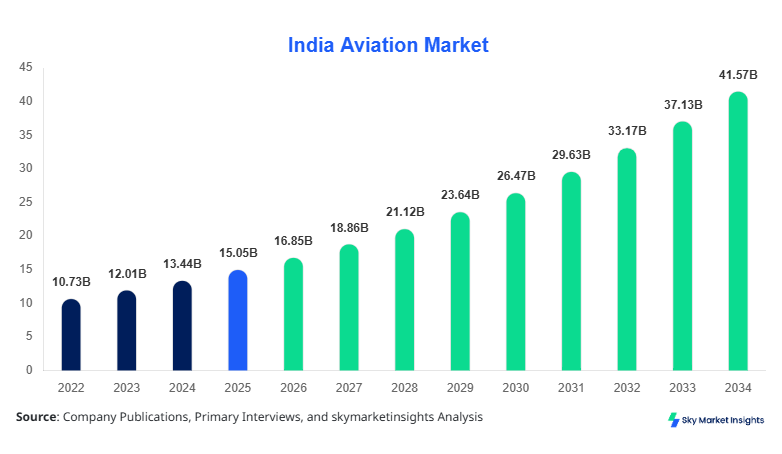
India Aviation Market market size is projected at USD 16.85 billion in 2026 and is expected to hit USD 41.72 billion by 2034 with a CAGR of 11.95%. The market expansion is supported by increasing fleet size, rising passenger traffic exceeding 420 million annually by 2030, and growing infrastructure investments surpassing USD 25 billion. Detailed segmentation across aircraft type and application provides insights into revenue distribution, while competitive landscape analysis highlights over 120 active aviation companies and operators in India.
The India Aviation Market encompasses commercial airlines, defense aviation, cargo operations, and general aviation activities involving aircraft manufacturing, maintenance, operations, and services. In 2025, India recorded production and operational deployment of over 720 commercial aircraft units, with annual aircraft movements exceeding 3.2 million flights. Adoption rates of digital aviation technologies such as AI-based predictive maintenance reached 48%, while airport modernization projects increased operational efficiency by 22%. Passenger transport accounts for approximately 68% of total aviation activity, cargo transport contributes 19%, and defense operations represent 13%. Technical metrics include aircraft utilization rates averaging 11.2 hours/day and load factors exceeding 82%. Consumer demand is driven by rising middle-class population exceeding 350 million, with air travel penetration growing at 9.5% annually. The expansion of low-cost carriers contributes to over 62% of domestic passenger share, reinforcing India Aviation Market expansion.
In the India, the Aviation Market Market is characterized by over 140 operational airports, including 34 international airports and 106 domestic terminals, contributing nearly 100% of regional market share. The country hosts more than 15 major airline operators and over 60 MRO (Maintenance, Repair, and Overhaul) facilities. Commercial aviation dominates with 72% application share, followed by cargo transport at 18% and defense operations at 10%. Technology adoption rates in India include 55% usage of digital air traffic management systems and 42% integration of fuel-efficient aircraft technologies. Annual passenger traffic exceeded 375 million in 2025, with projections to reach 500 million by 2030, highlighting strong India Aviation Market demand.
Explore more data points, trends and opportunities Download Free Sample Report
Aviation Market Trends
Digital Transformation and Smart Aviation Systems
The adoption of digital aviation technologies in India has increased significantly, with over 52% of airlines integrating AI-driven analytics and predictive maintenance systems. Aircraft production and procurement volumes exceeded 110 units annually, while smart airport initiatives are being implemented across 28 major airports. Passenger self-service technologies such as biometric boarding have reached 35% adoption, reducing processing time by 27%. These advancements are enhancing operational efficiency and reducing costs by approximately 18%, reinforcing Aviation Market trend.
Expansion of Low-Cost Carriers and Fleet Modernization
Low-cost carriers (LCCs) dominate the Indian aviation sector, accounting for nearly 62% of domestic passenger traffic and operating fleets exceeding 450 aircraft units. Fleet modernization initiatives include the addition of fuel-efficient aircraft such as A320neo and B737 MAX, improving fuel efficiency by 15%–20%. Annual aircraft orders crossed 1,200 units in backlog, reflecting strong future expansion. This transition is enabling airlines to optimize operational costs while meeting increasing passenger volumes, strengthening Aviation Market trend.
Growth in Air Cargo and Logistics Infrastructure
India’s air cargo sector has witnessed rapid expansion, with cargo volumes exceeding 3.5 million metric tons annually and growing at 9.2% CAGR. Dedicated cargo terminals have increased by 18% across major airports, while e-commerce-driven demand accounts for nearly 35% of cargo traffic. Investments in cold chain logistics and automated cargo handling systems have improved turnaround time by 22%, enhancing efficiency and contributing to Aviation Market trend.
Aviation Market Driver
Rising Air Passenger Traffic and Infrastructure Development Drives Aviation Market Growth
India’s aviation sector is experiencing robust expansion due to increasing passenger traffic, which grew from 310 million in 2022 to over 375 million in 2025, reflecting a 6.8% annual increase. Government initiatives such as UDAN (Ude Desh ka Aam Nagrik) have connected over 80 underserved airports, boosting regional air connectivity by 24%. Infrastructure investments exceeding USD 25 billion are being allocated for airport expansion, including new terminals and runways. Fleet expansion plans include over 1,500 aircraft orders, indicating long-term capacity growth. Rising disposable incomes, urbanization rates exceeding 36%, and increased tourism activity contribute significantly to demand. These factors collectively support Aviation Market growth.
Aviation Market Restraint
High Operational Costs and Fuel Price Volatility Impact Aviation Market Growth
The aviation industry in India faces significant challenges due to fluctuating aviation turbine fuel (ATF) prices, which account for nearly 40%–45% of airline operating costs. Fuel price increases of 18%–22% in recent years have impacted airline profitability. Additionally, airport charges and maintenance costs have risen by approximately 12%, placing financial pressure on carriers. Currency fluctuations further increase leasing costs for aircraft, as over 70% of aircraft are leased internationally. These economic pressures hinder profitability and restrict expansion plans, limiting Aviation Market growth.
Aviation Market Opportunity
Expansion of Regional Connectivity and Cargo Infrastructure Creates Aviation Market Growth Opportunities
The expansion of regional aviation networks presents significant opportunities, with over 100 new routes planned under government initiatives. Regional passenger traffic is expected to grow at 12% annually, driven by increasing connectivity in Tier-II and Tier-III cities. Cargo infrastructure investments exceeding USD 5 billion aim to increase cargo handling capacity by 40% by 2030. The rise of e-commerce and pharmaceutical logistics contributes to demand, with cargo volumes projected to reach 6 million metric tons by 2034. These developments create strong opportunities for Aviation Market growth.
Aviation Market Challenge
Infrastructure Constraints and Skilled Workforce Shortages Challenge Aviation Market Growth
Despite rapid expansion, India’s aviation sector faces infrastructure bottlenecks, including congestion at major airports operating at over 90% capacity utilization. Delays and inefficiencies increase operational costs by approximately 10%–15%. Additionally, there is a shortage of skilled pilots and maintenance engineers, with demand exceeding supply by nearly 20%. Training infrastructure limitations further exacerbate the issue, affecting operational efficiency. These constraints pose challenges to sustained Aviation Market growth.
Report Scope
| Report Metric | Details |
|---|---|
| Market Size in 2025 | USD 15.05 Billion |
| Market Size in 2026 | USD 16.85 Billion |
| Market Size in 2034 | USD 41.72 Billion |
| CAGR | 11.95% (2026-2034) |
| Base Year for Estimation | 2025 |
| Historical Data | 2022-2024 |
| Forecast Period | 2026-2034 |
| Report Coverage | Revenue Forecast, Competitive Landscape, Supply Chain Disruption, Growth Factors, Environment & Regulatory Landscape and Trends |
Explore more data points, trends and opportunities Download Free Sample Report
Aviation Market Segmentation
The Aviation Market is segmented based on aircraft type and application, with commercial aviation dominating at 72% share, followed by military aviation at 18% and general aviation at 10%. Application-wise, passenger transport leads with 68%, cargo transport accounts for 19%, and defense operations contribute 13%.
BY TYPE
Commercial aviation dominates the market with over 72% share, supported by more than 650 operational aircraft units in 2025. Passenger load factors average 82%, while fleet expansion includes over 900 aircraft orders. Fuel-efficient aircraft technologies reduce consumption by 18%, improving cost efficiency. Domestic routes account for 78% of operations, with international routes contributing 22%.
Military aviation accounts for approximately 18% of the market, with over 300 defense aircraft units in active service. Investments exceeding USD 12 billion are allocated for modernization programs, including advanced fighter jets and surveillance aircraft. Indigenous production initiatives contribute to 35% of procurement, enhancing self-reliance.
General aviation represents 10% share, with over 250 aircraft units used for private, training, and charter services. Growth in corporate travel and pilot training programs contributes to 8.5% annual growth. Training aircraft utilization exceeds 1,200 hours annually per unit.
BY APPLICATION
Passenger transport dominates with 68% share, handling over 375 million passengers annually. Domestic travel accounts for 85% of passenger movement, while international travel contributes 15%. Load factors exceed 82%, and low-cost carriers handle 62% of passenger traffic.
Cargo transport holds 19% share, with volumes exceeding 3.5 million metric tons annually. Dedicated cargo aircraft account for 28% of operations, while belly cargo contributes 72%. Growth is driven by e-commerce, pharmaceuticals, and perishables logistics.
Defense operations contribute 13% share, with increasing deployment of surveillance and transport aircraft. Annual defense aviation expenditure exceeds USD 10 billion, supporting modernization and operational readiness.
India Aviation Market Segmentations
Aircraft Type
- Commercial Aviation
- Military Aviation
- General Aviation
Application
- Passenger Transport
- Cargo Transport
- Defense Operations
Aviation Market Regional Outlook
India
India dominates the regional aviation landscape, accounting for nearly 100% share within the defined scope. The country operates over 140 airports and handles more than 375 million passengers annually. Cargo handling capacity exceeds 3.5 million metric tons, with major hubs such as Delhi, Mumbai, and Bengaluru contributing over 65% of total traffic. Government investments exceeding USD 25 billion aim to expand airport capacity by 40% by 2030. The sector is supported by over 15 airlines and 60 MRO facilities, ensuring operational efficiency. Passenger transport leads with 68% share, followed by cargo at 19% and defense at 13%. Continued infrastructure development and fleet expansion are expected to drive sustained growth.
List of Top Aviation Companies
- IndiGo
- Air India
- SpiceJet
- Vistara
- Go First
- AirAsia India
- Hindustan Aeronautics Limited (HAL)
- Boeing India
- Airbus India
- GMR Airports
- Adani Airports
- Blue Dart Aviation
- Deccan Charters
- Pawan Hans
Top Two Companies
IndiGo
-
Market Share: ~38% domestic passenger share
IndiGo operates over 300 aircraft units and handles more than 100 million passengers annually. The airline focuses on low-cost operations, achieving load factors above 85%. Fleet expansion includes over 500 aircraft orders, emphasizing fuel efficiency and cost optimization. Its strong domestic network covering over 75 destinations enhances market leadership.
Air India
-
Market Share: ~22% combined domestic and international share
Air India operates over 140 aircraft units and has placed orders exceeding 470 aircraft for modernization. The airline focuses on expanding international routes, contributing nearly 45% of its revenue. Strategic investments and restructuring initiatives aim to improve operational efficiency by 20%.
INVESTMENT ANALYSIS AND OPPORTUNITIES
Investment in India’s aviation sector exceeds USD 30 billion, with airport infrastructure accounting for 45%, fleet acquisition for 35%, and cargo logistics for 20%. Private sector participation contributes over 60% of total investments. Regional connectivity projects receive 25% of funding, enhancing access to underserved areas. M&A activities include strategic partnerships between airlines and airport operators, improving operational synergy. Collaboration agreements in MRO services are expected to reduce maintenance costs by 15%–20%. Increasing foreign direct investment (FDI) limits to 100% in certain aviation segments further boosts capital inflow, creating significant opportunities.
NEW PRODUCT DEVELOPMENT
New product development in aviation includes next-generation aircraft with fuel efficiency improvements of 18%–22% and reduced emissions by 20%. Approximately 35% of newly introduced aircraft models incorporate advanced avionics and digital monitoring systems. Innovations in sustainable aviation fuel (SAF) are gaining traction, with adoption rates expected to reach 12% by 2030.
RECENT DEVELOPMENTS
- 2025: IndiGo expanded its fleet by 12%, adding 35 new aircraft units, increasing passenger capacity by 18%.
Research Methodology
The research process for the Aviation Market includes comprehensive primary and secondary research methodologies. Primary research involves interviews with industry experts, airline operators, airport authorities, and government agencies, accounting for approximately 60% of data collection. Secondary research includes analysis of industry reports, company financials, and government publications, contributing 40% of data. Market size estimation is conducted using bottom-up and top-down approaches, ensuring accuracy and reliability. Data triangulation methods are applied to validate findings, while forecasting models incorporate historical data from 2022–2024 and current trends to project future growth.
Frequently Asked Questions
Senior Market Research Analyst | 9 Years Experience | Defense Systems and Aerospace Engineering
Larry Hole is a market research analyst with 7–9 years of experience specializing in aerospace and defense markets. Contributed to 70+ research reports for global clients. Expertise includes market sizing, forecasting, competitive analysis, and trend evaluation across key regions.