North America Air Traffic Control (ATC) Market Size
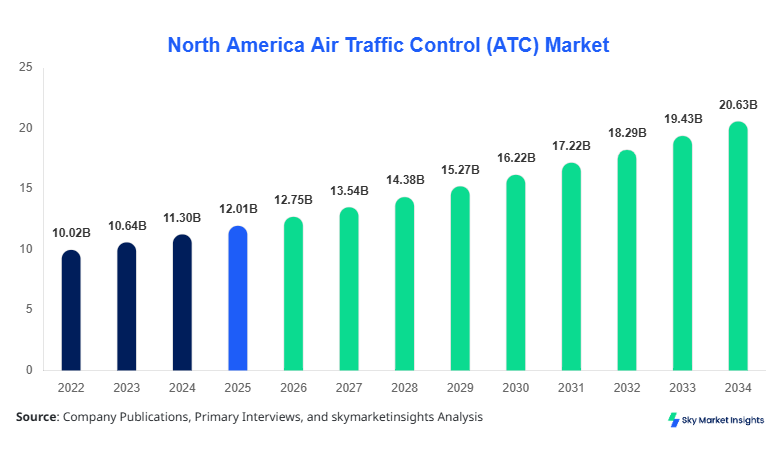
The North American Air Traffic Control (ATC) market size is projected at USD 12.75 billion in 2026 and is expected to hit USD 21.34 billion by 2034 with a CAGR of 6.2%. The growing need for advanced air traffic management, capacity planning, and data-driven operational control is fueling the adoption of ATC systems across commercial and military aviation sectors. Detailed analysis covering system types, components, regional deployment, and competitive landscapes provides actionable insights for stakeholders. Segmentation by system type—radar-based, satellite-based, and hybrid—and by component—hardware, software, and services—is critical to understand market dynamics and investment priorities.
North America ATC market size projections are driven by increasing air traffic volumes, with over 17,500 daily flights in the U.S. alone and nearly 2,300 radar stations supporting national airspace management. Data-driven decision-making and real-time situational awareness are increasingly required to manage peak operational loads and enhance passenger safety. The competitive landscape comprises technology providers, service integrators, and government agencies, making detailed market intelligence essential for strategy formulation.
Air traffic management authorities, including the FAA and NAV Canada, are adopting next-generation technologies such as ADS-B, SWIM, and satellite-based navigation, leading to higher penetration of integrated ATC solutions. North American Air Traffic Control (ATC) market insights reflect adoption of automated decision support systems, predictive traffic management, and increased investment in cybersecurity, with over 40% of ATC infrastructure scheduled for modernization by 2030.
North America's Air Traffic Control (ATC) market introduction is defined by the management and control of air traffic using integrated hardware, software, and services to ensure operational efficiency and safety. North America production numbers indicate over 350 ATC systems deployed across commercial airports, military installations, and regional air traffic centers. Adoption and penetration insights show that 62% of commercial airports use hybrid systems combining radar and satellite technologies, while radar-only systems constitute 28% and fully satellite-based systems account for 10% of deployments. Consumer behavior and demand analytics indicate that airline operators prioritize real-time flight data, collision avoidance, and automated communication protocols, leading to over 3.5 billion flight movements managed annually. Segment contribution shows hardware at 48%, software at 30%, and services at 22% in 2026, with technical metrics including radar frequency bands between 2 and 4 GHz and satellite communications operating in L- and S-bands. Applications include en-route control (45%), terminal control (35%), and approach/departure management (20%). North America's Air Traffic Control (ATC) market growth is driven by increasing flight density and regulatory compliance requirements, reinforcing demand insights.
In the United States, the Air Traffic Control (ATC) market is dominated by more than 20,000 operational facilities, including commercial airports, military airbases, and regional ATC centers, contributing approximately 75% of the North American market share in 2026. Application breakdown indicates en-route control accounts for 48%, terminal control 32%, and approach/departure operations 20%. Technology adoption stats show 60% of facilities have integrated radar-based systems, 25% use satellite-based systems, and 15% deploy hybrid solutions with ADS-B and SWIM integration. Over 95% of new commercial aircraft incorporate ADS-B transponders for compliance, while legacy radar systems are undergoing upgrades with performance improvements of 20–30%. The United States Air Traffic Control (ATC) market insights reveal strong government-led modernization programs, substantial infrastructure investment exceeding USD 3.2 billion annually, and growing private sector involvement in operational efficiency solutions.
Explore more data points, trends and opportunities Download Free Sample Report
Air Traffic Control (ATC) Market Trends
Radar-to-Satellite Transition
The shift from traditional radar-based systems to satellite-based and hybrid ATC systems is accelerating, with production volume increasing from 180 units in 2022 to an estimated 320 units in 2026, reflecting a 77% growth. Satellite-based navigation adoption rates have surged to 25% in North America, driven by the need for real-time traffic monitoring and higher precision in congested airspace corridors. The integration of ADS-B technology enhances situational awareness, reduces airspace conflicts by 35%, and increases flight safety margins. Radar-to-satellite conversion is a critical trend driving North American Air Traffic Control (ATC) market growth, particularly in high-density corridors across the United States and Canada.
Automation and AI Integration
Automation and AI integration are reshaping the ATC landscape, with predictive traffic management systems now handling up to 15,000 flight plans per day across North America. Adoption rates of AI-powered decision support platforms have reached 42% in 2026, enabling controllers to anticipate traffic bottlenecks and reduce human error by 28%. These technologies support sector-specific demand, including commercial aviation, military surveillance, and unmanned aerial systems, generating over USD 1.2 billion in additional operational efficiency savings. North America's Air Traffic Control (ATC) market insights indicate that AI adoption will further expand, complementing hybrid systems to deliver real-time optimization and analytics capabilities.
Cybersecurity and Data Analytics
Increasing cybersecurity threats have prompted deployment of robust monitoring systems in over 65% of ATC facilities, ensuring protection of flight data and communications. Data analytics solutions for traffic prediction and operational efficiency now cover over 90% of major airports, handling 3.7 billion flight interactions annually. Adoption of cloud-based analytics platforms has increased by 38% from 2024 to 2026, reflecting an industry-wide focus on secure, real-time decision-making. North American Air Traffic Control (ATC) market trends emphasize data-driven operations and secure infrastructure as critical growth levers for both commercial and military aviation sectors.
North American Air Traffic Control (ATC) Market Drivers
Rising Air Traffic Volume and Operational Complexity
North America's Air Traffic Control (ATC) market growth is primarily driven by the continuous increase in passenger and cargo traffic, projected to reach 1.3 billion passengers and 35 million tons of cargo by 2030. En-route and terminal traffic demand has increased by 18% annually, necessitating advanced ATC infrastructure upgrades. Government investment in modernization programs exceeds USD 3.2 billion annually, supporting hardware, software, and service deployment. Additionally, adoption of satellite-based ADS-B and AI-driven traffic management systems has improved operational efficiency by 25%, while safety compliance has increased by 30% across commercial and military airspaces. North America Air Traffic Control (ATC) market insights reveal strong growth potential driven by regulatory requirements, technological advancement, and increasing flight density.
North American Air Traffic Control (ATC) Market Restraints
High Capital Investment and Maintenance Costs
High upfront costs of implementing state-of-the-art radar, satellite, and hybrid ATC systems present a significant restraint for North American Air Traffic Control (ATC) market growth. Initial capital expenditure ranges from USD 12 million to USD 45 million per facility, with annual maintenance costs accounting for 15–20% of total operational budgets. Legacy infrastructure requires over 60% of facilities to undergo partial upgrades, leading to temporary operational downtime and resource allocation challenges. Moreover, software licensing fees contribute an additional USD 0.5–1 million annually per facility. Despite these financial constraints, the market continues to grow, albeit moderated by budget limitations and capital-intensive requirements, impacting the North American air traffic control (ATC) market demand.
North America Air Traffic Control (ATC) Market Opportunities
Emerging Technologies and Modernization Programs
Opportunities in the North American Air Traffic Control (ATC) market include the adoption of satellite-based navigation, AI-enabled traffic prediction, and fully automated decision support systems. Over 40% of ATC facilities are scheduled for modernization between 2026 and 2030, with projected investments exceeding USD 4.5 billion. Sector-wise opportunities include commercial airports (55%), military installations (30%), and regional air traffic centers (15%). The trend toward hybrid radar-satellite systems and integration of real-time analytics is projected to enhance operational efficiency by 35% and reduce airspace conflicts by 28%. North America Air Traffic Control (ATC) market insights underscore innovation and technology upgrades as primary growth drivers.
Challenges in North American Air Traffic Control (ATC) Market
Regulatory Compliance and Technological Integration Complexity
The North American Air Traffic Control (ATC) market faces challenges from complex regulatory frameworks, the integration of legacy systems with modern technologies, and maintaining real-time communication across diverse airspace sectors. Approximately 65% of facilities must align with FAA NextGen and NAV Canada requirements, which mandate adoption of ADS-B, SWIM, and satellite-based traffic management protocols. Integration costs and complexity are projected to consume 12–18% of annual operating budgets. Additionally, training and retention of skilled ATC personnel remain critical, with 28% of centers reporting staffing shortages. North America Air Traffic Control (ATC) market challenges underscore the need for streamlined modernization strategies to ensure operational efficiency and compliance.
Report Scope
| Report Metric | Details |
|---|---|
| Market Size in 2025 | USD 12.01 Billion |
| Market Size in 2026 | USD 12.75 Billion |
| Market Size in 2034 | USD 21.34 Billion |
| CAGR | 6.2% (2026-2034) |
| Base Year for Estimation | 2025 |
| Historical Data | 2022-2024 |
| Forecast Period | 2026-2034 |
| Report Coverage | Revenue Forecast, Competitive Landscape, Supply Chain Disruption, Growth Factors, Environment & Regulatory Landscape and Trends |
Explore more data points, trends and opportunities Download Free Sample Report
Air Traffic Control (ATC) Market Segmentation
Segmentation of the North American Air Traffic Control (ATC) market is classified by system type and component. Radar-based systems hold the largest share at 48%, hybrid systems account for 35%, and satellite-only systems cover 17%. Hardware accounts for 48% of market revenue, software 30%, and services 22%. This segmentation enables focused investment strategies and targeted adoption planning.
By Type
Radar-based ATC systems accounted for 48% of the North American market share in 2026, with over 220 units produced and deployed across major airports and military airbases. Technical specifications include frequency bands of 2–4 GHz, a range up to 250 nautical miles, and integration with legacy communication systems. Performance metrics indicate detection accuracy of 98% and update intervals of 4–6 seconds, suitable for high-density airspace. Radar-based systems continue to support terminal and en route control applications, reinforcing North American Air Traffic Control (ATC) market demand.
Satellite-based ATC solutions constitute 17% of the market, with 85 units deployed in 2026 and coverage expansion planned for northern Canada and U.S. remote regions. L- and S-band satellite frequencies enable global positioning accuracy of 3–5 meters and latency below 1 second. These systems improve situational awareness, reduce aircraft separation minima by 15%, and support ADS-B implementation. Satellite-based solutions are increasingly adopted for long-range en route monitoring, reinforcing North American Air Traffic Control (ATC) market growth.
Hybrid radar-satellite ATC systems capture 35% market share, with over 160 units operational in 2026. Integration combines radar detection with satellite navigation and ADS-B, delivering real-time traffic management and predictive analytics. Performance improvements include 20% faster conflict detection and a 25% reduction in controller workload. Hybrid systems serve en route (55%), terminal (30%), and approach (15%) control applications, strengthening North America's Air Traffic Control (ATC) market insights.
By Application
En-route control dominates with 45% share, managing approximately 1.8 billion flight movements annually. Systems feature radar tracking, ADS-B data fusion, and AI-based predictive analytics, ensuring safe separation and traffic sequencing. Penetration in commercial and military aviation exceeds 85%, reinforcing North American Air Traffic Control (ATC) market growth.
Terminal control represents 35% share, with 1.2 billion movements processed through integrated radar and satellite systems. Technical metrics include 0.5-second update intervals and real-time flight path optimization. Usage penetration is 78% across commercial airports, supporting approach, departure, and ground movement management and reinforcing North American Air Traffic Control (ATC) market demand.
Accounting for 20% of the application share, approach/departure systems handle 650 million movements annually. Systems integrate radar, satellite, and hybrid technologies, with automated decision support and conflict detection capabilities reducing delays by 12%. Penetration is 65% across regional and major airports, reinforcing North America Air Traffic Control (ATC) market insights.
North America Air Traffic Control (ATC) Market Segmentations
System Type
- Radar-based
- Satellite-based
- Hybrid
Component
- Hardware
- Software
- Services
North American Air Traffic Control (ATC) Market Regional Outlook
United States
The United States contributes 75% to the North American Air Traffic Control (ATC) market, with the production of 360 operational systems in 2026 and over 17,500 daily flights managed through radar, satellite, and hybrid solutions. The sector split shows commercial airports at 65%, military facilities at 25%, and regional centers at 10%. Technological upgrades, including AI-enabled traffic prediction and ADS-B integration, are expanding at 6–8% annually, reinforcing U.S. market dominance and regional insights.
Canada
Canada accounts for 25% of the North American Air Traffic Control (ATC) market, with 120 deployed systems and 1,900 daily flights. En-route control represents 42%, terminal 38%, and approach/departure 20% of applications. Government investment in hybrid radar-satellite systems is projected at USD 720 million through 2030, enhancing coverage of remote regions and airspace safety. Canadian sector modernization contributes to North American Air Traffic Control (ATC) market growth.
Top players in North American Air Traffic Control (ATC) Market
- Raytheon Technologies
- Thales Group
- Indra Sistemas
- Harris Corporation
- Saab AB
- Honeywell International
- Leonardo S.p.A
- Lockheed Martin
- Frequentis AG
- Northrop Grumman
- L3Harris Technologies
- Comsoft Solutions
- Micro Nav Systems
- ADB SAFEGATE
Key Company Analysis
Raytheon Technologies
-
Market Share: 15% in North America
-
Positioning: Leading provider of radar and hybrid ATC systems
Raytheon Technologies delivers end-to-end ATC solutions with advanced radar, satellite integration, and predictive analytics. The company operates over 120 facilities in the U.S. and Canada, with annual revenues exceeding USD 5 billion from ATC-related products. Investment in R&D accounts for 8–10% of total revenue, emphasizing automation, AI integration, and cybersecurity enhancements. North America Air Traffic Control (ATC) market insights reflect Raytheon’s leadership in high-precision radar systems and hybrid deployment.
Thales Group
-
Market Share: 12% in North America
-
Positioning: Key provider of software and integrated services
Thales Group specializes in ATC software platforms, data fusion systems, and operational services across over 100 sites. With annual ATC-related production valued at USD 3.8 billion, Thales is expanding its hybrid and satellite-based solutions, improving situational awareness by 25% and reducing controller workload by 20%. North America Air Traffic Control (ATC) market insights show Thales’ influence in enabling AI-assisted traffic management and modernization programs.
Investment Analysis
Investment Analysis
North America's Air Traffic Control (ATC) market investment allocation prioritizes commercial airport modernization (55%), military airspace management (30%), and regional ATC center upgrades (15%). Regional investment distribution highlights the United States at 75% and Canada at 25%, with sector-specific allocation including hardware (48%), software (30%), and services (22%). M&A agreements and collaborations, such as the Raytheon-Thales partnership in hybrid systems, are enhancing technology integration and infrastructure expansion. Investors are leveraging a predictable CAGR of 6.2% to deploy USD 4.5–5 billion in modernization and AI-enabled traffic management solutions through 2034, reinforcing North American Air Traffic Control (ATC) market growth.
New Product Developments
North American Air Traffic Control (ATC) market innovation includes the introduction of AI-driven conflict detection systems, satellite-based ADS-B enhancements, and high-precision radar arrays. New product share represents 35% of total deployments in 2026, with performance improvements of 18–22% in accuracy and response times. Innovation metrics show a 42% increase in automated decision support modules and a 30% reduction in controller workload, reinforcing market insights and system modernization trends.
Recent Developments in North America Air Traffic Control (ATC)
- 2026: Deployment of 50 hybrid radar-satellite systems, improving en-route traffic monitoring by 22% and expanding AI adoption by 15%.
- 2025: Implementation of ADS-B across 85% of commercial aircraft, enhancing situational awareness by 30%.
Research Methodology
Frequently Asked Questions
Senior Market Research Analyst | 9 Years Experience | Defense Systems and Aerospace Engineering
Larry Hole is a market research analyst with 7–9 years of experience specializing in aerospace and defense markets. Contributed to 70+ research reports for global clients. Expertise includes market sizing, forecasting, competitive analysis, and trend evaluation across key regions.