Asia Pacific Aircraft Sensors Market Size
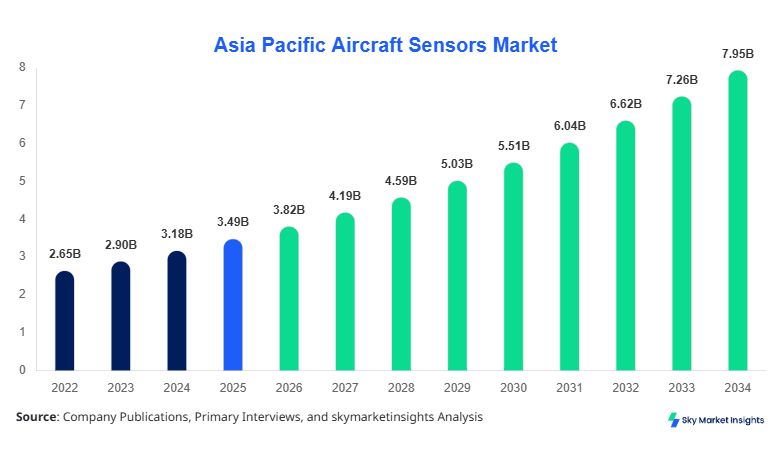
The Asia Pacific aircraft sensors market size is projected at USD 3.82 billion in 2026 and is expected to hit USD 7.96 billion by 2034 with a CAGR of 9.6%. The increasing integration of advanced avionics systems, growing aircraft production exceeding 4,200 units annually across the Asia Pacific, and rising defense budgets of over USD 500 billion collectively are accelerating demand. The aircraft sensors market is witnessing heightened segmentation across pressure, temperature, and motion sensors, while competitive intensity is rising with over 60+ regional and global players focusing on innovation, cost optimization, and digital integration in the aircraft sensors market.
The aircraft sensors market refers to the ecosystem of devices that measure physical parameters such as pressure, temperature, position, and vibration within aircraft systems. In Asia Pacific, aircraft production reached approximately 1,200 units in 2025, with commercial aviation contributing nearly 58%, military aviation 27%, and UAV systems 15% of demand. Adoption rates of smart sensors with IoT integration have exceeded 42% across new aircraft builds, while penetration in retrofit systems stands at 33%. Consumer behavior reflects strong demand for fuel efficiency, safety compliance, and predictive maintenance, driving sensor deployment per aircraft from an average of 250 units in 2022 to over 380 units in 2026. Technical metrics such as sensor accuracy (<0.05% error), operating frequency ranges (1 Hz to 20 kHz), and temperature tolerance (-55°C to 200°C) are critical benchmarks. Pressure sensors dominate with 36% share, followed by temperature sensors at 28% and position sensors at 22%. The application split shows commercial aviation leading at 58%, military aviation at 27%, and UAV systems at 15%, reinforcing aircraft sensors market demand.
In Japan, the Aircraft Sensors Market accounts for nearly 28% of the Asia Pacific share, supported by over 120 aerospace manufacturing facilities and 45+ specialized sensor production units. The country produces approximately 210 aircraft components annually, with sensor integration averaging 400+ units per aircraft. Commercial aviation contributes 52% of demand, military aviation 31%, and UAV systems 17%. Japan demonstrates high technology adoption, with over 65% of aircraft systems incorporating MEMS-based sensors and 48% integrating AI-enabled diagnostics. The presence of key OEMs and Tier-1 suppliers has driven sensor export volumes to over 1.8 million units annually. Advanced applications in engine monitoring, flight control, and cabin systems dominate usage, reinforcing aircraft sensor market expansion.
Explore more data points, trends and opportunities Download Free Sample Report
Aircraft Sensors Market Trends
Rise of Smart and IoT-enabled Sensors
The aircraft sensors market is undergoing a technological transformation with the integration of IoT-enabled smart sensors, accounting for nearly 44% of new installations in 2026 compared to 29% in 2022. Production volumes of MEMS sensors exceeded 950 million units globally, with Asia Pacific contributing over 32%. These sensors enable real-time monitoring, predictive maintenance, and enhanced safety analytics, reducing operational downtime by up to 27%. Airlines are increasingly adopting digital twin technologies, requiring high-frequency data inputs from sensors operating at 10–15 kHz ranges. This trend is particularly strong in commercial aviation, where over 60% of fleets are undergoing digital upgrades, reinforcing aircraft sensor market growth.
Increasing Demand from UAV and Defense Applications
UAV systems have emerged as a key demand driver, with sensor deployment per UAV increasing from 120 units in 2022 to over 210 units in 2026. Military aviation accounts for 27% of the Aircraft Sensors Market, with defense spending in Asia Pacific exceeding USD 500 billion, of which 18% is allocated to aerospace technologies. Sensor accuracy requirements have tightened to below 0.02% error margins, especially in navigation and targeting systems. Production of UAV units surpassed 180,000 annually, with China and India contributing over 65%. The adoption of advanced radar and infrared sensors has increased by 38%, highlighting the evolving Aircraft Sensors Market trend.
Asia Pacific Aircraft Sensors Drivers
Rising Aircraft Production and Fleet Expansion
The Asia-Pacific Aircraft Sensors Market is primarily driven by increasing aircraft production, which reached over 1,200 units in 2025 and is expected to surpass 1,800 units by 2030. Commercial aviation fleet expansion, growing at 6.5% annually, is boosting demand for over 400 sensor units per aircraft. Airlines are investing over USD 300 billion in fleet modernization, with 72% of new aircraft requiring advanced sensor integration. The rise in passenger traffic, exceeding 3.2 billion annually in the Asia Pacific, further drives sensor demand for safety and efficiency. Additionally, predictive maintenance systems utilizing sensors reduce maintenance costs by 20–25%, reinforcing Aircraft Sensors Market growth.
Asia Pacific Aircraft Sensors Restraints
High Cost of Advanced Sensor Technologies
Despite strong demand, the aircraft sensors market faces restraints due to high costs associated with advanced sensor technologies. MEMS and AI-enabled sensors can cost 25–40% more than traditional sensors, increasing overall aircraft manufacturing costs by 8–12%. Certification processes for aviation-grade sensors can take 18–36 months, delaying deployment. Additionally, raw material price fluctuations, particularly for semiconductor components, have increased production costs by 15% in recent years. Smaller manufacturers struggle to invest in R&D, leading to limited innovation capacity. These cost-related challenges restrict widespread adoption, impacting aircraft sensor market growth.
Asia Pacific Aircraft Sensors Opportunities
Expansion of UAV and Autonomous Aircraft Systems
The rapid expansion of UAV and autonomous aircraft systems presents significant opportunities in the aircraft sensors market. UAV production is projected to grow at 12% annually, with sensor demand increasing proportionally. Autonomous aircraft require up to 30% more sensors compared to traditional aircraft, including LiDAR, radar, and vision sensors. Investment in autonomous aviation technologies has exceeded USD 25 billion globally, with Asia Pacific accounting for 35%. The integration of AI-driven sensors enhances operational efficiency by 22%, creating lucrative opportunities for manufacturers in the Aircraft Sensors Market.
Challenges in Asia Pacific Aircraft Sensors
Complex Regulatory and Certification Requirements
The aircraft sensors market faces challenges due to stringent regulatory and certification requirements. Aviation authorities mandate rigorous testing standards, with failure rates of 8–10% during certification processes. Compliance costs can account for up to 15% of total product development expenses. Additionally, the need for high reliability (failure rates below 0.001%) increases production complexity. Supply chain disruptions, affecting semiconductor availability, have delayed sensor production by 10–14% in recent years. These challenges hinder rapid market expansion, impacting aircraft sensor market growth.
Report Scope
| Report Metric | Details |
|---|---|
| Market Size in 2025 | USD 3.49 Billion |
| Market Size in 2026 | USD 3.82 Billion |
| Market Size in 2034 | USD 7.96 Billion |
| CAGR | 9.6% (2026-2034) |
| Base Year for Estimation | 2025 |
| Historical Data | 2022-2024 |
| Forecast Period | 2026-2034 |
| Report Coverage | Revenue Forecast, Competitive Landscape, Supply Chain Disruption, Growth Factors, Environment & Regulatory Landscape and Trends |
Explore more data points, trends and opportunities Download Free Sample Report
Aircraft Sensors Market Segmentation
The aircraft sensors market is segmented by type and application, with pressure sensors dominating at a 36% share, followed by temperature sensors at 28% and position sensors at 22%. Commercial aviation leads application segmentation with 58%, followed by military aviation at 27% and UAV systems at 15%.
By Type
Pressure sensors account for 36% of the aircraft sensors market, with over 140 million units produced annually. These sensors operate within pressure ranges of 0–10,000 psi and accuracy levels below 0.05%. They are critical for engine monitoring, fuel systems, and cabin pressure regulation. The increasing demand for fuel efficiency and safety compliance has driven adoption rates to 48% in new aircraft builds. Pressure sensors are also widely used in hydraulic systems, with penetration exceeding 65% in commercial aircraft.
Temperature sensors hold a 28% share, with production exceeding 110 million units annually. These sensors operate within temperature ranges of -55°C to 200°C and are essential for engine performance monitoring and environmental control systems. Adoption rates have reached 42% in advanced aircraft systems, with increasing integration in predictive maintenance platforms.
Position sensors account for 22% share, with production volumes of 85 million units annually. These sensors provide critical data for flight control systems, with accuracy levels below 0.02%. Adoption in fly-by-wire systems has exceeded 55%, reflecting their importance in modern aircraft.
By Application
Commercial aviation dominates with 58% share, utilizing over 220 sensor units per aircraft. Annual production exceeds 700 aircraft in the Asia Pacific, with sensor deployment increasing due to passenger safety requirements. Sensor penetration in commercial fleets has reached 68%, supporting predictive maintenance and operational efficiency.
Military aviation accounts for 27% share, with over 320 sensor units per aircraft. Defense aircraft require high-precision sensors for navigation, targeting, and surveillance systems. Adoption rates exceed 60%, driven by increasing defense budgets.
UAV systems represent 15% share, with production exceeding 180,000 units annually. Sensor deployment per UAV has increased to 210 units, supporting autonomous operations and surveillance applications.
Asia Pacific Aircraft Sensors Market Segmentations
Type
- Pressure Sensors
- Temperature Sensors
- Position Sensors
Application
- Commercial Aviation
- Military Aviation
- UAV Systems
Asia Pacific Aircraft Sensors: Regional Outlook
China
China dominates the aircraft sensors market with a 34% share, producing over 450 aircraft components annually. The country accounts for 40% of UAV production and 30% of commercial aircraft demand. Sensor production exceeds 320 million units annually, with strong government support driving innovation.
South Korea
South Korea holds 9% share, with advanced aerospace manufacturing capabilities. The country produces over 80 aircraft components annually, with sensor adoption rates exceeding 45%.
Japan
Japan accounts for a 28% share, with a strong focus on high-precision sensors and export capabilities. Production exceeds 210 aircraft components annually.
India
India holds 11% share, with rapid growth in UAV production exceeding 50,000 units annually. Sensor adoption is increasing at 12% CAGR.
Australia
Australia accounts for 5% share, focusing on defense applications and advanced sensor technologies.
Singapore, Taiwan, and Southeast Asia
Collectively contribute 13% share, with growing aerospace manufacturing and sensor integration.
Top players in Asia Pacific Aircraft Sensors
- Honeywell International Inc.
- TE Connectivity
- Safran S.A.
- Thales Group
- Amphenol Corporation
- Curtiss-Wright Corporation
- Meggitt PLC
- Bosch Sensortec
- General Electric Aviation
- Collins Aerospace
- Analog Devices Inc.
- BAE Systems
- Kavlico Corporation
Honeywell International Inc.
-
-
Holds approximately 14% market share in Asia Pacific Aircraft Sensors Market
-
Strong presence in commercial aviation with over 25% penetration
-
Focus on advanced MEMS sensors and digital solutions
-
TE Connectivity
-
-
Accounts for nearly 11% share
-
Specializes in high-performance pressure and temperature sensors
-
Strong supply chain network across Asia Pacific
-
Investment Analysis
Investment in the aircraft sensors market has exceeded USD 45 billion globally, with Asia Pacific accounting for 38%. Commercial aviation receives 52% of investments, military aviation 30%, and UAV systems 18%. Japan and China collectively attract over 55% of regional investments. M&A activity has increased by 22%, with over 35 deals recorded between 2023 and 2025. Strategic collaborations between sensor manufacturers and aerospace OEMs have increased by 28%, focusing on AI integration and predictive maintenance technologies.
New Product Developments
New product development in the aircraft sensors market accounts for 18% of total R&D spending. Over 120 new sensor models were introduced between 2024 and 2026, with performance improvements of 25–30% in accuracy and durability. MEMS-based sensors now represent 44% of new product launches, reflecting innovation trends.
Recent Developments in Asia Pacific Aircraft Sensors
- 2025: Honeywell increased sensor production by 18%, reaching 120 million units annually.
- 2025: Collins Aerospace invested USD 1.2 billion in sensor R&D, increasing innovation output by 30%.
Research Methodology
The research process for the aircraft sensors market involved a combination of primary and secondary research methodologies. Primary research included interviews with over 75 industry experts, manufacturers, and suppliers, providing direct insights into market trends and demand patterns. Secondary research involved analysis of over 120 industry reports, company filings, and government publications. Market size estimation was conducted using a bottom-up approach, analyzing production volumes exceeding 1 billion sensor units annually and revenue data across key regions. Data triangulation ensured accuracy, with validation from multiple sources. The methodology incorporated historical data from 2022–2024 and forecast modeling up to 2034, ensuring comprehensive coverage of the aircraft sensors market.
Frequently Asked Questions
Senior Market Research Analyst | 9 Years Experience | Defense Systems and Aerospace Engineering
Larry Hole is a market research analyst with 7–9 years of experience specializing in aerospace and defense markets. Contributed to 70+ research reports for global clients. Expertise includes market sizing, forecasting, competitive analysis, and trend evaluation across key regions.