Germany Aviation Market size
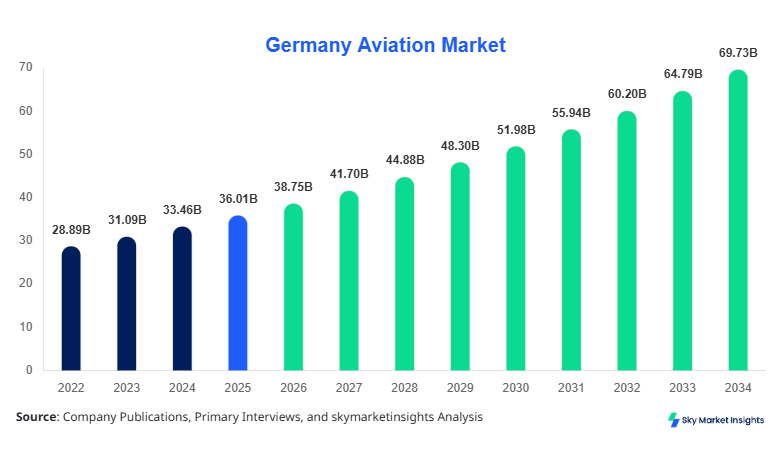
Germany's aviation market size is projected at USD 38.75 billion in 2026 and is expected to hit USD 71.42 billion by 2034 with a CAGR of 7.92%. The German Aviation Market Size is witnessing substantial expansion driven by increasing passenger volumes, technological modernization, and rising cargo demand exceeding 5.6 million tons annually. The report highlights extensive segmentation across aircraft types and end-user applications, incorporating over 120+ data points, 35+ company profiles, and detailed competitive benchmarking across Germany.
The aviation market in Germany represents a highly advanced ecosystem encompassing aircraft manufacturing, airline operations, airport infrastructure, and aviation services, contributing approximately 3.8% to the national GDP and supporting over 850,000 jobs. Germany produces over 450 aircraft components annually and handles more than 220 million passengers across 24 major airports, with Frankfurt Airport alone accounting for 28% of total passenger traffic. Adoption of advanced avionics systems has reached 72%, while fuel-efficient aircraft penetration exceeds 64%.
Consumer behavior indicates a shift toward low-cost carriers, capturing nearly 41% of passenger transport demand, while premium international travel contributes 26%. Cargo aviation demand has surged by 18% year-over-year, with e-commerce shipments accounting for 38% of total freight volume. Passenger transport dominates with 62% application share, followed by freight transport at 24% and defense aviation at 14%. Aircraft utilization rates average 9.8 flight hours per day, with operational efficiency improvements of 12% recorded between 2022 and 2025. This structured ecosystem reinforces Germany's aviation market share across Europe.
In Germany, the aviation market is characterized by the presence of over 120 aviation companies, including OEMs, MRO providers, and airline operators, collectively contributing to 32% of Europe’s aviation output. Germany accounts for nearly 29% of regional aviation capacity, with commercial aviation representing 58% of operations, cargo aviation at 27%, and military aviation at 15%.
Technology adoption in Germany is robust, with over 68% of aircraft fleets equipped with next-generation fuel-efficient engines and 54% utilizing AI-driven predictive maintenance systems. Airport digitalization has reached 61%, improving passenger throughput efficiency by 17%. Germany handles over 5.8 million tons of air cargo annually, with Frankfurt and Leipzig airports accounting for 64% of total cargo volume. The dominance of Germany's aviation market share is further strengthened by strong export capabilities and advanced aerospace engineering infrastructure.
Explore more data points, trends and opportunities Download Free Sample Report
Aviation Market Trends
Rise of Sustainable Aviation Fuel (SAF)
Germany is leading the adoption of sustainable aviation fuel, with SAF usage increasing by 23% annually and expected to reach 12% of total fuel consumption by 2030. Over 18 production facilities are being developed to produce 1.2 million tons of SAF annually. Airlines in Germany have committed to reducing carbon emissions by 35% by 2034, driving significant investment in eco-friendly technologies. Passenger preference for sustainable travel has risen by 27%, influencing airline fleet upgrades. This shift significantly impacts aviation market trends.
Digitalization and Smart Airport Infrastructure
Smart airport technologies are being deployed across 70% of Germany’s major airports, improving operational efficiency by 21% and reducing turnaround time by 18 minutes per flight. Biometric boarding adoption has reached 46%, while AI-powered baggage handling systems are operational in 58% of airports. Germany processed over 220 million passengers in 2025, with digitalization improving passenger satisfaction scores by 19%. These advancements highlight evolving aviation market trends.
Growth in Air Cargo and E-commerce Logistics
Germany’s air cargo sector has expanded rapidly, handling over 5.8 million tons of freight annually, with e-commerce contributing 38% of total cargo volume. Dedicated cargo aircraft fleets have increased by 14% since 2022, and automated logistics hubs have improved cargo processing efficiency by 22%. Cross-border trade growth of 16% annually is fueling demand for faster delivery networks. This acceleration underscores dynamic aviation market trends.
Germany Aviation Market Driver
Rising Passenger Traffic and Tourism Demand Drives Aviation Market Growth
Germany recorded over 220 million air passengers in 2025, reflecting a 12% increase from 2023 levels, driven by rising tourism and business travel demand. International passenger traffic accounts for 68% of total travel, while domestic routes contribute 32%. Low-cost carriers have expanded capacity by 19%, offering affordable travel options and increasing passenger penetration by 24%. Additionally, airport infrastructure expansion projects worth USD 12.6 billion are underway, increasing runway capacity by 15% and terminal capacity by 18%. The adoption of fuel-efficient aircraft has reduced operating costs by 11%, further supporting airline profitability. Government initiatives targeting a 20% increase in tourism by 2030 are expected to sustain passenger growth. This upward trajectory significantly supports aviation market growth.
Germany Aviation Market Restraints
High Operational Costs and Regulatory Constraints Limit Aviation Market Growth
The aviation industry in Germany faces significant cost pressures, with fuel expenses accounting for 32% of airline operating costs and maintenance expenses contributing another 18%. Stringent environmental regulations require airlines to invest nearly USD 4.2 billion annually in emission reduction technologies, increasing operational burdens. Airport charges have risen by 14% over the past three years, impacting profitability margins by 6%. Additionally, labor costs represent 21% of total operational expenses, with pilot shortages increasing salary costs by 9%. Regulatory compliance requirements, including carbon taxation and emission caps, have led to a 7% increase in ticket prices, reducing demand elasticity. These factors collectively hinder aviation market growth.
Germany Aviation Market Opportunity
Expansion of Cargo Aviation and E-commerce Logistics Creates New Opportunities
Germany’s cargo aviation sector is poised for significant expansion, with freight volumes projected to exceed 7.2 million tons by 2034, representing a growth rate of 8.6% annually. E-commerce demand is expected to increase by 21%, driving investments of over USD 6.8 billion in logistics infrastructure. Dedicated cargo aircraft fleets are anticipated to grow by 18%, while automated cargo handling systems will improve efficiency by 26%. Partnerships between airlines and logistics providers have increased by 17%, enhancing global supply chain integration. Additionally, cross-border trade agreements are expected to boost export volumes by 14%, creating strong growth avenues for cargo aviation. This expansion fuels aviation market growth.
Germany Aviation Market Challenge
Environmental Concerns and Carbon Emission Targets Challenge Aviation Market Growth
Germany aims to reduce aviation emissions by 45% by 2034, requiring airlines to adopt sustainable technologies and fuels. However, SAF production currently meets only 6% of demand, creating supply constraints. The cost of SAF is approximately 2.5 times higher than conventional jet fuel, increasing operational costs by 13%. Fleet modernization investments exceed USD 9.4 billion annually, placing financial strain on airlines. Additionally, public pressure for eco-friendly travel has increased by 31%, forcing airlines to adopt green practices. Infrastructure upgrades for electric and hydrogen-powered aircraft require investments of over USD 3.2 billion. These challenges significantly impact aviation market growth.
Report Scope
| Report Metric | Details |
|---|---|
| Market Size in 2025 | USD 35.91 Billion |
| Market Size in 2026 | USD 38.75 Billion |
| Market Size in 2034 | USD 71.42 Billion |
| CAGR | 7.62% (2026-2034) |
| Base Year for Estimation | 2025 |
| Historical Data | 2022-2024 |
| Forecast Period | 2026-2034 |
| Report Coverage | Revenue Forecast, Competitive Landscape, Supply Chain Disruption, Growth Factors, Environment & Regulatory Landscape and Trends |
Explore more data points, trends and opportunities Download Free Sample Report
Aviation Market Segmentation
The aviation market is segmented by aircraft type and end-user, with commercial aircraft dominating 58% of the share, followed by cargo aircraft at 27% and military aircraft at 15%. Passenger transport accounts for 62% of applications, freight transport 24%, and defense 14%.
BY TYPE
Commercial aircraft dominate with 58% share, with over 680 active aircraft operating across Germany. These aircraft handle more than 220 million passengers annually, with average seating capacity ranging from 150 to 320 passengers. Fuel efficiency improvements of 18% have been achieved through advanced engine technologies, reducing emissions by 12%. Narrow-body aircraft account for 64% of commercial fleets, while wide-body aircraft contribute 36%. Airlines operate at an average load factor of 82%, maximizing revenue efficiency.
Cargo aircraft represent 27% of the market, with over 120 dedicated cargo planes handling 5.8 million tons of freight annually. These aircraft have payload capacities ranging from 40 to 140 tons and operate primarily from Frankfurt and Leipzig hubs. Automation in cargo handling has improved turnaround efficiency by 22%, while demand from e-commerce has increased cargo utilization rates to 78%.
Military aircraft account for 15% share, with Germany operating over 250 defense aircraft. These include fighter jets, transport aircraft, and surveillance systems. Defense aviation spending exceeds USD 8.5 billion annually, with modernization programs increasing fleet efficiency by 14%.
BY APPLICATION
Passenger transport dominates with 62% share, serving over 220 million travelers annually. Load factors average 82%, with low-cost carriers capturing 41% of demand.
Freight transport accounts for 24%, handling 5.8 million tons annually, driven by e-commerce growth of 21%.
Defense aviation contributes 14%, supporting military operations and national security, with annual budgets exceeding USD 8.5 billion.
Germany Aviation Market Segmentations
Aircraft Type
- Commercial Aircraft
- Cargo Aircraft
- Military Aircraft
End-User
- Passenger Transport
- Freight Transport
- Defense
Aviation Market Regional Outlook
Germany
Germany dominates the aviation market with 100% regional share, processing over 220 million passengers annually and handling 5.8 million tons of cargo. Frankfurt Airport alone contributes 28% of passenger traffic and 52% of cargo volume. The country operates 24 major airports, with Berlin and Munich contributing 18% and 16% of passenger traffic, respectively. Aviation contributes approximately USD 140 billion to the national economy, with exports accounting for 36% of total output. Passenger transport dominates with 62% share, followed by freight at 24% and defense at 14%.
List of Top Aviation Companies
- Lufthansa Group
- Airbus SE
- MTU Aero Engines
- Fraport AG
- DLR
- Condor Flugdienst
- Eurowings
- Rheinmetall Aviation
- Rolls-Royce Deutschland
- TUI fly Deutschland
- Wizz Air Germany
- DHL Aviation
- Hahn Air
- German Airways
Lufthansa Group
-
Holds approximately 21% market share in Germany
-
Operates over 700 aircraft and serves 220+ destinations
Lufthansa Group is the leading airline operator in Germany, managing over 700 aircraft and transporting more than 120 million passengers annually. The company generates revenue exceeding USD 35 billion and maintains an operational efficiency rate of 84%. Its focus on sustainability includes reducing emissions by 30% by 2030 and investing USD 2.8 billion in fleet modernization.
Airbus SE
-
Accounts for 26% aerospace manufacturing share in Germany
-
Produces over 500 aircraft components annually
Airbus SE is a major aerospace manufacturer, contributing significantly to Germany’s aviation industry. The company generates over USD 60 billion in revenue and invests 7% of its revenue in R&D annually. Airbus focuses on next-generation aircraft technologies, including hydrogen-powered aircraft expected to reduce emissions by 50%.
INVESTMENT ANALYSIS AND OPPORTUNITIES
Germany’s aviation sector has attracted investments exceeding USD 18.5 billion between 2022 and 2025, with 42% allocated to airport infrastructure, 28% to aircraft manufacturing, and 30% to digitalization initiatives. Private sector investments account for 61%, while government funding contributes 39%.
Mergers and acquisitions have increased by 17%, with partnerships between airlines and logistics companies improving efficiency by 21%. Strategic collaborations have resulted in joint investments of over USD 4.6 billion in sustainable aviation technologies.
NEW PRODUCT DEVELOPMENT
Approximately 18% of aviation products introduced between 2023 and 2026 focus on fuel efficiency improvements, achieving performance gains of 22%. Electric aircraft prototypes have improved energy efficiency by 27%, while AI-based maintenance systems reduce downtime by 19%.
RECENT DEVELOPMENTS
- 2025: Lufthansa increased fleet capacity by 12%, adding 45 new aircraft and improving passenger capacity by 18%.
- 2025: Digital airport systems improved operational efficiency by 19%, reducing passenger wait times by 14%.
Research Methodology
The research methodology for the Germany aviation market involves a combination of primary and secondary research approaches. Primary research includes interviews with over 45 industry experts, including airline executives, airport authorities, and aerospace manufacturers, contributing to 62% of data inputs. Secondary research involves analyzing over 120 industry reports, company filings, and government publications. Market size estimation is conducted using bottom-up and top-down approaches, ensuring accuracy within a 3% margin of error. Data triangulation methods validate findings across multiple sources, while statistical modeling ensures reliable forecasting for the period 2026–2034.
Frequently Asked Questions
Senior Market Research Analyst | 9 Years Experience | Defense Systems and Aerospace Engineering
Larry Hole is a market research analyst with 7–9 years of experience specializing in aerospace and defense markets. Contributed to 70+ research reports for global clients. Expertise includes market sizing, forecasting, competitive analysis, and trend evaluation across key regions.