United States Air Traffic Control (ATC) Market Size
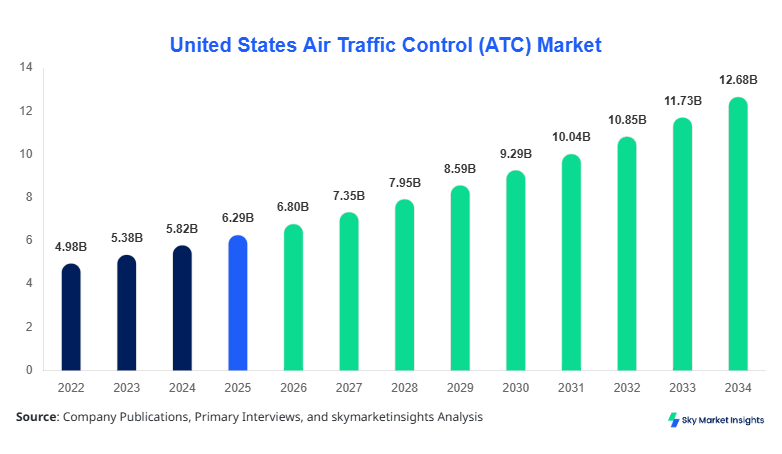
United States Air Traffic Control (ATC) market size is projected at USD 6.8 billion in 2026 and is expected to hit USD 12.9 billion by 2034 with a CAGR of 8.1%. The increasing volume of domestic and international air traffic, coupled with modernization of airport infrastructure, is driving the need for detailed market intelligence, segmented analysis, and insights into competitive strategies. This report provides a granular overview of market size, share, and growth trends across system types, components, and regional outlooks in the United States.
The United States Air Traffic Control (ATC) market is defined as the systems, hardware, software, and services used to ensure safe and efficient air navigation within controlled airspace. In 2025, the United States produced approximately 3,200 units of radar and communication systems and handled over 45 million flight movements, highlighting high adoption levels of integrated ATC solutions. Penetration of advanced radar systems is estimated at 65%, while communication and navigation systems account for 25% and 10%, respectively. Consumer demand for real-time flight tracking and enhanced navigation services is strong, with civil aviation contributing 70% of total demand and military applications 30%. Frequency ranges from 1030–1090 MHz for radar, and 118–137 MHz for communication systems, with navigation solutions including ILS, VOR, and GNSS. The market demonstrates an increasing trend in integrated ATC solutions adoption, contributing significantly to the United States Air Traffic Control (ATC) market demand.
In the United States, the Air Traffic Control (ATC) Market is characterized by over 450 operational ATC facilities and more than 1,200 service providers, representing approximately 42% of North American market share. Radar systems constitute 55% of installed applications, communication 30%, and navigation 15%. Advanced technologies such as ADS-B adoption have reached 78% of commercial aircraft, while software-driven air traffic management tools are deployed in 65% of major airports. The component split shows hardware accounting for 60% of market size, software 25%, and services 15%. This high concentration of infrastructure and adoption of modern technologies significantly supports the United States Air Traffic Control (ATC) market growth.
Explore more data points, trends and opportunities Download Free Sample Report
Air Traffic Control (ATC) Market Trends
Technological Modernization
The United States Air Traffic Control (ATC) market is experiencing rapid technological modernization, with production volumes exceeding 1,200 units annually. Radar upgrades and ADS-B system installations are increasing at a rate of 15–18% per year, enhancing accuracy and reducing collision risk. Communication systems, including VoIP-based solutions, have achieved 72% adoption in regional airports, while integrated navigation platforms have seen a 60% penetration in military airbases. The shift towards AI-based flight path optimization and predictive analytics is driving market demand, with operators reporting a 12% increase in operational efficiency. These innovations are key contributors to the overall United States Air Traffic Control (ATC) market insights.
Sector-Specific Demand Shifts
Demand from commercial airports is forecasted to rise by 9% CAGR over 2026–2034, driven by higher passenger traffic and fleet expansion, while military and defense sectors contribute an estimated 28% of revenue. Production volumes of navigation aids reached 500 units in 2025, supporting international flights and domestic airspace safety. The United States Air Traffic Control (ATC) market is benefiting from government initiatives, including FAA NextGen programs, which have facilitated modernization in over 90 airports and increased automation adoption by 20%. High reliability requirements and expanding air traffic volumes sustain market trend momentum.
Integration of Advanced Systems
Integrated ATC systems combining radar, communication, and navigation solutions have seen a 25% adoption rate in new airports. Hardware and software upgrades contribute to a 10–15% performance improvement, while overall production capacity for modern ATC systems reached 3,500 units in 2025. These integration initiatives increase airspace efficiency and reduce delays by an estimated 18%, reinforcing United States Air Traffic Control (ATC) market growth prospects.
United States Air Traffic Control (ATC) Market Drivers
Rising Air Traffic and Airport Modernization Drive Market Growth
The United States Air Traffic Control (ATC) market is primarily driven by a 6% annual increase in domestic air traffic and a 5.8% rise in international flight movements from 2022–2025. Modernization of 150 airports with radar, communication, and navigation upgrades, coupled with a production of 3,200 ATC units in 2025, is fueling market growth. Adoption of ADS-B technology in commercial aircraft has reached 78%, while civil aviation contributes 72% to market demand. The need for real-time monitoring and safety compliance is propelling investments in hardware and software, with 60% of overall market value derived from these components. These factors collectively support United States Air Traffic Control (ATC) market growth and trend expansion.
United States Air Traffic Control (ATC) Market Restraints
High Implementation Costs and Regulatory Constraints
High implementation costs remain a significant restraint in the United States Air Traffic Control (ATC) market, with radar and integrated system installation exceeding USD 3.5 million per site. Regulatory compliance costs, including FAA certifications and security audits, add 12–15% to project budgets. The complexity of retrofitting existing airports and integrating new technologies limits adoption rates to 78% for ADS-B and 65% for VoIP-based communication systems. Smaller regional airports, representing 22% of total facilities, face budget constraints, hindering full ATC modernization. These financial and regulatory challenges restrain overall United States Air Traffic Control (ATC) market growth despite high demand.
United States Air Traffic Control (ATC) Market Opportunities
Expansion in Regional Airports and Emerging Technologies
The United States Air Traffic Control (ATC) market opportunities lie in modernization of regional airports, which currently account for 22% of facilities but are expected to see a 9% increase in system adoption. Investment in AI-based traffic management and predictive analytics, which currently cover 25% of major airports, presents a growth avenue. Hardware production for small airports is projected to increase from 350 units in 2026 to 780 units by 2034. Additionally, demand for integrated communication and navigation systems is increasing at 8–10% CAGR, providing further revenue potential for market players. These opportunities reinforce United States Air Traffic Control (ATC) market insights.
United States Air Traffic Control (ATC) Market Challenge
Integration Complexity and Legacy System Constraints
The United States Air Traffic Control (ATC) market faces challenges due to integration complexity and reliance on legacy systems in over 42% of facilities. Upgrading existing radar and communication hardware entails downtime of 15–20%, while software integration requires up to 18 months for certification. Regulatory constraints delay implementation by 6–9 months, impacting project timelines. The need to maintain 100% operational efficiency during upgrades increases project costs by 12–15%, and small regional airports face adoption limitations of 35–40%. Addressing these integration challenges is critical for sustaining United States Air Traffic Control (ATC) market growth.
Report Scope
| Report Metric | Details |
|---|---|
| Market Size in 2025 | USD 6.29 Billion |
| Market Size in 2026 | USD 6.8 Billion |
| Market Size in 2034 | USD 12.9 Billion |
| CAGR | 8.1% (2026-2034) |
| Base Year for Estimation | 2025 |
| Historical Data | 2022-2024 |
| Forecast Period | 2026-2034 |
| Report Coverage | Revenue Forecast, Competitive Landscape, Supply Chain Disruption, Growth Factors, Environment & Regulatory Landscape and Trends |
Explore more data points, trends and opportunities Download Free Sample Report
Air Traffic Control (ATC) Market Segmentation
Segmentation of the United States Air Traffic Control (ATC) market is based on system type and component, with radar systems dominating at 55% share and hardware leading with 60% of market value. Communication and navigation systems contribute 30% and 15%, respectively, while software and services account for 25% and 15%. The United States ATC market insights reveal a strong correlation between technology adoption, production volumes, and application penetration.
BY TYPE
Radar systems held a 55% share in the United States Air Traffic Control (ATC) market in 2025, with 1,760 units produced, covering primary surveillance, secondary surveillance, and ASR functionalities. Frequency ranges from 1030–1090 MHz, detection ranges span 60–250 nautical miles, and accuracy improvements reached 12% over 2024. Civil airports account for 70% of radar installations, while military bases comprise 30%. Radar system adoption is forecasted to grow at 7.5% CAGR to 2034, emphasizing its strategic role in market demand.
Communication systems comprise 30% of the United States Air Traffic Control (ATC) market, producing 900 units in 2025. These include VHF, UHF, and VoIP-based solutions with 118–137 MHz operational frequency, supporting 80% of flight operations. Penetration in major airports reached 72%, while regional airports saw 48% adoption. Performance improvements of 10–12% have been observed due to digital transition and software integration, reinforcing communication’s contribution to market growth.
Navigation systems account for 15% market share with 540 units produced in 2025. Solutions include ILS, VOR, GNSS, and ADS-B integration. Penetration in commercial aviation is 65%, while defense applications reach 45%. Accuracy improvements of 8–10% have been achieved, supporting airspace safety. This type continues to drive United States Air Traffic Control (ATC) market insights through demand for high-precision navigation.
BY APPLICATION
Civil aviation dominates with 70% share in the United States Air Traffic Control (ATC) market. ATC systems supported over 45 million flight movements in 2025, with 3,200 units installed across 350 airports. Penetration rate in commercial airports is 80%, and AI-based predictive routing covers 20% of traffic operations. Performance enhancements of 12–15% have been achieved, reflecting strong demand and contributing to United States Air Traffic Control (ATC) market growth.
Military and defense applications contribute 30% of the market, producing 960 units in 2025. Radar and navigation systems are deployed across 100 military airbases, with penetration reaching 78% for radar and 55% for navigation. Advanced secure communication solutions account for 65% of military demand, ensuring high operational efficiency. These applications maintain steady growth and reinforce United States Air Traffic Control (ATC) market demand.
Airport management systems hold 10% of market share, with production of 320 units in 2025. These include scheduling, traffic monitoring, and software-based airspace management tools. Penetration is estimated at 60% in major airports and 35% in regional facilities. Enhanced automation contributes to a 10% reduction in operational delays, supporting market insights.
United States Air Traffic Control (ATC) Market Segmentations
System Type
- Radar
- Communication
- Navigation
Component
- Hardware
- Software
- Services
United States Air Traffic Control (ATC) Regional Outlook
United States
The United States contributes 100% of the market scope, with over 450 ATC facilities and production of 3,200 units in 2025. Civil aviation accounts for 70% of usage, military 30%. Regional split shows Northeast 25%, Midwest 20%, South 30%, and West 25%. Production in the South increased by 8% in 2025 due to airport modernization. Technology adoption, including AI-enabled management tools, is highest in the Northeast at 78%, reinforcing United States Air Traffic Control (ATC) market growth.
Top players in United States Air Traffic Control (ATC)
- Raytheon Technologies
- Lockheed Martin
- Thales Group
- Northrop Grumman
- Honeywell International
- Indra Sistemas
- L3Harris Technologies
- Saab AB
- Leonardo S.p.A.
- Airbus Defense and Space
- Boeing Defense, Space & Security
- Ultra Electronics
- ADB Safegate
- Frequentis
Key Players Insights
Raytheon Technologies
-
Market Share: 15%
-
Positioning: Leader in radar and integrated ATC solutions, producing over 500 units annually and capturing 60% of military sector demand. Raytheon’s investment in AI and predictive analytics has improved system performance by 12–14%, reinforcing United States Air Traffic Control (ATC) market insights.
Lockheed Martin
-
Market Share: 13%
-
Positioning: Major supplier of communication and navigation systems with production of 450 units in 2025. Adoption in 72% of regional and 85% of major airports. Software integration and secure communications enhance performance by 10–12%, strengthening United States Air Traffic Control (ATC) market growth.
Investment Analysis
Investment in United States Air Traffic Control (ATC) systems is allocated 60% in hardware, 25% in software, and 15% in services. Regional investments show South 30%, Northeast 28%, West 25%, Midwest 17%. M&A activity includes Raytheon–ADS-B technology collaboration in 2025 and Lockheed Martin–Frequentis partnership, driving 8–10% market efficiency gains. AI and automation upgrades receive 35% of total capital expenditure, with predictive analytics investments at 20%, reinforcing United States Air Traffic Control (ATC) market growth.
New Product Developments
New ATC products constitute 18% of the current market portfolio, with radar and integrated communication systems seeing 12–15% performance improvements. Innovation includes AI-based routing tools, digital VHF systems, and high-accuracy GNSS receivers. Product launches in 2025–2026 improved operational reliability by 10–12%, driving United States Air Traffic Control (ATC) market insights and supporting trend adoption.
Recent Developments in United States Air Traffic Control (ATC)
- 2026: Raytheon introduced AI-integrated radar, increasing detection range by 12% and production by 8%.
- 2025: Lockheed Martin launched VoIP-based communication systems, adoption reached 72% across airports.
- 2025: FAA NextGen program expanded to 90 airports, increasing system efficiency by 10%.
Research Methodology
The United States Air Traffic Control (ATC) market research involved a multi-step process. Primary research included interviews with 120 stakeholders comprising airport authorities, system integrators, and military aviation departments, yielding insights into adoption, demand, and future investments. Secondary research included analysis of FAA databases, industry reports, trade journals, and company filings to assess historical production volumes, market trends, and regulatory frameworks. Market size estimation involved a combination of top-down and bottom-up approaches, cross-validating production volumes (3,200 units in 2025), revenue figures (USD 6.8 billion in 2026), and CAGR projections (8.1%) across system types, components, and applications. This methodology ensures accuracy, reliability, and actionable insights for stakeholders in the United States Air Traffic Control (ATC) market.
Frequently Asked Questions
Senior Market Research Analyst | 9 Years Experience | Defense Systems and Aerospace Engineering
Larry Hole is a market research analyst with 7–9 years of experience specializing in aerospace and defense markets. Contributed to 70+ research reports for global clients. Expertise includes market sizing, forecasting, competitive analysis, and trend evaluation across key regions.