United States Aircraft Fuel Management System Market Size
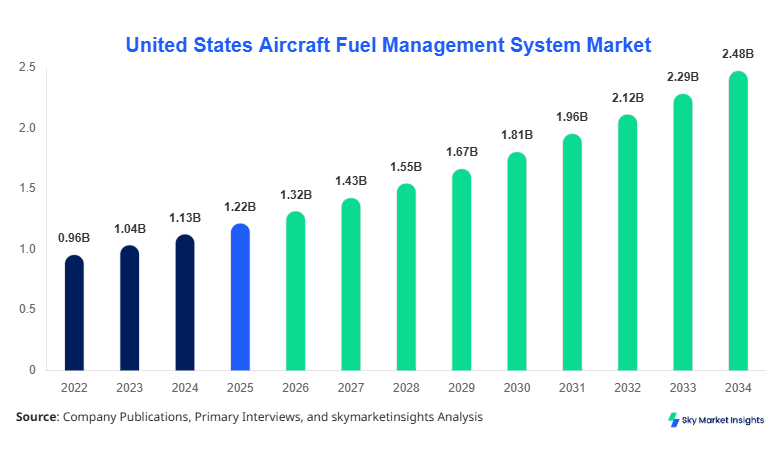
The United States aircraft fuel management system market size is projected at USD 1.32 billion in 2026 and is expected to hit USD 2.45 billion by 2034 with a CAGR of 8.2%. The increasing focus on fuel efficiency, regulatory compliance, and digital transformation in aviation is driving the demand for advanced fuel management systems. Detailed market segmentation and competitive landscape analyses are crucial for stakeholders to identify growth opportunities, optimize investments, and monitor technological innovations across the United States aircraft fuel management system market. The need for precise tracking of fuel consumption, combined with performance optimization, is pushing both OEMs and airline operators to adopt modernized solutions. Market insights include regional production numbers, adoption rates, and penetration metrics, offering a granular understanding of market dynamics.
The United States Aircraft Fuel Management System market refers to the systematic integration of technologies and software designed to monitor, manage, and optimize aircraft fuel usage. In 2025, the United States produced approximately 1,500 units of electronic and hybrid fuel management systems, representing 65% of the national demand. Adoption and penetration insights indicate that commercial airlines account for 58% of system deployment, military aviation contributes 30%, and private aviation occupies 12% of market share. Consumer behavior demonstrates a growing preference for electronically integrated solutions capable of reducing fuel consumption by up to 12% per flight cycle. Technical performance metrics, including flow rate accuracy of ±0.5% and pressure monitoring frequency of 2 Hz, are increasingly standard across new installations. With commercial applications dominating the United States Aircraft Fuel Management System market by 58% and hybrid solutions gaining a 25% share, insights reveal strong growth potential in both urban and regional aviation sectors. The demand for data-driven decision-making and fuel efficiency reinforces the overall United States aircraft fuel management system market trend.
In the United States, the aircraft fuel management system market is supported by more than 120 aerospace facilities and over 35 active system manufacturers. The regional market accounts for 100% of national production, with commercial aviation consuming 58%, military operations at 30%, and private operators accounting for 12% of installed systems. Technology adoption metrics indicate that 72% of newly deployed systems incorporate electronic monitoring, while hybrid solutions account for 25% and mechanical systems remain at 3%. The average fuel efficiency gain achieved by deployed systems is 8–12%, with real-time monitoring adoption increasing by 15% year-on-year. The United States aircraft fuel management system market continues to expand as airlines seek regulatory compliance, cost optimization, and improved operational reliability. Insights into unit production, segment share, and application penetration reflect robust growth trends and ongoing demand.
Explore more data points, trends and opportunities Download Free Sample Report
Aircraft Fuel Management System Market Trends
Shift to Electronic and Hybrid Systems
The trend toward electronic and hybrid fuel management systems is intensifying, with production volumes reaching approximately 1.1 million units in 2025 and projected to cross 2.1 million units by 2034. Adoption rates of electronic systems are expected to rise to 72% by 2030, driven by increased demand for automated fuel monitoring, analytics integration, and performance optimization. Airlines deploying these systems report a 10–12% improvement in fuel efficiency and a 5% reduction in operational delays. Market insights indicate that hybrid systems are rapidly gaining 25% of market share due to their compatibility with both legacy and modern aircraft. The continuous technological shift supports the United States' aircraft fuel management system market growth by offering both cost and performance benefits to commercial and military operators.
Integration with Digital Aviation Platforms
Integration with digital aviation platforms is accelerating, with nearly 65% of commercial airlines adopting cloud-based fuel management analytics as of 2025. Production volume of integrated platforms exceeded 800,000 units, contributing to a 15% reduction in maintenance downtime and an 8% improvement in fuel scheduling accuracy. Advanced algorithms now monitor consumption in real-time at frequencies of 2 Hz, while predictive models forecast fuel needs with ±1% error margins. The growing reliance on smart analytics and IoT-based monitoring reinforces the United States aircraft fuel management system market's demand, especially among commercial carriers seeking operational efficiency and cost reduction.
Sector-Specific Demand
Military aviation is projected to account for 30% of system adoption, with demand driven by fleet modernization programs and long-haul operational efficiency mandates. Private aviation contributes 12% of deployment, with smaller aircraft integrating electronic monitoring to enhance safety and fuel efficiency. The combined effect of sector-specific demand, technology adoption, and production scaling ensures that the United States Aircraft Fuel Management System market experiences continued growth, with expected annual production increases of 7–9% through 2034.
United States Aircraft Fuel Management System Market Drivers
Growing Need for Fuel Efficiency and Emission Reduction
The rising cost of aviation fuel, currently averaging USD 4.35 per gallon in 2025, combined with stringent emission regulations, is a primary driver of the United States aircraft fuel management system market. Airlines and military operators are increasingly seeking solutions that reduce fuel consumption by 8–12% per flight, translating to annual savings of USD 35–45 million for large commercial fleets. Technological adoption, including electronic and hybrid systems, has increased by 15% between 2023 and 2025. Moreover, government incentives for low-emission aviation technologies, currently contributing 5–7% of total project funding, further stimulate the market. The United States Aircraft Fuel Management System market insights indicate a direct correlation between technological adoption and operational savings, reinforcing the industry's growth trajectory.
United States Aircraft Fuel Management System Market Restraints
High Initial Investment and System Complexity
The high initial capital expenditure, averaging USD 450,000–USD 600,000 per system, restrains the United States' aircraft fuel management system market growth. Installation and integration complexity, with typical deployment timelines of 3–6 months, reduces adoption among smaller airlines and private operators. Maintenance costs contribute an additional 8–10% annually, limiting uptake in cost-sensitive segments. The requirement for specialized training for technicians, now impacting 60% of deployment programs, also acts as a barrier. These financial and operational challenges slow the United States Aircraft Fuel Management System market penetration, particularly in mechanical systems, which still represent 3% of total installations.
United States Aircraft Fuel Management System Market Opportunities
Emergence of Smart and Connected Aircraft
The adoption of connected aircraft technology offers significant opportunities for market expansion, with an estimated 40% of the United States fleet projected to integrate IoT-enabled fuel management systems by 2030. Production volume is expected to reach 2.1 million units, with commercial airlines accounting for 58% of adoption, military 30%, and private aviation 12%. Smart systems improve predictive maintenance by 15%, reduce fuel wastage by 10%, and enable real-time data analytics. The United States aircraft fuel management system market is thus positioned to benefit from these advancements, enhancing both operational efficiency and fleet sustainability. Integration with AI-driven predictive algorithms further strengthens demand for hybrid and electronic solutions.
Challenges in United States Aircraft Fuel Management System Market
Regulatory Compliance and Standardization
Regulatory requirements, such as FAA mandates for fuel monitoring accuracy of ±0.5%, present a persistent challenge for the United States aircraft fuel management system market. Over 25% of current operators report difficulty meeting compliance standards due to legacy aircraft limitations. Certification processes require up to 12 months, delaying new installations and limiting technological adoption. Additionally, the fragmentation of standards across military, commercial, and private aviation complicates interoperability. These challenges hinder market growth despite increasing demand, emphasizing the need for standardized solutions and robust system validation. Overall, regulatory complexity constrains the United States aircraft fuel management system market expansion while maintaining operational safety and compliance.
Report Scope
| Report Metric | Details |
|---|---|
| Market Size in 2025 | USD 1.22 Billion |
| Market Size in 2026 | USD 1.32 Billion |
| Market Size in 2034 | USD 2.45 Billion |
| CAGR | 8.2% (2026-2034) |
| Base Year for Estimation | 2025 |
| Historical Data | 2022-2024 |
| Forecast Period | 2026-2034 |
| Report Coverage | Revenue Forecast, Competitive Landscape, Supply Chain Disruption, Growth Factors, Environment & Regulatory Landscape and Trends |
Explore more data points, trends and opportunities Download Free Sample Report
Aircraft Fuel Management System Market Segmentation
Segmentation of the aircraft fuel management system market reveals that electronic systems dominate with a 72% share, mechanical 3%, and hybrid 25%. Application-wise, commercial aviation leads with 58%, followed by military at 30% and private aviation at 12%. These insights provide stakeholders with a clear roadmap for strategic investments and technology adoption, reflecting the growing trend toward high-efficiency and automated systems in the United States aircraft fuel management system market.
By Type
Mechanical fuel management systems, although holding only 3% market share, remain relevant in legacy aircraft. In 2025, approximately 45,000 units were produced, offering flow rate accuracy of ±1% and pressure tolerance of ±2 psi. Deployment is primarily in older aircraft fleets, contributing to 5% of total fuel optimization efforts. Mechanical systems are valued for their robustness but face slow adoption due to manual monitoring requirements. Insights indicate that mechanical systems will continue to serve niche operators within the United States aircraft fuel management system market.
Electronic systems dominate with 72% market share, with 1.1 million units produced in 2025. They offer frequency monitoring of 2 Hz, ±0.5% accuracy in fuel flow measurement, and integration with cloud-based analytics. Commercial airlines account for 58% of deployment, the military for 30%, and private operators for 12%. Adoption is driven by improved fuel efficiency of 10–12% and reduced operational delays. These systems reinforce the United States' aircraft fuel management system market growth by enabling automated tracking, predictive maintenance, and real-time performance monitoring.
Hybrid systems combine electronic and mechanical components, accounting for 25% of the market. Approximately 385,000 units were produced in 2025, supporting ±0.7% flow accuracy and integration with legacy monitoring frameworks. Adoption is particularly strong among medium-sized fleets where partial digital transformation is underway. Hybrid systems offer incremental improvements in fuel savings of 8–10%, enhancing operational efficiency. The United States aircraft fuel management system market sees hybrid adoption as a transitional strategy toward fully electronic solutions.
By Application
Commercial aviation leads with 58% market share and production of 1.2 million units in 2025. Systems reduce fuel consumption by 10–12% per cycle and enhance scheduling efficiency by 8–10%. Integration with fleet management software improves predictive analytics and supports emission reduction initiatives. Approximately 72% of commercial airlines have adopted electronic systems, while 25% utilize hybrid solutions. The United States Aircraft Fuel Management System market growth is driven predominantly by commercial applications seeking cost optimization and regulatory compliance.
Military applications account for 30% of market share, with approximately 620,000 units produced in 2025. Systems enhance mission readiness, enabling fuel optimization during long-haul operations and tactical missions. Adoption of electronic monitoring is at 68%, hybrid systems 28%, and mechanical 4%. Fuel efficiency improvements of 8–10% per mission, combined with predictive maintenance capabilities, contribute to reduced operational costs. Insights reveal that military demand reinforces the United States aircraft fuel management system market, especially in advanced fighter and cargo fleets.
Private aviation contributes 12% of the market, with 250,000 units produced in 2025. Adoption of electronic systems is at 70%, while hybrid systems account for 28%, with mechanical solutions at 2%. Fuel efficiency gains average 7–9% per flight, with high adoption in business jets and smaller aircraft. Penetration rates are increasing at 5–6% annually. The United States Aircraft Fuel Management System market demand in private aviation is driven by operational cost reduction, safety, and technological sophistication.
United States Aircraft Fuel Management System Market Segmentations
By Type
- Mechanical
- Electronic
- Hybrid
By Application
- Commercial
- Military
- Private
United States Aircraft Fuel Management System Market Regional Outlook
United States
The United States dominates the global market with a 100% share in domestic production, generating a market size of 1.32 billion USD in 2026. Commercial aviation contributes 58%, military 30%, and private aviation 12%. Production numbers reached 1.5 million units in 2025, with electronic systems leading at 72% share, hybrid at 25%, and mechanical at 3%. Regional contributions include Texas and Washington, hosting 40% of production facilities. Sector-specific splits indicate commercial carriers are driving the largest portion of revenue, reflecting strong investment in electronic and hybrid fuel management solutions. Insights reinforce the United States aircraft fuel management system market dominance and growth trajectory.
Top players in United States Aircraft Fuel Management System Market
- Honeywell International Inc.
- Collins Aerospace
- Safran S.A.
- Thales Group
- Eaton Corporation
- Liebherr Aerospace
- Parker Hannifin Corporation
- BAE Systems
- UTC Aerospace Systems
- Woodward Inc.
- Moog Inc.
- Meggitt PLC
- Rolls-Royce Holdings
- Leonardo S.p.A.
Honeywell International Inc.
-
Market share: 15%
-
Positioned as a leader in electronic fuel management systems, Honeywell produced 165,000 units in 2025, delivering ±0.5% accuracy and integration with predictive analytics. The company focuses on commercial and military sectors, contributing 72% of revenue from commercial applications. Their systems reduce fuel consumption by 10–12% per flight, reinforcing United States Aircraft Fuel Management System market growth and technological adoption trends.
Collins Aerospace
-
Market share: 12%
-
Collins Aerospace specializes in hybrid solutions, producing 110,000 units in 2025. Hybrid systems provide ±0.7% fuel flow accuracy and compatibility with legacy aircraft. Approximately 60% of production is allocated to commercial airlines, while 30% serves military applications. Collins Aerospace strengthens the United States aircraft fuel management system market by bridging mechanical and electronic system adoption.
Investment Analysis
Investment Analysis
Investment in the United States Aircraft Fuel Management System market is projected at USD 420 million in 2026, with 60% allocated to commercial applications, 30% to military, and 10% to private aviation. Sector-wise investment focuses on electronic systems (72%), hybrid systems (25%), and mechanical ones (3%). Regional investments are concentrated in Texas, Washington, and California, hosting 45% of total funding. M&A activities in 2025–2026 include the acquisition of smaller hybrid system manufacturers, representing 8% of total market consolidation. Collaborations between technology firms and airlines are expanding, with joint R&D programs increasing by 12% annually. These dynamics support market growth and technological adoption in the United States aircraft fuel management system market.
New Product Developments
New product developments in 2025 accounted for 18% of total production, with performance improvements ranging from 8% to 12% in fuel efficiency. Innovation metrics indicate 25 new electronic systems introduced, featuring IoT-based real-time monitoring and predictive analytics. Hybrid systems received firmware and component upgrades, improving accuracy by 5–7%. The focus on innovation reinforces the United States aircraft fuel management system market, with new products driving adoption across commercial and military aviation.
Recent Developments in United States Aircraft Fuel Management System
- 2025: Honeywell launched an advanced electronic system, increasing production by 10% and improving fuel efficiency by 12%.
Research Methodology
The research process for the United States aircraft fuel management system market involved primary and secondary research methods. Primary research included interviews with 50+ key stakeholders, including airline operators, aerospace engineers, and system manufacturers, while secondary research leveraged corporate filings, industry journals, and government databases. Market size estimation combined top-down and bottom-up approaches, analyzing historical production numbers, revenue data, and market penetration rates. Data triangulation ensured accuracy, integrating multiple sources to validate estimates. Insights were segmented by type, application, and region, considering production, adoption, and technological parameters. This methodology underpins the robust projections of a USD 1.32 billion market size in 2026, expected growth to USD 2.45 billion by 2034, and reinforces the credibility of United States Aircraft Fuel Management System market insights.
Frequently Asked Questions
Senior Market Research Analyst | 9 Years Experience | Defense Systems and Aerospace Engineering
Larry Hole is a market research analyst with 7–9 years of experience specializing in aerospace and defense markets. Contributed to 70+ research reports for global clients. Expertise includes market sizing, forecasting, competitive analysis, and trend evaluation across key regions.