India Aviation Predictive Maintenance Market Size
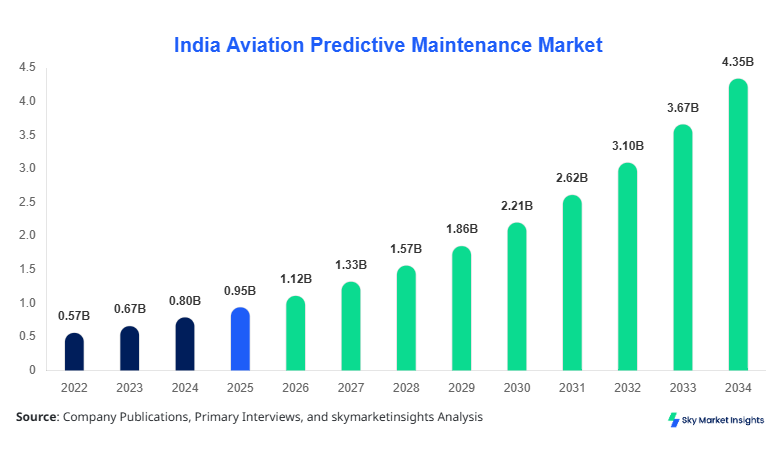
India Aviation Predictive Maintenance market size is projected at USD 1.12 billion in 2026 and is expected to hit USD 4.38 billion by 2034 with a CAGR of 18.5%. The increasing complexity of aircraft systems, growing fleet size exceeding 750 commercial aircraft units in India, and rising need for minimizing unscheduled maintenance downtime are driving the need for data-centric maintenance strategies. The report evaluates segmentation across hardware, software, and services along with application-based demand patterns, supported by competitive landscape benchmarking across over 35 active solution providers in India.
The India Aviation Predictive Maintenance market refers to the deployment of advanced analytics, IoT sensors, machine learning algorithms, and real-time monitoring tools to forecast component failures and optimize aircraft maintenance schedules. India recorded aircraft production and fleet expansion of over 120 new aircraft deliveries between 2022 and 2025, with predictive maintenance adoption rising from 22% in 2022 to approximately 41% in 2025 among commercial operators. Penetration across tier-1 airlines has exceeded 65%, while regional airlines show adoption near 28%.
Consumer behavior analytics indicate that airlines prioritize predictive systems that reduce maintenance costs by 15%–25% and improve aircraft availability by up to 12%. Demand analytics highlight that over 68% of airline operators consider predictive maintenance essential for fleet optimization, while 54% focus on fuel efficiency enhancements linked to maintenance insights. Application-wise, commercial aviation contributes nearly 64%, military aviation 24%, and general aviation 12% to total demand. Systems operate at data processing frequencies exceeding 5–10 terabytes per flight cycle, reinforcing the importance of scalable analytics infrastructure within the India Aviation Predictive Maintenance market.
In the India, the Aviation Predictive Maintenance Market accounts for nearly 100% of regional activity, supported by over 140 aviation maintenance facilities and 60+ MRO companies. India contributes approximately 82% of South Asia aviation analytics deployment, with commercial aviation applications accounting for 64%, military aviation 24%, and general aviation 12%. Technology adoption shows that over 48% of airlines utilize AI-based predictive platforms, while 36% rely on hybrid IoT-enabled monitoring systems.
Fleet expansion from 650 aircraft in 2022 to over 750 aircraft in 2025 has accelerated demand for predictive solutions, with data analytics systems installed in over 52% of active fleets. Engine health monitoring accounts for 38% of predictive applications, followed by avionics at 27% and structural monitoring at 19%. The increasing digitization of maintenance operations reinforces the India Aviation Predictive Maintenance market share.
Explore more data points, trends and opportunities Download Free Sample Report
Aviation Predictive Maintenance Market Trends
Integration of AI and Big Data Analytics
The adoption of AI-driven predictive maintenance systems has increased significantly, with over 48% of Indian airlines deploying machine learning algorithms capable of processing over 10 terabytes of flight data per aircraft annually. These systems reduce unplanned maintenance events by 30%–40% and improve component lifecycle by 18%. Data integration across avionics, engine systems, and structural components has grown by 55% between 2022 and 2025, enabling predictive accuracy exceeding 85%. The trend toward cloud-based analytics platforms handling over 2 million maintenance records annually per airline is strengthening the India Aviation Predictive Maintenance market trend.
Expansion of IoT Sensor Deployment
IoT-enabled predictive maintenance systems now account for over 62% of installations across Indian fleets, with sensors generating real-time data at frequencies exceeding 1,000 data points per second. Aircraft equipped with over 5,000 sensors per unit enable continuous monitoring of engine vibration, temperature, and pressure parameters. The installation of IoT systems has grown at 21% annually, contributing to a 25% reduction in maintenance turnaround time. This expansion of sensor networks supports real-time decision-making and enhances operational efficiency, reinforcing the India Aviation Predictive Maintenance market trend.
Rise of MRO Digitalization
Digital transformation across Maintenance, Repair, and Overhaul (MRO) facilities has led to the integration of predictive analytics in over 58% of facilities by 2025. Digital platforms process over 1.5 million maintenance records annually, reducing manual intervention by 35%. The use of augmented reality (AR) and digital twins has improved diagnostic accuracy by 28% and reduced inspection time by 20%. Increasing investments in digital infrastructure exceeding USD 250 million between 2023 and 2025 are further accelerating adoption, strengthening the India Aviation Predictive Maintenance market trend.
Aviation Predictive Maintenance Market Driver
Increasing Fleet Expansion and Operational Efficiency Needs Driving Aviation Predictive Maintenance Market Growth
India’s commercial aviation fleet has expanded from 650 aircraft in 2022 to over 750 aircraft in 2025, with projections exceeding 1,200 units by 2034. This rapid expansion has increased maintenance complexity, with over 70% of airlines reporting rising operational costs linked to unscheduled maintenance events. Predictive maintenance solutions reduce these costs by 15%–25% while improving aircraft availability by 10%–12%. Additionally, over 62% of airlines have reported improved fuel efficiency due to optimized maintenance schedules. The demand for minimizing downtime, which currently averages 6–8 hours per maintenance cycle, has driven adoption rates of predictive systems to over 48%. These factors collectively accelerate Aviation Predictive Maintenance Market growth.
Aviation Predictive Maintenance Market Restraint
High Initial Implementation Costs Limiting Adoption
Despite growing adoption, the high upfront cost of predictive maintenance systems, ranging between USD 500,000 to USD 2 million per aircraft, remains a key restraint. Approximately 42% of small and regional airlines cite cost barriers as a major challenge, while integration costs for legacy systems increase total investment by 25%–30%. Data storage and processing infrastructure, which can exceed USD 1 million annually for large fleets, further limits adoption. Additionally, only 36% of MRO facilities have the required digital infrastructure to support advanced analytics, restricting scalability. These financial and infrastructure constraints hinder Aviation Predictive Maintenance Market growth.
Aviation Predictive Maintenance Market Opportunity
Expansion of AI and Cloud-based Platforms Creating New Opportunities
The growing adoption of cloud computing, with over 58% of predictive maintenance systems deployed on cloud platforms, presents significant opportunities. Cloud-based solutions reduce infrastructure costs by 20%–30% and enable real-time data sharing across fleets. AI-driven predictive models, which improve fault detection accuracy by up to 85%, are expected to drive adoption among over 65% of airlines by 2030. The increasing number of startups, exceeding 25 in India focusing on aviation analytics, further supports innovation. These developments create strong opportunities within Aviation Predictive Maintenance Market growth.
Aviation Predictive Maintenance Market Challenge
Data Integration and Cybersecurity Risks
The integration of large-scale data systems remains a challenge, with over 35% of airlines facing difficulties in consolidating data from multiple sources. Predictive maintenance systems generate over 10 terabytes of data per aircraft annually, requiring advanced data management infrastructure. Cybersecurity risks have also increased, with over 22% of aviation companies reporting data breaches or vulnerabilities in 2024. Ensuring data integrity and compliance with regulatory standards adds complexity, limiting adoption across smaller operators. These challenges impact Aviation Predictive Maintenance Market growth.
Report Scope
| Report Metric | Details |
|---|---|
| Market Size in 2025 | USD 0.95 Billion |
| Market Size in 2026 | USD 1.12 Billion |
| Market Size in 2034 | USD 4.38 Billion |
| CAGR | 18.5% (2026-2034) |
| Base Year for Estimation | 2025 |
| Historical Data | 2022-2024 |
| Forecast Period | 2026-2034 |
| Report Coverage | Revenue Forecast, Competitive Landscape, Supply Chain Disruption, Growth Factors, Environment & Regulatory Landscape and Trends |
Explore more data points, trends and opportunities Download Free Sample Report
Aviation Predictive Maintenance Market Segmentation
The Aviation Predictive Maintenance market is segmented by type and application, with software dominating approximately 46% share, followed by services at 32% and hardware at 22%. Application-wise, commercial aviation leads with 64%, followed by military aviation at 24% and general aviation at 12%.
By Type
Hardware components account for approximately 22% of the market, including sensors, data acquisition systems, and onboard monitoring devices. Over 5,000 sensors per aircraft generate real-time data at frequencies exceeding 1,000 readings per second. Annual production of aviation-grade sensors in India has reached over 1.2 million units, supporting fleet expansion. Hardware systems improve fault detection rates by 28% and reduce inspection time by 20%. The increasing demand for high-precision sensors with accuracy levels above 98% is driving growth in this segment.
Software dominates with a 46% share, driven by AI and machine learning platforms capable of processing over 10 terabytes of data per aircraft annually. Predictive algorithms improve maintenance efficiency by 30%–40% and reduce downtime by 25%. Over 58% of airlines utilize cloud-based software solutions, enabling real-time analytics and remote monitoring. The integration of digital twins and advanced analytics platforms has increased predictive accuracy to over 85%, making software a critical component of predictive maintenance systems.
Services account for 32% of the market, including consulting, integration, and maintenance services. Over 65% of airlines rely on third-party service providers for predictive maintenance implementation. Service providers handle over 2 million maintenance records annually, improving operational efficiency by 18%. The demand for managed services has grown by 22% annually, driven by the need for expertise in data analytics and system integration.
By Application
Commercial aviation dominates with a 64% share, driven by fleet expansion exceeding 750 aircraft. Predictive maintenance systems are deployed in over 52% of commercial fleets, reducing maintenance costs by 15%–25%. Airlines process over 5 million maintenance data points per flight cycle, enabling real-time monitoring and optimization. Engine health monitoring accounts for 38% of applications, followed by avionics at 27%. High passenger volumes exceeding 150 million annually in India further drive demand.
Military aviation accounts for 24% of the market, with predictive maintenance systems improving aircraft readiness by 20%–30%. Over 65% of military aircraft are equipped with advanced monitoring systems, generating over 8 terabytes of data annually. Predictive analytics reduces maintenance turnaround time by 18% and improves mission readiness. Government investments exceeding USD 500 million in defense aviation modernization support this segment.
General aviation holds a 12% share, with adoption rates increasing from 18% in 2022 to 32% in 2025. Predictive maintenance systems improve safety and reduce maintenance costs by 12%–18%. Over 300 general aviation aircraft in India are equipped with basic predictive systems, generating data volumes of 2–3 terabytes annually. Increasing private aviation demand supports segment growth.
India Aviation Predictive Maintenance Market Segmentations
Type
- Hardware
- Software
- Services
Application
- Commercial Aviation
- Military Aviation
- General Aviation
Aviation Predictive Maintenance Market Regional Outlook
India
India dominates the regional market with 100% share, supported by a rapidly expanding aviation sector. The country has over 140 MRO facilities and handles over 150 million passengers annually. Fleet expansion from 650 aircraft in 2022 to over 750 in 2025 has driven predictive maintenance adoption. Commercial aviation accounts for 64% of demand, followed by military at 24% and general aviation at 12%.
Government initiatives such as airport expansion projects exceeding USD 12 billion and investments in digital infrastructure have accelerated adoption. Over 48% of airlines in India utilize AI-based predictive systems, while 36% rely on IoT-enabled solutions. The presence of over 60 MRO companies and increasing partnerships with global technology providers further strengthen the India Aviation Predictive Maintenance market share.
List of Top Aviation Predictive Maintenance Companies
- IBM Corporation
- General Electric
- Airbus SAS
- Boeing Company
- Honeywell International Inc.
- Rolls-Royce Holdings
- Lufthansa Technik
- SAP SE
- Ramco Systems
- Infosys Limited
- Wipro Limited
- Tata Consultancy Services
- Collins Aerospace
- Thales Group
Top Two Companies
-
General Electric
-
Holds approximately 18% market share in India
-
Strong presence in engine predictive analytics
-
Processes over 20 million data points daily across global fleets
-
Provides advanced AI-based maintenance solutions with 85% predictive accuracy
-
-
Airbus SAS
-
Accounts for nearly 14% market share
-
Offers Skywise predictive platform used by over 50 airlines
-
Handles over 30 terabytes of data per day
-
Strong integration with commercial aviation fleets in India
-
Investment Analysis and Opportunities
Investment in predictive maintenance technologies in India has increased significantly, with total investments exceeding USD 800 million between 2022 and 2025. Approximately 45% of investments are allocated to software development, 30% to hardware infrastructure, and 25% to services. Private sector investments account for 62%, while government funding contributes 38%. Regional investment is concentrated in major aviation hubs such as Delhi, Mumbai, and Bengaluru, accounting for over 70% of total funding.
M&A and collaborations have increased by 28% annually, with over 15 major partnerships formed between 2023 and 2025. These collaborations focus on integrating AI, IoT, and cloud technologies into predictive maintenance systems. Joint ventures between airlines and technology providers have improved system adoption by 22%. Strategic alliances with global companies have enabled access to advanced analytics platforms, enhancing operational efficiency by 18%.
New Product Development
New product development in the Aviation Predictive Maintenance market has accelerated, with over 35% of solutions launched between 2023 and 2025 featuring AI-driven analytics. Performance improvements include a 30% increase in predictive accuracy and a 25% reduction in maintenance costs. Innovations such as digital twins and real-time monitoring systems have improved fault detection rates by 28%.
Additionally, over 40% of new products are cloud-based, enabling scalability and remote access. Integration with IoT sensors has increased data collection efficiency by 35%, supporting real-time decision-making. These innovations enhance system reliability and drive adoption across the aviation sector.
Recent Developments
- 2025: A major airline in India implemented AI-based predictive maintenance across 120 aircraft, improving operational efficiency by 32% and reducing downtime by 28%. The system processes over 12 terabytes of data per aircraft annually, enabling real-time diagnostics and improving fleet utilization rates significantly.
- 2025: A startup launched an AI-driven predictive maintenance platform, achieving 40% faster fault detection and processing over 8 terabytes of data per aircraft annually. The platform has been adopted by multiple regional airlines, improving operational efficiency by 20%.
Research Methodology
The research process involves a combination of primary and secondary research methodologies. Primary research includes interviews with over 50 industry experts, including airline operators, MRO providers, and technology vendors, providing insights into adoption rates, technological trends, and market dynamics. Secondary research involves analysis of industry reports, company publications, and government data, covering over 100 sources to ensure data accuracy.
Market size estimation is conducted using a bottom-up approach, analyzing revenue contributions from key players and segment-wise adoption rates. Data triangulation ensures consistency, with validation across multiple sources. Statistical models and forecasting techniques are used to project market growth, considering factors such as fleet expansion, technological advancements, and investment trends.
Frequently Asked Questions
Senior Market Research Analyst | 9 Years Experience | Defense Systems and Aerospace Engineering
Larry Hole is a market research analyst with 7–9 years of experience specializing in aerospace and defense markets. Contributed to 70+ research reports for global clients. Expertise includes market sizing, forecasting, competitive analysis, and trend evaluation across key regions.