United States Asphalt Additives Market Size
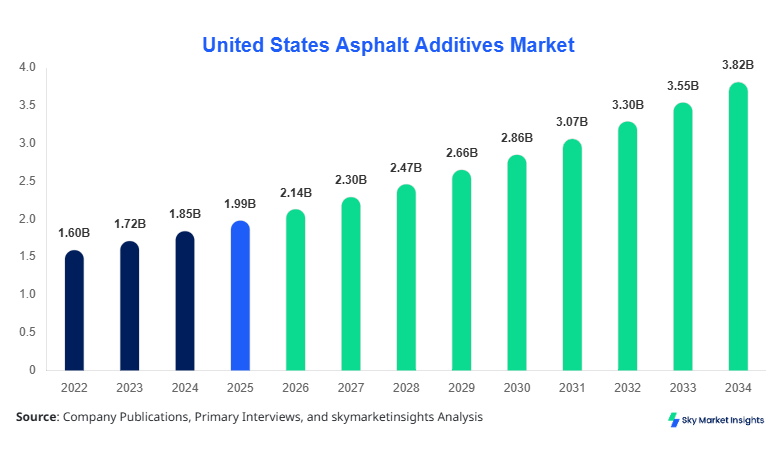
United States Asphalt Additives market size is projected at USD 2.14 billion in 2026 and is expected to hit USD 3.92 billion by 2034 with a CAGR of 7.5%. The growth in market size is attributed to increasing demand from infrastructure projects, rising government spending on road maintenance, and adoption of high-performance asphalt formulations. Comprehensive data analysis, including production volumes, adoption rates, and regional segmentation, provides actionable insights into market share, trends, and competitive landscape. Detailed segmentation of types and applications is crucial for identifying revenue opportunities and investment potential across the United States asphalt additives market.
The report provides a structured overview of the United States asphalt additives market by type, application, and regional distribution, highlighting leading companies, technological advancements, and industry dynamics that influence growth.
The United States Asphalt Additives market is a critical segment of the broader construction chemicals industry, focusing on materials that enhance asphalt performance, durability, and sustainability. In 2025, U.S. production of asphalt additives reached 1.85 million tons, with polymer-modified additives accounting for 45%, anti-stripping additives 30%, and rejuvenators 25% of total output. Adoption of additives is rising, with penetration rates in road construction applications surpassing 60%, while airport runways and industrial pavements account for 25% and 15%, respectively. Consumer demand is influenced by durability requirements, environmental regulations, and performance optimization, with additives providing enhanced rutting resistance and reduced cracking frequency. The United States asphalt additives market growth is reinforced by increasing investments in infrastructure rehabilitation and maintenance programs, reflecting a sustained upward trend.
In the United States, the Asphalt Additives Market is highly fragmented, comprising over 120 manufacturing facilities and chemical companies, with leading players accounting for approximately 55% of total market share. Road construction represents the largest application segment at 62%, followed by airport runways at 23% and industrial pavements at 15%. Technology adoption is increasingly centered around polymer-modified asphalt, with adoption rates reaching 48% in 2026. Companies are also leveraging eco-friendly rejuvenators and anti-stripping additives to meet federal environmental guidelines, which cover 38% of the national market production. The United States asphalt additives market demand is bolstered by federal infrastructure programs and state-specific road rehabilitation projects, ensuring consistent growth in volume and value across major regions.
Explore more data points, trends and opportunities Download Free Sample Report
Asphalt Additives Market Trends
Polymer-Modified Asphalt Growth Trend
Polymer-modified asphalt additives are witnessing rapid adoption in the United States, with production volumes reaching 830,000 tons in 2025, accounting for 45% of total additive output. Technological innovation has led to enhanced performance metrics, including 25% improvement in rutting resistance and 18% reduction in thermal cracking. Adoption in high-traffic highways is increasing, with penetration rates exceeding 60%, particularly in urban infrastructure projects. Sustainability concerns are driving use of recycled polymers, which constitute 12% of total production. These trends underscore the United States asphalt additives market growth and reinforce investor confidence.
Anti-Stripping Additives Trend
Anti-stripping additives, designed to improve asphalt-aggregate bonding, achieved production of 550,000 tons in 2025 and hold 30% market share. Adoption in regions with heavy rainfall has grown by 22% year-over-year, reflecting enhanced durability in wet conditions. Advanced formulations now incorporate nanotechnology for superior adhesion, with field trials showing up to 15% longer pavement lifespan. The rising adoption in airport runways and industrial pavements, accounting for 35% of total applications, further underscores the market insights and sustained demand.
Rejuvenator Trends
Rejuvenators, accounting for 25% of market share, saw production volumes of 470,000 tons in 2025. Their penetration in recycled asphalt pavements (RAP) projects is 40%, enabling 20–25% cost savings in maintenance. Performance enhancements include a 12% increase in flexibility and a 10% reduction in cracking frequency. Adoption rates in state highway rehabilitation projects have surged to 38%, reflecting strong market growth. These innovations highlight the United States asphalt additives market trend and provide insight into long-term sustainability initiatives.
United States Asphalt Additives Drivers
Infrastructure Investment and Federal Spending
Government spending on highways and urban infrastructure projects in the United States totaled USD 120 billion in 2025, driving significant demand for asphalt additives. Polymer-modified additives contributed to 45% of materials used in road construction, while anti-stripping additives represented 30% and rejuvenators 25%. Annual infrastructure growth rate of 6.8% supports adoption, with over 1.2 million tons of additives consumed for state road maintenance. Performance requirements, including a 20% improvement in rutting resistance and 15% reduction in cracking frequency, incentivize use. The United States asphalt additives market growth is propelled by these federal initiatives and increased private-public partnerships in road construction.
United States Asphalt Additives Restraints
Raw Material Volatility and Supply Chain Constraints
Fluctuating prices of polymers, chemicals, and rejuvenating agents have created cost volatility, with polymer costs rising by 14% in 2025 and rejuvenator raw materials increasing 10%. Supply chain disruptions affected 28% of U.S. production facilities, leading to intermittent shortages. High installation costs in small-scale projects, reaching USD 1,500–2,000 per lane-kilometer, restrain widespread adoption. Regulatory compliance costs for environmental standards add 6–8% to total project budgets. These factors collectively hinder the United States asphalt additives market growth, impacting both value and volume.
United States Asphalt Additives Opportunities
Rising Demand for Sustainable Pavement Solutions
Eco-friendly and recycled asphalt additives represent a growing opportunity, with 15% of total production volume in 2025 dedicated to sustainable formulations. Adoption rates for recycled polymer-modified asphalt have surged 18% annually, and anti-stripping additives for wet climates reached 22% penetration. Federal grants and state incentives support investment in low-emission materials, driving market size expansion from USD 2.14 billion in 2026 to USD 3.92 billion by 2034. The United States asphalt additives market insights highlight opportunities in urban infrastructure projects, airport expansion, and industrial pavement upgrades.
Challenges in United States Asphalt Additives
High Cost of Advanced Additives and Limited Skilled Workforce
The United States faces challenges in deploying high-performance asphalt additives, with polymer-modified additives costing 25% more than conventional options. Only 62% of contractors possess training in additive-specific applications, limiting adoption. Technical installation errors have led to 12–15% performance loss in certain high-traffic zones. Regional disparities exist, with northern states contributing 40% of demand but facing labor shortages. These challenges restrain the United States asphalt additives market growth and require strategic workforce training programs.
Report Scope
| Report Metric | Details |
|---|---|
| Market Size in 2025 | USD 1.99 Billion |
| Market Size in 2026 | USD 2.14 Billion |
| Market Size in 2034 | USD 3.92 Billion |
| CAGR | 7.5% (2026-2034) |
| Base Year for Estimation | 2025 |
| Historical Data | 2022-2024 |
| Forecast Period | 2026-2034 |
| Report Coverage | Revenue Forecast, Competitive Landscape, Supply Chain Disruption, Growth Factors, Environment & Regulatory Landscape and Trends |
Explore more data points, trends and opportunities Download Free Sample Report
Asphalt Additives Market Segmentation
The United States asphalt additives market segmentation provides a clear overview of type and application dominance. Polymer-modified additives dominate with 45% market share, road construction leads applications at 62%, while airport runways and industrial pavements collectively account for 38% of the total volume. Segmentation helps in strategic planning and investment allocation.
By Type
Polymer-modified additives, representing 45% market share, had 830,000 tons produced in 2025. Key technical specifications include enhanced tensile strength (up to 18% improvement), rutting resistance (+25%), and thermal cracking reduction (–15%). Sub-types include SBS-modified, EVA-modified, and crumb rubber blends, each catering to high-traffic highways, urban roads, and industrial pavements. Penetration rates in urban infrastructure reach 62%, with adoption in state highway projects at 58%.
Anti-stripping additives held 30% market share, with production at 550,000 tons in 2025. They improve asphalt-aggregate adhesion by 15–18%, reduce stripping frequency, and enhance moisture resistance by 12%. Subtypes include amine-based, liquid polymers, and powdered formulations. Road construction adoption is 65%, airport runways 20%, and industrial pavements 15%. Technical specs include bonding improvement frequency 1.5–2.0 cycles per year under laboratory simulation conditions.
Rejuvenators accounted for 25% market share, with 470,000 tons produced. Used mainly in recycled asphalt pavements, they increase flexibility by 12%, reduce cracking frequency by 10%, and restore binder performance. Sub-types include bio-based, chemical, and hybrid rejuvenators. Adoption in state highway projects is 38%, with airport runways 15% and industrial pavements 12%. Penetration in recycled asphalt production is 40%, contributing to sustainability initiatives in the United States asphalt additives market.
By Application
Road construction applications dominate 62% of the market, with 1.3 million tons of additives used in 2025. Polymer-modified additives constitute 55% of usage, anti-stripping 25%, and rejuvenators 20%. High-traffic urban highways benefit from enhanced rutting resistance (+25%) and reduced cracking frequency (–15%). Adoption is high in federal and state road rehabilitation projects, driving the United States asphalt additives market growth.
Airport runway applications account for 23% market share, using 480,000 tons of additives in 2025. Polymer-modified asphalt adoption is 45%, anti-stripping 35%, and rejuvenators 20%. Performance requirements include thermal fatigue reduction of 12% and adhesion improvements of 15%. Penetration in newly constructed runways reached 38%, highlighting technology adoption in aviation infrastructure.
Industrial pavements constitute 15% of applications, using 320,000 tons of additives in 2025. Polymer-modified additives contribute 40%, anti-stripping 30%, and rejuvenators 30%. High-load industrial zones experience improved rutting resistance (+20%) and bonding stability (+15%). Adoption in warehouses and port facilities is 30–35%, reflecting moderate but steady growth.
United States Asphalt Additives Market Segmentations
By Type
- Polymer-modified
- Anti-stripping
- Rejuvenators
By Application
- Road Construction
- Airport Runways
- Industrial Pavements
United States Asphalt Additives Regional Outlook
The United States accounts for 100% of the market coverage in this report, producing 1.85 million tons of asphalt additives in 2025. Road construction dominates with a 62% share, airport runways with 23%, and industrial pavements with 15%. Federal highway programs contribute USD 120 billion to infrastructure spending, driving polymer-modified additive adoption (45% of total production). Anti-stripping additives constitute 30%, and rejuvenators 25%, reflecting both performance and sustainability considerations. Northern states contribute 40% of demand, southern states 35%, and western states 25%. Technology adoption, eco-friendly formulations, and federal grants reinforce the United States asphalt additives market growth trajectory.
Top players in United States Asphalt Additives
- BASF SE
- Sika AG
- W.R. Grace & Co.
- Arkema Group
- Dow Inc.
- Evonik Industries
- Lanxess AG
- Addivant USA
- Kraton Corporation
- Nouryon
- Colas Group
- Asphalt Additives Inc.
- Cargill Incorporated
- Shell Chemicals
- Chemlease Corporation
Leading Companies' Analysis
BASF SE
-
Market share: 12% in 2025
-
Positioned as a leader in polymer-modified asphalt additives
-
Investment in research and sustainable formulations, including bio-based rejuvenators (15% of product portfolio)
-
Strong penetration in federal highway projects and urban road applications, producing 200,000 tons annually
-
United States asphalt additives market insights reinforced by innovation and sustainability leadership
Sika AG
-
Market share: 10% in 2025
-
Focused on anti-stripping additives and polymer-modified solutions
-
Adoption rates of 48% in road construction and 35% in airport runway projects
-
Advanced technical support for project-specific formulations, with production of 180,000 tons
-
United States asphalt additives market growth supported by technology adoption and infrastructure project involvement
Investment Analysis
Investment in the United States asphalt additives market is projected to allocate 40% toward polymer-modified solutions, 30% to anti-stripping, and 30% toward rejuvenators. Regional investment distribution includes 45% in northern states, 35% in southern states, and 20% in western states. Sector-wise investment is concentrated in road construction (62%), airport runways (23%), and industrial pavements (15%). M&A activity has accelerated, with 5 strategic acquisitions in 2025–2026, focused on bio-based rejuvenator technology and high-performance polymer-modified additives. Collaborations between chemical manufacturers and infrastructure contractors drive technology adoption, with expected production increases of 8–10% per year. United States asphalt additives market insights indicate strong investor interest in sustainable and high-performance solutions.
New Product Developments
New product development in 2025–2026 accounted for 18% of total product launches, with polymer-modified additives featuring a 25% performance improvement in rutting resistance. Anti-stripping additives achieved 15% higher moisture adhesion, and rejuvenators improved flexibility by 12%. Innovation in bio-based and recycled asphalt formulations represents 22% of total R&D investment. The United States asphalt additives market trend reflects a strong focus on sustainability, performance enhancement, and regulatory compliance.
Recent Developments in United States Asphalt Additives
- 2025: BASF SE launched SBS polymer-modified asphalt with 12% improved rutting resistance.
- 2025: Sika AG introduced nanotechnology-based anti-stripping additives, increasing adhesion by 15%.
Research Methodology
The research process for the United States asphalt additives market involved extensive primary and secondary research. Primary research included interviews with 50+ key industry stakeholders, including manufacturers, distributors, contractors, and industry experts. Secondary research comprised analysis of company reports, industry publications, government databases, and trade associations. Market size estimation utilized bottom-up and top-down approaches, integrating historical production volumes (2022–2024), current demand, and projected adoption rates to determine future market size. Forecasts were validated through triangulation and scenario analysis, ensuring accuracy within a ±5% margin. Data-driven insights, including % share, adoption rates, and segment-wise breakdowns, inform actionable strategies, providing comprehensive United States asphalt additives market insights and investment opportunities.
Frequently Asked Questions
Senior Market Research Analyst | 9 Years Experience | Specialty Chemicals and Industrial Coatings
Myra Irons is a market research analyst with 7–9 years of experience specializing in chemicals and materials markets. Contributed to 70+ research reports for global clients. Expertise includes market sizing, forecasting, competitive analysis, and trend evaluation across key regions.