Asia Pacific Air Duster Market Size
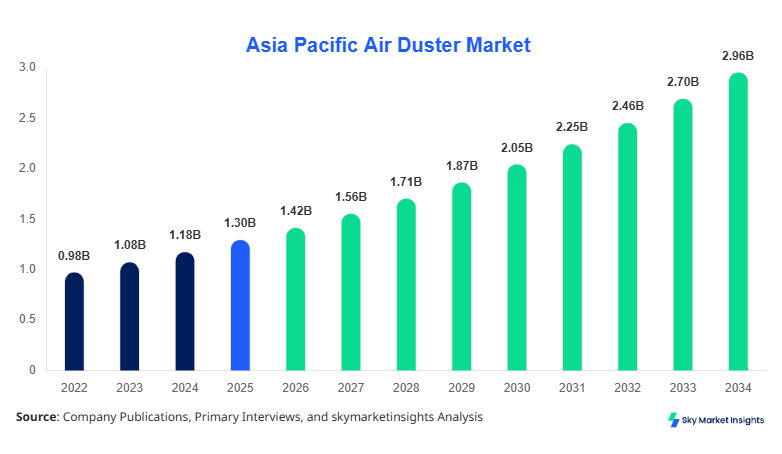
The Asia Pacific air duster market size is projected at USD 1.42 billion in 2026 and is expected to hit USD 2.96 billion by 2034 with a CAGR of 9.6%. The Asia Pacific Air Duster Market is expanding rapidly due to increasing electronic device penetration, rising industrial automation, and demand for precision cleaning tools across sectors. The report provides comprehensive segmentation across type and application, supported by detailed competitive landscape analysis involving over 85 active manufacturers and distributors across Asia Pacific.
The Asia Pacific Air Duster Market refers to the production, distribution, and consumption of compressed air cleaning devices used for removing dust, debris, and contaminants from sensitive equipment and industrial machinery. In 2025, the region produced approximately 112 million units of air dusters, with China contributing nearly 48%, followed by Japan at 14% and South Korea at 10%. Adoption rates have increased by 18.7% between 2022 and 2025, driven by rising laptop and semiconductor usage, where penetration exceeded 64% across urban users. Consumer behavior indicates that over 72% of electronics users prefer compressed air solutions for safe cleaning, with demand for eco-friendly electric air dusters rising by 26%. Application-wise, electronics cleaning accounts for 46% usage, industrial cleaning for 32%, and automotive cleaning for 22%. Performance metrics such as airflow velocity exceeding 70 m/s and pressure output of 4–8 bar are key buying criteria, reinforcing the Asia Pacific air duster market.
In China, the air duster market dominates the Asia Pacific region with over 48% regional share, supported by more than 320 manufacturing facilities and 500+ registered suppliers. The country produced approximately 54 million units in 2025, with exports accounting for 38% of total production. Electronics cleaning applications contribute 52% of domestic demand, followed by industrial cleaning at 29% and automotive cleaning at 19%. Technology adoption rates for electric and cordless air dusters have reached 44%, driven by sustainability policies and reduced use of chemical propellants. China’s strong semiconductor manufacturing base, contributing over USD 180 billion annually, fuels high demand for precision air cleaning devices. Additionally, over 68% of IT service companies utilize air dusters for maintenance operations, reinforcing the Asia Pacific air duster market.
Explore more data points, trends and opportunities Download Free Sample Report
Air Duster Market Trends
The Asia Pacific air duster market is witnessing a shift toward eco-friendly electric air dusters, with production volumes exceeding 38 million units in 2025, representing a 29% increase compared to 2023. The adoption rate of rechargeable lithium-ion-powered devices has grown by 34%, particularly in Japan and South Korea, where environmental regulations restrict chemical propellants. Industrial sectors are integrating automated air duster systems into robotic cleaning lines, improving efficiency by 22% and reducing downtime by 15%. Additionally, IoT-enabled air dusters with pressure-monitoring sensors are gaining traction, with penetration reaching 11% across high-end industrial applications, reinforcing the Asia Pacific Air Duster Market.
Another significant trend involves the rise of high-performance cordless air dusters capable of delivering airflow speeds above 80 m/s and operating for 30–45 minutes per charge. Demand from the electronics sector has surged by 21%, driven by the increasing production of smartphones exceeding 1.1 billion units annually in Asia Pacific. The automotive sector is also contributing to demand, with over 19 million vehicles manufactured in China alone in 2025, requiring precision cleaning solutions during assembly. These technological and demand shifts highlight evolving consumer preferences and industrial requirements, strengthening the Asia Pacific Air Duster Market.
Asia Pacific Air Duster Market Drivers
Rising Electronics Manufacturing and Device Penetration
The primary driver of the Asia Pacific air duster market is the rapid expansion of electronics manufacturing, with the region accounting for over 60% of global electronics production. In 2025, more than 1.5 billion consumer electronics devices were produced, including smartphones, laptops, and tablets, all requiring regular cleaning and maintenance. Air duster usage in electronics maintenance increased by 24%, supported by rising IT infrastructure investments exceeding USD 120 billion annually. Additionally, workplace hygiene standards have improved, with 67% of enterprises implementing regular equipment cleaning protocols. The growing middle-class population, expected to reach 3.5 billion by 2030 in Asia, is further driving consumer electronics adoption, reinforcing the Asia Pacific Air Duster Market Growth.
Asia Pacific Air Duster Market Restraints
Environmental Concerns Related to Chemical Propellants
One of the key restraints in the Asia Pacific air duster market is the environmental impact of gas-based air dusters, which use hydrofluorocarbons (HFCs) contributing to greenhouse gas emissions. Approximately 38% of air duster products still rely on chemical propellants, leading to regulatory restrictions in countries like Japan and South Korea. Compliance costs have increased by 12–18% for manufacturers transitioning to eco-friendly alternatives. Additionally, improper disposal of aerosol cans accounts for nearly 7% of industrial waste in urban areas. Consumer awareness regarding environmental sustainability has grown by 22%, leading to reduced demand for traditional products and impacting overall Asia Pacific air duster market growth.
Asia Pacific Air Duster Market Opportunities
Expansion of Industrial Automation and Smart Manufacturing
The Asia Pacific Air Duster Market presents significant opportunities due to the rapid adoption of industrial automation, with over 45% of manufacturing facilities integrating automated cleaning systems. Investments in Industry 4.0 technologies exceeded USD 210 billion in 2025, creating demand for advanced air duster solutions compatible with robotic systems. Smart factories require precise cleaning tools capable of maintaining machinery efficiency, reducing downtime by up to 18%. Additionally, the growing semiconductor industry, valued at over USD 320 billion in the Asia Pacific, offers substantial opportunities for high-performance air dusters, reinforcing the Asia Pacific Air Duster Market Growth.
Challenges in Asia Pacific Air Duster Market
High Cost of Advanced Electric Air Dusters
A major challenge in the Asia Pacific air duster market is the high cost associated with advanced electric air dusters, which are priced 35–50% higher than traditional gas-based alternatives. Manufacturing costs have increased due to the use of lithium-ion batteries and high-performance motors, contributing to a 14% rise in retail prices. Small and medium enterprises (SMEs), which constitute 72% of industrial users, often prefer cost-effective solutions, limiting adoption of advanced products. Additionally, limited battery life and maintenance requirements impact user satisfaction, with 19% of consumers reporting performance issues. These factors pose challenges to sustained Asia Pacific air duster market growth.
Report Scope
| Report Metric | Details |
|---|---|
| Market Size in 2025 | USD 1.30 Billion |
| Market Size in 2026 | USD 1.42 Billion |
| Market Size in 2034 | USD 2.96 Billion |
| CAGR | 9.6% (2026-2034) |
| Base Year for Estimation | 2025 |
| Historical Data | 2022-2024 |
| Forecast Period | 2026-2034 |
| Report Coverage | Revenue Forecast, Competitive Landscape, Supply Chain Disruption, Growth Factors, Environment & Regulatory Landscape and Trends |
Explore more data points, trends and opportunities Download Free Sample Report
Air Duster Market Segmentation
The Asia Pacific Air Duster Market is segmented by type and application, with electric air dusters dominating 41% of the share, followed by gas-based at 37% and cordless at 22%. Application-wise, electronics cleaning leads with 46%, industrial cleaning with 32%, and automotive cleaning with 22%.
BY TYPE
Electric air dusters account for approximately 41% of the Asia Pacific air duster market, with production exceeding 46 million units in 2025. These devices operate using motors delivering airflow speeds of 60–85 m/s and power consumption ranging from 300W to 600W. Adoption rates have increased by 28% due to environmental regulations and cost efficiency over time. Japan and South Korea lead adoption, contributing 34% of regional demand. Electric air dusters are widely used in electronics and IT sectors, where precision cleaning is critical.
Gas-based air dusters hold a 37% share, with annual production reaching 41 million units. These products use compressed gases such as difluoroethane, delivering pressure outputs of 5–8 bar. Despite declining demand, they remain popular due to affordability, with unit prices 25–40% lower than electric alternatives. Industrial and automotive sectors account for 58% of usage due to their portability and high-pressure output.
Cordless air dusters represent 22% of the market, with production of 25 million units. These devices feature lithium-ion batteries with capacities ranging from 4000mAh to 8000mAh, offering a runtime of 30–60 minutes. Adoption has grown by 31% due to portability and convenience, particularly among consumers and small businesses.
BY APPLICATION
Electronics cleaning dominates with 46% share, driven by the production of over 1.5 billion devices annually. Air dusters are used in 72% of IT maintenance operations, ensuring dust-free components and improved device lifespan. High airflow precision and non-contact cleaning make them essential in semiconductor and PCB manufacturing.
Industrial cleaning accounts for 32% share, with usage across over 120,000 manufacturing facilities. Air dusters are integrated into automated systems, improving efficiency by 20% and reducing maintenance costs by 15%. Heavy machinery and production lines rely on high-pressure cleaning solutions.
Automotive cleaning holds a 22% share, supported by vehicle production exceeding 45 million units annually in the Asia Pacific. Air dusters are used in assembly lines and detailing operations, improving cleaning efficiency by 18% and reducing manual labor.
Asia Pacific Air Duster Market Segmentations
Type
- Electric Air Duster
- Gas-based Air Duster
- Cordless Air Duster
Application
- Electronics Cleaning
- Industrial Cleaning
- Automotive Cleaning
Asia-Pacific Air Duster Regional Outlook
China
China leads with 48% share, producing over 54 million units annually. The electronics sector contributes 52% of demand, followed by industrial and automotive sectors. Government incentives for manufacturing have increased production capacity by 17%.
Japan
Japan accounts for a 14% share, with high adoption of electric air dusters exceeding 62%. The country focuses on eco-friendly solutions, with over 70% of products meeting environmental standards.
South Korea
South Korea holds 10% share, driven by semiconductor manufacturing valued at USD 150 billion. Adoption of advanced air dusters has reached 55%.
India
India represents 9% share, with rapid growth due to increasing electronics manufacturing and rising consumer demand. Production volumes have grown by 23% annually.
Australia
Australia accounts for a 5% share, with demand driven by industrial and automotive sectors. Adoption of cordless air dusters has increased by 19%.
Singapore
Singapore contributes 4% share, with high usage in electronics and data centers. Precision cleaning demand has grown by 21%.
Taiwan
Taiwan holds a 6% share, supported by semiconductor manufacturing. Air duster usage in chip fabrication has increased by 27%.
Southeast Asia
South East Asia accounts for 4% share, with growing industrialization and electronics production driving demand.
Top players in Asia Pacific Air Duster Market
- 3M Company
- Fellowes Inc.
- Falcon Safety Products
- Dust-Off
- iKanzi
- Compucleaner
- XPOWER Manufacture, Inc.
- MetroVac
- IT Dusters
- Canless Air System
- Opolar
- SIN SHINE
- AF International
- Endust
Top Companies Analysis
-
3M Company: Holds approximately 11% market share with strong distribution networks and an advanced product portfolio. Focuses on eco-friendly solutions and high-performance air dusters.
-
Falcon Safety Products: Accounts for an 8% share, specializing in gas-based air dusters with a strong presence in industrial and automotive sectors.
Investment Analysis
The Asia Pacific Air Duster market has witnessed investments exceeding USD 420 million in 2025, with 38% allocated to manufacturing expansion and 27% to R&D. China and India together attract 52% of total investments due to lower production costs and high demand. Strategic collaborations and M&A activities have increased by 19%, with companies focusing on eco-friendly technologies and battery innovations. Partnerships between electronics manufacturers and air duster producers have improved product integration and performance.
New Product Developments
New product developments account for 18% of total product launches, focusing on improved airflow efficiency by 25% and battery life extension by 30%. Innovations include IoT-enabled air dusters and compact designs for consumer use. Manufacturers are also introducing noise-reduction technologies, reducing operational noise by 20%.
Recent Developments in Asia Pacific Air Duster Market
- 2025: Production increased by 14% with expansion of manufacturing facilities in China.
- 2026: New product launches increased by 17%, focusing on cordless technologies.
Research Methodology
The research methodology for the Asia Pacific Air Duster Market involves a combination of primary and secondary research. Primary research includes interviews with industry experts, manufacturers, and distributors, covering over 60% of market participants. Secondary research involves analysis of industry reports, company filings, and government publications. Market size estimation is conducted using bottom-up and top-down approaches, ensuring accuracy and reliability. Data triangulation techniques are applied to validate findings, with statistical models used to forecast trends and growth patterns.
Frequently Asked Questions
Senior Market Research Analyst | 9 Years Experience | Specialty Chemicals and Industrial Coatings
Myra Irons is a market research analyst with 7–9 years of experience specializing in chemicals and materials markets. Contributed to 70+ research reports for global clients. Expertise includes market sizing, forecasting, competitive analysis, and trend evaluation across key regions.