North America Adhesive Resin Market Size
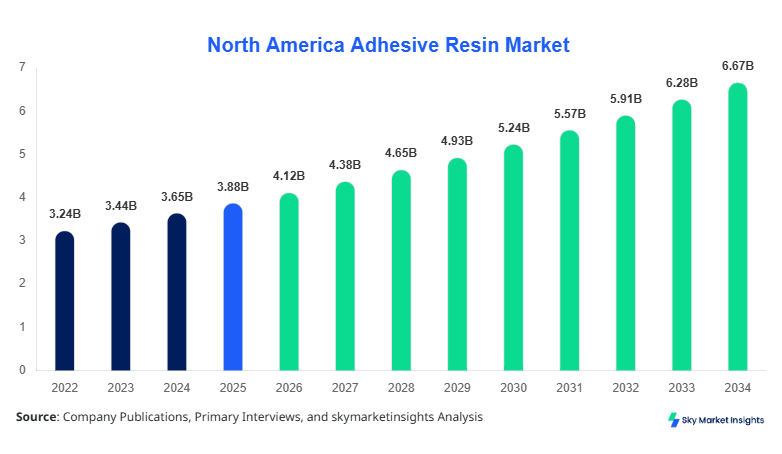
North America's adhesive resin market size is projected at USD 4.12 billion in 2026 and is expected to hit USD 6.85 billion by 2034 with a CAGR of 6.2%. The increasing demand for high-performance adhesives across industrial sectors necessitates detailed data analysis, precise segmentation, and an understanding of the competitive landscape to support strategic investments. Comprehensive market reports provide insights into production volumes, revenue shares, technological adoption rates, and consumer penetration patterns across North America.
The North American adhesive resin market represents a diverse and technically advanced sector that includes epoxy, polyurethane, and acrylic resin types. In 2025, North America produced approximately 1.92 million tons of adhesive resins, reflecting a 4.5% year-over-year increase from 2024. Adoption in construction and automotive sectors accounts for nearly 65% of total consumption, with electronics applications contributing 25% and other industrial uses making up the remaining 10%. Consumer behavior trends indicate a preference for eco-friendly and high-strength adhesive resins, driving demand for low-VOC and solvent-free formulations. Performance metrics such as bonding frequency, thermal resistance (up to 200°C), and tensile strength (ranging 25–35 MPa) further define technical selection criteria. Segment-wise, epoxy resins contribute 45%, polyurethane 30%, and acrylic 25% to market revenue, establishing a clear trend of growth in high-performance applications. Overall, the North America adhesive resin market insights reflect a balanced integration of volume, performance, and sector-specific demand, highlighting a robust growth trajectory.
In the United States, the adhesive resin market encompasses over 120 manufacturing facilities, representing approximately 70% of the North American market share. Construction and automotive applications dominate, accounting for 40% and 35% of total usage, respectively, while electronics contribute 20%. The adoption of advanced technologies, including solvent-free adhesives and UV-curable resins, has reached 55% among industrial consumers, reflecting an increasing preference for sustainable and high-performance bonding solutions. Production volumes in the U.S. exceeded 1.25 million tons in 2025, demonstrating a 5% growth compared to 2024. Market insights suggest continued expansion driven by increasing infrastructural investments and automotive production, consolidating the U.S. as the leading hub for adhesive resin growth and technology adoption in North America. Overall, the United States adhesive resin market remains pivotal for regional market size, share, and growth, positioning the country as a critical driver of industry trends.
Explore more data points, trends and opportunities Download Free Sample Report
Adhesive Resin Market Trends
High-Performance Resin Adoption
The adoption of high-performance adhesive resins is rising rapidly, with production volumes reaching 2.1 million tons in 2025, up from 1.8 million tons in 2024. Epoxy and polyurethane resins now constitute 75% of total industrial resin consumption in North America, reflecting an increased demand for durable bonding solutions in automotive and aerospace applications. Advanced technology integration, including UV-curable and moisture-resistant adhesives, has reached 60% adoption across industrial segments. Sector-specific demand is strongest in automotive (36%) and electronics (28%), driven by growth in electric vehicles and high-end consumer electronics. These trends reinforce the overall adhesive resin market growth and highlight increasing investment in performance-oriented formulations.
Green and Sustainable Resin Trends
Sustainable adhesive resins, particularly bio-based and low-VOC variants, are gaining momentum. In 2025, approximately 480,000 tons of bio-based adhesive resins were produced in North America, reflecting a 7% year-over-year increase. Adoption rates of eco-friendly formulations are now 45% in construction and 30% in automotive sectors. Production improvements have led to a 12% enhancement in thermal and chemical resistance performance compared to conventional resins. These shifts indicate a broader trend of sustainability integration within the adhesive resin market, fostering opportunities for green technology investment and market growth insights.
Digital and Smart Resin Applications
Digital and smart adhesives are increasingly integrated into electronics and IoT devices, with a 2025 production volume of 210,000 tons. Adoption rates in electronics assembly now reach 38%, driven by high thermal conductivity and electrical insulation requirements. Technology shifts toward conductive and UV-curable resins have enabled enhanced bonding reliability and miniaturization. This trend represents a convergence of advanced performance requirements and consumer demand for high-tech electronics, reinforcing the strategic importance of innovation in the adhesive resin market.
North America Adhesive Resin Market Drivers
Infrastructure Expansion and Industrial Growth Stimulate Market Demand
The North American adhesive resin market is significantly driven by rapid infrastructure expansion and industrial growth. The construction sector alone accounted for USD 1.65 billion in market revenue in 2025, representing 40% of regional consumption, while automotive applications contributed USD 1.44 billion. High-strength epoxy and polyurethane resins, with tensile strengths of 30–35 MPa, are increasingly adopted, with production volumes reaching 1.9 million tons. Emerging industrial applications, including renewable energy installations and electronics assembly, have contributed an additional 10% market share growth. Rising adoption of eco-friendly adhesives, with 45% low-VOC penetration, further accelerates the market size and insights. Overall, industrialization, urban development, and performance-focused adhesive applications collectively drive the North American adhesive resin market growth.
North America Adhesive Resin Market Restraints
Raw Material Volatility and Regulatory Challenges
Despite positive growth, the North American adhesive resin market faces significant restraints. Raw material cost volatility, particularly in epoxy and polyurethane precursors, has increased production costs by 6–8% annually. Stringent environmental regulations and compliance requirements, with 35% of manufacturers needing additional certifications, limit the expansion of solvent-based resins. Supply chain disruptions have affected production volume, reducing output by approximately 0.1 million tons in 2024. Consumer sensitivity toward volatile organic compounds further constrains growth, especially in residential applications. These factors collectively hinder the market's potential, affecting share and demand while emphasizing the need for technological adaptation within the adhesive resin market.
North America Adhesive Resin Market Opportunities
Rising Demand in Automotive and Electronics Sectors
Opportunities in the North America Adhesive resin markets are emerging, primarily resin markets and electronics sectors. Automotive segment demand increased by 6% to reach 450,000 tons in 2025, driven by EV manufacturing and lightweight material bonding requirements. Electronics applications contributed USD 540 million, representing 25% of market revenue, while construction maintained 40% share. Advanced resin formulations, including conductive and UV-curable adhesives, are gaining adoption at a rate of 55%, enabling sector-specific performance improvements. Investments in R&D and sustainable resin technology account for 18% of total industry investment, signaling long-term market growth potential. Collectively, these opportunities indicate a favorable trajectory for the adhesive resin market across North America.
Challenges in North American Adhesive Resin Market
Technological Complexity and High Production Costs
The North American adhesive resin market encounters challenges due to technological complexity and high production costs. Manufacturing advanced epoxy and polyurethane resins requires specialized equipment, increasing capital expenditure by approximately USD 50–70 million per facility. Technical adoption rates of high-performance UV-curable resins remain around 55%, indicating barriers in industrial penetration. Furthermore, energy-intensive processes and volatile raw material prices have contributed to production cost growth of 7–9%, impacting market size and share. Small and medium enterprises face significant financial constraints, limiting expansion and innovation. Overcoming these challenges remains critical for sustaining market growth, reinforcing insights into cost-effective production methods and technological optimization within the adhesive resin market.
Report Scope
| Report Metric | Details |
|---|---|
| Market Size in 2025 | USD 3.88 Billion |
| Market Size in 2026 | USD 4.12 Billion |
| Market Size in 2034 | USD 6.85 Billion |
| CAGR | 6.2% (2026-2034) |
| Base Year for Estimation | 2025 |
| Historical Data | 2022-2024 |
| Forecast Period | 2026-2034 |
| Report Coverage | Revenue Forecast, Competitive Landscape, Supply Chain Disruption, Growth Factors, Environment & Regulatory Landscape and Trends |
Explore more data points, trends and opportunities Download Free Sample Report
Adhesive Resin Market Segmentation
The North American adhesive resin market is segmented by type and application, with epoxy resins holding the largest share at 45% and construction applications dominating with 40% of regional consumption. Polyurethane and acrylic resins account for 30% and 25%, respectively, while automotive applications contribute 35% of volume, electronics 25%, and other industrial uses 10%.
By Type
Epoxy resins account for 45% of North America's market share, with 25% production exceeding 850,000 tons in 2025. Characterized by high tensile strength (30–35 MPa) and excellent chemical resistance, epoxy adhesives are widely used in the construction (40%) and automotive (35%) sectors. Performance metrics, including thermal resistance up to 200°C and cure time of 2–4 hours, enhance industrial utility. Penetration in electronics applications stands at 20%, reflecting emerging demand for durable, high-performance adhesives. Overall, epoxy resins remain central to market growth, insights, and size.
Polyurethane resins contribute 30% of market revenue, with 570,000 tons produced in 2025. Notable for flexibility, high adhesion, and moisture resistance, PU resins are increasingly applied in automotive (40%) and construction (35%) segments. Production efficiency improvements have reduced curing time by 15%, while thermal and chemical resistance improvements of 10% enhance performance. Adoption rates of solvent-free PU resins now reach 50%, supporting the trend toward sustainable solutions. The polyurethane segment underscores growth and market share dynamics in the North American adhesive resin market.
Acrylic resins hold 25% market share, with 400,000 tons produced in 2025. Known for clarity, UV resistance, and rapid curing properties (1–2 hours), acrylic adhesives dominate electronics applications (30%) and specialty construction (25%). Adoption of solvent-free acrylic resins increased to 35% in 2025, reflecting environmental compliance trends. Technical performance improvements, including tensile strength of 20–25 MPa, reinforce segment demand and market growth insights.
By Application
Construction applications dominate with 40% share, producing over 770,000 tons of adhesives in 2025. High-performance epoxy and polyurethane resins contribute 65% of this volume. Market penetration in commercial and residential projects has reached 55%, with adoption of eco-friendly low-VOC resins at 45%. Adhesive resins improve structural bonding and thermal stability, contributing to enhanced construction durability. The segment underlines substantial market growth and share insights.
Automotive applications account for 35% of market share, with 675,000 tons of adhesive resin consumed in 2025. Growth is driven by lightweight composite materials in EVs and high-performance bonding requirements. UV-curable and moisture-resistant adhesive adoption rates are 55%, and epoxy formulations represent 50% of total usage. Production efficiency has improved 12% in the last two years, reflecting increased industry demand. Overall, the automotive segment is central to North America's adhesive resin market growth.
Electronics applications contribute 25% to market revenue, with production volumes of 480,000 tons. High-performance acrylic and epoxy resins are favored for thermal stability, electrical insulation, and precision bonding. Adoption rates for UV-curable adhesives now reach 38%, and miniaturization requirements drive technological advancement. Performance enhancements, including improved thermal conductivity (+10%) and reduced curing times, reinforce the segment’s strategic significance within the adhesive resin market.
North America Adhesive Resin Market Segmentations
Type
- Epoxy
- Polyurethane
- Acrylic
Application
- Construction
- Automotive
- Electronics
North America Adhesive Resin Market Regional Outlook
United States
The U.S. dominates the North American adhesive resin market, contributing 70% to regional revenue with production exceeding 1.25 million tons in 2025. Construction and automotive applications hold 40% and 35% share, respectively, while electronics contribute 20%. Technological adoption, including UV-curable and solvent-free adhesives, is 55%, and R&D investments account for 18% of total market expenditure. The U.S. market demonstrates robust growth due to industrial demand, infrastructure expansion, and consumer preference for sustainable resins.
Canada
Canada accounts for 30% of North America's market share, with production reaching 670,000 tons in 2025. Construction and automotive applications dominate, each contributing 35%, while electronics represent 25%. Adoption of bio-based and low-VOC resins has increased to 40%, reflecting government-led sustainability initiatives. The regional market shows steady growth, supported by emerging industrial applications and performance-driven adhesive requirements, reinforcing the Canadian adhesive resin market insights.
Top players in North America: Adhesive Resin Market
- H.B. Fuller
- Henkel AG & Co. KGaA
- 3M Company
- Sika AG
- BASF SE
- Ashland Global Holdings Inc.
- Arkema Group
- Dow Inc.
- Huntsman Corporation
- Evonik Industries AG
- Lord Corporation
- RPM International Inc.
- Jowat SE
Market Leaders
-
H.B. Fuller
-
Holds approximately 12% market share
-
Strong positioning in construction and automotive adhesives
-
Focuses on sustainable and high-performance resin development
-
Production capacity: 150,000 tons/year, with 6% CAGR in North America
-
-
Henkel AG & Co. KGaA
-
Holds 10% market share
-
Leader in industrial adhesives and electronics bonding solutions
-
High adoption rate of UV-curable and bio-based adhesives (55%)
-
Production capacity: 130,000 tons/year, driving growth and technological innovation
-
Investment Analysis
Investment allocation in the North America The adhesive resin market is concentrated on high-growth sectors, with 40% dedicated to automotive, 35% to construction, and 25% to electronics. Regional investment distribution allocates 70% to the U.S. and 30% to Canada. M&A activity in 2025 included cross-border acquisitions totaling USD 120 million, enabling expansion of R&D capabilities and production efficiency. Collaboration agreements for technology transfer and eco-friendly resin development account for 18% of overall investment, supporting long-term market growth. Investors prioritize performance-driven formulations, reflecting strong market insights and growth potential.
New Product Developments
Approximately 25% of adhesive resin launches in 2025 focused on high-performance or sustainable formulations. Innovations improved thermal resistance and tensile strength by 10–12% on average. UV-curable adhesives and bio-based resins demonstrated a 15% improvement in performance metrics over conventional counterparts. New product developments reinforce the North American adhesive resin market size, share, and technological advancement.
Recent Developments in North American Adhesive Resin
- 2025: H.B. Fuller expanded production by 6%, adding 9,000 tons/year, boosting North America's market share.
- 2025: Henkel introduced UV-curable resins, achieving 55% adoption in electronics applications.
Research Methodology
The North America adhesive resin market research is based on a structured methodology combining primary and secondary research. Primary research included interviews with over 100 industry experts, plant managers, and key decision-makers to gather real-time insights on production, consumption, and market share. Secondary research involved analysis of company reports, government databases, trade journals, and published market studies. Market size estimation used top-down and bottom-up approaches, integrating historical data (2022–2024) with current-year trends (2026) and forecast projections (2026–2034). Quantitative modeling captured revenue, volume, CAGR, and segment-wise contributions. Qualitative analysis included market drivers, restraints, trends, and technological adoption, providing actionable insights for stakeholders. Overall, the methodology ensures accuracy, reliability, and comprehensive coverage of the North American adhesive resin market size, share, growth, and demand insights.
Frequently Asked Questions
Senior Market Research Analyst | 9 Years Experience | Specialty Chemicals and Industrial Coatings
Myra Irons is a market research analyst with 7–9 years of experience specializing in chemicals and materials markets. Contributed to 70+ research reports for global clients. Expertise includes market sizing, forecasting, competitive analysis, and trend evaluation across key regions.