Europe Alcohol Ethoxylates Market Size
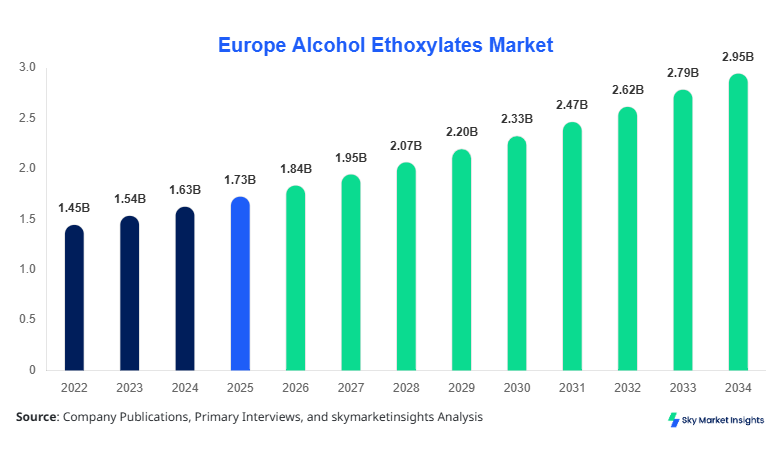
Europe's alcohol ethoxylates market size is projected at USD 1.84 billion in 2026 and is expected to hit USD 2.96 billion by 2034 with a CAGR of 6.1%.
The increasing demand for biodegradable surfactants across industrial cleaning, detergents, textile processing, and personal care sectors is supporting steady expansion across the European alcohol ethoxylates market. Growing investments in sustainable chemical manufacturing, stringent European Union environmental regulations, and rising adoption of low-foam nonionic surfactants are accelerating production capacity additions across Germany, France, Italy, and the United Kingdom. The report evaluates detailed segmentation, production analysis, consumption trends, supply-chain integration, pricing fluctuations, and competitive positioning across the European alcohol ethoxylates market.
Alcohol ethoxylates are nonionic surfactants produced through the ethoxylation of fatty alcohols using ethylene oxide. These chemicals are widely used due to their superior emulsification, detergency, wetting, and dispersing capabilities. In Europe, production volumes exceeded 1.42 million metric tons in 2025, with Germany accounting for nearly 28% of regional manufacturing output. Household detergents represented approximately 41% of total consumption, while industrial cleaning applications contributed 31%, and personal care products accounted for 18% of demand. More than 67% of manufacturers shifted toward biodegradable alcohol ethoxylates with reduced volatile organic compound emissions between 2022 and 2025. Penetration of bio-based alcohol ethoxylates increased from 14% in 2022 to nearly 24% in 2025 due to stricter sustainability regulations. Consumer demand for eco-labeled cleaning products increased by 21% across Europe in 2025, while industrial sanitation demand rose by 17% due to food processing and healthcare expansion. Performance efficiency levels of alcohol ethoxylates reached above 95% wetting capability and 89% grease removal efficiency in industrial formulations. The European alcohol ethoxylates market continues to witness rising adoption in sustainable surfactant applications.
In Germany, the alcohol ethoxylates market accounted for nearly 32% of regional revenue generation in 2025 due to the presence of advanced chemical manufacturing infrastructure and strong industrial cleaning demand. Germany operated more than 85 large-scale surfactant production facilities and over 240 specialty chemical processing units linked to alcohol ethoxylate manufacturing. Industrial cleaning applications represented 36% of Germany’s total alcohol ethoxylates consumption, followed by household detergents at 39%, while personal care applications contributed 15%. More than 72% of German surfactant manufacturers integrated low-toxicity ethoxylation technology between 2023 and 2025. Germany also reported production exceeding 410 thousand metric tons in 2025, supported by BASF SE, Evonik Industries, and Clariant AG. Approximately 64% of industrial users preferred biodegradable alcohol ethoxylate formulations due to evolving wastewater discharge regulations. Automation adoption in chemical production surpassed 58%, enhancing manufacturing efficiency and lowering energy consumption by 11%. The German alcohol ethoxylates industry continues to support the broader European alcohol ethoxylates market.
Explore more data points, trends and opportunities Download Free Sample Report
Alcohol Ethoxylates Market Trends
Rising Adoption of Bio-based Surfactants
The transition toward sustainable surfactants has emerged as one of the strongest trends across the European alcohol ethoxylates industry. Bio-based feedstock utilization increased from 19% in 2022 to nearly 33% in 2025 due to rising environmental compliance standards. Production of plant-derived alcohol ethoxylates exceeded 470 thousand metric tons in Europe during 2025. Household detergent manufacturers increased procurement of bio-based surfactants by 28% year-over-year, particularly in Germany, France, and the Nordic region. More than 61% of detergent brands launched phosphate-free formulations containing biodegradable alcohol ethoxylates. Industrial cleaning facilities also increased sustainable surfactant usage by 22% due to stricter occupational safety and wastewater regulations. Investments in green chemistry projects exceeded USD 310 million across Europe between 2023 and 2025, strengthening innovation within the European alcohol ethoxylates market.
Expansion of Low-Foam Industrial Cleaning Formulations
Industrial cleaning applications continue to generate significant demand for low-foam alcohol ethoxylate formulations across manufacturing, healthcare, food processing, and transportation sectors. Production volumes for industrial-grade low-foam alcohol ethoxylates reached nearly 390 thousand metric tons in 2025, representing 27% of total European output. Adoption rates among automated cleaning systems increased by 31% due to improved rinsing efficiency and reduced residue formation. More than 48% of industrial sanitation facilities integrated high-performance nonionic surfactants into cleaning protocols during 2025. Demand from pharmaceutical manufacturing expanded by 18%, while food processing sanitation demand increased by 21%. Technological improvements enhanced biodegradation rates above 93% within 28 days under OECD testing conditions. The rising industrial preference for efficient low-foam formulations is strengthening the European alcohol ethoxylates market.
Technological Advancements in Ethoxylation Processes
Advanced ethoxylation technologies are improving production efficiency, reducing emissions, and enhancing surfactant purity levels across Europe. More than 55% of surfactant manufacturing plants adopted digitally monitored ethoxylation systems between 2023 and 2025. Continuous ethoxylation reactors improved batch efficiency by 16% while reducing energy consumption by 12%. Automation penetration in specialty surfactant facilities reached 59% across Germany and France. Advanced catalyst systems reduced unreacted alcohol residue levels below 1.8%, significantly improving formulation performance in detergents and cosmetics. Companies invested over USD 240 million in process optimization projects to improve yield consistency and product sustainability. Rising technological integration continues to accelerate operational modernization throughout the European alcohol ethoxylates market.
Europe Alcohol Ethoxylates Market Drivers
Growing Demand for Sustainable Cleaning Solutions
The increasing preference for environmentally friendly cleaning formulations is a major factor supporting expansion across Europe. More than 69% of European consumers preferred biodegradable cleaning products in 2025, compared with 54% in 2021. Household detergent production exceeded 5.8 million metric tons across Europe in 2025, with alcohol ethoxylates representing nearly 34% of surfactant formulations. Industrial hygiene standards in food processing and healthcare sectors increased sanitation chemical consumption by 19% between 2023 and 2025. Regulatory pressure under the European Green Deal encouraged manufacturers to reduce non-biodegradable surfactant usage by 26%. Investments in green surfactant manufacturing facilities surpassed USD 420 million during 2024 and 2025. Approximately 58% of detergent producers introduced concentrated formulations using high-efficiency alcohol ethoxylates to reduce packaging and transportation costs. Rising sustainability awareness and industrial hygiene requirements continue to strengthen Europe's alcohol ethoxylates market expansion.
Europe Alcohol Ethoxylates Market Restraints
Volatility in Ethylene Oxide and Fatty Alcohol Prices
Raw material price fluctuations remain a major challenge for manufacturers across Europe. Ethylene oxide prices increased by nearly 18% during 2024 due to supply-chain disruptions and higher energy costs. Fatty alcohol prices also fluctuated between 11% and 16% depending on palm kernel oil availability and import regulations. Production costs for alcohol ethoxylates increased by approximately 13% across several European manufacturing facilities during 2025. More than 37% of mid-sized producers reported margin pressure due to unstable feedstock procurement expenses. Transportation costs for specialty chemicals rose by 9% owing to regional logistics constraints and fuel price volatility. Smaller surfactant manufacturers experienced production slowdowns of nearly 7% due to fluctuating raw material inventory levels. These pricing pressures continue to affect profitability across the European alcohol ethoxylates market.
Europe Alcohol Ethoxylates Market Opportunities
Expansion of Personal Care and Cosmetic Applications
The growing demand for sulfate-free and mild cleansing formulations presents substantial opportunities for alcohol ethoxylates manufacturers across Europe. Personal care product production exceeded 3.2 million metric tons in Europe during 2025, while demand for nonionic surfactants increased by 24% within cosmetic formulations. Nearly 52% of premium skincare brands incorporated biodegradable alcohol ethoxylates into facial cleansers and shampoos. Consumption in personal care applications rose by 16% year-over-year due to consumer preference for skin-compatible ingredients. Research spending on low-irritation surfactants increased by 21% between 2023 and 2025. Germany, France, and Italy accounted for nearly 63% of regional cosmetic-grade alcohol ethoxylates' demand. Product innovation in dermatologically tested formulations is creating long-term opportunities within the European alcohol ethoxylates market.
Challenges in Europe: Alcohol Ethoxylates Market
Stringent Environmental and Regulatory Compliance
Environmental compliance obligations remain one of the biggest operational challenges for alcohol ethoxylates manufacturers in Europe. Nearly 44% of production facilities required process modifications between 2022 and 2025 to comply with updated emission and wastewater discharge standards. Compliance-related capital expenditure increased by approximately 15% for medium-sized chemical producers. Restrictions on hazardous surfactant by-products led to reformulation expenses rising by 12%. More than 31% of manufacturers reported delays in product approvals due to enhanced toxicity and biodegradability assessments. Wastewater treatment costs increased by 10% due to stricter environmental monitoring regulations. Additionally, REACH compliance procedures increased documentation and testing expenditures across specialty chemical manufacturers. These operational complexities continue to challenge profitability within the European alcohol ethoxylates market.
Report Scope
| Report Metric | Details |
|---|---|
| Market Size in 2025 | USD 1.73 Billion |
| Market Size in 2026 | USD 1.84 Billion |
| Market Size in 2034 | USD 2.96 Billion |
| CAGR | 6.1% (2026-2034) |
| Base Year for Estimation | 2025 |
| Historical Data | 2022-2024 |
| Forecast Period | 2026-2034 |
| Report Coverage | Revenue Forecast, Competitive Landscape, Supply Chain Disruption, Growth Factors, Environment & Regulatory Landscape and Trends |
Explore more data points, trends and opportunities Download Free Sample Report
Alcohol Ethoxylates Market Segmentation
The European alcohol ethoxylates industry is segmented based on type and application. Linear alcohol ethoxylates accounted for approximately 46% of total demand in 2025 due to their superior biodegradability and low toxicity characteristics. Household detergents remained the dominant application segment with nearly a 41% share, followed by industrial cleaning and personal care sectors.
By Type
Linear alcohol ethoxylates represented approximately 46% of total European production in 2025, exceeding 650 thousand metric tons. These surfactants are widely used due to their enhanced biodegradability exceeding 94% under standard wastewater treatment conditions. More than 62% of household detergent formulations across Germany, France, and the United Kingdom utilized linear alcohol ethoxylates because of their superior emulsification and low-foam properties. The average ethoxylation degree ranged between 3 and 12 moles depending on end-use requirements. Industrial procurement of linear alcohol ethoxylates increased by 18% between 2023 and 2025. Production facilities improved reactor efficiency by 13% through advanced catalyst systems. The detergency efficiency of linear alcohol ethoxylates exceeded 91% grease removal performance in high-temperature industrial cleaning systems.
Branched alcohol ethoxylates accounted for nearly 29% of regional consumption during 2025 due to their strong wetting and low-temperature cleaning characteristics. Production volumes reached approximately 410 thousand metric tons across Europe. These surfactants are extensively utilized in textile processing, metal cleaning, and agricultural formulations due to superior penetration and dispersion properties. More than 37% of textile cleaning formulations in Southern Europe utilized branched alcohol ethoxylates for stain removal efficiency. Industrial penetration increased by 14% in automotive maintenance applications. The cloud point performance of branched alcohol ethoxylates ranged between 48°C and 72°C depending on molecular structure. Germany and Italy collectively contributed nearly 45% of European branched alcohol ethoxylates production.
Fatty alcohol ethoxylates represented approximately 25% of Europe’s total alcohol ethoxylates consumption during 2025. Production exceeded 350 thousand metric tons due to growing demand from cosmetic and pharmaceutical applications. These products offer enhanced mildness and compatibility with sensitive skin formulations. Nearly 42% of sulfate-free shampoos manufactured in Europe utilized fatty alcohol ethoxylates as secondary surfactants. Demand from premium skincare products increased by 19% between 2023 and 2025. Biodegradability levels exceeded 92%, supporting compliance with European sustainability regulations. Cosmetic-grade fatty alcohol ethoxylates achieved penetration rates of 28% in luxury personal care formulations across France and Italy.
By Application
Household detergents remained the largest application segment, accounting for approximately 41% of total European alcohol ethoxylate consumption in 2025. Production of detergent-grade alcohol ethoxylates exceeded 580 thousand metric tons. More than 71% of liquid laundry detergents manufactured across Europe utilized nonionic surfactants due to superior stain removal and compatibility with hard water conditions. Concentrated detergent formulations increased by 23% between 2023 and 2025 as consumers shifted toward eco-friendly packaging. Germany, France, and the United Kingdom collectively contributed over 64% of household detergent demand. Technical performance indicators showed grease removal efficiency above 93% and foam control efficiency near 88%. Demand for phosphate-free detergents increased by 26%, driving further adoption of biodegradable alcohol ethoxylates.
Industrial cleaning applications accounted for nearly 31% of market demand in 2025. Consumption volumes exceeded 440 thousand metric tons across manufacturing, healthcare, transportation, and food processing sectors. More than 52% of automated cleaning systems integrated low-foam alcohol ethoxylate formulations due to improved rinsing performance and lower residue levels. Food processing sanitation demand increased by 21%, while pharmaceutical manufacturing cleaning applications expanded by 18%. Technical performance efficiency exceeded 95% surface wetting capability in industrial degreasing applications. Germany alone represented nearly 29% of industrial cleaning demand across Europe. Industrial users increasingly adopted concentrated cleaning chemicals to reduce logistics and packaging expenses.
Personal care applications represented approximately 18% of total regional demand during 2025. Consumption volumes surpassed 250 thousand metric tons due to rising demand for sulfate-free shampoos, facial cleansers, and skin-friendly cosmetic products. More than 48% of premium personal care brands integrated biodegradable alcohol ethoxylates into product formulations. Consumer preference for mild surfactants increased by 22% across France and Italy. Production of cosmetic-grade alcohol ethoxylates rose by 15% year-over-year. Foam stabilization efficiency exceeded 90% in shampoo formulations, while skin irritation reduction improved by nearly 17% compared with traditional anionic surfactants. Expanding dermatological product development continues supporting alcohol ethoxylate adoption.
Europe Alcohol Ethoxylates Market Segmentations
Type
- Linear Alcohol Ethoxylates
- Branched Alcohol Ethoxylates
- Fatty Alcohol Ethoxylates
Application
- Household Detergents
- Industrial Cleaning
- Personal Care
Europe Alcohol Ethoxylates Market Regional Outlook
United Kingdom
The United Kingdom accounted for approximately 16% of the regional alcohol ethoxylates industry during 2025. Production volumes exceeded 220 thousand metric tons due to strong detergent and industrial cleaning demand. Household detergents represented 44% of UK consumption, while industrial cleaning accounted for 29%. More than 58% of UK detergent manufacturers shifted toward biodegradable surfactant formulations between 2023 and 2025. Industrial sanitation demand increased by 14% due to healthcare and hospitality sector expansion. Investments in sustainable chemical processing exceeded USD 70 million across the country.
Germany
Germany dominated the regional landscape with nearly a 32% share of total European alcohol ethoxylates consumption in 2025. Production exceeded 410 thousand metric tons, supported by advanced chemical infrastructure and integrated manufacturing clusters. Household detergent applications represented 39% of consumption, while industrial cleaning contributed 36%. More than 72% of manufacturers implemented low-emission production systems. Germany also accounted for nearly 35% of European research investment in sustainable surfactant innovation. Export volumes increased by 12% between 2023 and 2025.
France
France represented approximately 15% of the regional industry during 2025. Consumption exceeded 210 thousand metric tons driven by personal care and household cleaning demand. Cosmetic-grade alcohol ethoxylates accounted for 27% of French consumption due to the country’s large beauty and skincare industry. More than 51% of premium cosmetic brands adopted biodegradable surfactant technologies. Industrial cleaning demand increased by 13% owing to food processing and pharmaceutical sector expansion. France also invested nearly USD 58 million in sustainable surfactant manufacturing modernization.
Spain
Spain accounted for nearly 11% of regional alcohol ethoxylates demand during 2025. Production volumes exceeded 150 thousand metric tons. Household detergents represented 43% of national consumption, while industrial cleaning applications contributed 28%. Tourism-related hospitality cleaning demand increased by 16% between 2023 and 2025. More than 47% of Spanish surfactant producers introduced concentrated formulations with improved biodegradability performance. Industrial adoption in textile processing and automotive cleaning sectors also expanded steadily.
Italy
Italy represented approximately 12% of the European alcohol ethoxylates industry during 2025. Consumption exceeded 170 thousand metric tons, supported by personal care and textile processing applications. Cosmetic and skincare applications accounted for nearly 24% of national demand. Italy’s premium cosmetic manufacturing sector increased procurement of mild surfactants by 18% year-over-year. More than 54% of industrial cleaning producers shifted toward phosphate-free formulations. Investments in specialty chemical production exceeded USD 45 million during 2025.
Russia
Russia accounted for nearly 9% of regional alcohol ethoxylates consumption during 2025. Production volumes exceeded 125 thousand metric tons primarily driven by industrial cleaning and oilfield chemical applications. Industrial applications represented 46% of total demand due to manufacturing and energy sector requirements. More than 38% of Russian producers expanded domestic surfactant manufacturing to reduce import dependency. Detergent manufacturing demand increased by 12% between 2023 and 2025. Industrial cleaning product penetration reached nearly 63% within heavy manufacturing sectors.
Top players in Europe: alcohol ethoxylates Market
- BASF SE
- Clariant AG
- Shell Chemicals
- Sasol Limited
- Evonik Industries AG
- Dow Inc.
- Croda International Plc
- Huntsman Corporation
- Solvay SA
- Stepan Company
- Indorama Ventures
- Kao Chemicals Europe
- Nouryon
- Arkema SA
- Oxiteno SA
BASF SE
-
BASF SE accounted for approximately 14% of Europe's alcohol ethoxylates production capacity in 2025.
-
The company operates integrated surfactant manufacturing facilities across Germany and Belgium with production exceeding 180 thousand metric tons annually.
-
BASF increased investment in bio-based surfactant technologies by 19% between 2023 and 2025.
-
More than 62% of its alcohol ethoxylates portfolio complies with advanced biodegradability standards.
-
The company strengthened its position through sustainable formulation partnerships with detergent and personal care manufacturers.
Clariant AG
-
Clariant AG held nearly an 11% share of the regional alcohol ethoxylates supply during 2025.
-
The company expanded specialty surfactant production capacity by 13% across Europe.
-
More than 58% of Clariant’s product portfolio focused on low-toxicity and renewable-based surfactants.
-
Industrial cleaning and personal care applications represented over 64% of its alcohol ethoxylates' revenue contribution.
-
Clariant invested significantly in green chemistry technologies and digital production optimization systems to improve operational efficiency and environmental performance.
Investment Analysis
Investment activity across Europe’s alcohol ethoxylates industry increased substantially due to rising demand for sustainable surfactants. More than USD 1.1 billion was allocated toward specialty chemical modernization projects between 2023 and 2025. Approximately 42% of total investments targeted bio-based surfactant production, while 31% focused on industrial cleaning applications and 18% on cosmetic-grade formulations. Germany attracted nearly 34% of regional investments due to advanced chemical infrastructure and strong export capabilities. France and Italy collectively represented 26% of sustainable surfactant investment allocation.
Strategic collaborations and mergers accelerated across the regional surfactant industry. More than 17 joint development agreements were announced between chemical producers and detergent manufacturers during 2024 and 2025. BASF, Clariant, and Croda collectively invested over USD 280 million in research partnerships focused on biodegradable formulations. Approximately 38% of mergers involved technology-sharing agreements aimed at reducing carbon emissions and improving ethoxylation efficiency. Industrial cleaning product manufacturers increased capital expenditure by 16% to expand production capacity for low-foam nonionic surfactants.
Private equity participation within specialty chemicals also expanded significantly. Investment in renewable feedstock processing increased by 22% across Europe during 2025. More than 44% of newly commissioned surfactant facilities incorporated digital process monitoring systems to improve operational efficiency and reduce energy consumption. Growing sustainability mandates and expanding industrial cleaning demand continue attracting long-term investment into the European alcohol ethoxylates industry.
New Product Developments
Manufacturers across Europe introduced multiple new alcohol ethoxylate formulations between 2024 and 2025 to improve biodegradability and performance efficiency. Nearly 29% of new product launches focused on sulfate-free and low-foam industrial cleaning formulations. Advanced bio-based alcohol ethoxylates demonstrated biodegradation improvements exceeding 18% compared with conventional surfactants. More than 36% of newly introduced products utilized renewable feedstocks derived from vegetable oils and natural fatty alcohols.
Innovation within cosmetic-grade alcohol ethoxylates also accelerated significantly. Personal care manufacturers reported a 21% increase in demand for mild surfactants compatible with sensitive skin formulations. Newly developed products improved foam stability by 15% and reduced irritation potential by 12%. Companies also enhanced ethoxylation technologies to reduce residual by-products below 1.5%, supporting compliance with strict European environmental regulations.
Recent Developments in Europe Alcohol Ethoxylates
- 2025: BASF expanded its sustainable surfactant manufacturing operations in Germany by increasing production capacity by approximately 14%. The expansion added nearly 35 thousand metric tons annually and improved energy efficiency by 11% through advanced reactor automation technologies. The company also increased renewable feedstock integration across detergent-grade alcohol ethoxylate production.
- 2025: Clariant introduced a new line of biodegradable alcohol ethoxylates for industrial cleaning applications. The formulations improved biodegradability rates above 95% and reduced wastewater residue levels by nearly 18%. Production volumes for the new portfolio exceeded 22 thousand metric tons within the first year of commercialization.
Research Methodology
The European alcohol ethoxylates industry analysis was developed through a combination of primary and secondary research methodologies focused on production trends, consumption analysis, competitive positioning, and technological advancements. The research process involved extensive data collection from chemical manufacturers, distributors, detergent producers, industrial cleaning solution providers, and personal care companies operating across Germany, France, the United Kingdom, Italy, Spain, and Russia. Primary research included interviews with senior executives, product managers, procurement specialists, and regulatory consultants to evaluate production capacity, technology adoption rates, and demand fluctuations.
Secondary research involved analysis of company annual reports, trade journals, chemical industry databases, regulatory publications, import-export statistics, and sustainability reports. Market size estimation was conducted using a bottom-up and top-down analytical framework combining production volumes, application-level consumption, pricing analysis, and regional trade dynamics. More than 120 verified data points were analyzed to evaluate industry penetration, investment activity, technological innovation, and competitive intensity across the European alcohol ethoxylates sector during the forecast period.
Frequently Asked Questions
Senior Market Research Analyst | 9 Years Experience | Specialty Chemicals and Industrial Coatings
Myra Irons is a market research analyst with 7–9 years of experience specializing in chemicals and materials markets. Contributed to 70+ research reports for global clients. Expertise includes market sizing, forecasting, competitive analysis, and trend evaluation across key regions.