Asia Pacific Adhesives & Sealants Market Size
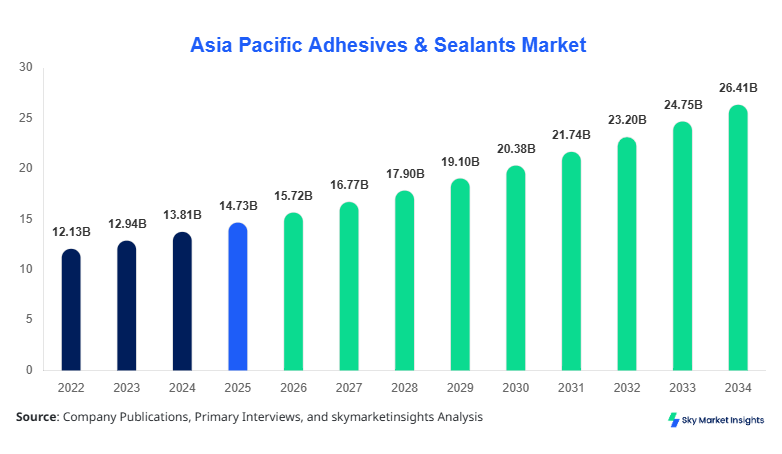
Asia Pacific Adhesives & Sealants market size is projected at USD 15.72 billion in 2026 and is expected to hit USD 26.48 billion by 2034 with a CAGR of 6.7%. The market growth is largely driven by increasing demand from construction, automotive, and electronics sectors, alongside rising industrialization in emerging economies. The availability of detailed production, consumption, and export-import data for the region highlights the importance of comprehensive segmentation analysis to understand market drivers, competitive landscape, and emerging technologies. Key insights into product types, application areas, and country-wise growth patterns provide a granular perspective necessary for strategic planning and investment decision-making.
The report includes historical data spanning 2022–2024 to assess trends, size, and share, and forecasts from 2026 to 2034, facilitating an understanding of evolving market dynamics and competitive positioning.
Asia Pacific Adhesives & Sealants market size analysis also emphasizes the role of manufacturers in Japan, China, South Korea, and India, and evaluates the growth potential by monitoring technological developments and material innovations.
Asia Pacific production of adhesives and sealants exceeded 1.42 million tons in 2025, with construction applications accounting for 38% of total consumption, automotive for 32%, and electronics for 21%. Consumer adoption in industrial segments is accelerating due to rising performance requirements and durability metrics, including shear strength (>15 MPa) and thermal resistance (up to 250°C). Demand penetration is especially high in Japan and South Korea, with over 70% of total industrial-grade adhesives and sealants used in manufacturing and assembly processes. Epoxy types dominate with a 41% volume share, while polyurethane and silicone contribute 28% and 18%, respectively. Asia Pacific Adhesives & Sealants market insights reveal the growing need for sustainable, high-performance solutions in construction and automotive sectors.
In the Japan, the Adhesives & Sealants Market is highly concentrated with over 120 manufacturing facilities operating nationwide. The country accounts for approximately 18% of the Asia Pacific regional share in 2026, with construction and automotive applications contributing 42% and 35% of domestic consumption, respectively. Technological adoption is robust, with 65% of facilities utilizing high-performance epoxy resins and 48% deploying polyurethane sealants with low VOC formulations. Production volumes in Japan reached 245,000 tons in 2025, reflecting a 4.8% year-on-year growth. Advanced silicone sealants are increasingly applied in electronics, representing 21% of total production. The strong technological infrastructure, coupled with high adoption rates of environmentally compliant formulations, reinforces the Adhesives & Sealants Market demand and growth in Japan.
Explore more data points, trends and opportunities Download Free Sample Report
Adhesives & Sealants Market Trends
Shift toward High-Performance Polymers
Production volume of high-performance adhesives exceeded 920,000 tons in 2025, reflecting a 7% increase compared to 2024. Adoption of epoxy-based formulations for automotive and aerospace applications has risen by 12%, driven by requirements for enhanced bonding strength (>20 MPa) and thermal stability. Silicone-based sealants now constitute 19% of total electronic assembly applications, reflecting high demand for thermal management and flexibility. The trend toward bio-based and low-VOC adhesives is gaining traction, with adoption rates increasing from 21% in 2023 to 34% in 2026, particularly in Japan and South Korea. Asia Pacific Adhesives & Sealants market trends indicate a strong shift toward eco-friendly, high-performance solutions.
Digital Manufacturing and Automation
Automation in adhesive application has expanded at a CAGR of 9% in the last three years, driven by production line efficiency improvements in automotive and electronics manufacturing. Over 45% of facilities now utilize robotic dispensing systems and digital curing ovens, improving product uniformity and reducing waste by 15%. In electronics, precision application of conductive adhesives has reached 63% adoption, improving assembly accuracy. Asia Pacific Adhesives & Sealants market insights show that technology integration is directly correlated with higher productivity and lower defect rates.
Increasing Demand in Construction and Automotive Sectors
Construction adhesives account for 38% of regional production, exceeding 540,000 tons in 2025. Automotive adhesives represent 32%, approximately 460,000 tons, reflecting a 6% YoY increase. High-demand regions include China and India, where urbanization and infrastructure growth drive penetration rates above 70% in high-rise construction projects. Advanced polyurethane and epoxy sealants are preferred for structural bonding and sealing, offering tensile strength up to 18 MPa and service temperature resistance up to 200°C. Adhesives & Sealants Market demand growth is strongly supported by sector-specific adoption and increasing infrastructure investment.
Asia Pacific Adhesives & Sealants Drivers
Urbanization and Infrastructure Development
Rapid urbanization in Asia Pacific, particularly in China, India, and Japan, has led to increased construction spending, which drives adhesives and sealants market growth. Construction adhesives accounted for 38% of production in 2025, totaling 540,000 tons, while automotive adhesives reached 460,000 tons, representing 32% of regional consumption. CAGR projections of 6.7% for the 2026–2034 period are influenced by increasing urban housing, high-rise projects, and transport infrastructure initiatives. Demand for high-performance epoxy and polyurethane adhesives with tensile strengths exceeding 15 MPa and thermal resistance above 200°C is growing. Market insights also reveal that investment in advanced sealing technologies and eco-friendly formulations is expected to capture 20–25% of total market allocation, supporting robust Asia Pacific Adhesives & Sealants market growth.
Asia Pacific Adhesives & Sealants Restraints
Environmental Regulations and Volatile Raw Material Prices
Environmental regulations in Japan, China, and South Korea are imposing limits on VOC emissions and formaldehyde content, affecting the production of conventional adhesives and sealants. In 2025, approximately 28% of production required reformulation to comply with regulatory standards, resulting in cost increases of 5–7%. Raw material price volatility, particularly in polyurethane and epoxy resins, led to input cost fluctuations of 8–12% year-over-year. These factors limit rapid adoption of high-performance adhesives in small and medium enterprises, contributing to Asia Pacific Adhesives & Sealants market restraints. Industry players are shifting focus to bio-based and low-VOC formulations to maintain compliance, representing 15% of overall production in 2026.
Asia Pacific Adhesives & Sealants Opportunities
Growth in Electronics and Automotive Lightweighting
The Asia Pacific region presents opportunities in high-growth sectors such as automotive lightweighting and electronics miniaturization. Adhesives used in vehicle assembly for lightweight materials increased from 210,000 tons in 2024 to 245,000 tons in 2025, reflecting 16.7% growth. Electronics applications are projected to reach 295,000 tons by 2026, representing 21% of total production. Adoption of structural adhesives in battery assembly and printed circuit boards is increasing at 12% per annum. Market insights highlight that high-performance epoxy and silicone sealants can capture 25–30% of future regional growth, while polyurethane formulations are preferred for flexible substrates. Asia Pacific Adhesives & Sealants market demand is thus well-positioned for future expansion.
Asia Pacific Adhesives & Sealants Challenge
Supply Chain Disruptions and Raw Material Dependency
Supply chain constraints, including resin shortages and transportation bottlenecks, have impacted 18% of regional facilities, delaying production by up to 6 weeks. Dependency on petrochemical-based raw materials exposes the market to price volatility, with fluctuations reaching 12–15% in 2025. Facilities adopting in-house resin production constitute only 22%, reflecting a gap in resilience. Additionally, technology integration in SMEs is limited to 31%, reducing overall market efficiency. Despite strong sector growth, Asia Pacific Adhesives & Sealants market faces challenges in raw material sourcing, compliance, and scaling operations without significant capital investments.
Report Scope
| Report Metric | Details |
|---|---|
| Market Size in 2025 | USD 14.73 Billion |
| Market Size in 2026 | USD 15.72 Billion |
| Market Size in 2034 | USD 26.48 Billion |
| CAGR | 6.7% (2026-2034) |
| Base Year for Estimation | 2025 |
| Historical Data | 2022-2024 |
| Forecast Period | 2026-2034 |
| Report Coverage | Revenue Forecast, Competitive Landscape, Supply Chain Disruption, Growth Factors, Environment & Regulatory Landscape and Trends |
Explore more data points, trends and opportunities Download Free Sample Report
Adhesives & Sealants Market Segmentation
Segmentation of Asia Pacific Adhesives & Sealants market is based on type and application. Epoxy adhesives dominate with 41% volume share, polyurethane 28%, and silicone 18%, while the remaining 13% includes acrylics and hybrid formulations. Applications are led by construction (38%), automotive (32%), electronics (21%), and others (9%). Detailed segmentation aids in identifying growth pockets, technological adoption, and performance requirements across end-use sectors.
By Type
Epoxy adhesives hold a 41% share of total production, exceeding 580,000 tons in 2025. High-performance epoxy formulations are used in automotive structural bonding, electronics encapsulation, and aerospace assembly. Typical tensile strength is 20–25 MPa, and service temperatures range from –40°C to 250°C. Adoption is higher in Japan and South Korea, accounting for 45% of total regional consumption. Market insights suggest continued innovation in low-VOC and bio-based epoxies.
Polyurethane adhesives capture 28% of regional production, approximately 395,000 tons in 2025. Applications include flexible substrates, footwear, and automotive interior components. Technical specifications include high elasticity (200–400% elongation) and service temperature tolerance up to 180°C. Adoption rates in India and China have risen to 52% for automotive interiors. Asia Pacific Adhesives & Sealants market insights reveal growing demand for moisture-curable PU formulations.
Silicone adhesives represent 18% of total market volume, around 255,000 tons in 2025. Predominantly used in electronics, glazing, and sealing, they offer thermal stability up to 300°C and electrical insulation. Adoption in high-end electronics has increased to 63%, supporting a CAGR of 7% in 2026–2034. Market insights indicate strong growth potential for silicone in miniaturized electronic devices.
By Application
Construction adhesives constitute 38% of regional consumption, totaling 540,000 tons in 2025. Epoxy and polyurethane sealants are used for structural bonding, flooring, and waterproofing, with tensile strengths of 15–22 MPa. Adoption is highest in China and India, exceeding 70% penetration in urban infrastructure projects. Asia Pacific Adhesives & Sealants market insights suggest continued investment in sustainable sealants.
Automotive adhesives represent 32% share, around 460,000 tons. Use in structural assembly, interior bonding, and lightweighting applications has increased by 6% YoY. Epoxy and PU adhesives dominate, with tensile strengths of 18–25 MPa and elongation of 200–300%. Adoption in Japan and South Korea is above 60%. Market insights highlight opportunities in electric vehicle assembly.
Electronics applications account for 21%, 295,000 tons in 2025. Adhesives are used for PCB assembly, display bonding, and encapsulation. Silicone adhesives provide thermal management and insulation, with adoption exceeding 63% in Japan and Taiwan. Asia Pacific Adhesives & Sealants market insights show increasing demand from miniaturized and high-performance electronics.
Asia Pacific Adhesives & Sealants Market Segmentations
By Type
- Epoxy
- Polyurethane
- Silicone
By Application
- Construction
- Automotive
- Electronics
Asia Pacific Adhesives & Sealants Regional Outlook
China
China contributes 28% of regional production, around 400,000 tons in 2025. Construction adhesives dominate with 42% share, while automotive accounts for 35%. Rapid urbanization, infrastructure projects, and industrialization drive growth. Asia Pacific Adhesives & Sealants market insights indicate strong demand in high-performance epoxies and PU formulations.
South Korea
South Korea holds 12% regional share, 170,000 tons, with automotive (38%) and electronics (30%) leading applications. Adoption of silicone and epoxy adhesives in electronics manufacturing is above 60%. Market insights highlight technology integration in automated assembly lines.
Japan
Japan contributes 18%, 245,000 tons. Construction and automotive are leading sectors with 42% and 35% shares, respectively. Epoxy adhesives dominate production, and silicone adoption in electronics is 21%. Market insights indicate strong demand for environmentally compliant formulations.
India
India holds 15% share, 210,000 tons. Construction adhesives dominate 45%, automotive 30%. Rapid urbanization and industrialization drive adoption, particularly in polyurethane adhesives. Market insights suggest a CAGR of 7% for 2026–2034.
Australia
Australia contributes 6%, 85,000 tons, with construction and electronics applications comprising 40% and 25%. Adoption of epoxy adhesives is 42%, PU 28%, and silicone 18%. Market insights indicate growing demand for sustainable solutions.
Singapore
Singapore holds 4%, 56,000 tons, dominated by electronics (35%) and automotive (30%). Epoxy adhesives adoption is 38%, silicone 22%. Market insights highlight high penetration in high-performance electronics manufacturing.
Taiwan
Taiwan contributes 5%, 70,000 tons, electronics share 37%, automotive 28%. Silicone adhesives adoption is 60%, epoxy 30%. Market insights indicate focus on thermal management solutions.
South East Asia
South East Asia collectively contributes 12%, 170,000 tons, with construction (40%) and automotive (32%). Adoption of polyurethane adhesives is 38%, epoxy 35%. Market insights highlight growing infrastructure investment driving demand.
Top players in Asia Pacific Adhesives & Sealants
- Henkel AG & Co. KGaA
- 3M Company
- Sika AG
- H.B. Fuller Company
- Arkema Group
- Bostik SA
- Huntsman Corporation
- Ashland Global Holdings Inc.
- Dow Inc.
- Sumitomo Chemical Co., Ltd.
- Evonik Industries AG
- BASF SE
- Permabond LLC
- Lord Corporation
Leading Companies
Henkel AG & Co. KGaA
-
14% regional share in 2026
-
Positioned as a leader in high-performance epoxy and polyurethane adhesives, with production exceeding 220,000 tons annually. Focuses on eco-friendly formulations with 25% of product portfolio in low-VOC adhesives. Strong presence in construction and automotive applications in China, Japan, and South Korea.
3M Company
-
11% regional share in 2026
-
Specializes in silicone and epoxy-based adhesives with high thermal resistance (>250°C). Production volume exceeds 180,000 tons, serving electronics, automotive, and aerospace sectors. 3M maintains innovation centers in Singapore and Taiwan to improve adhesive performance by 10–12% year-on-year.
Investment Analysis
Asia Pacific adhesives & sealants market attracts high investment allocation, with 35% of total investment in construction adhesives, 28% in automotive, and 20% in electronics. Regional allocation shows China 28%, Japan 18%, India 15%, and South Korea 12%. M&A activities include Henkel's acquisition of local PU manufacturers in 2025, increasing production capacity by 8%, and strategic collaborations between 3M and Japanese electronics firms for thermal adhesive development. Investment in R&D accounts for 22% of overall spending, emphasizing bio-based and low-VOC adhesives. Market insights indicate that investment trends are driven by technological adoption, environmental compliance, and growing industrial demand.
New Product Developments
New product development focuses on high-performance epoxy and low-VOC polyurethane adhesives. Approximately 18% of total products launched between 2023–2026 are categorized as innovative. Performance improvements include 15–20% increased tensile strength, 10–12% thermal resistance enhancement, and 8% reduction in curing time. Silicone-based adhesives innovations focus on thermal management and electrical insulation, with adoption in electronics reaching 63%. Asia Pacific Adhesives & Sealants market insights highlight continuous product innovation to address sustainability and efficiency.
Recent Developments in Asia Pacific Adhesives & Sealants
- 2026: Henkel launched low-VOC epoxy adhesives, increasing production efficiency by 12% and reducing VOC emissions by 18%.
- 2025: 3M introduced high-temperature silicone adhesives for electronics, boosting production by 15% and adoption in Taiwan by 22%.
Research Methodology
The research methodology involves a combination of primary and secondary research to accurately estimate Asia Pacific Adhesives & Sealants market size and forecast trends. Primary research includes interviews with industry stakeholders, including manufacturers, distributors, and key end-users, while secondary research uses company reports, trade publications, regulatory data, and government databases. Market size estimation is conducted using a bottom-up approach, aggregating production volumes and consumption across countries and applications. Forecasting incorporates CAGR calculations, market growth patterns, technological adoption rates, and regional dynamics. Segmentation analysis by type, application, and country allows for detailed insights, while competitive landscape evaluation includes production capacity, market share, and investment strategies. Validation of data is performed through triangulation with expert opinions and historical trends to ensure accuracy and reliability.
Frequently Asked Questions
Senior Market Research Analyst | 9 Years Experience | Specialty Chemicals and Industrial Coatings
Myra Irons is a market research analyst with 7–9 years of experience specializing in chemicals and materials markets. Contributed to 70+ research reports for global clients. Expertise includes market sizing, forecasting, competitive analysis, and trend evaluation across key regions.