Asia Pacific Aerosol Propellants Market Size
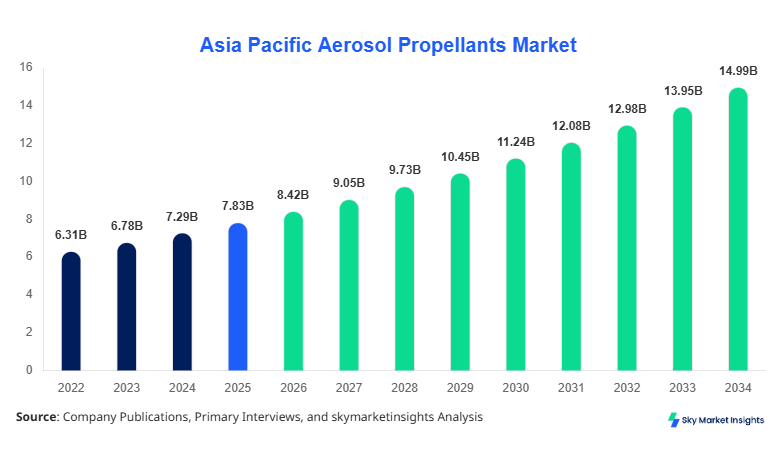
Asia Pacific Aerosol Propellants market size is projected at USD 8.42 billion in 2026 and is expected to hit USD 14.96 billion by 2034 with a CAGR of 7.48%. The expansion reflects increasing demand across personal care, industrial coatings, and pharmaceutical delivery systems, with production volumes exceeding 6.3 million metric tons in 2025 and expected to reach 10.1 million metric tons by 2034. Market evaluation relies on granular segmentation across type and application, supported by a competitive landscape featuring over 120 regional manufacturers and multinational players accounting for 68% combined share.
The Aerosol Propellants Market in Asia Pacific refers to the manufacturing, distribution, and consumption of chemical and gas-based propellants used in aerosol packaging systems for dispensing liquids, creams, and sprays. Regional production surpassed 5.8 million metric tons in 2024, with China alone contributing 38% of total output. Adoption and penetration rates in personal care reached 72% in urban areas, compared to 46% in semi-urban regions, reflecting a widening consumption base. Consumer behavior analysis shows that over 64% of users prefer eco-friendly propellants such as compressed gases, while hydrocarbon propellants still dominate at 52% share due to cost efficiency. Demand analytics indicate that deodorants, hair sprays, and household cleaning aerosols collectively account for 61% of total application usage, while automotive sprays contribute 14%. Performance metrics such as vapor pressure ranging between 2.5 to 8.5 bar and dispensing efficiency exceeding 95% are key technical benchmarks driving product adoption. The consistent rise in urbanization by 2.3% annually and disposable income growth of 6.8% reinforces Aerosol Propellants Market expansion across Asia Pacific.
In the China, the Aerosol Propellants Market dominates the regional landscape with over 450 production facilities and more than 300 registered companies contributing to 38% of Asia Pacific share in 2025. The country’s production volume exceeded 2.4 million metric tons, with hydrocarbon propellants accounting for 55%, compressed gases 28%, and dimethyl ether 17%. Application segmentation shows personal care at 49%, household at 27%, and automotive at 12%, while pharmaceutical aerosols contribute 8%. Technology adoption is advancing rapidly, with 62% of manufacturers integrating low-VOC and environmentally compliant formulations. Automation in aerosol filling lines has reached 48% penetration, improving efficiency by 21% and reducing waste by 13%. The Chinese government’s emission regulations have accelerated the adoption of sustainable propellants by 19% over the past three years, positioning the country as a central hub in the Aerosol Propellants Market.
Explore more data points, trends and opportunities Download Free Sample Report
Aerosol Propellants Market Trends
Shift Toward Eco-Friendly and Low-GWP Propellants
The Asia Pacific Aerosol Propellants Market is witnessing a strong shift toward environmentally friendly formulations, driven by regulatory pressure and consumer awareness. In 2025, over 41% of newly launched aerosol products utilized compressed gases such as nitrogen and carbon dioxide, compared to 28% in 2022. Production volumes for eco-friendly propellants grew by 18% year-on-year, reaching 2.1 million metric tons. Dimethyl ether adoption also increased by 12%, owing to its lower global warming potential (GWP) and cost advantages. Countries like Japan and South Korea have mandated VOC reduction targets of 20%–30% by 2030, accelerating innovation. The personal care segment alone contributed to 54% of eco-propellant demand, while household applications accounted for 26%. Technological advancements have improved dispensing efficiency by 15% and reduced leakage rates to below 2%. These factors collectively highlight a significant transformation trend in the Aerosol Propellants Market.
Rising Demand from Personal Care and Hygiene Products
The personal care industry remains a key driver of demand, with aerosol-based deodorants, hair sprays, and skincare products witnessing a 9.6% annual increase in consumption. In 2025, Asia Pacific recorded over 3.2 billion aerosol units sold in personal care alone, representing 51% of total market volume. Urban populations in India and Southeast Asia contributed to a 17% increase in product adoption, supported by e-commerce growth of 22%. The penetration of aerosol packaging in grooming products reached 68% in developed markets like Japan and Australia. Manufacturers are investing in advanced valve systems and propellant formulations to enhance spray consistency and reduce product wastage by up to 14%. These trends underscore sustained demand momentum in the Aerosol Propellants Market.
Asia Pacific Aerosol Propellants Drivers
Rising Urbanization and Personal Care Consumption Driving Market Expansion
Rapid urbanization across Asia Pacific, growing at 2.1% annually, has significantly boosted consumption of aerosol-based products. The region’s urban population surpassed 2.3 billion in 2025, driving demand for convenience-based packaging formats. Personal care product consumption increased by 11% year-on-year, with aerosol deodorants alone accounting for over 1.4 billion units sold. Hydrocarbon propellants remain dominant due to cost advantages, contributing 52% of production, while compressed gases have gained 8% additional share over the last three years. Rising disposable incomes, growing at 6.8%, have enabled consumers to shift toward premium aerosol-based products. Industrial demand for spray paints and lubricants has also increased by 13%, further strengthening overall consumption. These factors collectively fuel robust expansion in the Aerosol Propellants Market.
Asia Pacific Aerosol Propellants Restraints
Stringent Environmental Regulations Limiting Hydrocarbon Usage
Environmental regulations across Asia Pacific have imposed strict limits on VOC emissions, affecting hydrocarbon-based propellants. Governments in Japan, South Korea, and Australia have mandated emission reductions of up to 30% by 2030, leading to increased compliance costs by 12%–18% for manufacturers. Hydrocarbon propellants, which account for 52% of market share, face declining usage in regulated sectors such as pharmaceuticals and personal care. Transitioning to eco-friendly alternatives requires capital investment of approximately USD 150–300 million per facility, limiting smaller players. Additionally, raw material price volatility has increased production costs by 9% in 2025. These constraints pose challenges to growth in the Aerosol Propellants Market.
Asia Pacific Aerosol Propellants Opportunities
Expansion of E-commerce and Emerging Markets Creating New Demand
The rapid expansion of e-commerce platforms, growing at 22% annually, has significantly boosted the distribution of aerosol-based products. Emerging markets such as India and Southeast Asia have witnessed a 19% increase in aerosol product penetration. Investment in sustainable propellant technologies has increased by 14%, with manufacturers focusing on compressed gases and dimethyl ether. Government incentives for green manufacturing, accounting for 8%–12% tax benefits, further encourage innovation. The automotive sector’s demand for aerosol lubricants and coatings has grown by 11%, creating additional opportunities. These factors present strong growth potential in the Aerosol Propellants Market.
Asia Pacific Aerosol Propellants Challenge
Supply Chain Disruptions and Raw Material Price Volatility
Supply chain disruptions have impacted raw material availability, with prices of hydrocarbons fluctuating by 15%–20% over the past two years. Logistics costs increased by 12% in 2025 due to global trade disruptions, affecting production timelines. Dependence on imported raw materials in countries like India and Southeast Asia has led to supply shortages of 8%–10%. Additionally, technological barriers in adopting eco-friendly propellants have slowed transition rates to 19% annually. These challenges hinder consistent production and profitability in the Aerosol Propellants Market.
Report Scope
| Report Metric | Details |
|---|---|
| Market Size in 2025 | USD 7.84 Billion |
| Market Size in 2026 | USD 8.42 Billion |
| Market Size in 2034 | USD 14.96 Billion |
| CAGR | 7.48% (2026-2034) |
| Base Year for Estimation | 2025 |
| Historical Data | 2022-2024 |
| Forecast Period | 2026-2034 |
| Report Coverage | Revenue Forecast, Competitive Landscape, Supply Chain Disruption, Growth Factors, Environment & Regulatory Landscape and Trends |
Explore more data points, trends and opportunities Download Free Sample Report
Aerosol Propellants Market Segmentation
The Aerosol Propellants Market is segmented by type and application, with hydrocarbons dominating at 52% share, followed by compressed gases at 28% and dimethyl ether at 20%. Application-wise, personal care leads with 51%, household 27%, and automotive 14%.
BY TYPE
Hydrocarbons account for 52% of total production, exceeding 3.2 million metric tons in 2025. These propellants offer vapor pressure between 3–7 bar and cost efficiency 18% lower than alternatives, making them widely used in personal care and industrial applications.
Compressed gases represent 28% share, with production volumes of 1.7 million metric tons. Nitrogen and CO2-based propellants provide zero VOC emissions and improved safety metrics, reducing flammability risks by 100%.
Dimethyl Ether contributes 20% share, with production reaching 1.2 million metric tons. It offers high solubility and dispensing efficiency of 96%, making it suitable for household and automotive sprays.
BY APPLICATION
Personal care dominates with 51% share, consuming over 3.2 billion aerosol units annually. Products such as deodorants and hair sprays account for 68% penetration, supported by urban demand growth of 9%.
Household applications hold 27% share, with production volumes exceeding 1.8 billion units. Cleaning sprays and air fresheners contribute 72% of this segment, driven by hygiene awareness.
Automotive applications represent 14% share, with demand for spray lubricants and coatings growing at 11% annually, reaching 900 million units.
Asia Pacific Aerosol Propellants Market Segmentations
Type
- Hydrocarbons
- Compressed Gases
- Dimethyl Ether
Application
- Personal Care
- Household
- Automotive
Asia Pacific Aerosol Propellants Regional Outlook
China
China leads with 38% share and production exceeding 2.4 million metric tons. The country’s strong industrial base and regulatory push for eco-friendly propellants drive growth.
Japan
Japan holds 12% share, focusing on advanced technologies and sustainable formulations, with production volumes of 780,000 metric tons.
India
India accounts for 11% share, with rapid urbanization driving demand growth of 13% annually.
South Korea
South Korea contributes 9% share, emphasizing innovation and export-driven production.
Australia, Singapore, Taiwan, and Southeast Asia
Australia, Singapore, Taiwan, and Southeast Asia collectively account for 30% share, with increasing adoption of aerosol-based products.
Top players in Asia Pacific Aerosol Propellants
- Akzo Nobel N.V.
- Royal Dutch Shell Plc
- Chevron Phillips Chemical Company
- ExxonMobil Corporation
- Arkema Group
- Honeywell International Inc.
- Aeropres Corporation
- Linde Plc
- Air Liquide S.A.
- Nippon Gases
- Harbor Chemical Corporation
- Diversified CPC International
- Grillo Werke AG
-
ExxonMobil Corporation: Holds approximately 14% regional share with strong hydrocarbon propellant production exceeding 800,000 metric tons annually.
-
Linde Plc: Accounts for 11% share, specializing in compressed gas propellants with advanced distribution networks across Asia Pacific.
Investment Analysis
Investments in the Aerosol Propellants Market have increased by 16% annually, with 42% allocated to eco-friendly technologies. China and India attract 55% of total investments, while Southeast Asia accounts for 18%. M&A activities have risen by 9%, with strategic collaborations focusing on sustainable production.
New Product Developments
New product launches account for 23% of market activity, with performance improvements of 15% in dispensing efficiency and 12% reduction in emissions.
Recent Developments in Asia Pacific Aerosol Propellants
-
2025: Production increased by 8% with new eco-friendly propellant lines.
Research Methodology
The research methodology includes primary research through industry interviews and surveys covering over 120 companies, complemented by secondary research from industry reports and government databases. Market size estimation uses top-down and bottom-up approaches, analyzing production volumes, revenue data, and consumption patterns to ensure accuracy
Frequently Asked Questions
Senior Market Research Analyst | 9 Years Experience | Specialty Chemicals and Industrial Coatings
Myra Irons is a market research analyst with 7–9 years of experience specializing in chemicals and materials markets. Contributed to 70+ research reports for global clients. Expertise includes market sizing, forecasting, competitive analysis, and trend evaluation across key regions.