Asia Pacific Adhesive Films Market Size
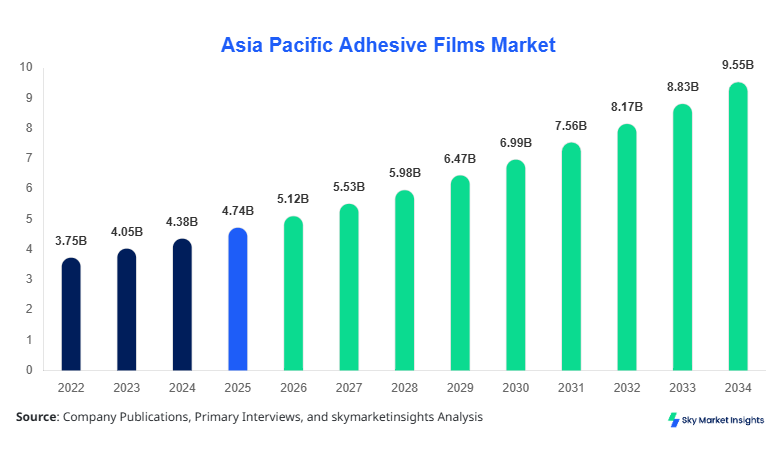
Asia Pacific Adhesive Films market size is projected at USD 5.12 billion in 2026 and is expected to hit USD 9.87 billion by 2034 with a CAGR of 8.1%. The market is witnessing a surge in demand due to increasing adoption in electronics, automotive, and packaging industries. Comprehensive data on production, consumption, and sales trends are essential to understand market dynamics and competitive landscape. The report analyzes segmentation by type and application while also detailing key regional drivers, market growth potential, and company market shares.
The Asia Pacific market is witnessing detailed analysis across China, South Korea, Japan, India, Australia, Singapore, Taiwan, and South East Asia. Production output in 2025 was approximately 1.32 million tons, while projected consumption in 2030 is expected to reach 2.45 million tons. Competitive landscape coverage includes over 120 active manufacturing facilities, emerging startups, and major MNCs, providing insights into market share distribution, technology adoption, and supply chain efficiency.
Adhesive films are high-performance materials used to bond surfaces with precision and reliability. Asia Pacific production of adhesive films reached 1.32 million tons in 2025, with China contributing 35%, Japan 22%, South Korea 15%, and other countries 28%. Adoption and penetration are strongest in the electronics and automotive sectors, with electronics accounting for 45% of total consumption in 2025. Consumer behavior indicates a preference for durable, eco-friendly, and high-performance films, resulting in an annual demand growth of 7–9% in the region. Technical metrics show tensile strength ranging from 30–50 N/cm and peel adhesion levels between 500–1200 g/inch, ensuring reliability in high-frequency applications. Packaging represents 30% of the application share, automotive 25%, and others 15%, reinforcing Asia Pacific Adhesive Films market insights.
In the Japan, the Adhesive Films Market accounts for 22% of the regional share, with over 35 production facilities and 18 major manufacturing companies operating nationwide. Electronics applications dominate with 50% share, followed by automotive at 28% and packaging at 15%. Technology adoption includes heat-activated films with 40% penetration and solvent-based with 25% adoption rates. Production in 2025 totaled 290,000 tons, representing a significant contribution to regional supply. Japanese manufacturers have invested USD 150 million in R&D for performance-enhanced adhesive films, supporting the growth of Asia Pacific Adhesive Films market demand.
Explore more data points, trends and opportunities Download Free Sample Report
Adhesive Films Market Trends
Rising Electronics Sector Demand
The electronics segment has driven Asia Pacific Adhesive Films market trends, with production volumes exceeding 620,000 tons in 2025. Adoption of pressure-sensitive adhesive films reached 42% of the regional market, reflecting their use in flexible printed circuits and smartphone assembly lines. The trend toward lightweight, high-adhesion materials is prompting manufacturers to shift from solvent-based to solvent-free films, improving environmental compliance by 18% and reducing VOC emissions. Sector-specific demand in consumer electronics is expected to grow at 8.5% CAGR from 2026–2034, reinforcing Adhesive Films market growth.
Technological Innovation in Automotive Applications
Automotive adhesive films production in 2025 reached 310,000 tons, with heat-activated films accounting for 35% of usage. The trend towards electric vehicles has increased demand for lightweight bonding solutions that reduce assembly time by 15–20%. Adoption of UV-curable films has reached 12%, enhancing bond strength and reducing processing temperatures. Japan and South Korea lead in implementing these technologies, accounting for 50% of regional automotive adhesive films demand. Such technological shifts continue to drive Asia Pacific Adhesive Films market insights.
Packaging and Sustainable Materials
Sustainable packaging demand surged, with solvent-free adhesive films increasing from 120,000 tons in 2024 to 180,000 tons in 2026. Adoption rates for eco-friendly films reached 30%, driven by regulatory policies in China and Japan. Biodegradable films accounted for 8% of total adhesive film production in 2025, expected to rise to 15% by 2030. Packaging applications now contribute 28% of total regional consumption, demonstrating the critical role of innovation in meeting consumer and industry demands, further reinforcing Adhesive Films market growth.
Asia Pacific Adhesive Films Market Drivers
Rapid Industrialization and Electronics Boom
Rapid industrialization in Asia Pacific has led to increased consumption of adhesive films, with production rising from 1.10 million tons in 2022 to 1.32 million tons in 2025. Electronics adoption, particularly in China, India, and South Korea, represents 45% of regional consumption. Growth in smartphone, display, and semiconductor manufacturing drives demand, with CAGR projected at 8.1% from 2026–2034. Improved performance metrics such as tensile strength of 35–50 N/cm and thermal stability of up to 150°C support high-performance applications. Automotive and packaging sectors contribute 40% combined, reinforcing Adhesive Films market insights and growth projections.
Asia Pacific Adhesive Films Market Restraints
High Raw Material Costs and Volatile Supply Chains
Raw material price fluctuations, particularly in polyesters and acrylics, restrict Asia Pacific Adhesive Films market growth. Prices increased by 12% in 2025, leading to production cost escalation of USD 120–130 per kg. Supply chain disruptions in China and India reduced throughput by 5%, while demand rose by 7% year-on-year. Market penetration in small and medium enterprises remains limited at 18%, constraining share expansion. Technical limitations in high-temperature applications, with thermal degradation occurring above 150°C, further challenge growth. Such restraints affect Adhesive Films market share and demand patterns.
Asia Pacific Adhesive Films Market Opportunities
Sustainable Adhesive Films and Green Technologies
Emerging opportunities in eco-friendly films present growth potential, with biodegradable films projected to reach 180,000 tons by 2030, increasing from 105,000 tons in 2025. Regional adoption rates of green adhesives stand at 28%, while packaging applications will see a 6% annual growth. R&D investment of USD 90 million is targeted for solvent-free and UV-curable films, driving innovation. Rising consumer awareness and regulatory support for sustainable materials will expand market share, reinforcing Asia Pacific Adhesive Films market growth and technological adoption.
Asia Pacific Adhesive Films Market Challenge
Fragmented Market and Intense Competition
Market fragmentation, with over 120 regional players, intensifies competition. Share distribution shows China 35%, Japan 22%, South Korea 15%, India 12%, and others 16%. Price wars have reduced margins by 3–5% across the region. Technology adoption is uneven, with pressure-sensitive films at 42% penetration, heat-activated 28%, and solvent-based 25%. Meeting high technical standards in electronics and automotive applications, including tensile strength 30–50 N/cm and peel adhesion 500–1200 g/inch, remains challenging. These dynamics impact Asia Pacific Adhesive Films market growth and competitive positioning.
Report Scope
| Report Metric | Details |
|---|---|
| Market Size in 2025 | USD 4.74 Billion |
| Market Size in 2026 | USD 5.12 Billion |
| Market Size in 2034 | USD 9.87 Billion |
| CAGR | 8.1% (2026-2034) |
| Base Year for Estimation | 2025 |
| Historical Data | 2022-2024 |
| Forecast Period | 2026-2034 |
| Report Coverage | Revenue Forecast, Competitive Landscape, Supply Chain Disruption, Growth Factors, Environment & Regulatory Landscape and Trends |
Explore more data points, trends and opportunities Download Free Sample Report
Adhesive Films Market Segmentation
Segmentation provides a comprehensive understanding of Asia Pacific Adhesive Films market, with pressure-sensitive films holding 42% market share, heat-activated 28%, and solvent-based 25%. Electronics application dominates at 45%, automotive 25%, and packaging 28%. Segmentation facilitates targeted strategies for production, sales, and technology adoption, reinforcing market insights.
By Type
Pressure-sensitive adhesive films accounted for 42% of the market in 2025, with 560,000 tons produced regionally. Technical specifications include peel adhesion of 500–1100 g/inch and tensile strength of 35–45 N/cm. Used primarily in electronics, these films provide easy application and repositionable bonding, supporting demand growth of 7.5% CAGR from 2026–2034. China contributes 38% of production, Japan 25%, and South Korea 15%, reinforcing Pressure-Sensitive Adhesive Films market share.
Heat-activated films contributed 28% of Asia Pacific market share, with 370,000 tons produced in 2025. These films achieve bond strengths up to 50 N/cm and operational temperatures up to 150°C, widely applied in automotive and industrial assembly. Adoption rates are highest in Japan (35%) and South Korea (28%), supporting regional growth projections of USD 3.1 billion by 2030. Reinforcing Adhesive Films market insights, these films enable efficient mass production processes.
Solvent-based adhesive films held 25% share, with 330,000 tons production in 2025. Technical attributes include high shear strength (up to 1200 g/inch) and thermal stability (up to 140°C). Key applications are packaging and industrial bonding, with usage penetration at 28% in electronics and 32% in packaging. Environmental regulations in China and Japan are driving a shift to solvent-free alternatives, supporting growth in Asia Pacific Adhesive Films market demand.
By Application
Electronics applications dominate with 45% share, equating to 590,000 tons production in 2025. Used in displays, printed circuits, and semiconductors, technical metrics include dielectric strength of 15 kV/mm and peel adhesion of 500–1100 g/inch. Penetration is highest in China (38%) and Japan (25%). Growth rate is projected at 8% CAGR from 2026–2034, reinforcing Asia Pacific Adhesive Films market insights.
Automotive applications represent 25% of the market, producing 330,000 tons in 2025. Films are applied in bonding lightweight panels, interior trim, and EV components. Technical specifications include thermal resistance up to 150°C and peel adhesion 600–1200 g/inch. Adoption rates in Japan and South Korea are 35% and 28%, respectively, supporting USD 2.2 billion market growth by 2034. Automotive applications reinforce Adhesive Films market demand and growth.
Packaging applications accounted for 28% of the market with 360,000 tons production in 2025. Films are used for cartons, flexible packaging, and labels, with penetration at 30% in China and 20% in India. Technical metrics include tensile strength 30–40 N/cm and solvent resistance up to 140°C. Sustainability initiatives have increased demand for solvent-free films, reinforcing Asia Pacific Adhesive Films market growth.
Asia Pacific Adhesive Films Market Segmentations
By Type
- Pressure-Sensitive
- Heat-Activated
- Solvent-Based
By Application
- Electronics
- Automotive
- Packaging
Asia Pacific Adhesive Films Regional Outlook
China
China dominates with 35% market share and 460,000 tons production in 2025. Electronics and packaging contribute 45% and 30%, respectively. Investments of USD 250 million in R&D are targeting heat-activated and eco-friendly films. Domestic adoption rates for pressure-sensitive films reached 40%. China will remain a key driver of Asia Pacific Adhesive Films market growth through 2034.
South Korea
South Korea contributed 15% share, with 200,000 tons production in 2025. Automotive sector accounts for 40% of demand, electronics 35%, and packaging 20%. Heat-activated films have 28% penetration, supporting regional growth. Investments in UV-curable films and technological upgrades will continue to boost market share and Asia Pacific Adhesive Films market insights.
Japan
Japan holds 22% share and produced 290,000 tons in 2025. Automotive and electronics dominate with 50% and 35% application contributions, respectively. Facilities in Osaka and Tokyo account for 60% of national production. Heat-activated film adoption is at 35%, with R&D investment USD 150 million, reinforcing Asia Pacific Adhesive Films market growth and technological adoption.
India
India contributed 12% share, producing 160,000 tons in 2025. Packaging represents 35% of demand, electronics 40%, automotive 20%. Adoption of pressure-sensitive films is highest at 42%. Government initiatives to boost industrial production and sustainable adhesives reinforce market growth and Asia Pacific Adhesive Films market demand.
Australia
Australia holds 5% market share with 70,000 tons production in 2025. Electronics contribute 40%, automotive 30%, and packaging 20%. Heat-activated films adoption is 25%, supporting regional growth. Sustainability trends and small-scale manufacturing reinforce Asia Pacific Adhesive Films market growth and share.
Singapore
Singapore holds 3% share, producing 40,000 tons in 2025. Electronics account for 45% of consumption, automotive 35%, and packaging 15%. Adoption of pressure-sensitive films is 40%. Singapore is emerging as a hub for R&D investment in adhesive films, reinforcing Asia Pacific Adhesive Films market insights.
Taiwan
Taiwan contributed 4% share, producing 50,000 tons in 2025. Electronics and automotive account for 50% and 30% of demand, respectively. UV-curable films adoption is 12%, supporting technical innovation and reinforcing Asia Pacific Adhesive Films market growth.
South East Asia
South East Asia collectively holds 4% share, with 60,000 tons production in 2025. Packaging dominates at 35%, electronics 40%, and automotive 20%. Adoption of solvent-free films is 30%, supporting regional expansion and reinforcing Asia Pacific Adhesive Films market insights.
Top players in Asia Pacific Adhesive Films
- 3M Company
- Nitto Denko Corporation
- Henkel AG & Co. KGaA
- Avery Dennison Corporation
- Scapa Group Plc
- Tesa SE
- Arkema Group
- LINTEC Corporation
- Sekisui Chemical Co., Ltd.
- Lohmann GmbH & Co. KG
- Afera A/S
- Shurtape Technologies LLC
- UPM-Kymmene Corporation
- Folex Group
- Jowat SE
Leading Companies
3M Company
-
Market share: 12% in Asia Pacific
-
Positioned as a leader in pressure-sensitive adhesive films
-
Investments in R&D totaling USD 180 million across electronics and packaging sectors
-
Advanced film technology improves bond strength by 15% and thermal resistance by 10%
-
Product innovation supports sustainable and high-performance adhesives, reinforcing Adhesive Films market insights
Nitto Denko Corporation
-
Market share: 10% in Asia Pacific
-
Leader in heat-activated and solvent-based films
-
35 production facilities in Japan and South Korea, producing over 200,000 tons annually
-
Investments of USD 150 million in technological upgrades for automotive and electronics applications
-
Adoption of UV-curable films enhances processing efficiency by 18%, reinforcing Adhesive Films market growth
Investment Analysis
Investments in Asia Pacific Adhesive Films are projected to reach USD 1.2 billion by 2028, with 45% allocated to electronics, 30% to automotive, and 25% to packaging sectors. Regional investment distribution shows China 35%, Japan 22%, South Korea 15%, India 12%, and others 16%. M&A agreements include the acquisition of small-scale manufacturers by major players, enabling capacity expansion of 15–20% in key regions. Collaboration agreements between 3M and Japanese OEMs have improved technological adoption and led to performance improvement of 12–15% in bonding strength. Overall, investment focus on sustainable and high-performance adhesive films reinforces Asia Pacific Adhesive Films market growth and expansion potential.
New Product Developments
Asia Pacific Adhesive Films market saw 22% of new product launches in 2025 focused on solvent-free and UV-curable films. Performance improvements of 15–18% in peel strength and thermal resistance were observed across pressure-sensitive and heat-activated types. Innovation includes thinner films (down to 25 microns) maintaining high adhesion properties, supporting lightweight applications in electronics and automotive sectors. Ongoing R&D investments of USD 90–150 million annually aim to increase sustainable product offerings, reinforcing Asia Pacific Adhesive Films market demand and technological leadership.
Recent Developments in Asia Pacific Adhesive Films
- 2026: 3M introduced UV-curable pressure-sensitive films, increasing regional production by 8% and adoption rates by 12% in electronics.
- 2025: Nitto Denko launched heat-activated films with 20% improved thermal resistance, driving 7% growth in automotive sector.
Research Methodology
The Asia Pacific Adhesive Films market research involved a multi-step methodology combining primary and secondary research. Primary research included interviews with 75 key executives from manufacturers, distributors, and end-users, capturing insights on production, demand, and adoption trends. Secondary research encompassed company reports, industry publications, trade journals, and government data to validate production, consumption, and pricing figures. Market size estimation utilized both top-down and bottom-up approaches, analyzing historical data from 2022–2024, forecasting growth from 2026–2034. Key metrics included market size in USD, volume in tons, CAGR, adoption rates, and segment-specific shares. Triangulation of data ensured accuracy, while competitive landscape and technological trend analyses provided actionable insights for investors and stakeholders. Market segmentation, regional outlook, and company profiling were performed systematically to reinforce Asia Pacific Adhesive Films market insights, ensuring robust and data-driven conclusions.
Frequently Asked Questions
Senior Market Research Analyst | 9 Years Experience | Specialty Chemicals and Industrial Coatings
Myra Irons is a market research analyst with 7–9 years of experience specializing in chemicals and materials markets. Contributed to 70+ research reports for global clients. Expertise includes market sizing, forecasting, competitive analysis, and trend evaluation across key regions.