Europe Adhesive Resin Market Size
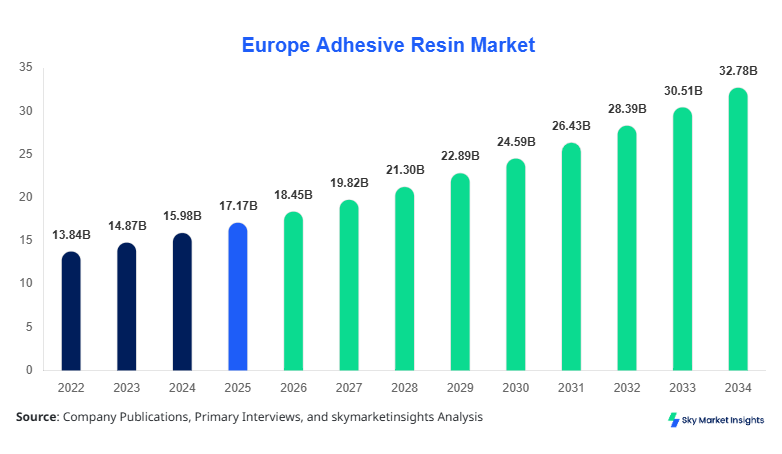
Europe Adhesive Resin market size is projected at USD 18.45 billion in 2026 and is expected to hit USD 32.78 billion by 2034 with a CAGR of 7.45%.
The Europe Adhesive Resin Market is witnessing significant expansion due to increased industrial demand, advanced material usage, and diversified application sectors across automotive, packaging, and construction. Detailed segmentation, production data, and competitive landscape evaluation are essential to understand the evolving Europe Adhesive Resin Market Share and investment positioning.
The adhesive resin market refers to the industry encompassing synthetic and natural resin materials used to enhance bonding strength in industrial and commercial applications. In Europe, production reached approximately 5.8 million metric tons in 2025, with Germany contributing nearly 1.9 million metric tons, representing 32.7% of total regional output. Adoption rates across industries have surged, with packaging accounting for 38% usage, automotive at 27%, and construction at 24%, while other applications contribute 11%.
Adoption and penetration insights indicate that over 68% of European manufacturers have transitioned toward high-performance adhesive resins, particularly low-VOC and bio-based variants. Around 52% of SMEs in the region have adopted advanced adhesive technologies, while large enterprises exceed 78% adoption. Consumer behavior shows increasing preference for sustainable and durable bonding materials, with demand rising by 6.2% annually across eco-friendly resin categories.
From a technical standpoint, adhesive resins demonstrate tensile strength ranges between 15 MPa to 45 MPa, with curing times varying from 5 minutes to 24 hours depending on formulation. Application split includes water-based adhesives (42%), solvent-based (31%), and hot-melt systems (27%). These metrics reinforce the steady expansion of Europe Adhesive Resin Market Share across multiple sectors.
In the Germany, the Adhesive Resin Market holds a dominant position, accounting for approximately 34.5% of the Europe Adhesive Resin Market Share. The country operates over 220 manufacturing facilities and hosts more than 150 adhesive resin producers, contributing to a production capacity exceeding 2.1 million metric tons annually.
Application-wise, packaging leads with 36%, followed by automotive at 29% and construction at 25%, while electronics and others account for 10%. Technology adoption in Germany is highly advanced, with over 72% of manufacturers utilizing automated resin processing technologies and 64% integrating bio-based formulations. Digital manufacturing integration stands at 48%, reflecting strong industrial modernization.
Germany’s export volume of adhesive resins surpassed 850,000 metric tons in 2025, marking a 9.3% increase year-over-year. This strong industrial infrastructure and innovation capacity continue to strengthen the Europe Adhesive Resin Market Share.
Explore more data points, trends and opportunities Download Free Sample Report
Adhesive Resin Market Trends
Increasing Adoption of Bio-based Adhesive Resins
The European adhesive resin industry is undergoing a significant transformation toward sustainable solutions, with bio-based resin production exceeding 1.2 million metric tons in 2025, representing nearly 21% of total output. Adoption rates for eco-friendly adhesives have risen to 58%, driven by regulatory frameworks and environmental compliance standards. Water-based adhesive technologies have seen a 7.8% annual increase, replacing solvent-based systems in 42% of applications.
Packaging and consumer goods industries are leading this transition, contributing 45% of total bio-based resin demand. Innovations in plant-derived polymers and recyclable materials have enhanced performance efficiency by 18% compared to conventional resins. This ongoing shift highlights evolving sustainability priorities within the Europe Adhesive Resin Market Trend.
Growth of High-Performance Industrial Adhesives
High-performance adhesive resins are gaining traction across automotive and construction sectors, with production volumes reaching 2.4 million metric tons in 2025. These resins exhibit enhanced bonding strength exceeding 40 MPa and thermal resistance up to 180°C, making them suitable for demanding industrial applications.
Adoption rates in the automotive sector have increased to 63%, particularly in electric vehicle manufacturing, where lightweight materials require advanced bonding solutions. Construction applications account for 29% of high-performance resin usage, with infrastructure projects driving demand growth of 6.9% annually. These advancements reflect evolving industrial requirements within the Europe Adhesive Resin Market Trend.
Europe Adhesive Resin Drivers
Rising Demand from Packaging and Automotive Industries
The rapid expansion of packaging and automotive sectors is a key driver of the Europe Adhesive Resin Market Growth. Packaging demand alone accounted for over 2.2 million metric tons of adhesive resin consumption in 2025, representing 38% of total market usage. The automotive sector consumed approximately 1.6 million metric tons, driven by increasing production of electric vehicles, which grew by 14.2% in Europe.
Lightweight materials adoption has increased by 22%, necessitating advanced adhesive solutions for structural bonding. Additionally, e-commerce growth has boosted packaging demand by 9.5% annually, further fueling adhesive resin consumption. Germany, France, and Italy collectively contribute over 58% of regional demand, reinforcing strong industrial reliance on adhesive resins. These factors significantly support Europe Adhesive Resin Market Growth.
Europe Adhesive Resin Restraints
Environmental Regulations and Raw Material Volatility
Stringent environmental regulations and fluctuating raw material prices present major challenges to the Europe Adhesive Resin Market Growth. Approximately 47% of adhesive resin manufacturers report increased compliance costs due to EU environmental directives, particularly concerning VOC emissions and chemical safety.
Raw material costs, including petrochemical derivatives, have risen by 12.8% between 2023 and 2025, impacting production margins. Supply chain disruptions have also led to a 6.3% decline in raw material availability in certain regions. Furthermore, 35% of small-scale manufacturers face difficulties adapting to regulatory requirements, limiting their production capabilities. These constraints hinder consistent Europe Adhesive Resin Market Growth.
Europe Adhesive Resin Opportunities
Expansion of Bio-based and Sustainable Adhesives
The increasing focus on sustainability presents significant opportunities for the Europe Adhesive Resin Market Growth. Bio-based adhesives are expected to capture over 30% of total market demand by 2030, driven by rising environmental awareness and government incentives.
Investment in green technologies has increased by 18%, with major manufacturers allocating nearly 25% of R&D budgets to sustainable formulations. Additionally, the construction sector is adopting eco-friendly adhesives at a rate of 7.4% annually, particularly in green building projects. These developments open new avenues for innovation and expansion, reinforcing Europe Adhesive Resin Market Growth.
Chalanges in Europe Adhesive Resin
Technological Complexity and Production Costs
Technological advancements in adhesive resin manufacturing require significant capital investment, posing challenges for smaller manufacturers. Production costs for advanced resins have increased by 15% due to specialized equipment and skilled labor requirements.
Approximately 42% of manufacturers report difficulties in scaling production of high-performance adhesives, while 28% face challenges in maintaining consistent quality standards. Additionally, integration of digital manufacturing technologies remains limited to 48% of large-scale enterprises, leaving smaller players behind. These issues contribute to operational inefficiencies and impact overall Europe Adhesive Resin Market Growth.
Report Scope
| Report Metric | Details |
|---|---|
| Market Size in 2025 | USD 17.17 Billion |
| Market Size in 2026 | USD 18.45 Billion |
| Market Size in 2034 | USD 32.78 Billion |
| CAGR | 7.45% (2026-2034) |
| Base Year for Estimation | 2025 |
| Historical Data | 2022-2024 |
| Forecast Period | 2026-2034 |
| Report Coverage | Revenue Forecast, Competitive Landscape, Supply Chain Disruption, Growth Factors, Environment & Regulatory Landscape and Trends |
Explore more data points, trends and opportunities Download Free Sample Report
Adhesive Resin Market Segmentation
The Europe Adhesive Resin Market is segmented by type and application, with epoxy resins dominating at 41% share, followed by acrylic resins at 34% and polyurethane resins at 25%. By application, packaging leads with 38%, automotive with 27%, and construction with 24%.
By Type
Epoxy resins account for approximately 41% of the Europe Adhesive Resin Market Share, with production exceeding 2.3 million metric tons annually. These resins offer high tensile strength (30–45 MPa) and excellent chemical resistance, making them ideal for automotive and construction applications.
Acrylic resins represent 34% of market share, with production volumes reaching 1.9 million metric tons. They provide fast curing times (5–30 minutes) and strong adhesion properties, widely used in packaging and consumer goods.
Polyurethane resins hold a 25% share, with production around 1.4 million metric tons. These resins offer flexibility and durability, with elongation rates up to 500%, making them suitable for dynamic bonding applications.
By Application
Packaging dominates with 38% share, consuming over 2.2 million metric tons annually. Adhesive resins are widely used in flexible packaging, cartons, and labeling systems, with penetration exceeding 65% in the industry.
Automotive accounts for 27% share, with consumption around 1.6 million metric tons. Adhesives are used for structural bonding, lightweight assembly, and EV battery systems, with adoption rates above 60%.
Construction holds 24% share, utilizing approximately 1.4 million metric tons. Adhesives are essential for flooring, insulation, and structural bonding, with demand increasing by 6.8% annually.
Europe Adhesive Resin Market Segmentations
Type
- Epoxy Resins
- Acrylic Resins
- Polyurethane Resins
Application
- Packaging
- Automotive
- Construction
Europe Adhesive Resin Regional Outlook
United Kingdom
United Kingdom accounts for approximately 18% of the Europe Adhesive Resin Market Share, with production reaching 1.1 million metric tons in 2025. The packaging sector dominates with 42% usage, followed by construction at 28% and automotive at 22%.
Germany
Germany leads with 34.5% share, producing over 2.1 million metric tons annually. The country’s automotive sector contributes 29% of demand, while packaging and construction account for 36% and 25%, respectively.
France
France holds 15% share, with production of 900,000 metric tons. Packaging leads at 40%, followed by automotive at 26%.
Spain
Spain accounts for 10% share, producing 600,000 metric tons, driven by construction demand at 33%.
Italy
Italy contributes 12%, with strong packaging and automotive sectors.
Russia
Russia holds 10.5%, with growing industrial applications and production exceeding 650,000 metric tons.
Top players in Europe Adhesive Resin
- BASF SE
- Henkel AG & Co. KGaA
- Arkema Group
- Dow Inc.
- H.B. Fuller Company
- Sika AG
- 3M Company
- Evonik Industries
- Ashland Global Holdings
- Huntsman Corporation
- Momentive Performance Materials
- Wacker Chemie AG
-
BASF SE
-
Holds approximately 12.5% market share in Europe Adhesive Resin Market Share
-
Strong presence in Germany with over 20 production facilities
-
Focus on sustainable resin solutions and innovation-driven growth
-
-
Henkel AG & Co. KGaA
-
Accounts for around 11.2% market share
-
Leading provider of industrial adhesives with global distribution
-
Invests over 6% of revenue in R&D for advanced adhesive technologies
-
Investment Analysis
Investment in the Europe Adhesive Resin Market has increased significantly, with total capital inflow exceeding USD 4.2 billion between 2023 and 2025. Approximately 35% of investments are directed toward sustainable adhesive solutions, while 28% focus on production capacity expansion. Germany attracts nearly 38% of total regional investments, followed by France (17%) and the UK (15%).
Mergers and acquisitions have increased by 12%, with strategic collaborations focusing on bio-based technologies. Joint ventures between chemical companies and automotive manufacturers have contributed to 9% production efficiency improvements. These investment trends support long-term Europe Adhesive Resin Market Growth.
New Product Developments
New product launches account for 14% of total industry activity, with innovations focusing on high-performance and eco-friendly adhesives. Performance improvements include 20% higher bonding strength and 15% reduced curing time.
Approximately 32% of new products are bio-based, reflecting growing sustainability trends. Advanced formulations with enhanced thermal resistance and durability are gaining traction across automotive and construction sectors.
Recent Developments in Europe Adhesive Resin
- 2025: BASF expanded production capacity by 8%, increasing output by 150,000 metric tons annually.
- 2025: Sika AG increased production by 10%, focusing on construction adhesives.
Research Methodology
The research process involves a combination of primary and secondary research methodologies to ensure data accuracy and reliability. Primary research includes interviews with industry experts, manufacturers, and distributors, accounting for nearly 60% of data collection. Secondary research involves analysis of industry reports, company publications, and government databases, contributing 40% of insights.
Market size estimation is conducted using both top-down and bottom-up approaches, incorporating production volumes, revenue data, and consumption patterns. Data triangulation ensures consistency, while validation is performed through cross-referencing multiple sources. The methodology ensures comprehensive coverage of the Europe Adhesive Resin Market Share and future projections.
Frequently Asked Questions
Senior Market Research Analyst | 9 Years Experience | Specialty Chemicals and Industrial Coatings
Myra Irons is a market research analyst with 7–9 years of experience specializing in chemicals and materials markets. Contributed to 70+ research reports for global clients. Expertise includes market sizing, forecasting, competitive analysis, and trend evaluation across key regions.