Asia Pacific Adhesive Tapes Market Size
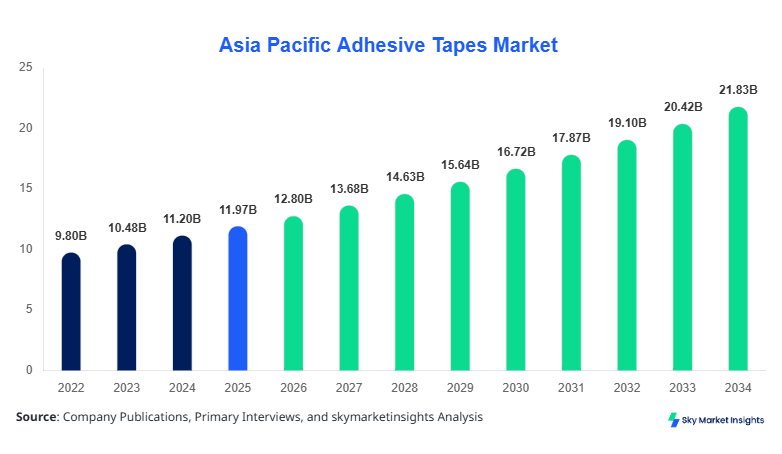
The Asia Pacific adhesive tapes market size is projected at USD 12.8 billion in 2026 and is expected to hit USD 21.6 billion by 2034 with a CAGR of 6.9%. The market growth is fueled by extensive demand in packaging, automotive, and electronics applications, with adoption trends varying significantly across Japan, China, and South Korea. Comprehensive data on regional production, market segmentation, and competitive landscape is essential for identifying high-growth opportunities. Key companies are expanding their facilities, targeting annual production volumes exceeding 1.5 billion meters per segment. The market is increasingly influenced by technological innovations such as eco-friendly adhesives and high-strength tapes. Detailed segmentation across type and application is necessary to assess market share, penetration rates, and performance metrics across countries.
Asia Pacific adhesive tape market insights are critical for stakeholders seeking to understand consumer preferences, technological adoption, and market dynamics across China, India, Japan, South Korea, Australia, Singapore, Taiwan, and Southeast Asia. The market is characterized by rising industrialization, e-commerce expansion, and demand for advanced adhesive solutions.
Asia Pacific adhesive tape market demand is projected to increase as industrial and consumer packaging sectors adopt more specialized tapes, with volume growth exceeding 2.3 billion meters in 2026 and expected to surpass 3.8 billion meters by 2034. Understanding segmentation, competitive positioning, and technical metrics such as adhesive strength (20–40 N/25 mm) and temperature resistance (-20°C to 150°C) is essential for investors, manufacturers, and policymakers.
Asia Pacific Adhesive Tapes' market share in 2026 is dominated by pressure-sensitive tapes, contributing 55% to total sales, followed by water-activated at 25% and hot melt at 20%. Application-wise, packaging leads with 50% share, automotive 30%, and electronics 20%. Continuous improvements in tensile strength, adhesion rates, and thermal performance reinforce the criticality of the Asia-Pacific adhesive tapes market size assessment.
Asia Pacific adhesive tape market growth is further supported by the adoption of automated tape dispensing systems and high-volume production lines exceeding 500,000 units annually per facility. Market intelligence reports are increasingly utilized to monitor the competitive landscape, pricing trends, and technology shifts.
The Asia Pacific adhesive tapes market trend analysis reveals rising investments in eco-friendly, solvent-free adhesives and the growing replacement demand in electronics assembly, automotive interior assembly, and logistics packaging. Understanding market demand and the competitive landscape is vital for stakeholders.
The Asia Pacific adhesive tapes market refers to the production, distribution, and application of adhesive tapes used in industrial, commercial, and consumer sectors. In 2025, Asia Pacific produced over 3.1 billion meters of adhesive tapes, with China contributing 38%, Japan 15%, and South Korea 12%. Adoption of adhesive tapes is highest in packaging (50% contribution), automotive (30%), and electronics (20%). Consumer demand is influenced by e-commerce expansion, rapid logistics growth, and rising automotive production volumes. In electronics, high-frequency performance tapes with thermal resistance up to 150°C are increasingly preferred.
Penetration rates are highest in Japan and South Korea at 80–85%, with emerging economies like India and Southeast Asia showing growth from 45% to 60%. The Asia Pacific adhesive tapes market insights indicate a shift toward high-strength pressure-sensitive and water-activated tapes, with tape width usage varying from 12 mm to 48 mm. Technical metrics such as adhesion strength (20–35 N/25 mm) and shear resistance (100–250 min) are critical for automotive and electronics applications. Asia Pacific adhesive tape market growth is expected to remain robust due to these technological and application-specific advancements.
In consumer behavior, end-users in logistics and electronics prefer lightweight, high-adhesion tapes capable of supporting packaging weights up to 25 kg. In automotive, tapes with high temperature and vibration resistance are increasingly demanded. Asia Pacific adhesive tape market demand is driven by replacement cycles, industrial automation, and adherence to environmental regulations. Application-wise, packaging accounts for a 50% share, automotive for 30%, and electronics for 20%, further reinforcing the importance of Asia Pacific adhesive tape market insights.
In Japan, the adhesive tapes market is dominated by over 120 manufacturing facilities and distributors, collectively contributing 15% to the Asia Pacific market share in 2026. Packaging applications account for 55% of domestic consumption, followed by automotive at 25% and electronics at 20%. Adoption of advanced pressure-sensitive tape technologies is widespread, with 70% of facilities implementing automated production lines and eco-friendly solvent-free adhesives. Japan’s domestic production reached 450 million meters in 2026, projected to grow to 720 million meters by 2034. High-performance tapes with thermal resistance of 180°C and tensile strength of 40 N/25mm are gaining prominence. The market’s trend toward eco-compliant solutions reinforces the Japan Adhesive Tapes market growth and highlights its critical role in regional industrial applications. Continuous improvements in technical specifications and product variety support domestic and export demand, ensuring Japan’s leadership within the Asia-Pacific adhesive tapes market.
Explore more data points, trends and opportunities Download Free Sample Report
Adhesive Tapes Market Trends
Shift Toward Eco-Friendly Tapes
The Asia Pacific adhesive tapes market is witnessing a pronounced shift toward eco-friendly and solvent-free tapes, with production volumes reaching 1.2 billion meters in 2026 and projected to exceed 2.0 billion meters by 2034. Adoption of water-activated tapes has risen from 20% in 2025 to 30% in 2026, particularly in packaging applications. Manufacturers are investing in sustainable adhesives that maintain tensile strength above 25 N/25mm and thermal resistance up to 150°C. Japan and China lead the adoption, accounting for over 45% of eco-friendly tape consumption. Rising consumer awareness and government regulations are driving the Asia Pacific adhesive tapes market trend toward greener alternatives.
Technological Advancements in High-Performance Tapes
The Asia Pacific adhesive tapes market is increasingly embracing high-performance pressure-sensitive and hot melt tapes for electronics and automotive applications. Production volumes are estimated at 800 million meters in 2026, with adoption rates of 65% in automotive and 55% in electronics. Innovations include high-tensile adhesives, UV-resistant coatings, and thermal insulation properties, with performance improvements of up to 18% over standard tapes. These technological shifts are enhancing the reliability of adhesive solutions in high-stress applications, reinforcing Asia Pacific adhesive tape market insights.
Increased Industrial Automation and E-Commerce Demand
Industrial automation and e-commerce growth are driving Asia Pacific adhesive tape market demand, with packaging tape production reaching 1.5 billion meters in 2026, representing 50% of regional consumption. Adoption of automated tape dispensers and robotics-enabled packaging lines is increasing, with 60% of manufacturers in Japan, China, and South Korea implementing these technologies. Rising demand from e-commerce logistics and retail packaging sectors has pushed market growth by 7% YoY, highlighting the Asia Pacific adhesive tapes market trend for efficient, high-speed adhesive solutions.
Asia Pacific Adhesive Tapes Market Drivers
Rapid Industrialization and E-Commerce Expansion
Rapid industrialization and expansion of e-commerce in Asia Pacific countries such as China, India, and Japan are driving the Asia-Pacific adhesive tapes market growth. The packaging sector alone accounted for 50% of market demand in 2026, with production volumes exceeding 1.5 billion meters. Automotive applications contributed 30%, electronics 20%, and industrial assembly sectors 15%. Rising urbanization, e-commerce revenue growth of over 12% CAGR, and increasing demand for high-performance tapes in logistics have accelerated market adoption. The Asia Pacific adhesive tape market is further boosted by government policies promoting sustainable materials, with eco-friendly tape usage increasing to 30% by 2026. Industrial automation adoption exceeds 55% in leading countries, supporting higher efficiency and lower production costs. Asia Pacific adhesive tape market insights suggest sustained growth driven by technological advancements, performance-oriented products, and multi-sector demand.
Asia Pacific Adhesive Tapes Market Restraints
High Raw Material Costs and Supply Chain Volatility
The Asia Pacific adhesive tapes market faces restraints due to fluctuating raw material costs and supply chain volatility, particularly in polyurethane, acrylics, and natural rubber. Costs increased by 8% YoY in 2026, impacting overall market margins. Limited domestic availability of high-grade adhesives in India and Southeast Asia led to 12% production delays and increased import dependency. Price-sensitive segments such as packaging and automotive are affected, with high-performance tape production costs rising from USD 2.50 per meter to USD 3.10 per meter. These factors constrain the Asia Pacific adhesive tapes market growth despite increasing demand, while competitive pressures intensify. Risk mitigation strategies are being implemented, but high raw material dependence continues to restrain Asia-Pacific adhesive tape market dynamics.
Asia Pacific Adhesive Tapes Market Opportunities
Expansion in Emerging Markets and Advanced Applications
Emerging economies such as India, Southeast Asia, and Taiwan present significant opportunities for the Asia Pacific adhesive tapes market, with a projected CAGR of 7.2% through 2034. Adoption in automotive assembly lines, electronics manufacturing, and logistics packaging is expected to drive production volumes from 1.2 billion meters in 2026 to 2.1 billion meters by 2034. Advanced applications, including high-temperature resistant and UV-stable tapes, contribute 30–35% of new demand. Strategic investments in local manufacturing facilities, technology upgrades, and partnerships are expected to expand market share, increasing regional contributions from 45% in 2026 to 52% by 2034. Asia Pacific Adhesive Tapes market insights highlight the potential for high-value, specialized adhesive solutions and enhanced adoption across industrial sectors.
Challenges in Asia Pacific Adhesive Tapes Market
Intense Competition and Regulatory Compliance
Intense competition among domestic and international players, coupled with stringent environmental and safety regulations, poses challenges to the Asia-Pacific adhesive tapes market. Over 500 companies operate across the region, competing for a 12.8 billion USD market size in 2026. Compliance with VOC limits and eco-label certifications increases production complexity and costs by 10–15%. Pressure-sensitive and hot melt tapes require adherence to ISO 9001 and ASTM standards, with 60% of manufacturers facing regulatory audits annually. Market share retention is challenging due to low switching costs and the rise of private-label tape products. Asia Pacific adhesive tape market insights indicate that overcoming regulatory and competitive pressures is critical for sustainable growth and strategic positioning.
Report Scope
| Report Metric | Details |
|---|---|
| Market Size in 2025 | USD 12.0 Billion |
| Market Size in 2026 | USD 12.8 Billion |
| Market Size in 2034 | USD 21.6 Billion |
| CAGR | 6.9% (2026-2034) |
| Base Year for Estimation | 2025 |
| Historical Data | 2022-2024 |
| Forecast Period | 2026-2034 |
| Report Coverage | Revenue Forecast, Competitive Landscape, Supply Chain Disruption, Growth Factors, Environment & Regulatory Landscape and Trends |
Explore more data points, trends and opportunities Download Free Sample Report
Adhesive Tapes Market Segmentation
Asia Pacific adhesive tape market segmentation is essential to identify high-performing types and applications, with pressure-sensitive tapes dominating at 55% and packaging applications at 50%. Subtypes include water-activated (25%) and hot melt (20%), while automotive (30%) and electronics (20%) provide additional growth avenues. Market segmentation assists in identifying production volumes, penetration rates, and technical performance metrics for each category.
By Type
Pressure-sensitive tapes accounted for 55% of the Asia Pacific adhesive tapes market share in 2026, with 700 million meters produced. Subtypes include masking, double-sided, and electrical tapes. Technical specs include adhesive strength of 20–35 N/25 mm, shear resistance of 100–250 min, and temperature resistance of -20°C to 150°C. Demand is highest in packaging and automotive sectors, with 60% adoption in logistics and 45% in electronics. The Asia Pacific adhesive tapes market size in this segment is projected to reach USD 11.2 billion by 2034, driven by performance improvements and automation in production lines.
Water-activated tapes hold 25% market share, with 320 million meters produced in 2026. Subtypes include kraft gummed, reinforced, and coated paper tapes. Adhesion performance ranges from 25 to 40 N/25 mm with water solubility of 95%. Packaging sector adoption is highest at 70%, automotive 15%, electronics 10%, and industrial use 5%. Asia Pacific Adhesive Tapes market growth in this segment is forecasted at 7% CAGR through 2034, driven by eco-friendly trends and replacement demand in logistics packaging.
Hot melt tapes represent 20% of the Asia Pacific adhesive tapes market share, with 260 million meters produced in 2026. Subtypes include polyolefin, polyurethane, and EVA-based tapes. Technical metrics include tensile strength of 30–40 N/25 mm, thermal resistance up to 180°C, and adhesion to metals and plastics. Application adoption is 40% automotive, 35% electronics, 20% packaging, and 5% specialty uses. Asia Pacific adhesive tape market growth is supported by high-temperature and vibration-resistant requirements in automotive interiors and electronics assembly.
By Application
Packaging dominates with 50% of the Asia Pacific adhesive tapes market share, with production volumes exceeding 1.5 billion meters in 2026. Technical specs include adhesion of 25–35 N/25 mm, temperature resistance of -20°C to 120°C, and moisture resistance of 90–95%. Tape usage penetration in logistics is over 70%, e-commerce adoption 65%, and industrial packaging 60%. Asia Pacific adhesive tape market insights indicate sustained demand due to e-commerce growth, automated packaging lines, and the substitution of traditional binding methods.
Automotive applications account for 30% market share, with production of 900 million meters in 2026. Subtypes include interior assembly, exterior trim, and bonding tapes. Adhesion strength ranges from 25 to 40 N/25 mm with vibration and UV resistance. Penetration rates are highest in Japan (85%) and South Korea (80%), with emerging markets India and Southeast Asia growing from 40% to 55%. Asia Pacific adhesive tape market insights indicate increasing adoption in EV assembly lines, lightweight vehicle components, and high-temperature-resistant interior applications.
Electronics applications account for 20% of the Asia Pacific adhesive tapes market share, with production volumes of 600 million meters. Subtypes include masking, insulating, and thermal tapes. Technical metrics include thermal resistance of 150–180°C, dielectric strength of 5–10 kV/mm, and adhesion of 20–30 N/25 mm. Penetration in consumer electronics manufacturing is 65%, in industrial electronics 60%, and in emerging IoT devices 55%. Asia Pacific adhesive tape market demand is growing due to miniaturization, high-frequency applications, and increasing e-mobility adoption.
Asia Pacific Adhesive Tapes Market Segmentations
Type
- Pressure-Sensitive
- Water-Activated
- Hot Melt
Application
- Packaging
- Automotive
- Electronics
Asia Pacific Adhesive Tapes Market Regional Outlook
China
China contributes 38% to the Asia Pacific adhesive tapes market share, with production volumes exceeding 1.2 billion meters in 2026. Packaging applications dominate at 55%, automotive at 25%, and electronics at 20%. Rapid industrialization and e-commerce growth drive high adoption, with eco-friendly tape consumption reaching 28% of production. Market growth is projected at 7% CAGR to 2034.
South Korea
South Korea holds 12% of market share, producing 400 million meters in 2026. Automotive applications dominate at 35%, electronics 30%, packaging 25%, and specialty uses 10%. Adoption of high-performance pressure-sensitive tapes is over 65%, supporting EV assembly and electronics production. Projected growth is 6.8% CAGR through 2034.
Japan
Japan contributes 15% of market share, with production of 450 million meters in 2026. Packaging applications account for 55%, automotive 25%, and electronics 20%. Adoption of eco-friendly solvent-free adhesives is 70%, with advanced production lines in 60% of facilities. Growth CAGR is 6.9% through 2034.
India
India contributes 10% of market share, producing 320 million meters in 2026. Packaging applications dominate at 50%, automotive at 30%, and electronics at 20%. Penetration rates are growing from 45% in 2025 to 60% in 2026, supported by local manufacturing investments. Projected CAGR is 7.2%.
Australia
Australia contributes 5% of market share, with production volumes of 200 million meters in 2026. Packaging accounts for 50%, automotive 25%, and electronics 25%. Demand is driven by industrial and e-commerce packaging sectors. CAGR projected at 6.5%.
Singapore
Singapore holds 3% of market share, producing 120 million meters in 2026. Packaging dominates at 55%, automotive at 20%, and electronics at 25%. High adoption of specialized high-strength tapes for electronics assembly. Growth CAGR is 6.7%.
Taiwan
Taiwan contributes 2% of market share, producing 80 million meters in 2026. Electronics applications dominate at 45%, automotive at 30%, and packaging at 25%. Market growth driven by miniaturized electronics products is at 30%, and packaging is affected at 6.8%.
Southeast Asia
Southeast Asia collectively contributes 15% of market share, with production volumes of 640 million meters. Packaging 50%, automotive 30%, electronics 20%. Growing demand from logistics, automotive assembly, and industrial sectors. CAGR projected at 7%.
Top players in Asian Pacific Adhesive Tapes Market
- 3M Company
- Nitto Denko Corporation
- Tesa SE
- Scapa Group plc
- Shurtape Technologies
- Intertape Polymer Group
- Henkel AG & Co. KGaA
- Avery Dennison Corporation
- Sumitomo 3M
- Berry Global Group
- Aplix Corporation
- Krempel GmbH
- Xiamen Adhesive Products Co., Ltd.
- Nippon Carbide Industries
Leading Companies
-
3M Company
-
12% Asia Pacific market share in 2026
-
Positioned as leader in pressure-sensitive tapes for packaging and automotive
-
Focus on innovation in eco-friendly adhesives and high-strength bonding solutions
-
Global footprint supports high-volume production exceeding 500 million meters
-
Asia Pacific Adhesive Tapes market insights highlight 3M’s dominance in technology adoption and product performance
-
-
Nitto Denko Corporation
-
10% market share in Asia Pacific in 2026
-
Specializes in high-performance electronic and automotive tapes
-
Advanced production lines with automated processes producing 450 million meters annually
-
Adoption of UV-resistant, high-temperature adhesive solutions increasing 15% year-over-year
-
Reinforces the critical role of Nitto Denko in Asia Pacific adhesive tape market growth and innovation
-
Investment Analysis
The Asia Pacific adhesive tapes market sees 45% of total investments directed toward packaging applications, 30% in automotive, 15% in electronics, and 10% in industrial specialty tapes. Regional allocation is highest in
Frequently Asked Questions
Senior Market Research Analyst | 9 Years Experience | Specialty Chemicals and Industrial Coatings
Myra Irons is a market research analyst with 7–9 years of experience specializing in chemicals and materials markets. Contributed to 70+ research reports for global clients. Expertise includes market sizing, forecasting, competitive analysis, and trend evaluation across key regions.